What You Need to Know About State Farm Insurance Agent Salary Before You Apply


The state farm insurance agent salary picture is more complicated than most job seekers expect — and in 2025-2026, it got a lot more complicated.
Here’s a quick snapshot of what agents and team members actually earn:
| Role | Estimated Annual Pay |
|---|---|
| State Farm Agent (median total pay) | $60,000 – $65,000 |
| Agent/Owner | $88,000 – $151,000 |
| Agency Team Member (first-year) | $40,000 – $70,000+ |
| Licensed Staff Agent | $59,000 – $97,000 |
| Claims Specialist | $53,000 – $66,000 |
| Underwriter | $61,000 – $68,000 |
A few things to know upfront:
- State Farm agents are not corporate employees. They operate as independent contractors who run their own small businesses.
- Team members work for the agent, not State Farm directly. This means pay, benefits, and culture vary widely from office to office.
- The compensation landscape just shifted significantly. State Farm announced major cuts to base commissions — reportedly 35-40% lower — affecting all 19,000 agents nationwide.
As one former agent put it, the era of building a multi-million dollar book of business and treating it like a stable annuity is effectively over.
Whether you’re eyeing a career as an agent, considering joining an agency as a licensed team member, or simply wondering if the pay still makes sense in 2026 — the numbers below will help you decide.
What is the Average State Farm Insurance Agent Salary in 2026?
When analyzing the average state farm insurance agent salary, we have to look past the top-line numbers often posted on job boards. Because State Farm operates on an independent contractor model, an agent’s true take-home earnings are highly dependent on their contract structure, the size of their policy book, and their local market.
According to crowdsourced compensation data, the Total salary range for State Farm Agent roles generally spans from $45,000 to $79,000 per year, with a median total pay of approximately $60,000. When we look at specialized “Insurance Agent” designations within the network, the estimated total pay range shifts slightly higher to $51,000–$84,000 per year, with a median total pay of $65,000.
However, there is a massive distinction between a standard agent (which often includes experienced team members or corporate-adjacent representatives) and an Agency Owner (the principal entrepreneur who owns the franchise).
An Agency Owner’s salary typically ranges from $88,000 to $151,000 per year. For these owners, the base salary is only a small piece of the puzzle. Their actual income is driven by a complex mix of base commissions, renewal (or “trailing”) commissions, and performance-based bonuses.
| Job Title | Low End of Pay | Median Pay | High End of Pay | Primary Pay Drivers |
|---|---|---|---|---|
| Agency Owner / Principal | $88,000 | $119,500 | $151,000+ | Business profits, new business commissions, legacy renewals |
| Licensed Staff Agent | $59,000 | $78,000 | $97,000 | Base salary, personal sales commissions, performance bonuses |
| Agent Intern | $56,000 | $71,000 | $86,000 | Corporate training stipend, localized sales goals |
| Agency Team Member | $35,000 | $52,500 | $70,000 | Hourly base, small commission splits, localized owner bonuses |
To understand how this money flows into an agent’s pocket, we must look at the standard compensation cycle:
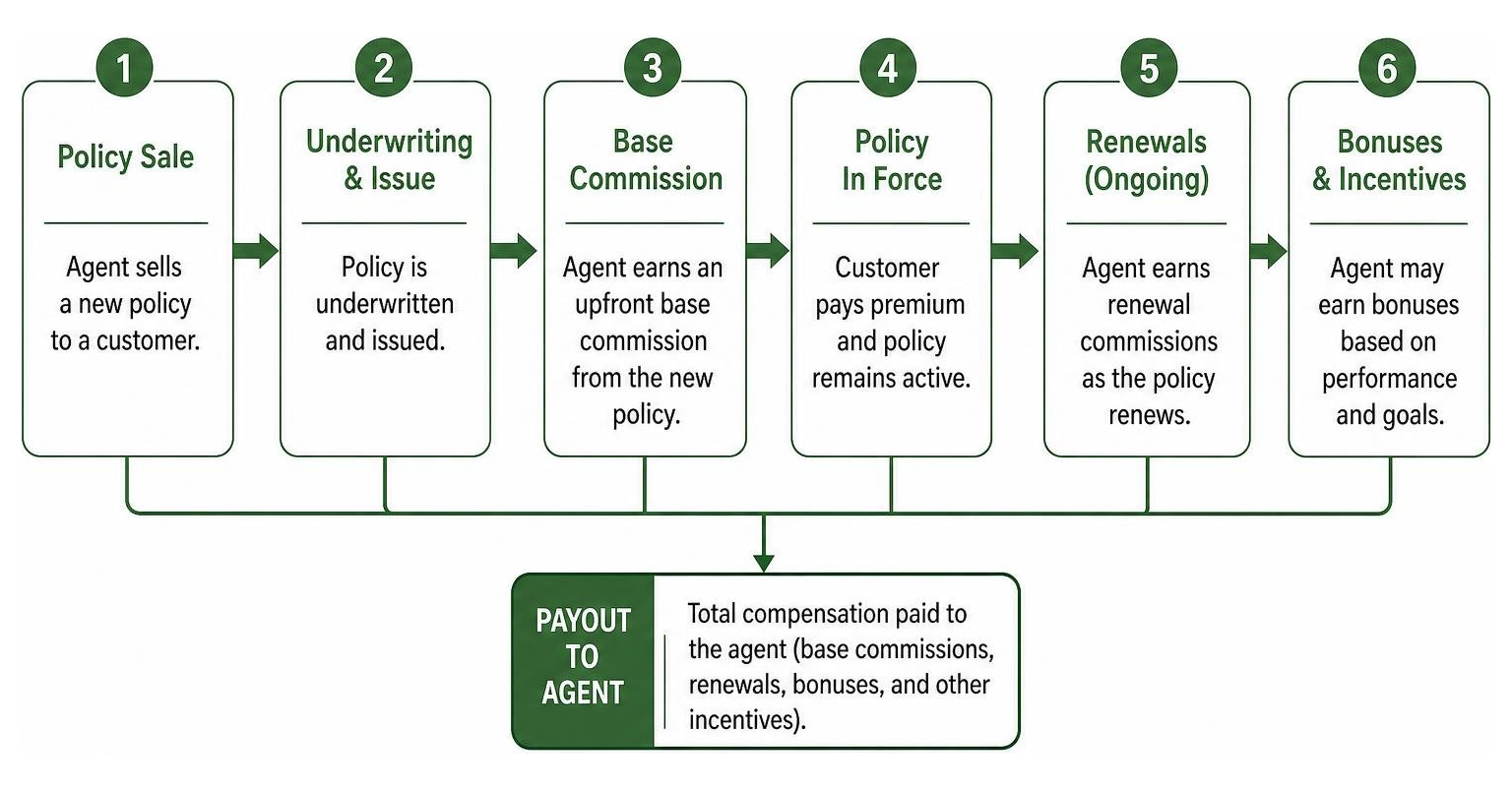
Historically, an agent could secure a highly comfortable lifestyle by maintaining a large “book of business.” The steady stream of trailing commissions from policy renewals acted as a financial safety net. However, recent corporate shifts have turned this traditional model on its head.
The 2025-2026 Compensation Restructuring and Its Impact on Earnings
If you are researching the state farm insurance agent salary landscape today, you cannot ignore the massive contract restructuring that has sent shockwaves through the agency community.
State Farm has transitioned its 19,000 independent agents across the country to a new, standardized single-contract style. This change effectively eliminated the legacy contracts that protected long-tenured agents, putting everyone under the same compensation rules regardless of how many decades they have spent with the brand.

The most controversial aspect of this shift is a drastic reduction in base commission rates. According to internal reports and testimonies from former agents, State Farm has cut base commission compensation by an estimated 35% to 40%. While corporate spokespeople have disputed these specific percentages as speculation, agents on the ground confirm that their steady, predictable monthly income has taken a massive hit.
The goal of this restructuring is clear: corporate headquarters wants to shift agent focus away from passive policy retention and heavily toward active new business acquisition.
Instead of earning high trailing commissions for simply keeping existing clients on the books, agents must now constantly write new auto, home, and life policies to maintain their historical income levels. While agents can theoretically “earn back” some of their lost commission by hitting aggressive corporate growth targets, doing so requires a much higher volume of sales activity and significantly more stress.
How the Restructuring Affects Your Long-Term State Farm Insurance Agent Salary Potential
This contract overhaul does not just touch active commissions; it also systematically strips away long-term wealth-building mechanisms and benefits that agents have relied on for decades.
- Elimination of the AIPP: The Annual Investment Payment Program (AIPP) was a highly valued deferred compensation plan. It paid agents roughly 5% of their previous year’s production earnings for up to 20 years after completing five years of service. This program has been completely terminated, removing a vital retirement safety net.
- Termination of Health Insurance Coverage: State Farm has ended company-sponsored health insurance coverage for active agents and their spouses. Previously, agents could access group plans with premiums averaging around $585 per month per person. Now, agents must source and fund their own private health insurance.
- Cuts to Retired Agent Benefits: The corporate belt-tightening has even reached retirees. State Farm is ending its Medicare supplement support for retired agents, which previously provided $2,400 per year per person (up to $4,800 for an agent and their spouse).
The reaction within the agent community has been highly tense. Private online support groups have surged in popularity, with one agent-only forum growing to over 800 members in just five days to discuss strategies for surviving the contract changes.
To ease the transition, State Farm offered a buyout window running from June 1 through September 30, allowing agents who felt they could no longer run a profitable business under the new terms to exit the company with a structured payout. For those who stayed, maximizing their state farm insurance agent salary now requires running a highly optimized, lean sales machine.
Independent Contractor Agents vs. Agency Team Members
When browsing job listings for State Farm, it is incredibly important to understand who your actual employer will be.
If you apply for a role like a sales representative, account associate, or office manager, you are not applying to work for State Farm corporate. Instead, you are applying to work for an independent contractor agent who operates a local franchise.
This distinction is crucial because it means State Farm corporate does not set your salary, determine your PTO, or manage your daily work environment. Your local agent is a small business owner who determines your compensation package based on their own agency’s profitability and local market rates.
To see this in action, we can look at real-world job structures. For example, a listing for a Multi-Line Representative – State Farm Agent Team Member | Kevin Hale – State Farm Agent highlights a clear focus on outbound sales, relationship building, and local lead generation.
Similarly, an Account Associate – State Farm Agent Team Member, State Farm listing shows that these roles are heavily focused on customer service, policy reviews, and cross-selling financial products.
Earning Potential for a Licensed Team Member
Working as an agency team member can be a fantastic way to learn the ropes of the insurance industry. In fact, many aspiring entrepreneurs use a two-year stint as a licensed team member as a direct stepping stone to qualify for State Farm’s agency leadership program, which eventually allows them to open their own office.
But what can you expect to earn during this foundational phase?
According to crowdsourced data on State Farm Hourly Pay, an agency team member’s compensation is typically structured as a modest base salary supplemented by commission splits and performance bonuses.
For instance, a first-year Multi-Line Representative in Milford, NH, has an estimated earning potential of $40,000 to $70,000+ per year.
To reach the higher end of that range, team members must be highly proactive. Success in these roles requires holding both a Property & Casualty (P&C) license and a Life & Health (L&H) license, allowing you to maximize your commission opportunities by cross-selling multiple lines of coverage to every household.
Geographic Variations: How Location Affects Agent Pay
Just like any other career, geography plays a massive role in determining your real-world purchasing power and overall compensation. Because State Farm agencies operate as localized small businesses, local market density, state regulations, and regional economic conditions directly impact average earnings.
Let’s look at how the average state farm insurance agent salary varies across different states compared to the national average:
- Texas: The average yearly pay for a State Farm Insurance Agent in Texas is approximately $46,165. This is a staggering 29% below the national average. This lower average is often driven by a highly saturated market of local agents competing for the same client base, alongside a lower general cost of living in many parts of the state.
- Arizona: In Arizona, the average yearly pay stands at approximately $51,764, which sits about 21% below the national average.
- National Average: Across the United States, the average base salary for an insurance agent team member hovers around $65,000, though this number is heavily skewed upward by high-cost-of-living metropolitan areas.
Maximizing Your State Farm Insurance Agent Salary in High-Cost States
If you are operating in a high-cost area, the perceived value of your salary can shrink rapidly. For example, the State Farm Agency Average Salary, Pay Ranges & Benefits | Salary.com database highlights that in the New York metropolitan area, the average agency employee makes $106,651 per year, with a standard range of $93,844 to $120,598.
While a six-figure salary sounds fantastic on paper, we have to look at the regional context. New York City’s Cost of Living Index sits at 204.5, which is 104.5% higher than the national average. With estimated monthly living expenses for a single person ranging from $5,177 to $7,877 (excluding taxes), that higher salary is quickly consumed by housing, utilities, and local transit costs.
To maximize your earnings in these competitive, high-cost environments, agents and team members must focus on high-value policies. Writing basic auto policies won’t move the needle enough.
Instead, top-earning professionals focus on complex commercial lines, umbrella policies, and life insurance. If you want to see how top experts position themselves to sell high-value coverage, check out our guide on the Best Life Insurance Agents in 2026 Top Experts to Compare Before You Buy.
Comparing Agent Earnings to Other Corporate Roles
If the stress of running an independent agency or working on a commission-heavy sales floor feels too volatile, you might want to consider a corporate path. State Farm employs a massive corporate workforce in claims, underwriting, technology, and administration. These roles offer stable, predictable salaries, standard corporate benefits, and clear avenues for career progression.
When we look at How Much Does State Farm Employees Make, we can see a clear contrast between the entrepreneurial risk of agency life and the stability of corporate departments:
- Claims Specialist: Earning an average of $53,000 to $66,000 per year, claims specialists handle policyholder claims, evaluate property damage, and coordinate payouts. This role often features a hybrid work schedule (typically requiring one week in-office per month).
- Underwriter: Averaging $61,000 to $68,000 per year, underwriters assess risk profiles to determine whether the company should issue a policy and at what premium. Their career progression is highly structured and often tied to completing professional industry designations.
- Claims Manager: For those who climb the corporate ladder, management roles offer excellent compensation, with average salaries hovering around $97,000 to $109,000+ per year.
While corporate roles lack the unlimited earning upside of a highly successful independent agency owner, they protect you from the direct impact of commission restructurings and overhead costs.
Additionally, working for a top-tier corporate parent has its perks. As we noted in our analysis of the Most Reputable Car Insurance Companies in 2026 Top 10 Ranked, State Farm’s massive market share and brand recognition provide corporate employees with excellent job security and robust training resources.
Frequently Asked Questions about Agent Compensation
What is the starting salary for a new agent?
For a brand-new independent Agency Owner, State Farm often provides a temporary launch stipend or signing bonus structure to help cover initial office startup costs and staff payroll during the first year. However, their actual starting salary is essentially $0, as their personal income is entirely dependent on the commissions generated by their new office. For new team members (employees of an agent), starting base salaries typically range from $30,000 to $45,000 per year, plus commission opportunities.
How did the recent contract changes affect retired agents?
The recent contract changes have been incredibly tough on retired agents. State Farm has completely terminated legacy Medicare supplement support, which previously paid retired agents and their spouses up to $4,800 per year ($2,400 per person) to help offset healthcare costs in retirement.
Do team members get health benefits?
Because team members are employed directly by local independent agents (and not State Farm corporate), health benefits vary completely by office. Some established, highly profitable agents offer group health plans, retirement matching, and paid time off to attract top talent. However, smaller or newer agencies may offer no health benefits at all, leaving team members to source their own coverage.
Conclusion
Navigating a career in the insurance industry in 2026 requires a clear understanding of how corporate decisions, regional economics, and contract structures impact your wallet. While the recent commission cuts and benefit reductions have made earning a high state farm insurance agent salary more challenging, the brand’s market dominance still offers incredible opportunities for driven sales professionals.
Whether you decide to build a local agency, join an office as a licensed team member, or pursue a stable corporate role in claims or underwriting, success comes down to efficiency and smart career planning.
At Aixoria, we believe that staying ahead of industry shifts requires leveraging the best modern tools to streamline your daily workflows. If you want to maximize your daily sales output and eliminate administrative bottlenecks, explore our deep dive into What is the best AI for productivity in 2026? to keep your business running at peak performance.
1 thought on “State Farm Insurance Agent Salary in 2026: Pay, Commission & Career Guide”