Why Finding the Best Life Insurance Agents Can Make or Break Your Coverage

The best life insurance agents can mean the difference between a policy that truly protects your family and one that leaves critical gaps. But with hundreds of agents, brokers, and online platforms competing for your attention, knowing who to trust is harder than it should be.
Here is a quick look at the top options to consider in 2026:
| Agent / Platform | Type | Best For |
|---|---|---|
| Policygenius | Independent broker platform | Comparing multiple carriers online |
| Northwestern Mutual agents | Captive agents | Universal life, lowest complaint ratio |
| New York Life agents | Captive agents | Seniors, multilingual support |
| Guardian agents | Captive agents | Health conditions, term life |
| MassMutual agents | Captive agents | Whole life, cash value growth |
| Independent brokers (e.g. via Smart Choice) | Independent agents | Access to 80+ carriers |
| USAA agents | Captive agents | Veterans and military families |
| Lemonade | Direct digital insurer | Instant coverage, 40-year term |
A good agent does more than sell you a policy. They help you figure out how much coverage you need, which type fits your life stage, and which carrier offers the best rate for your health profile.
The challenge is that not all agents have equal access to carriers. A captive agent works for one company only. An independent broker shops dozens of companies on your behalf. That single difference can affect both your price and your options significantly.
According to NerdWallet’s 2026 analysis of over 50 insurers, the average cost of term life insurance is $26 per month for a healthy nonsmoking 40-year-old buying a $500,000 twenty-year policy. But that number can shift a lot depending on who helps you shop for it.

Independent Brokers vs. Captive Agents: Which is Best?
When you start searching for the best life insurance agents, you will quickly run into two main types of professionals: captive agents and independent brokers. Understanding how they operate is crucial to getting the best deal.
Captive agents work exclusively for one insurance company (such as State Farm, New York Life, or Northwestern Mutual). They have deep, specialized knowledge of their company’s specific policies, riders, and underwriting niches. However, they can only sell you products from that single carrier. If that carrier’s rates are high for your specific age or health profile, a captive agent cannot offer you an alternative.
Independent brokers, on the other hand, are not tied to any single insurance brand. They maintain “carrier appointments” with dozens of different insurers. This gives them immense pricing flexibility. If you have a mild health condition, an independent broker can scan the market to find the specific carrier that looks most favorably upon that condition.
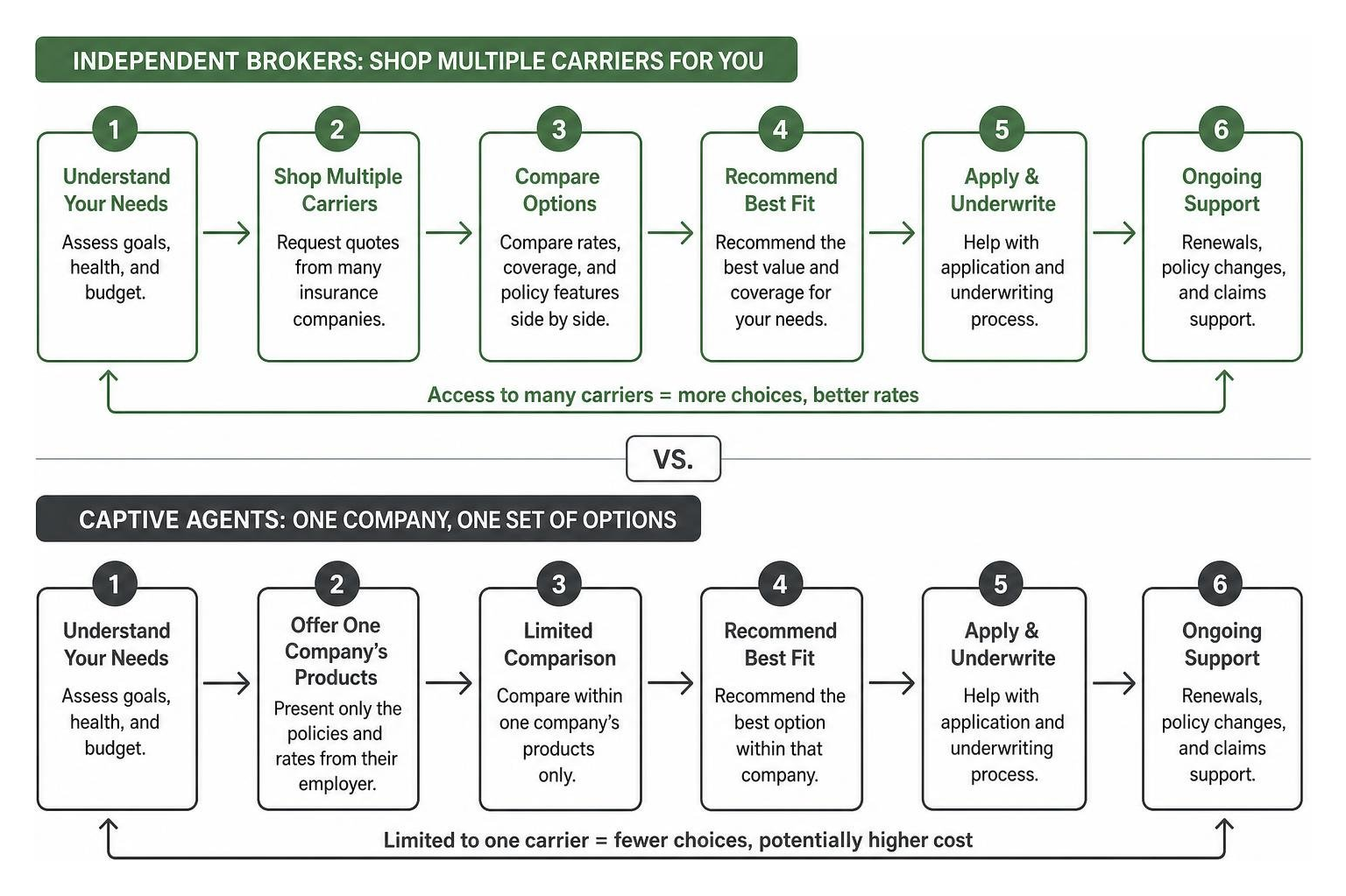
For most consumers, working with an independent broker is the better route because it encourages competition. Brokers can compare rates side-by-side to find the lowest premium for the exact same level of coverage.
For example, an independent advocate like Alex Espersen — Licensed Life Insurance Broker can shop across more than 30 A-rated carriers to find personalized solutions like mortgage protection, final expense, or tax-free retirement strategies without being bound to one company’s pricing model. Similarly, a dedicated professional like Verified Agent William Kyle Glenn, who is licensed in all 50 states, can compare policies from over 37 A-rated companies to ensure your family gets the exact final expense or mortgage protection coverage they need.
Independent brokers work for you, while captive agents work for their insurance company.
How to Choose the BEST life insurance agents for Your Needs
Finding the right policy starts with vetting the person selling it to you. You shouldn’t just choose the first agent who pops up in a local search. Instead, we recommend a structured approach to verify their background and expertise.

First, always verify their state licensing. Every legitimate agent must be licensed in your state to sell insurance. You can easily check an agent’s license status and look for any past consumer complaints through the National Association of Insurance Commissioners (NAIC) Consumer Information Source or your state’s insurance department website.
Looking at established professionals can give you peace of mind. For example, Danielle Mcclung — Bankers Life Agent offers a broad range of wealth management, retirement planning, and life insurance options with a clear, local presence. In the same way, Kristopher Wadsworth — Bankers Life Agent brings advanced industry training to the table to help clients integrate life insurance seamlessly into their retirement and cash flow planning.
Key Credentials of the BEST life insurance agents
While any licensed agent can sell you a policy, the best life insurance agents often hold advanced designations that demonstrate a deeper commitment to the financial planning industry:
- Chartered Life Underwriter (CLU): This is the gold standard for life insurance professionals. It requires extensive coursework in estate planning, business planning, and individual life insurance.
- Chartered Financial Consultant (ChFC): This designation covers comprehensive financial planning, including investments, tax planning, and retirement strategies.
- Life Underwriter Training Council Fellow (LUTCF): This credential focuses on practical insurance sales concepts, ethics, and product knowledge.
- Fiduciary Standards: If your agent is also acting as a registered financial advisor, ask if they operate under a fiduciary duty. A fiduciary is legally obligated to put your financial interests ahead of their own commissions.
Questions to Ask the BEST life insurance agents Before Buying
Before signing on the dotted line, we recommend asking your agent these key questions:
- “Are you an independent broker or a captive agent?” (This lets you know if they are shopping the entire market or just one company.)
- “How many carrier appointments do you actively write policies with?”
- “What are the commission rates on this policy compared to other options?” (Transparency here helps you spot if they are pushing a policy just for a higher payout.)
- “What are the policy exclusions, and under what conditions would a claim be denied?”
- “What are the renewal terms, and will my premiums increase over time?”
- “What kind of ongoing customer support do you offer if I need to change my beneficiaries or adjust my coverage later?”
Top-Rated Life Insurance Companies and Agent Networks Compared
If you decide to work with a captive agent or a highly specialized mutual insurance company network, it helps to know how the top carriers stack up. These companies have been evaluated based on financial strength (measured by agencies like AM Best), consumer complaint ratios, and policy variety.
| Carrier | AM Best Rating | Complaint Ratio | Known For |
|---|---|---|---|
| Northwestern Mutual | A++ (Superior) | Extremely Low | Best for universal life, strong dividends |
| MassMutual | A++ (Superior) | Very Low | Industry-leading whole life cash value growth |
| New York Life | A++ (Superior) | Low | Excellent senior policies, highly transparent |
| Guardian | A++ (Superior) | Low | Highly accessible term life, inclusive underwriting |
Northwestern Mutual and MassMutual
Both Northwestern Mutual and MassMutual are structured as “mutual” insurance companies. This means the policyholders, rather than public shareholders, own a stake in the company. Eligible permanent life insurance policyholders can receive annual dividend payments, which can be used to purchase additional coverage, reduce premiums, or boost cash value growth.
Northwestern Mutual stands out for its exceptional customer satisfaction. In NerdWallet’s multi-year analysis of over 50 insurers, Northwestern Mutual maintained the lowest ratio of consumer complaints. They are a premier choice for complex universal life policies.
MassMutual is widely regarded as the industry leader for whole life insurance. Their permanent policies offer highly competitive guaranteed cash value growth rates, making them a staple for long-term estate planning.
New York Life and Guardian
New York Life is the largest mutual life insurance company in the United States, commanding a massive market share. They are highly praised for policy transparency and their specialized options for seniors.
New York Life agents are also known for their diverse, community-focused approach. For instance, their agent network features professionals who speak more than 20 languages. If you are looking for highly personalized, local guidance, agents like Stephanie Victoria Yamashiro — New York Life Agent in Glendale, California, or Shane Michael Corbett — New York Life Agent in Colchester, Vermont, can help you customize plans that protect your family and grow your wealth as your life circumstances evolve.
Guardian is another top-tier option, particularly famous for its inclusive underwriting. For example, Guardian offers robust term life coverage options for HIV-positive applicants with coverage limits ranging from $100,000 all the way up to $10 million. They make securing term life insurance straightforward, even for those with complex medical backgrounds.
Digital Platforms vs. Traditional Agents
In 2026, you don’t necessarily have to sit down in a local office to buy life insurance. Digital platforms and direct-to-consumer models have changed the landscape.
Platforms like Policygenius act as digital independent brokers. Policygenius has placed over 320,000 life insurance policies and served more than 30 million people. They hold an impressive 4.7 out of 5-star rating based on over 5,775 customer reviews. The main appeal of Policygenius is that they combine the speed of online comparison algorithms with real, human support from licensed agents who do not work on direct commission.
If you are looking for rapid, no-medical-exam policies, direct digital insurers like Lemonade use AI-driven underwriting to issue term life policies within minutes for qualified applicants. Uniquely, Lemonade offers term lengths of up to 40 years—an option that very few traditional insurers provide.
For military personnel, veterans, and their families, USAA remains the gold standard. USAA agents specialize in military-specific needs, offering flexible coverage top-up options that adjust as you transition from active duty to civilian life.
Frequently Asked Questions About Life Insurance Agents
What is the difference between an insurance agent and an insurance broker?
An insurance agent typically represents the insurance company. A captive agent represents one company, while an independent agent represents several. An insurance broker, however, legally represents the client. Brokers shop the entire market to find the best policy for your specific needs and may sometimes charge a flat administrative fee for their advocacy, whereas agents are compensated via carrier commissions.
How do life insurance agents get paid?
Life insurance agents are paid via commissions built directly into your policy’s premium. For term life insurance, agents typically receive 70% to 95% of the first year’s premium as their commission. For permanent life policies (like whole or universal life), the first-year commission usually ranges from 55% to 70%. Because these fees are paid by the carrier, using an agent does not make the policy more expensive for you than buying it directly.
How can I verify if a life insurance agent is licensed?
You can verify any agent’s licensing credentials by visiting the NAIC Consumer Information Source online or by checking your state’s specific Department of Insurance registry. You will need the agent’s full name, state of operation, or their National Producer Number (NPN) to pull up their licensing history and check for any past regulatory disciplinary actions.
Conclusion

Finding the best life insurance agents is all about aligning your personal needs with the right expertise. Whether you choose a highly specialized captive agent from a top-rated mutual insurer like New York Life or MassMutual, or prefer to shop the open market with an independent broker, taking the time to verify credentials, ask about commission structures, and compare multiple quotes will save you thousands of dollars over the life of your policy.
As technology continues to reshape the financial landscape, keeping up with the intersection of automated tools and human expertise is more important than ever. To stay ahead of the curve, Explore the latest AI updates and industry trends with us to see how modern technology is making financial planning simpler and more secure.Why Finding the Best Life Insurance Agents Can Make or Break Your Coverage
The best life insurance agents can mean the difference between a policy that truly protects your family and one that leaves critical gaps. But with hundreds of agents, brokers, and online platforms competing for your attention, knowing who to trust is harder than it should be.
Here is a quick look at the top options to consider in 2026:
| Agent / Platform | Type | Best For |
|---|---|---|
| Policygenius | Independent broker platform | Comparing multiple carriers online |
| Northwestern Mutual agents | Captive agents | Universal life, lowest complaint ratio |
| New York Life agents | Captive agents | Seniors, multilingual support |
| Guardian agents | Captive agents | Health conditions, term life |
| MassMutual agents | Captive agents | Whole life, cash value growth |
| Independent brokers (e.g. via Smart Choice) | Independent agents | Access to 80+ carriers |
| USAA agents | Captive agents | Veterans and military families |
| Lemonade | Direct digital insurer | Instant coverage, 40-year term |
A good agent does more than sell you a policy. They help you figure out how much coverage you need, which type fits your life stage, and which carrier offers the best rate for your health profile.
The challenge is that not all agents have equal access to carriers. A captive agent works for one company only. An independent broker shops dozens of companies on your behalf. That single difference can affect both your price and your options significantly.
According to NerdWallet’s 2026 analysis of over 50 insurers, the average cost of term life insurance is $26 per month for a healthy nonsmoking 40-year-old buying a $500,000 twenty-year policy. But that number can shift a lot depending on who helps you shop for it.
Independent Brokers vs. Captive Agents: Which is Best?
When you start searching for the best life insurance agents, you will quickly run into two main types of professionals: captive agents and independent brokers. Understanding how they operate is crucial to getting the best deal.
Captive agents work exclusively for one insurance company (such as State Farm, New York Life, or Northwestern Mutual). They have deep, specialized knowledge of their company’s specific policies, riders, and underwriting niches. However, they can only sell you products from that single carrier. If that carrier’s rates are high for your specific age or health profile, a captive agent cannot offer you an alternative.
Independent brokers, on the other hand, are not tied to any single insurance brand. They maintain “carrier appointments” with dozens of different insurers. This gives them immense pricing flexibility. If you have a mild health condition, an independent broker can scan the market to find the specific carrier that looks most favorably upon that condition.
For most consumers, working with an independent broker is the better route because it encourages competition. Brokers can compare rates side-by-side to find the lowest premium for the exact same level of coverage.
For example, an independent advocate like Alex Espersen — Licensed Life Insurance Broker can shop across more than 30 A-rated carriers to find personalized solutions like mortgage protection, final expense, or tax-free retirement strategies without being bound to one company’s pricing model. Similarly, a dedicated professional like Verified Agent William Kyle Glenn, who is licensed in all 50 states, can compare policies from over 37 A-rated companies to ensure your family gets the exact final expense or mortgage protection coverage they need.
Independent brokers work for you, while captive agents work for their insurance company.
How to Choose the BEST life insurance agents for Your Needs
Finding the right policy starts with vetting the person selling it to you. You shouldn’t just choose the first agent who pops up in a local search. Instead, we recommend a structured approach to verify their background and expertise.
First, always verify their state licensing. Every legitimate agent must be licensed in your state to sell insurance. You can easily check an agent’s license status and look for any past consumer complaints through the National Association of Insurance Commissioners (NAIC) Consumer Information Source or your state’s insurance department website.
Looking at established professionals can give you peace of mind. For example, Danielle Mcclung — Bankers Life Agent offers a broad range of wealth management, retirement planning, and life insurance options with a clear, local presence. In the same way, Kristopher Wadsworth — Bankers Life Agent brings advanced industry training to the table to help clients integrate life insurance seamlessly into their retirement and cash flow planning.
Key Credentials of the BEST life insurance agents
While any licensed agent can sell you a policy, the best life insurance agents often hold advanced designations that demonstrate a deeper commitment to the financial planning industry:
- Chartered Life Underwriter (CLU): This is the gold standard for life insurance professionals. It requires extensive coursework in estate planning, business planning, and individual life insurance.
- Chartered Financial Consultant (ChFC): This designation covers comprehensive financial planning, including investments, tax planning, and retirement strategies.
- Life Underwriter Training Council Fellow (LUTCF): This credential focuses on practical insurance sales concepts, ethics, and product knowledge.
- Fiduciary Standards: If your agent is also acting as a registered financial advisor, ask if they operate under a fiduciary duty. A fiduciary is legally obligated to put your financial interests ahead of their own commissions.
Questions to Ask the BEST life insurance agents Before Buying
Before signing on the dotted line, we recommend asking your agent these key questions:
- “Are you an independent broker or a captive agent?” (This lets you know if they are shopping the entire market or just one company.)
- “How many carrier appointments do you actively write policies with?”
- “What are the commission rates on this policy compared to other options?” (Transparency here helps you spot if they are pushing a policy just for a higher payout.)
- “What are the policy exclusions, and under what conditions would a claim be denied?”
- “What are the renewal terms, and will my premiums increase over time?”
- “What kind of ongoing customer support do you offer if I need to change my beneficiaries or adjust my coverage later?”
Top-Rated Life Insurance Companies and Agent Networks Compared
If you decide to work with a captive agent or a highly specialized mutual insurance company network, it helps to know how the top carriers stack up. These companies have been evaluated based on financial strength (measured by agencies like AM Best), consumer complaint ratios, and policy variety.
| Carrier | AM Best Rating | Complaint Ratio | Known For |
|---|---|---|---|
| Northwestern Mutual | A++ (Superior) | Extremely Low | Best for universal life, strong dividends |
| MassMutual | A++ (Superior) | Very Low | Industry-leading whole life cash value growth |
| New York Life | A++ (Superior) | Low | Excellent senior policies, highly transparent |
| Guardian | A++ (Superior) | Low | Highly accessible term life, inclusive underwriting |
Northwestern Mutual and MassMutual
Both Northwestern Mutual and MassMutual are structured as “mutual” insurance companies. This means the policyholders, rather than public shareholders, own a stake in the company. Eligible permanent life insurance policyholders can receive annual dividend payments, which can be used to purchase additional coverage, reduce premiums, or boost cash value growth.
Northwestern Mutual stands out for its exceptional customer satisfaction. In NerdWallet’s multi-year analysis of over 50 insurers, Northwestern Mutual maintained the lowest ratio of consumer complaints. They are a premier choice for complex universal life policies.
MassMutual is widely regarded as the industry leader for whole life insurance. Their permanent policies offer highly competitive guaranteed cash value growth rates, making them a staple for long-term estate planning.
New York Life and Guardian
New York Life is the largest mutual life insurance company in the United States, commanding a massive market share. They are highly praised for policy transparency and their specialized options for seniors.
New York Life agents are also known for their diverse, community-focused approach. For instance, their agent network features professionals who speak more than 20 languages. If you are looking for highly personalized, local guidance, agents like Stephanie Victoria Yamashiro — New York Life Agent in Glendale, California, or Shane Michael Corbett — New York Life Agent in Colchester, Vermont, can help you customize plans that protect your family and grow your wealth as your life circumstances evolve.
Guardian is another top-tier option, particularly famous for its inclusive underwriting. For example, Guardian offers robust term life coverage options for HIV-positive applicants with coverage limits ranging from $100,000 all the way up to $10 million. They make securing term life insurance straightforward, even for those with complex medical backgrounds.
Digital Platforms vs. Traditional Agents
In 2026, you don’t necessarily have to sit down in a local office to buy life insurance. Digital platforms and direct-to-consumer models have changed the landscape.
Platforms like Policygenius act as digital independent brokers. Policygenius has placed over 320,000 life insurance policies and served more than 30 million people. They hold an impressive 4.7 out of 5-star rating based on over 5,775 customer reviews. The main appeal of Policygenius is that they combine the speed of online comparison algorithms with real, human support from licensed agents who do not work on direct commission.
If you are looking for rapid, no-medical-exam policies, direct digital insurers like Lemonade use AI-driven underwriting to issue term life policies within minutes for qualified applicants. Uniquely, Lemonade offers term lengths of up to 40 years—an option that very few traditional insurers provide.
For military personnel, veterans, and their families, USAA remains the gold standard. USAA agents specialize in military-specific needs, offering flexible coverage top-up options that adjust as you transition from active duty to civilian life.
Frequently Asked Questions About Life Insurance Agents
What is the difference between an insurance agent and an insurance broker?
An insurance agent typically represents the insurance company. A captive agent represents one company, while an independent agent represents several. An insurance broker, however, legally represents the client. Brokers shop the entire market to find the best policy for your specific needs and may sometimes charge a flat administrative fee for their advocacy, whereas agents are compensated via carrier commissions.
How do life insurance agents get paid?
Life insurance agents are paid via commissions built directly into your policy’s premium. For term life insurance, agents typically receive 70% to 95% of the first year’s premium as their commission. For permanent life policies (like whole or universal life), the first-year commission usually ranges from 55% to 70%. Because these fees are paid by the carrier, using an agent does not make the policy more expensive for you than buying it directly.
How can I verify if a life insurance agent is licensed?
You can verify any agent’s licensing credentials by visiting the NAIC Consumer Information Source online or by checking your state’s specific Department of Insurance registry. You will need the agent’s full name, state of operation, or their National Producer Number (NPN) to pull up their licensing history and check for any past regulatory disciplinary actions.
Conclusion
Finding the best life insurance agents is all about aligning your personal needs with the right expertise. Whether you choose a highly specialized captive agent from a top-rated mutual insurer like New York Life or MassMutual, or prefer to shop the open market with an independent broker, taking the time to verify credentials, ask about commission structures, and compare multiple quotes will save you thousands of dollars over the life of your policy.
As technology continues to reshape the financial landscape, keeping up with the intersection of automated tools and human expertise is more important than ever. To stay ahead of the curve, Explore the latest AI updates and industry trends with us to see how modern technology is making financial planning simpler and more secure.
I’ll right away grasp your rss feed as I can’t in finding your email subscription hyperlink or e-newsletter service.
Do you have any? Please permit me understand so that I may subscribe.
Thanks.