Why Software Engineering Internships Can Launch Your Entire Tech Career

Software engineering internships are one of the fastest paths into a high-paying tech career — and the 2026 market is bigger and more competitive than ever.
Here’s a quick snapshot of what you need to know:
| Category | Key Facts |
|---|---|
| Top pay (Quant firms) | Up to $127/hr (e.g., D. E. Shaw & Co.) |
| FAANG+ pay range | $62–$67/hr (e.g., Uber, NVIDIA) |
| Typical program length | 10–12 weeks |
| Active US listings | 1,000+ (243 tracked in community repos) |
| Top locations | San Jose, San Francisco, New York, Seattle |
| In-demand skills | Python, Java, C++, AI/ML, CI/CD, Kubernetes |
| Conversion opportunity | Top interns can receive full-time offers |
The competition is real. Hundreds of new postings appear every week, and top companies like Amazon, Apple, and JPMorgan Chase are recruiting months — sometimes over a year — in advance.
But here’s the good news: students who know where to look, what skills to build, and when to apply have a massive edge.
Whether you’re targeting a high-paying quant role in New York or a hands-on AI engineering program in San Francisco, this guide breaks down the top 10 opportunities worth your time in 2026.
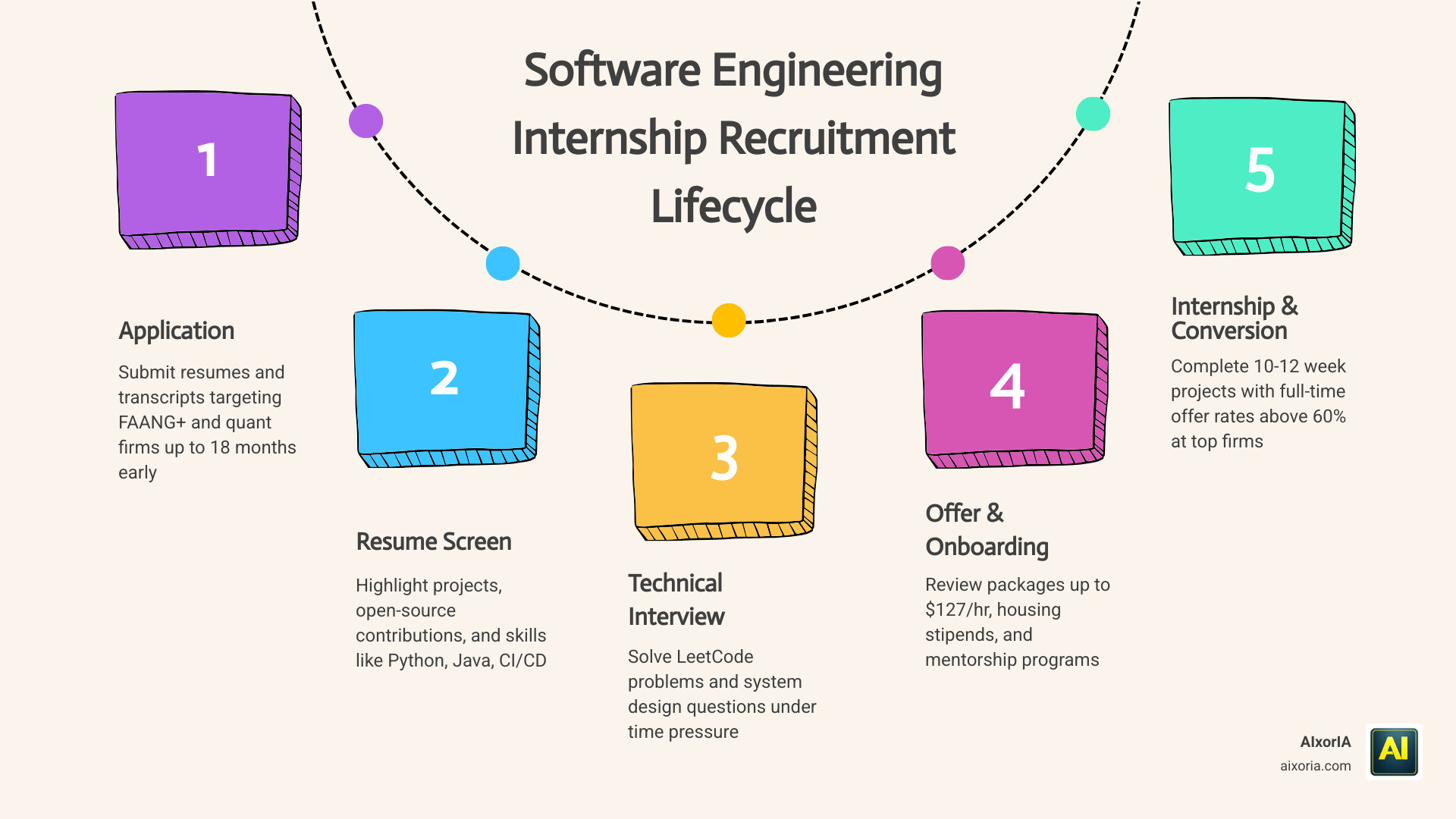
Top 10 Software Engineering Internships for 2026

Navigating the 2026 landscape requires looking at different “tiers” of opportunities. While FAANG+ remains a staple, specialized AI and quantitative finance roles are setting new records for compensation and technical depth.
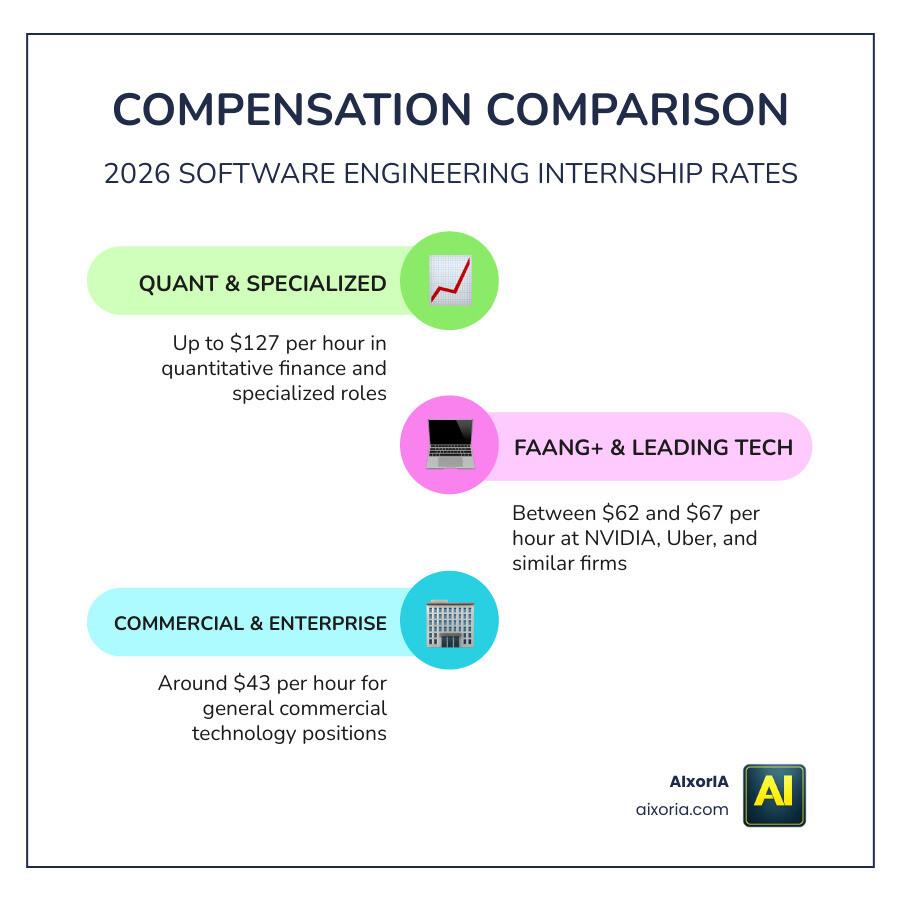
- Quantitative Finance Leaders (e.g., D. E. Shaw & Co., Jane Street): These are the “heavy hitters” of the internship world. With hourly rates reaching a staggering $127 per hour, these firms look for students with exceptional mathematical and algorithmic prowess.
- Google: A perennial favorite, Google Careers offers internships that allow students to work on products used by billions, ranging from Android to sophisticated AI search algorithms.
- Databricks: As a leader in data intelligence, a Software Engineering Intern (2026) – Databricks focuses on building platforms that scale. They offer roles across backend, infrastructure, and databases, with pay reaching up to $60/hr.
- Apple: Known for its focus on the “user experience,” Apple internships involve everything from Core OS development to Siri and Apple Maps. They prioritize candidates with strong object-oriented design skills.
- Amazon: Their SDE internships are famous for their “ownership” culture. Interns are responsible for the full lifecycle of their code, from design to deployment, often earning an annualized salary equivalent of $110,000 to $160,000.
- NVIDIA & Uber: These FAANG+ titans are currently offering between $62 and $67 per hour for 2026 positions, focusing heavily on AI hardware integration and high-scale distributed systems.
- JPMorgan Chase: For those interested in fintech, the Software Engineer Program provides a 10-week immersive experience building systems for millions of customers.
- C3 AI: Their “Ascend” program is perfect for those wanting to jump into Enterprise AI, offering dedicated mentorship and rapid career acceleration.
- Aerospace and Defense (e.g., KBR, CACI): These roles offer a unique challenge, often involving national security protocols and specialized software for space or defense technology.
- Scale AI: As a data platform for AI, Scale offers internships at the intersection of software development and data science, which is a massive trend for 2026.
Essential Skills and Roles in Software Engineering Internships

The “generalist” intern is becoming a thing of the past. In 2026, we see a massive shift toward specialized roles and the integration of AI into the daily workflow.
Most In-Demand Programming Languages
While Python remains the king of AI and data science, Java and C++ are still the workhorses of backend systems and high-performance computing. We are also seeing a rise in Rust for systems engineering due to its memory safety features.
Emerging Specialized Roles
- AI Alignment & Engineering: Beyond just using AI, firms want interns who can ensure AI systems are safe and efficient. Using the 20 best AI software development tools is now a standard requirement.
- Site Reliability Engineering (SRE): This role focuses on the “ops” side of “DevOps,” ensuring that massive platforms stay online and performant.
- Infrastructure Engineering: With the world moving to the cloud, knowing Kubernetes and CI/CD pipelines is non-negotiable for these roles.
The Impact of AI on Coding
In 2026, interns aren’t just writing code from scratch; they are using the 7 best AI coding tools for developers to boost productivity. Companies like Amazon now explicitly list the use of GenAI tools as a key responsibility to enhance development cycles. If you’re working on machine learning, you’ll need to be familiar with the best AI tools for ML projects to keep up with the pace of modern agile teams.
Compensation, Benefits, and Geographic Hubs
Money isn’t everything, but in software engineering internships, it’s certainly a lot! The 2026 compensation landscape shows a widening gap between specialized finance and general commercial tech.
Geographic Hubs: Where the Jobs Are
While remote work exists, the 2026 trend is a return to the office. The primary hubs remain:
- San Jose & San Francisco: The heart of the industry, with over 151 active high-tier listings.
- New York City: The go-to for high-paying Quant and Fintech roles.
- Seattle & Bellevue: Dominated by Amazon and Microsoft, with competitive rates around $51-$60/hr.
Beyond the Hourly Rate
Top companies offer more than just a paycheck. Common benefits include:
- Housing Allowances: Often ranging from $2,000 to $5,000 per month or provided corporate housing.
- Relocation Stipends: To help you move to hubs like Santa Clara or New York.
- Health Insurance: Many 10-12 week programs now include full health benefits for the duration of the internship.
- Mentorship: Programs like Databricks and JPMorgan Chase pair you with a senior advocate to guide your career.
To manage your time effectively during a high-pressure internship, many students utilize the best AI tools for productivity to handle administrative tasks and focus on their core project.
Application Timelines and How to Stand Out
If you’re reading this in May 2026, you should already be looking at Fall 2026 and Summer 2027 cycles. The recruitment window for software engineering internships has shifted remarkably early.
The Recruitment Calendar
- Summer 2026: Most of these roles were filled in late 2025, but “off-cycle” and late-season postings still appear.
- Fall 2026 & Winter 2027: Recruitment typically peaks 6–9 months before the start date.
- Co-ops: These 6-month placements often have more flexible hiring windows than traditional summer spots.
How to Stand Out
- Personal Projects: Don’t just follow a tutorial. Build something that solves a real problem. Using AI tools for students can help you prototype faster.
- Open Source: Contributions to major repositories show you can work within a large, existing codebase—a skill every manager wants.
- Coding Competitions: Platforms like Codeforces or LeetCode contests prove you can handle the “algorithmic pressure” of technical interviews.
- Portfolio Building: Ensure your GitHub is clean and your README files clearly explain why you built what you built.
Frequently Asked Questions about Software Engineering Internships
When should I apply for 2026 software engineering internships?
You should begin your search as early as 12 to 18 months in advance. For the Summer 2026 cycle, many top-tier firms opened their applications in the summer or fall of 2025. However, mid-sized companies and startups often post roles 3–5 months before the start date.
What are the requirements for national security software engineering internships?
Internships at firms like KBR or CACI differ significantly from commercial roles. They often require US Citizenship and the ability to obtain a Security Clearance. The technical rigor is high, but there is an additional emphasis on protocols, documentation, and system integrity compared to the “move fast and break things” mentality of some startups.
What soft skills do major financial institutions prioritize in software engineering internships?
Financial giants like JPMorgan Chase value “well-rounded” individuals. Beyond coding, they look for:
- Ownership Mindset: Taking a project from an ambiguous idea to a finished product.
- Teamwork: The ability to work in agile teams and communicate technical concepts to non-technical stakeholders.
- Leadership: Showing initiative in school clubs or previous work experiences.
Conclusion
The journey to securing one of the best software engineering internships in 2026 is a marathon, not a sprint. From the high-stakes world of quantitative finance to the innovative frontiers of AI infrastructure, these programs offer more than just a high hourly wage—they provide a launchpad for your entire professional life.
By mastering in-demand languages like Python and C++, embracing modern AI development tools, and applying early, you can position yourself at the forefront of the tech industry. We’ve seen that the most successful interns are those who combine technical “hard skills” with a proactive, ownership-driven mindset.
At AIxorIA, we specialize in helping businesses and individuals navigate these complex technological shifts. Whether you are looking for custom AI solutions or want to stay ahead of the curve with our performance audits, we are here to simplify technology for you. If you’re interested in how these technologies apply to other fields, learn more about AI tools for industrial engineering in 2026.
Good luck with your applications—the future of software engineering is waiting for you!