How SEO and Marketing Automation Work Together
Scr0ll d0wn to D0VVNL0AD
To connect seo and marketing automation, use search data to find the pages that attract potential buyers. Capture leads on those pages, then use the page they visited and the actions they took to guide follow-up emails and sales outreach. Set up SEO alerts, too, so a broken page or traffic drop leads to a fix rather than quietly reducing your lead flow.
The goal is not more tools. It is a simple, reliable path from search visit to customer, with shared data and clear owners at each step.
Understanding the Difference Between SEO and Marketing Automation
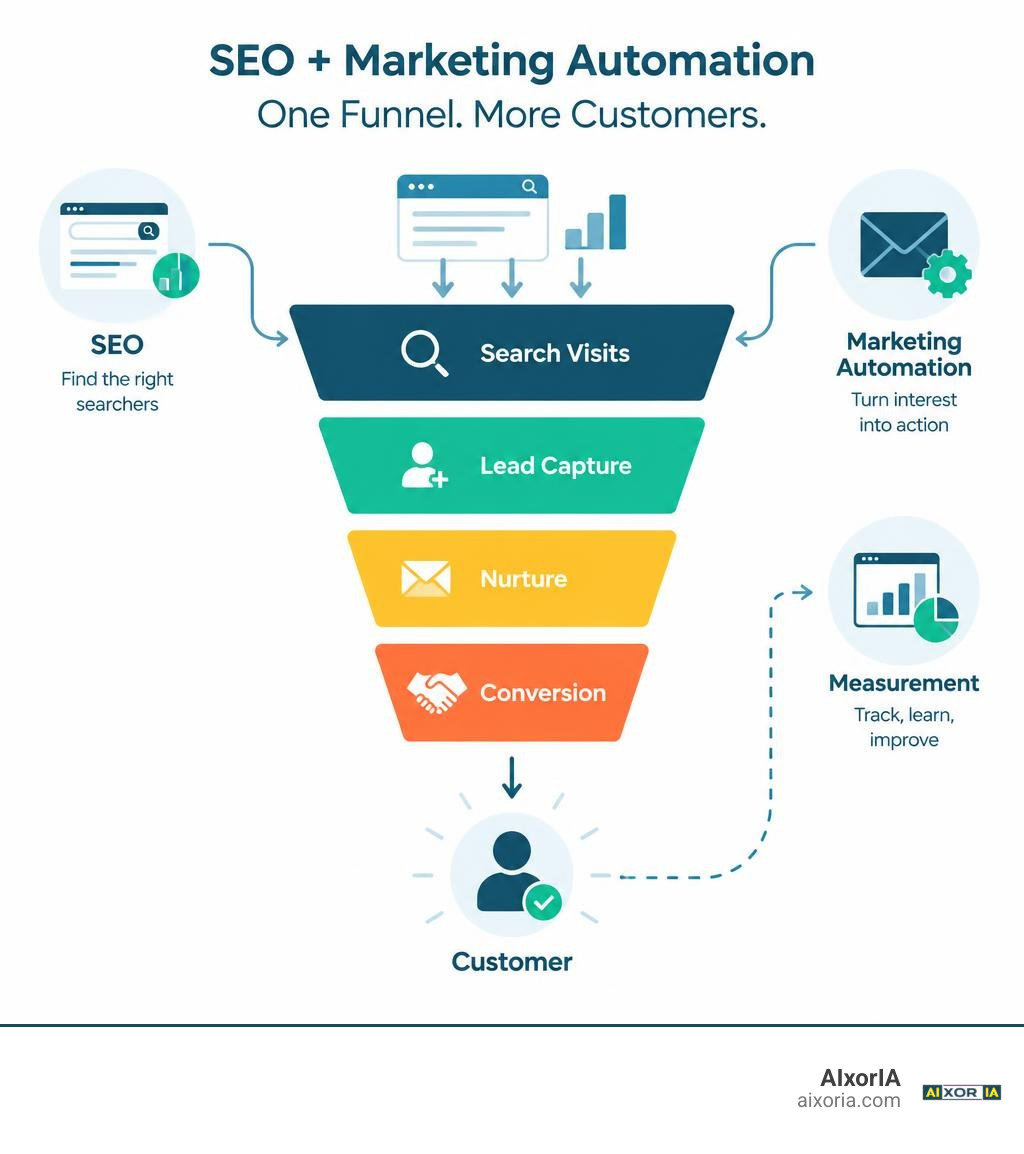
For years, digital marketing teams have treated search engine optimization and marketing automation as distant cousins who only speak at annual planning meetings. SEO teams lived in keyword tracking dashboards and crawl reports, while automation specialists spent their days building multi-stage email drip campaigns in customer relationship management (CRM) software.
To get the most out of your campaigns, you must understand their core differences and how they connect. Search engine optimization focuses primarily on the top of the funnel. It is an inbound discipline designed to capture demand, earn organic search visibility, match search intent, and drive qualified web visitors to your digital assets. It deals with technical website health, structured data, backlink profiles, and on-page topical authority.
Marketing automation, by contrast, operates primarily from the middle of the funnel down to retention. It relies on rule-based engines, event listeners, and behavioral triggers to segment visitors, deliver personalized messaging, score prospective buyers, and route sales-ready opportunities to your sales representatives.
When you learn how AI search optimization tools increase organic traffic, you quickly realize that driving traffic is only half the battle. Without automation, organic visitors arrive on a blog post, read the advice, and leave without a trace. Without search optimization, your automation workflows sit starved of fresh, qualified prospects.
| Lifecycle Stage | Primary Focus: SEO Automation | Primary Focus: Marketing Automation | Combined Business Outcome |
|---|---|---|---|
| Top of Funnel (Attract) | Keyword intent mapping, technical site crawls, rank tracking, schema generation. | Social media distribution scheduling, top-of-funnel ad retargeting. | Continuous, low-cost organic discovery paired with instant content amplification. |
| Middle of Funnel (Engage) | On-page content optimization, internal link structuring, landing page intent matching. | Gated asset forms, dynamic content blocks, behavioral email triggers. | High-converting landing pages that capture intent and enroll leads into tailored nurture streams. |
| Bottom of Funnel (Convert) | Commercial intent keyword targeting, competitor comparison page visibility. | Lead scoring algorithms, CRM pipeline alerts, personalized sales handoffs. | High-intent searchers automatically qualified and routed to sales reps in real time. |
| Post-Purchase (Retain) | Knowledge base indexing, technical documentation discoverability. | Automated onboarding drips, customer feedback loops, referral campaigns. | Reduced customer support friction and sustained brand advocacy. |
How SEO and Marketing Automation Complement Each Other
When properly integrated, search workflows and marketing automation form a closed-loop inbound flywheel. Organic search drives low-cost, high-intent traffic to your specialized landing pages. Once those visitors arrive, behavioral tracking scripts identify their engagement patterns and convert anonymous sessions into known profiles.
From there, marketing automation takes the wheel. As prospects read your articles and consume your resources, automated systems deliver relevant follow-up content, nurturing them across multiple touchpoints. When satisfied leads share your guides across their networks, those actions create digital footprints, brand mentions, and organic backlinks that further improve your search rankings. Using SEO, AI workflows, and operational automation makes it possible to connect these search signals directly into your communication channels without manual data exports.
Core Mechanics of an Inbound Integration Funnel
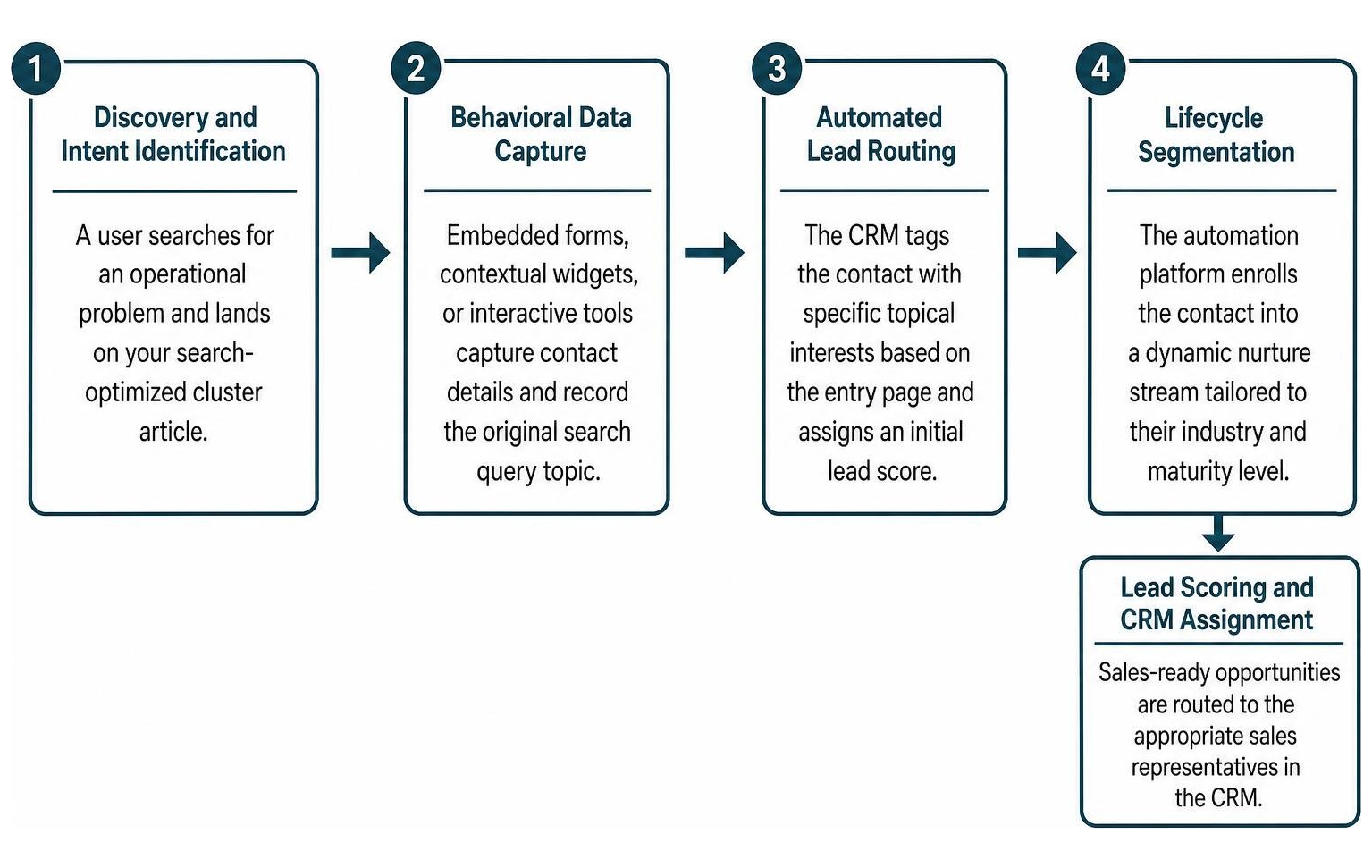
A resilient integration funnel runs on event-driven triggers. Rather than treating an organic visit as a static pageview metric, your system should evaluate the visitor’s context:
- Discovery and Intent Identification: A user searches for an operational problem and lands on your search-optimized cluster article.
- Behavioral Data Capture: Embedded forms, contextual widgets, or interactive tools capture contact details and record the original search query topic.
- Automated Lead Routing: The CRM tags the contact with specific topical interests based on the entry page and assigns an initial lead score.
- Lifecycle Segmentation: The automation platform enrolls the contact into a dynamic nurture stream tailored to their industry and maturity level.
Critical SEO Tasks to Automate for Cross-Channel Workflows
Trying to run enterprise search campaigns manually is like trying to fill a swimming pool with a teaspoon. Modern search engines evaluate billions of machine learning signals daily. Relying on manual spreadsheets leaves your strategy vulnerable to silent technical errors and missed opportunities.
Cloud-based tools now command a 68% market share across the search industry, and for good reason. Automating routine tasks preserves team bandwidth for creative strategy and revenue-generating campaigns.
Selecting the best free AI for SEO data analysis allows your team to automate initial data extraction, surfacing anomalies before they affect lead pipelines.

Automating Technical Audits and Real-Time Performance Alerts
Technical issues often arise unexpectedly. A routine code deployment might accidentally add a noindex tag to a core revenue page, or a server misconfiguration could trigger a cascade of 5xx errors across your product catalog.
By scheduling automated nightly crawls and status code monitors, your systems can detect HTTP anomalies, broken canonical tags, and Core Web Vitals regressions within minutes. Connecting these audit scripts to webhooks delivers immediate alerts to development channels in Slack or Microsoft Teams. Catching a technical error within an hour can save weeks of traffic recovery and prevent lead generation funnels from drying up.
Automated Keyword Research to Fuel Email and Social Campaigns
Keyword research should never live in an isolated quarterly slide deck. Modern keyword intelligence platforms can analyze over 50,000 related search queries in seconds, and roughly 63% of local SEO platforms introduced automated keyword suggestions to accelerate cross-channel planning.
By pulling search console query data and routing it through programmatic intent-clustering tools, you can identify trending pain points in real time. When you discover a sudden surge in search queries around a specific operational problem, you can use SEO APIs and AI to build automations that feed those topic clusters directly into your social media scheduling software and automated newsletter drafts. This ensures your outbound marketing directly addresses the exact topics your audience is searching for online.
Connecting SEO Data to Marketing Automation Triggers
The most powerful marketing automation workflows run on high-fidelity search intent data. When you know which search terms brought a user to your site, you no longer have to guess what challenges they face.

By deploying the best AI tools for sales and marketing, you can bridge the gap between anonymous organic visits and personalized email follow-ups.
Personalizing Lifecycle Sequences with Search Intent Data
Consider two users visiting your website. User A arrives via an informational search query like “what is marketing campaign management software”, while User B lands on a high-intent commercial page via “enterprise GTM orchestration platform pricing”.
Enrolling both users into an identical generic welcome sequence is a missed opportunity. User A needs foundational guides, industry benchmarks, and educational content that builds topical authority over time. User B is evaluating solutions and should immediately receive product comparison teardowns, implementation timelines, and an invitation to schedule an architecture audit.
By capturing the landing page category in your CRM contact record, you can trigger dynamic email sequences that adapt their subject lines, recommended resources, and calls to action based on the user’s search intent.
How to Build a Lead Nurture Funnel Using SEO and Marketing Automation
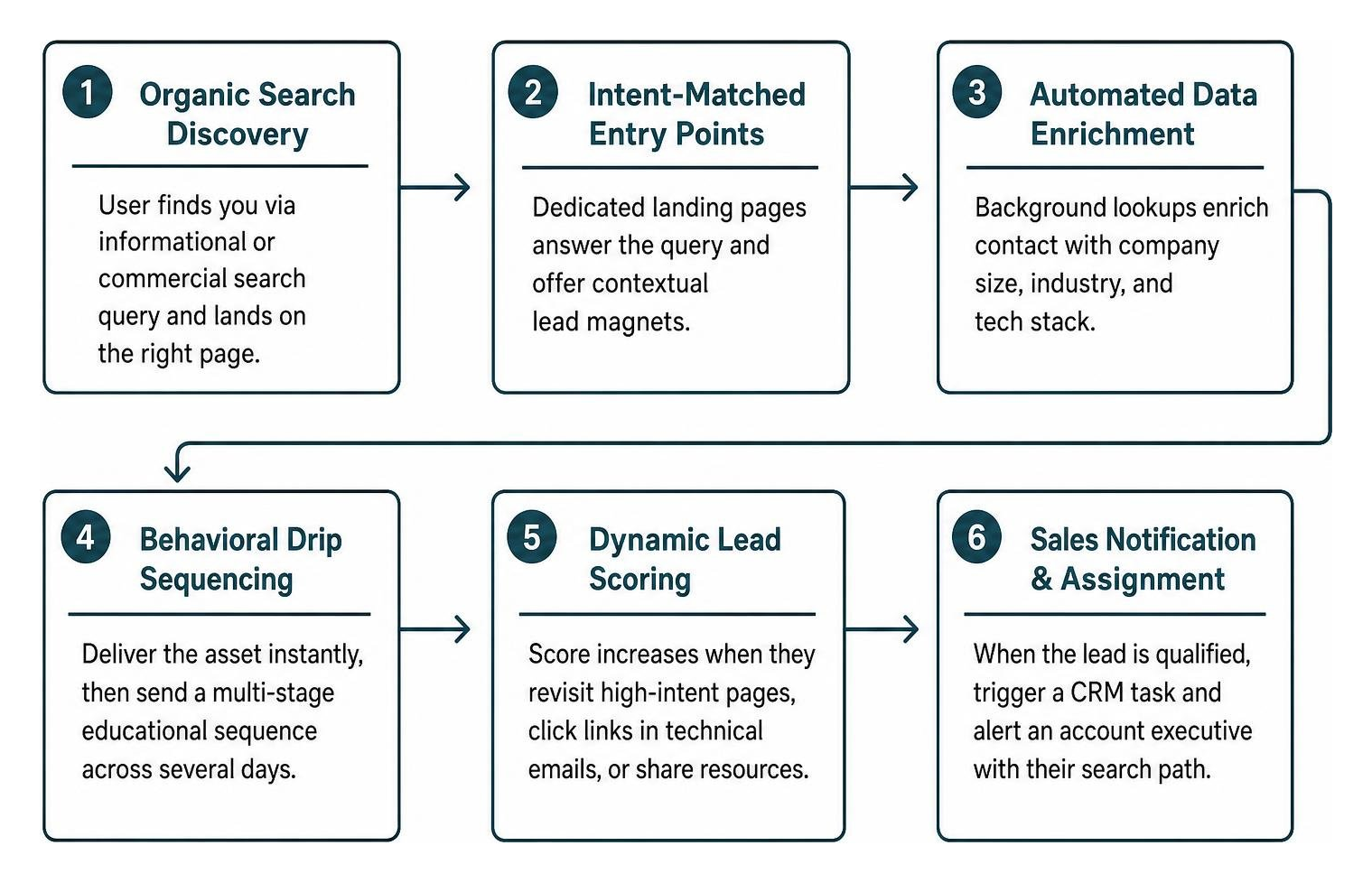
Building a high-converting nurture funnel requires seamless coordination between search-optimized landing pages and downstream email operations:
- Intent-Matched Entry Points: Build dedicated landing pages that directly answer specific transactional or informational queries. Content creators can consult top AI search optimization tools for content creators to balance search intent matching with editorial clarity.
- Contextual Lead Capture: Avoid generic “Subscribe to our newsletter” banners. Offer contextual lead magnets—such as automation templates, audit checklists, or operational calculators—that naturally solve the searcher’s query.
- Automated Data Enrichment: Use background API lookups to enrich the contact record with company size, industry, and tech stack details without burdening the visitor with a 10-field form.
- Behavioral Drip Sequencing: Deliver the requested asset instantly, followed by a multi-stage educational sequence spaced out across several days.
- Dynamic Lead Scoring: Increase the lead’s internal engagement score when they revisit high-intent commercial pages, click links in technical emails, or share your resources.
- Sales Notification & Assignment: When the contact crosses your qualification threshold, trigger an automated CRM task alerting an account executive with a summary of the visitor’s search path.
Scaling Content Optimization and Overcoming Integration Challenges
Scaling an organic content operation requires balancing publication velocity with strict quality control. If you produce generic, surface-level content, search engines and discerning readers will pass you by.
Modern marketing campaign management software helps organize cross-channel assets, but search optimization requires specialized workflows that evaluate entity coverage, heading structures, and topical depth.
Feeding Automated Content Optimization into Your Pipeline
Content teams often struggle with bottlenecks during research and brief creation. Automated content intelligence tools solve this by evaluating top-ranking SERP patterns, extracting semantic entities, and structuring automated briefs in minutes. Organizations using automated content brief workflows have tripled their monthly article production while maintaining high editorial standards.
Once a draft is completed, optimization engines can analyze heading hierarchies, internal linking suggestions, and readability benchmarks. To ensure your production meets search engine guidelines for original thought, run drafts through best AI content detectors for SEO before pushing assets to your content management system (CMS).
Solving Tool Overlap and Data Silos in SEO and Marketing Automation
As marketing stacks expand, organizations frequently suffer from tool overlap, data silos, and spiraling software costs. When your SEO platform, email engine, and CRM operate in isolation, your team wastes valuable hours manually exporting and reformatting CSV files.
To build a clean, unified marketing stack:
- Audit Redundant Subscriptions: Identify tools that share identical features (such as rank tracking, social listening, and basic crawl diagnostics) and consolidate around core platforms with open APIs.
- Establish Centralized Data Architecture: Route search performance data, landing page visits, and CRM lead records into a centralized data warehouse or unified dashboard.
- Enforce Webhook Idempotency: Ensure that automated webhooks connecting your CMS, search tools, and email engines have error-branching rules and retry mechanisms to prevent duplicate task creation.
- Implement Role-Based Access Controls (RBAC): Protect sensitive customer data and production environments by granting granular permissions across development, content, and marketing operations teams.
- Stage API Request Schedules: Decouple intensive data crawls from real-time customer event triggers to avoid running into API rate limit collisions.
Measuring the Combined ROI of Search and Marketing Workflows
Proving the business value of your integrated search and automation initiatives requires looking beyond vanity metrics like raw organic pageviews or email open rates. Executive leadership cares about customer acquisition costs (CAC), sales pipeline velocity, and closed-won revenue.
Modern search behavior splits user intent between traditional search engines and generative answer engines. Using the 7 best AI visibility tools for marketers allows you to monitor brand citation frequency across modern AI engines alongside standard search rankings.
To calculate the return on investment of your integrated engine, evaluate how automated nurturing improves the yield of your organic traffic:
By connecting Google Search Console and analytics APIs directly into your CRM, you can trace a closed-won deal back to the original search query and landing page that brought the buyer into your ecosystem.
Frequently Asked Questions About SEO and Marketing Automation
What is the most important SEO task to automate first?
Start by automating your highest-friction operational maintenance tasks: daily rank tracking alerts and technical site health sweeps. Setting up automated notifications for sudden indexation drops, broken redirect loops, or 5xx server errors provides immediate protection for your existing traffic. Once technical monitoring is automated via webhooks into your team chat, expand into automated keyword clustering and brief generation.
Is it safe to fully automate SEO content generation?
No. Fully automating content generation without human editorial review introduces significant risks. Unchecked AI generation frequently leads to factual hallucinations, repetitive sentence structures, and bland summaries that fail search engine helpfulness standards.
Automation is safest and most effective when used for data scaffolding—such as intent clustering, competitor gap analysis, schema generation, and initial draft outlines. An expert human writer should always provide experiences, unique points of view, and final brand voice governance.
How do real-time ranking alerts trigger automated marketing responses?
Real-time ranking alerts use threshold-monitoring algorithms to detect volatility. If a core commercial landing page drops from position 2 to position 8, an automated event trigger can execute three distinct responses:
- Development & SEO Alert: Create an urgent triage ticket in your project management software with a crawl report of the affected URL.
- Paid Search Rebalancing: Temporarily increase pay-per-click (PPC) ad bids on that exact keyword cluster to protect top-of-funnel lead flow while the organic issue is diagnosed.
- Content Refresh Queue: Pull current competitor SERP changes and generate an updated content optimization brief for your editorial team.
Conclusion
Succeeding in digital marketing requires dismantling the artificial barrier between top-of-funnel search acquisition and bottom-of-funnel automated nurturing. Search engine optimization drives the discoverability that fills your pipeline, while marketing automation delivers the personalization, speed, and consistency required to convert anonymous visitors into lifelong customers.
Building this integrated inbound engine does not require an enterprise budget or an overwhelming roster of complicated software. By focusing on open API connectivity, clean event-driven data triggers, and consistent human oversight, your team can scale organic revenue efficiently while avoiding costly vendor lock-in.
At AIxorIA, we specialize in artificial intelligence and B2B SaaS solutions, offering curated AI tool ecosystems, actionable operational guides, and tailored go-to-market orchestration frameworks. Whether you need performance audits or hands-on workflow training workshops, we help your marketing team build resilient automation engines that scale sustainably.
Ready to eliminate repetitive busywork and build a predictable lead generation flywheel? Discover how to scale your search and marketing integration with AIxorIA today.