How Marketing Automation Campaign Management Works
Scr0ll d0wn to D0VVNL0AD
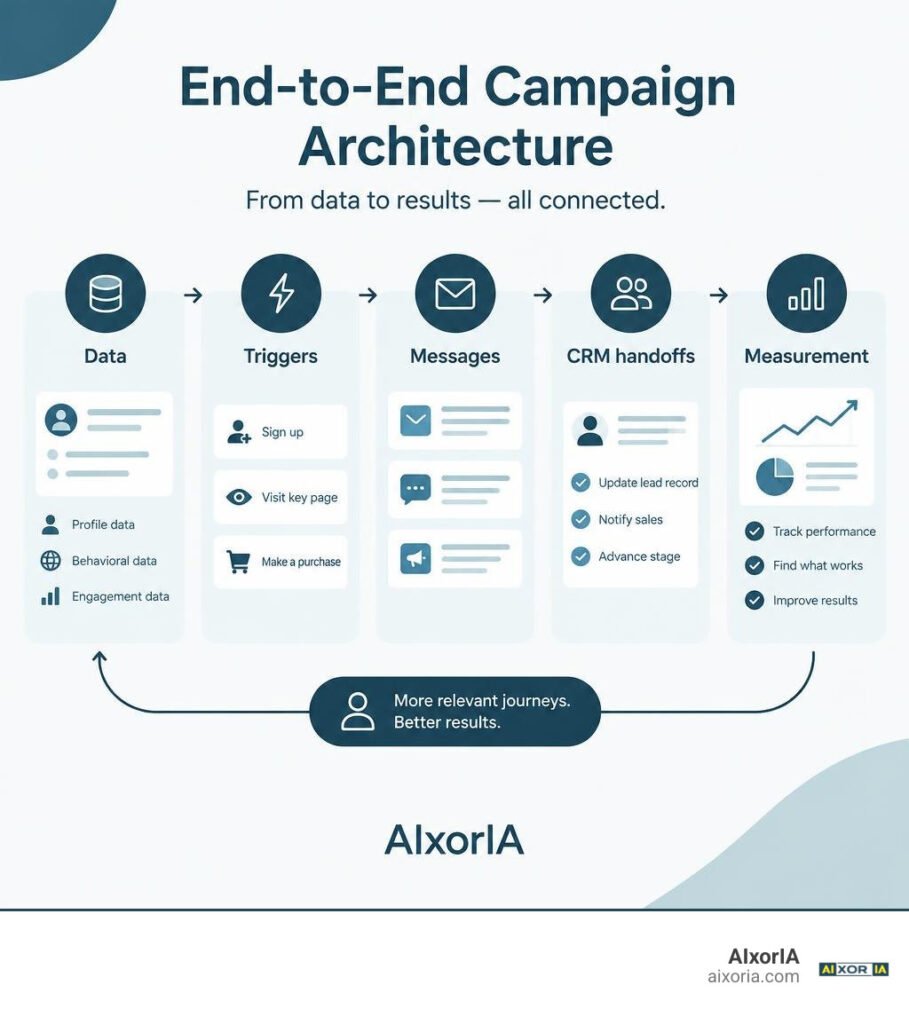
Marketing automation campaign management uses customer data and behavior to run, track, and improve campaigns with less manual work. A prospect signs up, visits a key page, or makes a purchase; that action can trigger a relevant message, update a lead record, or alert sales.
The goal is not to put every message on autopilot. It is to connect your tools, set clear rules for each customer journey, and measure what leads to results. This guide covers the basics, from campaign setup and CRM handoffs to choosing a stack that will not become a maintenance burden.
What Is Marketing Automation Campaign Management?
At its core, marketing automation campaign management is the systematic use of software, rules, and data triggers to orchestrate, execute, and evaluate multi-channel marketing initiatives throughout the entire buyer journey.
Rather than manually launching one-off email blasts or copy-pasting lead records into a spreadsheet, automated campaign management establishes a predictable demand waterfall. When a potential buyer interacts with your digital footprint—whether by reading a technical resource, clicking an ad, or exploring a pricing page—the platform tracks those behavioral signals in real time.
Modern marketing campaign management software serves as the central brain connecting your audience data to outbound touchpoints. By tracking digital body language, such as visit frequency, content downloads, and email engagement, teams can move away from generic mass outreach and deliver timely, personalized experiences that adapt as prospects move from awareness to decision.
Marketing Automation vs. CRM in Campaign Execution
A common area of confusion when evaluating go-to-market systems is the division of labor between marketing automation platforms (MAPs) and customer relationship management (CRM) systems. While both tools store contact data, their primary purposes, operational cadences, and target audiences differ substantially.
Marketing automation systems focus on one-to-many communication, top-to-middle funnel nurturing, and tracking anonymous-to-known behavioral conversions. In contrast, CRM software serves as the single source of truth for one-to-one sales interactions, deal pipeline stages, contract negotiations, and post-sale account management.
| Functional Area | Marketing Automation Platform (MAP) | Customer Relationship Management (CRM) |
|---|---|---|
| Primary Audience | Marketing teams, growth specialists, demand gen | Sales representatives, account executives, customer success |
| Funnel Focus | Top and middle of the funnel (Lead capture & nurture) | Bottom of the funnel and customer lifecycle (Deals & renewals) |
| Core Functions | Behavioral tracking, email drips, scoring, segmentation | Opportunity tracking, pipeline stages, activity logging, quotas |
| Communication Mode | Automated, triggered, dynamic one-to-many messaging | Direct, personal, manual one-to-one communication |
| Primary Metrics | Open/click rates, cost per lead, MQL volume, attribution | Win rates, deal velocity, quota attainment, customer LTV |
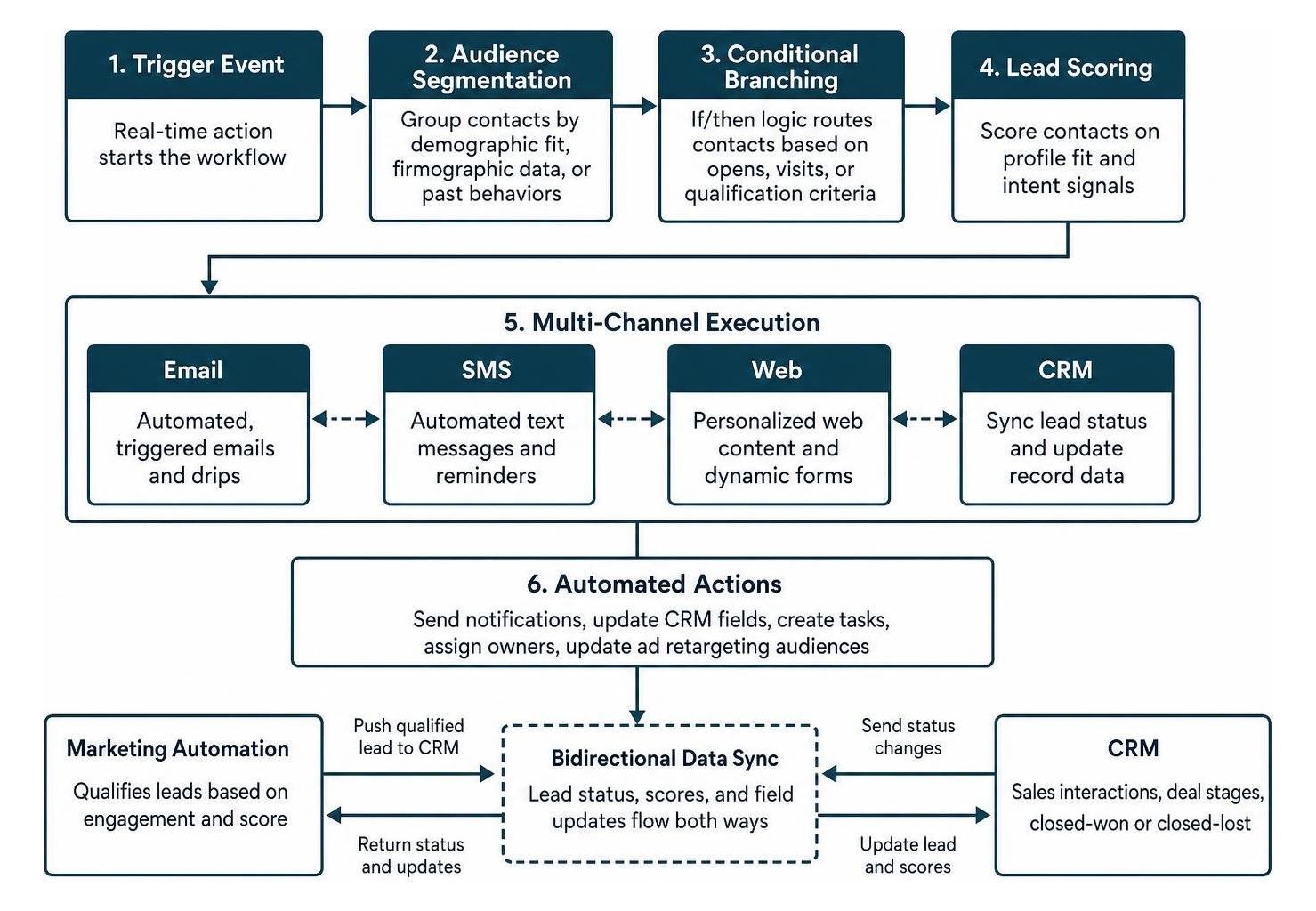
The magic happens when these two platforms maintain a bidirectional data sync. When marketing automation qualifies a lead based on engagement, it pushes that record into the CRM and assigns a sales rep. Conversely, when a sales rep marks an opportunity as “closed-lost,” that status change automatically flows back to the marketing engine, enrolling the prospect into a long-term educational re-engagement sequence.
Core Components of Marketing Automation Campaign Management
Every automated marketing campaign, regardless of complexity, relies on several foundational building blocks:
- Trigger Events: The specific real-time action or database change that initiates a workflow (e.g., submitting a contact form, abandoning a checkout cart, or reaching a specific page-visit threshold).
- Audience Segmentation: Dynamic grouping based on demographic fit, firmographic data, or past behaviors. Contacts move in and out of segments automatically as their profile properties update.
- Conditional Branching: Decision logic (if/then rules) that routes contacts down different journey paths based on whether they open an email, visit a URL, or match specific qualification criteria.
- Lead Scoring Engines: Algorithmic models that assign numerical points to prospects based on explicit profile fit (such as job title and company revenue) and implicit intent signals (such as visiting pricing pages or attending webinars).
- Dynamic Content Delivery: Modifiable content blocks within emails, landing pages, and web banners that display tailored copy, imagery, and product recommendations matching the visitor’s industry or lifecycle stage.
- Automated Actions: The downstream tasks executed by the system, including sending notifications to account owners, updating CRM field properties, creating tasks, or altering ad retargeting audiences.
How End-to-End Automated Campaigns Work Across Channels
To build campaigns that generate reliable pipeline, organizations must look beyond single-channel email sequences. Modern buyers interact across dozens of digital touchpoints before speaking with a sales representative. Orchestrating an end-to-end automated campaign requires mapping consistent messaging across email, SMS, search ads, web personalization, and physical touchpoints.
Instead of overwhelming prospects with lengthy intake forms on their first visit, high-performing automated engines use progressive profiling. When a user downloads an initial top-of-funnel whitepaper, the form asks only for their name and email address. When they return three weeks later to register for a webinar, the system recognizes their existing cookie and dynamically replaces those completed fields with new questions, such as company size and primary technical challenge. This approach keeps conversion friction low while progressively enriching your lead database.
Designing Multi-Channel Customer Journeys
Building an effective customer journey involves aligning the right communication channel with the recipient’s level of intent.
- Email Sequences: The foundation of B2B and B2C nurturing. Utilizing the best email drip campaign software allows teams to deliver educational content, onboarding guides, and milestone updates on an automated schedule.
- SMS & Direct Messaging Triggers: Ideal for high-urgency, time-sensitive alerts such as webinar reminders, appointment confirmations, or limited-time promotional windows.
- Dynamic Web Personalization: Displaying tailored customer testimonials and case studies directly on your website based on the visitor’s industry segment.
- Social & Paid Ad Integration: Coordinating audience lists with external ad platforms to ensure prospects who enter a specific nurture track simultaneously see matching creative across their social feeds. Choosing effective social media campaign management software ensures messaging stays unified across both organic and paid touchpoints.
- Direct Mail Workflows: For high-value enterprise accounts, triggering offline touchpoints like executive gift boxes or personalized handwritten notes using direct mail campaign management software creates memorable, tactile moments in a noisy digital landscape.
Lead Scoring, Routing, and CRM Integration
The ultimate goal of campaign automation is delivering sales-ready opportunities to revenue teams while filtering out unqualified noise. A robust lead-scoring framework combines two distinct data dimensions:
- Firmographic/Demographic Fit (Explicit Data): Does this contact match your ideal customer profile (ICP)? Points are added for target job titles, relevant industries, and qualifying company revenue tiers, while points are deducted for non-business email domains or unserviceable geographic locations.
- Behavioral Intent (Implicit Data): How active is this contact? Points are awarded when prospects read case studies, attend live product demos, or repeatedly visit pricing tables.
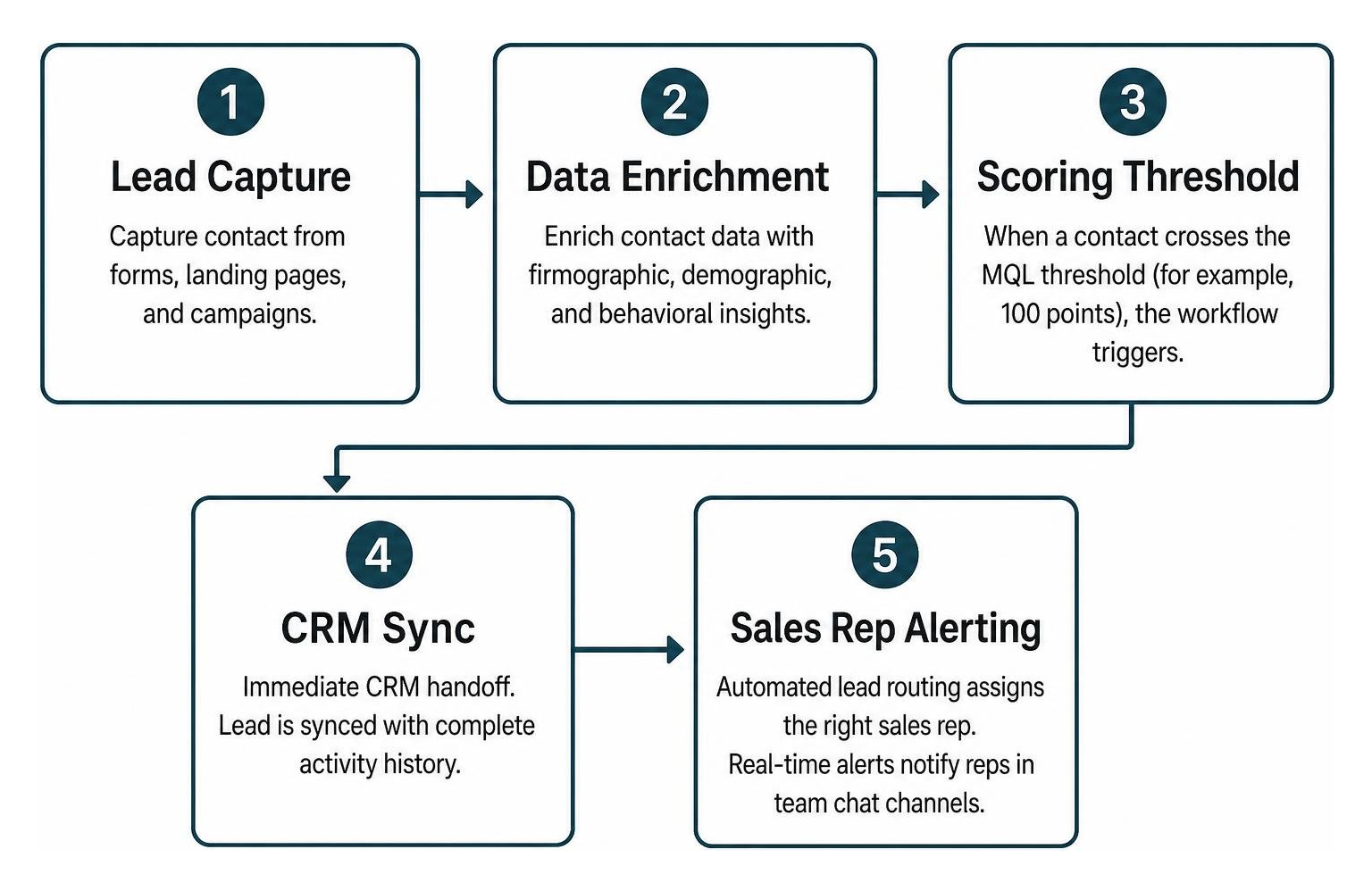
When a contact crosses a predefined Marketing Qualified Lead (MQL) threshold (for example, accumulating 100 points), the workflow executes an immediate CRM handoff. Selecting top-tier email marketing tools for CRM software ensures these leads transfer into your pipeline with complete activity histories attached.
Automated lead routing assigns the contact to the appropriate account executive based on territory, industry, or company size. At the same time, the system triggers real-time alerts in internal team chat channels so sales reps can respond while buying intent is highest.
Key Benefits and Strategic Impact of Campaign Automation
Implementing marketing automation across your campaign operations changes how marketing and sales teams operate. According to Forrester, global marketing technology expenditure was projected to reach USD 148 billion by the end of 2024, reflecting the critical priority organizations place on software-driven growth.

- Massive Operational Efficiency: Teams can manage campaigns for 100,000 leads using the same operational bandwidth previously required to handle 1,000. Manual, repetitive data entry is replaced with automated rules.
- Accelerated Pipeline Velocity: Automated triggers deliver immediate responses to inbound inquiries, preventing prospects from cooling off while waiting for manual review.
- Closed-Loop Revenue Attribution: Connecting campaign touchpoints directly to closed-won deals in your CRM makes it easy to calculate Return on Marketing Investment (ROMI) and identify top-performing channels.
- Significant Error Reduction: Standardized campaign templates, automated UTM link generation, and automated QA checks eliminate broken tracking links and manual data entry mistakes.
Real-World Examples of High-Converting Automated Campaigns
To understand how automated marketing campaigns drive tangible business results, let us examine several standard workflows:
- E-Commerce Cart Recovery & Browse Abandonment: When a logged-in user adds items to their shopping cart and leaves without completing the purchase, an automated sequence triggers two hours later with an item reminder. If no purchase occurs after 24 hours, a secondary message offers an exclusive limited-time incentive, often recovering over 20% of otherwise lost revenue.
- Interactive Event Registration & Follow-Up: A contact registers for an upcoming virtual conference. The automation engine sends a calendar invite, delivers a series of preparation reminders, and tracks live attendance. Post-event, attendees receive session recordings and product trial offers, while non-attendees receive a recap summary and an invite to the next session.
- Customer Onboarding & Product Activation: Upon creating a new software account, users enter an automated onboarding sequence. If the user fails to activate a key product feature within three days, the workflow branches to deliver a short video tutorial highlighting that specific tool, boosting long-term user retention.
- Re-Engagement & Win-Back Tracks: Inactive subscribers who have not engaged with marketing assets for 90 days are automatically enrolled in a re-engagement flow. The system asks them to update their content preferences or offers a special discount, automatically pruning contacts who remain unresponsive to maintain high inbox deliverability.
- RFM (Recency, Frequency, Monetary) Value Campaigns: Online retailers group customers based on how recently they purchased, how often they buy, and how much they spend. High-value VIP segments automatically receive exclusive early access to product launches, while at-risk buyers receive automated retention offers.
Overcoming Common Implementation and Data Challenges
Despite its clear advantages, campaign automation comes with operational hurdles. Research indicates that 37% of sales and marketing managers regularly see leads get stuck between marketing tools and the CRM or during handoffs, and 51% identify better integrations as a top priority.
- Bridging Marketing and Sales Data Silos: Ensure your integration architecture supports bidirectional, real-time data sync rather than delayed batch updates that leave sales reps working with stale context.
- Managing Internal Change & Workflow Alignment: Marketing automation fundamentally shifts how teams work. Establish clear Service Level Agreements (SLAs) defining exact MQL thresholds and required sales follow-up timelines before launching campaigns.
- Sustaining Content Velocity: An automated journey is only as good as the content inside it. Without relevant case studies, guides, and comparison sheets tailored to each funnel stage, automated workflows quickly lose engagement.
- Filtering Bot Activity for Data Hygiene: Corporate email security filters often generate automated clicks and opens to scan links. Modern automation setups must include bot-filtering rules to prevent false engagement signals from artificially inflating lead scores.
The Role of AI in Modern Campaign Management
Artificial intelligence has shifted marketing automation from static, rule-based execution to dynamic, adaptive journey orchestration. McKinsey projects that generative AI will increase marketing productivity by up to 15% of total marketing expenditure, unlocking an estimated USD 463 billion in annual value. Furthermore, a study by the IBM Institute for Business Value found that more than three out of four CMOs believe generative AI will fundamentally alter how marketing operates.
Modern platforms leverage AI to draft campaign copy variations, forecast conversion probabilities, and optimize message delivery timing for individual recipients based on their past engagement patterns. However, teams must understand the limitations of current AI email marketing tools, particularly regarding hallucinations, generic tone, and brand compliance risks.
How AI Transforms Marketing Automation Campaign Management
The evolution of AI in marketing is moving campaign management from rigid, manually constructed workflow charts toward autonomous, goal-driven campaign agents.

- Goal-Driven Autonomous Journeys: Instead of manually plotting every if/then branch, marketers can define a strategic objective (such as “increase product demo bookings among enterprise healthcare accounts”), allowing AI models to recommend and configure multi-touchpoint journeys automatically.
- Continuous Adaptive Testing: Rather than running static A/B tests between two email subject lines, machine learning models continuously evaluate multi-variant creative assets and automatically route traffic to the top-performing combinations in real time.
- Conversational Analytics & Discovery: Marketing leaders can query their campaign data in natural language—asking questions like, “Which lead source generated the highest pipeline value last quarter?”—and receive instant visual reports without complex database filtering.
- Pre-Flight Brand Governance: AI compliance agents can automatically scan campaign copy, imagery, and layout elements against brand guidelines and regulatory standards before launch, preventing costly compliance errors across global markets.
Platform Evaluation Framework: Choosing the Right Automation Stack
Selecting the right software foundation requires balancing your team’s current technical maturity with long-term strategic needs:
- Open Ecosystem Architecture: Prioritize platforms that offer open APIs, flexible webhook support, and native connectors to your existing CRM and data warehouses. Avoid closed, proprietary systems that make migrating your data difficult.
- Transparent Pricing Models: Be mindful of how vendors charge. Some platforms price based on total database contacts—which penalizes you for storing historical data—while others charge based on monthly active communication volume.
- Usability vs. Customization: Ensure the platform provides intuitive drag-and-drop visual journey builders for everyday campaign managers, along with advanced scripting and webhook capabilities for technical marketing operations teams.
- Deliverability & Governance Infrastructure: Verify that the software supports modern authentication protocols (SPF, DKIM, DMARC), dedicated IP configuration, role-based access permissions, and clear audit logging.
Frequently Asked Questions About Marketing Automation
What is the primary difference between a basic campaign tool and marketing automation?
A basic campaign tool focuses primarily on scheduling and sending one-off broadcast emails or SMS messages to static contact lists. Full-featured marketing automation platforms manage the entire customer lifecycle, track real-time website and app behavior, use dynamic multi-branch decision logic, score leads algorithmically, and integrate bidirectionally with CRM pipelines for multi-touch revenue attribution.
How do automated workflows improve sales and marketing handoffs?
Automated workflows eliminate the delays and data entry errors that occur when passing leads manually between teams. When a prospect engages with marketing assets and crosses your qualification threshold, the automation system enriches their profile, creates or updates their CRM record, assigns an account owner, and triggers instant alerts to sales reps with complete context on which assets the prospect viewed.
What are the essential metrics to track campaign performance?
Beyond basic vanity metrics like email open and click rates, effective campaign measurement focuses on business impact:
- Funnel Conversion Velocity: The average time it takes for a newly captured contact to become a qualified opportunity.
- Pipeline Contribution: The total dollar value of sales opportunities influenced or originated by automated campaigns.
- Customer Acquisition Cost (CAC) Efficiency: The blended cost required to generate a paying customer across automated channels compared to manual outreach.
- Customer Lifetime Value (LTV) Lift: The increase in retention, renewal rates, and cross-sell revenue driven by post-sale automated customer journeys.
Conclusion
Marketing automation campaign management is no longer just about scheduling email queues—it is the operational backbone that connects customer data, multi-channel engagement, and sales pipeline into a unified growth engine. By mapping clear buyer journeys, establishing dependable lead scoring models, and connecting your tools without data silos, your team can deliver personalized experiences at scale while maintaining clean attribution.
At AIxorIA, we help businesses build cost-effective, scalable GTM operations. Whether you are looking to audit your current stack, train your team on modern workflow methodologies, or implement adaptable orchestration systems that avoid vendor lock-in, explore AIxorIA’s GTM orchestration frameworks to build automation engines that deliver measurable revenue impact.