Why the Best Free ETL Tools for Developers Matter More Than Ever
Scr0ll d0wn to D0VVNL0AD
The best free ETL tools for developers can make the difference between a data pipeline that runs smoothly and one that costs your team weeks of painful manual work.
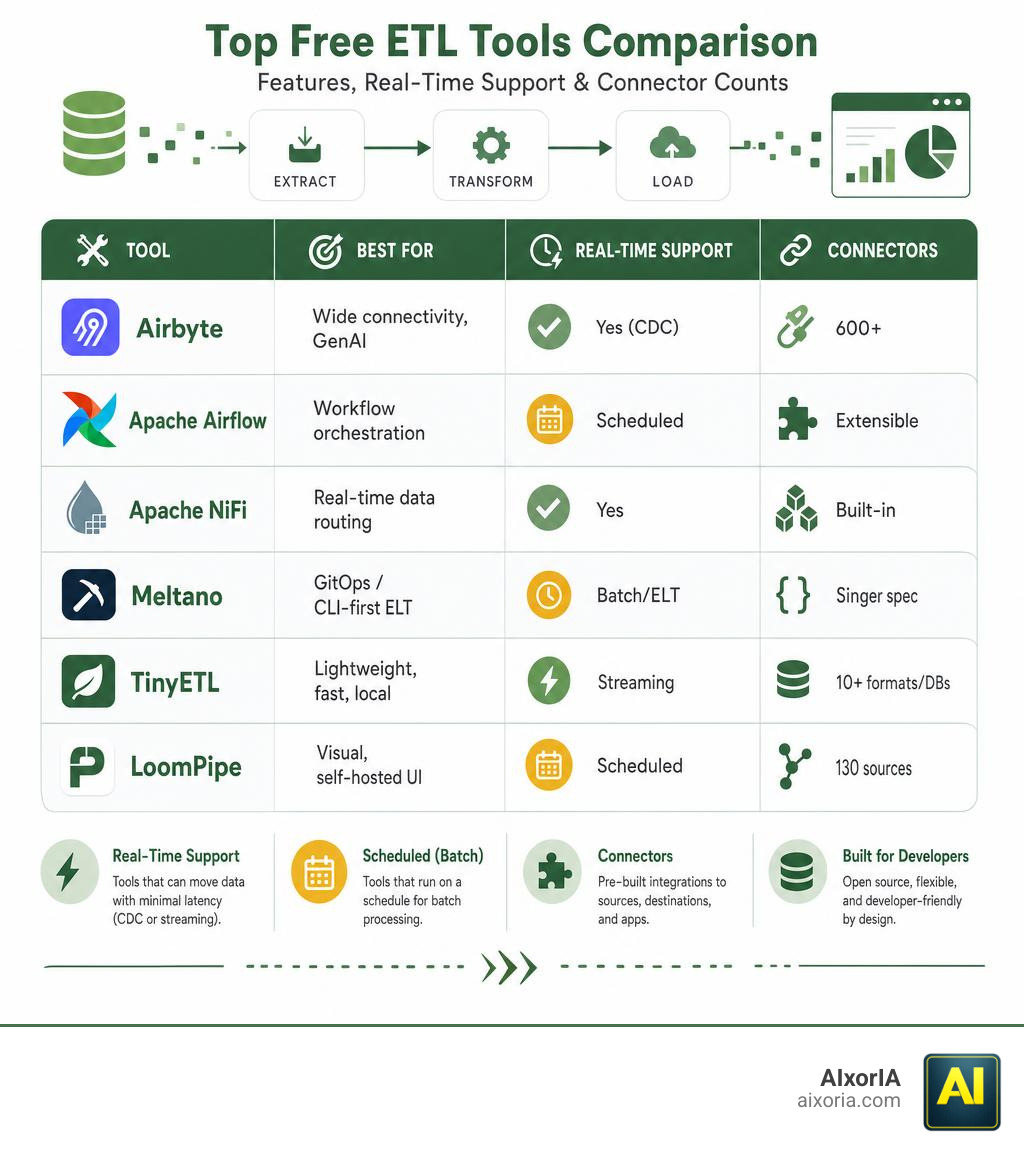
Here’s a quick answer if you just need the list:
| Tool | Best For | Real-Time? | Connectors |
|---|---|---|---|
| Airbyte | Wide connectivity, GenAI | Yes (CDC) | 600+ |
| Apache Airflow | Workflow orchestration | Scheduled | Extensible |
| Apache NiFi | Real-time data routing | Yes | Built-in |
| Meltano | GitOps / CLI-first ELT | Batch/ELT | Singer spec |
| TinyETL | Lightweight, fast, local | Streaming | 10+ formats/DBs |
| LoomPipe | Visual, self-hosted UI | Scheduled | 130 sources |
Data volumes are growing fast. By some estimates, the world generates tens of zettabytes of data every year — and most small teams are struggling to keep up.
The good news? You don’t need an expensive enterprise contract to move and transform data reliably. a new generation of free and open-source ETL tools gives developers serious power without the price tag.
But not all tools are equal. Some are built for huge engineering teams. Others are perfect for a solo developer who just needs to get data from point A to point B — fast.
This guide cuts through the noise. We cover the top free ETL tools available in 2026, what each one is actually good at, and how to pick the right one for your situation.
Understanding ETL vs ELT for Modern Developers
Before diving into the tools, we need to address a fundamental architectural shift: ETL vs. ELT.
Historically, developers extracted data from sources, transformed it on a middle-tier staging server, and loaded it into a target database (ETL). Today, with modern cloud data warehouses, we often extract raw data, load it directly, and transform it inside the destination (ELT).
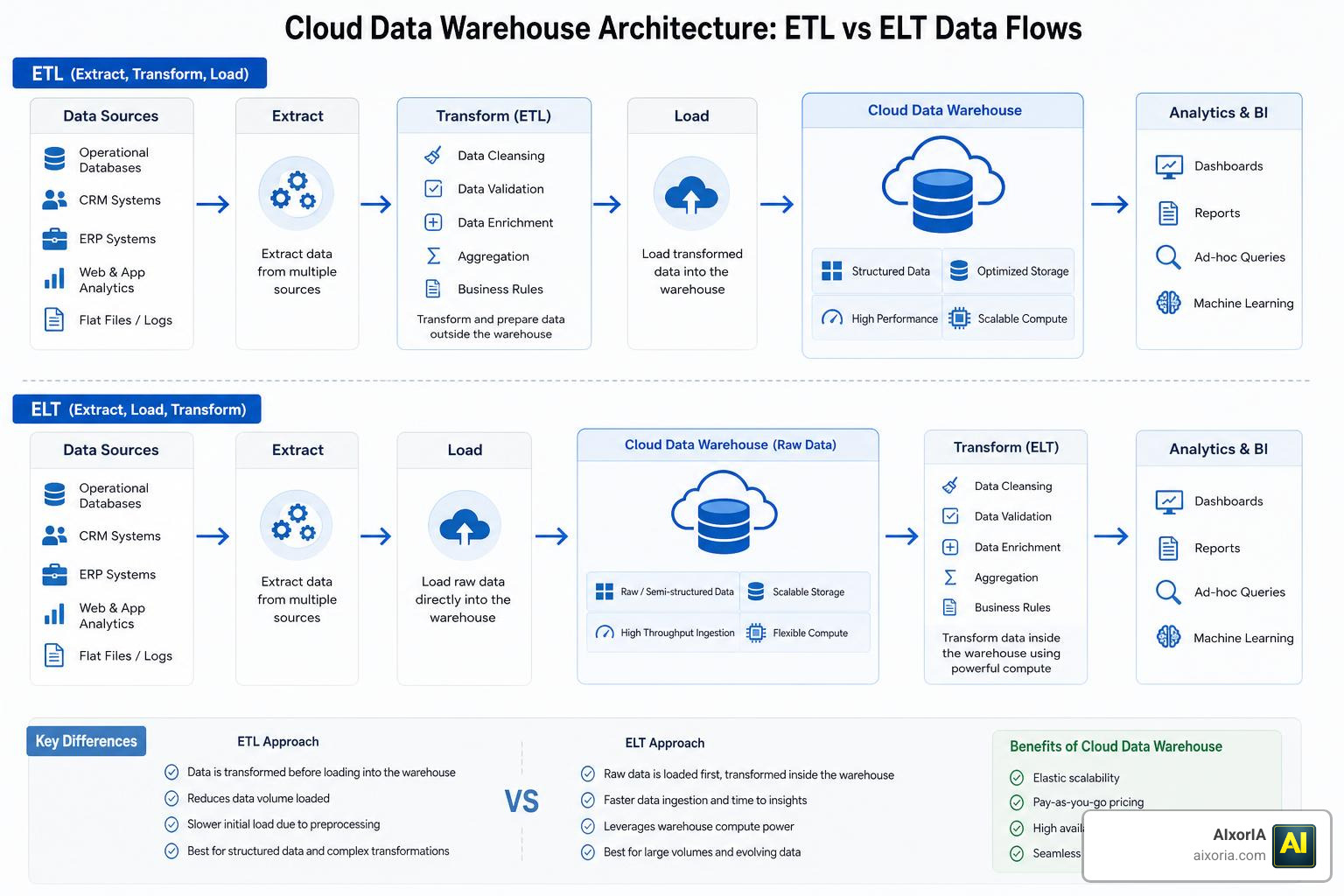
Why does this matter? Storage constraints are largely a thing of the past, and cloud warehouses are incredibly fast at running SQL-based transformations. Using ELT allows you to keep raw historical data intact and run transformations on demand.
When choosing the best free ETL tools for developers, you must decide if your target architecture is a traditional database or a modern cloud warehouse. For those who want to write customized transformation logic natively, exploring ETL in Python is a great starting point for custom scripts. If you are pushing directly to cloud environments, choosing the best ETL tools in data warehouse in 2026 will drastically simplify your infrastructure.
Key Selection Criteria for the Best Free ETL Tools for Developers
Selecting a tool isn’t just about finding the one with the most GitHub stars. To build a reliable data stack, we recommend evaluating tools based on these four criteria:
- Connector Availability: Does the tool support your specific data sources and destinations out of the box?
- Customizability: Can you write custom Python, SQL, or Lua code when standard connectors fall short?
- Scalability & Performance: Can it handle your data volumes? A lightweight tool might choke on gigabytes of streaming data, while a heavy framework might be overkill for simple API syncing.
- Total Cost of Ownership (TCO): While open-source software is free to download, hosting, maintaining, and debugging it requires engineering hours.
If your team has limited engineering resources to manage complex infrastructure, you might want to look into the best no-code ETL tools in 2026 to reduce maintenance overhead.

Top Free and Open-Source ETL Tools in 2026
If you are building your stack today, these are the standout free and open-source options that deserve a spot on your radar.
Airbyte: The Modern Standard for Best Free ETL Tools for Developers
Airbyte has quickly become a dominant force in the data ingestion space. With over 20,600 GitHub stars and a vibrant Slack community of more than 25,000 members, it has massive momentum behind it.
- Key Strengths: Airbyte boasts a library of over 600 pre-built connectors. Its standout feature is the AI-powered Connector Builder, which can generate custom connectors from API documentation in minutes—cutting connector maintenance time by up to 60%.
- Scalability: It features a Kubernetes-native architecture that supports horizontal scaling to handle petabyte-level workloads.
- GenAI Support: It seamlessly integrates with vector databases like Pinecone, Milvus, and Weaviate, making it a stellar choice for teams building AI-driven pipelines.
For developers seeking to integrate AI capabilities, checking out the best AI tools for data integration in 2026 can help unlock even more automated pipeline features.
Apache Airflow: Orchestration Powerhouse for Best Free ETL Tools for Developers
It is important to note that Apache Airflow is not strictly an ETL tool—it is a workflow orchestrator. However, it is the industry standard for managing complex data pipelines.
- How it Works: Airflow uses Directed Acyclic Graphs (DAGs) written in Python to schedule, monitor, and orchestrate tasks.
- Best Use Case: Airflow is perfect when you need to coordinate multiple steps—such as triggering an Airbyte sync, running a dbt transformation, and then sending an alert to Slack.
To see how Airflow fits into a broader cloud strategy, look at the 9 best data integration tools for cloud services in 2026.
Apache NiFi: Real-Time Data Routing
Originally developed by the NSA, Apache NiFi is a powerful, enterprise-grade tool built specifically for real-time data routing, transformation, and system mediation.
- Visual Interface: NiFi provides an intuitive drag-and-drop web UI that allows you to design data flows visually.
- Real-Time Processing: Unlike batch-oriented tools, NiFi processes data as continuous streams. It is highly effective for IoT data, log aggregation, and real-time event streaming.
Meltano: Declarative ELT for GitOps
Meltano takes a software engineering approach to data integration. It is a CLI-first tool built on top of the open Singer specification.
- GitOps Friendly: With Meltano, your entire pipeline configuration is stored in a single
meltano.ymlfile. This means you can version control, code review, and CI/CD your data pipelines just like any other application code. - Extensibility: It integrates beautifully with dbt for transformations and Airflow for orchestration.
TinyETL: Lightweight Single-Binary ETL
If you want to avoid setting up complex Docker containers, Kubernetes clusters, or JVM environments, TinyETL is an incredibly refreshing option.
- Zero Config: TinyETL runs as a single 15MB binary with no external dependencies.
- Performance: Despite its tiny size, it can stream over 180,000 rows per second.
- Features: It supports Lua scripting for custom transformations and handles formats like CSV, JSON, Parquet, and Avro alongside databases like PostgreSQL, SQLite, and DuckDB.
You can download and try TinyETL on GitHub to get started in seconds.
LoomPipe: Self-Hosted Visual Data Pipelines
LoomPipe is a self-hosted, .NET-based ETL platform that provides a beautiful web UI for developers who want a visual workflow without the enterprise price tag.
- Features: It includes 130 source connectors, 22 destination connectors, visual field mapping (with Levenshtein-distance fuzzy matching), and built-in expression transformation functions.
- Developer Control: It supports watermark-based incremental loading, encrypted credential storage, and role-based access control.
You can explore LoomPipe on GitHub to deploy it via Docker.
Outdated Tools and Migration Strategies
Data technology moves fast. If you are starting a new project in 2026, there are several legacy tools you should avoid or actively migrate away from.
The most notable example is Talend Open Studio, which was officially retired on January 31, 2026. Teams relying on it must plan migrations to modern alternatives like Airbyte or Meltano to avoid security vulnerabilities and unmaintained connectors. Similarly, Pentaho Data Integration (Kettle), while still functional, has a steep learning curve and lacks the cloud-native flexibility demanded by modern architectures.
If you are managing enterprise-level migrations, we recommend reviewing the most reliable ETL tools for enterprise data in 2026 to ensure your new stack is future-proof.
Frequently Asked Questions about Free ETL Tools
What is the difference between open-source ETL and managed SaaS ETL?
Open-source ETL is free to download and highly customizable, but your team is responsible for hosting, scaling, and maintaining the infrastructure. Managed SaaS ETL tools charge based on data volume or compute time but handle all hosting, connector updates, and security compliance automatically.
Can free ETL tools handle petabyte-scale data volumes?
Yes, but it depends on the tool’s architecture. Tools like Airbyte (using Kubernetes-native scaling) and Apache NiFi are designed to scale horizontally across clusters to handle massive workloads. Lightweight tools like TinyETL are optimized for fast local processing and are better suited for smaller or medium-sized datasets.
How do I choose between batch and real-time ETL tools?
If your business decisions rely on up-to-the-minute data (e.g., fraud detection or live inventory tracking), choose a real-time streaming tool like Apache NiFi or Airbyte with Change Data Capture (CDC). If daily or hourly updates are sufficient, batch processing with Airflow or Meltano is simpler to build and maintain.
Conclusion
Finding the best free ETL tools for developers comes down to balancing your technical requirements with your team’s maintenance capacity. Whether you need the massive connector library of Airbyte, the lightweight simplicity of TinyETL, or the GitOps workflow of Meltano, the open-source ecosystem in 2026 has never been stronger.
If you are looking to build highly optimized data systems but want to bypass the steep learning curve, we can help. At AIxorIA, we provide custom AI solutions, tool training workshops, hands-on tutorials, and performance audits to empower your business. We believe in simple language, affordable services, and fast customer support to help you get your pipelines running flawlessly.
Ready to explore more options? Discover the 20 Best ETL Tools for Data Integration or check out our guide on the best free ETL tools for developers in 2026 to find the perfect fit for your stack!