How AI Tools for Shift Scheduling in Restaurants Help
Scr0ll d0wn to D0VVNL0AD
AI tools for shift scheduling in restaurants use sales trends, staff availability, and labor rules to suggest who should work each shift. Look for a tool that forecasts busy hours, flags overtime, lets staff request swaps, and connects with your POS and payroll systems. Managers should review the draft before publishing it.
That can mean less time spent fixing spreadsheets and fewer staffing gaps during a rush. The goal is not simply to cut hours. It is to put the right people in the right roles when guests need them.
How AI Tools for Shift Scheduling for Restaurants Transform Operations
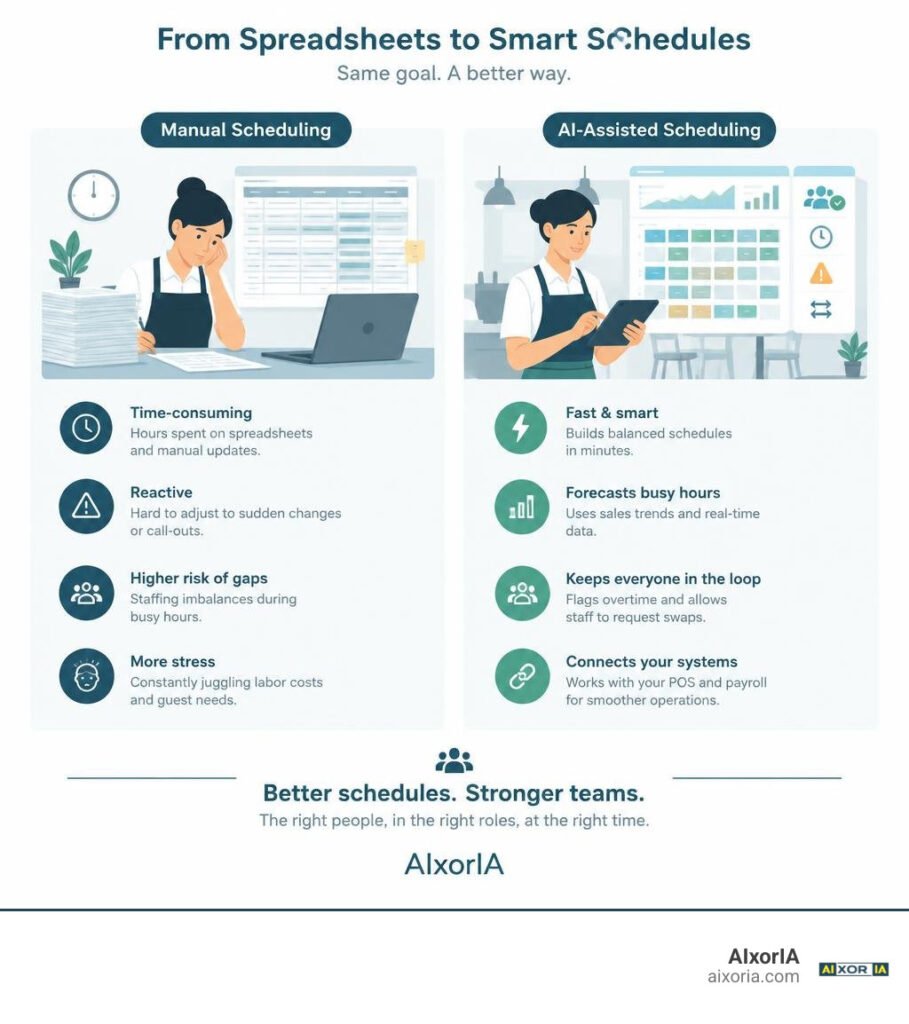
Running a restaurant often feels like solving a puzzle where the pieces change shape mid-service. Between sudden weather shifts, unpredictable foot traffic, and unexpected call-outs, static scheduling methods fall apart quickly. Managers often spend 5 to 10 hours every week buried in spreadsheets, attempting to balance labor budgets against guest expectations.
When restaurants transition to modern machine learning engines, shift planning evolves from reactive guesswork into proactive operational planning. AI models analyze years of transaction logs, live reservation volumes, and external variables to build balanced schedules in minutes rather than hours.
| Operational Dimension | Manual Spreadsheet Scheduling | AI-Powered Restaurant Scheduling |
|---|---|---|
| Shift Creation Time | 5–10 hours per week per store | 15–30 minutes per week per store |
| Demand Forecasting | Static averages, manager gut feeling | Granular daypart predictions based on sales, weather, and events |
| Overtime Management | Retroactive discovery on payroll day | Real-time pre-shift alerts and preventive slotting |
| Call-Out Handling | Frantic phone trees and group texts | Automated broadcasts to qualified, available peer pools |
| Labor Compliance | Manual memory of break rules and limits | Automated multi-jurisdiction checks (Fair Workweek, minors) |
| Labor Cost Accuracy | Frequent budget overruns (15–25% variance) | Tight margin control (8–15% average labor savings) |
Core Architecture of AI Tools for Shift Scheduling in Restaurants
Modern scheduling engines rely on continuous data ingestion. The system reads historical point-of-sale (POS) ticket velocity, timeclock punches, approved time-off requests, and employee skill profiles.
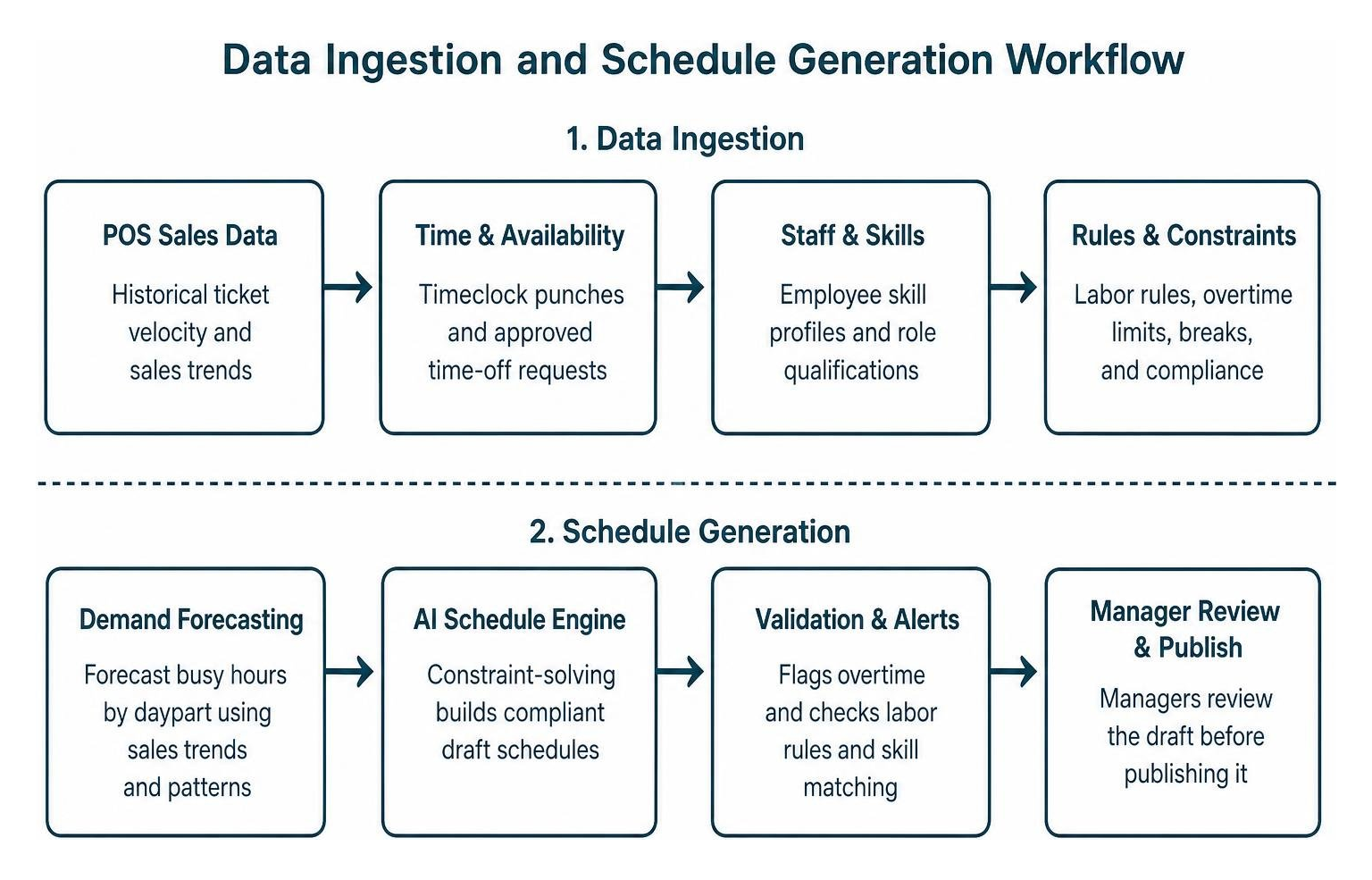
Using dedicated restaurant employee scheduling software, the platform applies constraint-solving algorithms to build compliant rosters. Rather than forcing managers to drag and drop shifts manually, conversational agents allow leadership to adjust parameters using natural language commands, such as requesting extra bar support for a local concert night. Every shift assignment includes an audit log verifying rest intervals, certified skill matching, and wage impact before the manager approves the final draft.
Granular Demand Forecasting by Daypart and Sales Patterns

A fundamental challenge in hospitality labor is timing. A restaurant can schedule the mathematically correct number of weekly labor hours but still fail if those hours are misaligned across the day.
AI forecasting breaks the operating day into distinct dayparts:
- Breakfast & Morning Prep: Focusing on prep volume and early morning transaction speed.
- Lunch Rush: High ticket turnover requiring maximum kitchen line throughput.
- Mid-Afternoon Lull (2:00 PM – 4:00 PM): Scaling back front-of-house floor coverage to protect margins from unnecessary labor leakage.
- Dinner Service: Matching full-service floor coverage to table turns and reservation pacing.
- Late-Night & Close: Balancing cleaning protocols with strict overtime limits.
By analyzing historical sales patterns, scheduled community events, and weather forecasts, the system predicts demand spikes—like a Friday dinner that averages 30% higher sales than a Wednesday service—and aligns shift start times to match.
Financial and Operational Impact on Hospitality Margins
In food service, labor is the single largest controllable operating expense. Applying the best AI tools for business productivity to workforce management protects operating margins while maintaining service standards. Academic and field research, such as studies on the Optimal Scheduling of Waitstaff with Different Experience Levels at a Restaurant Chain, shows that balancing experienced staff with newer team members directly stabilizes table turn times, prevents service bottlenecks, and lifts average guest check sizes.
Mitigating Overstaffing, Split Shift Gaps, and Overtime Leakage
Uncontrolled overtime often occurs in the form of “micro-extensions”—fifteen minutes of lingering post-rush prep or thirty minutes of delayed table turn cleanups that accumulate across dozens of workers. Over a pay cycle, these untracked minutes create substantial budget overruns.
Deploying dedicated AI employee scheduling software for restaurants allows operators to set hard guardrails on wage percentages and hours worked. The algorithms accurately manage complex arrangements like split shifts—bringing staff in for peak lunch and dinner rushes while honoring mandatory rest breaks in between—delivering measurable labor cost savings of 8% to 15% across multi-unit operations.
Boosting Retention and Team Satisfaction with Autonomous Swapping
Hospitality historically experiences high employee turnover. Much of this friction stems from rigid scheduling practices and unpredictable shift notices.
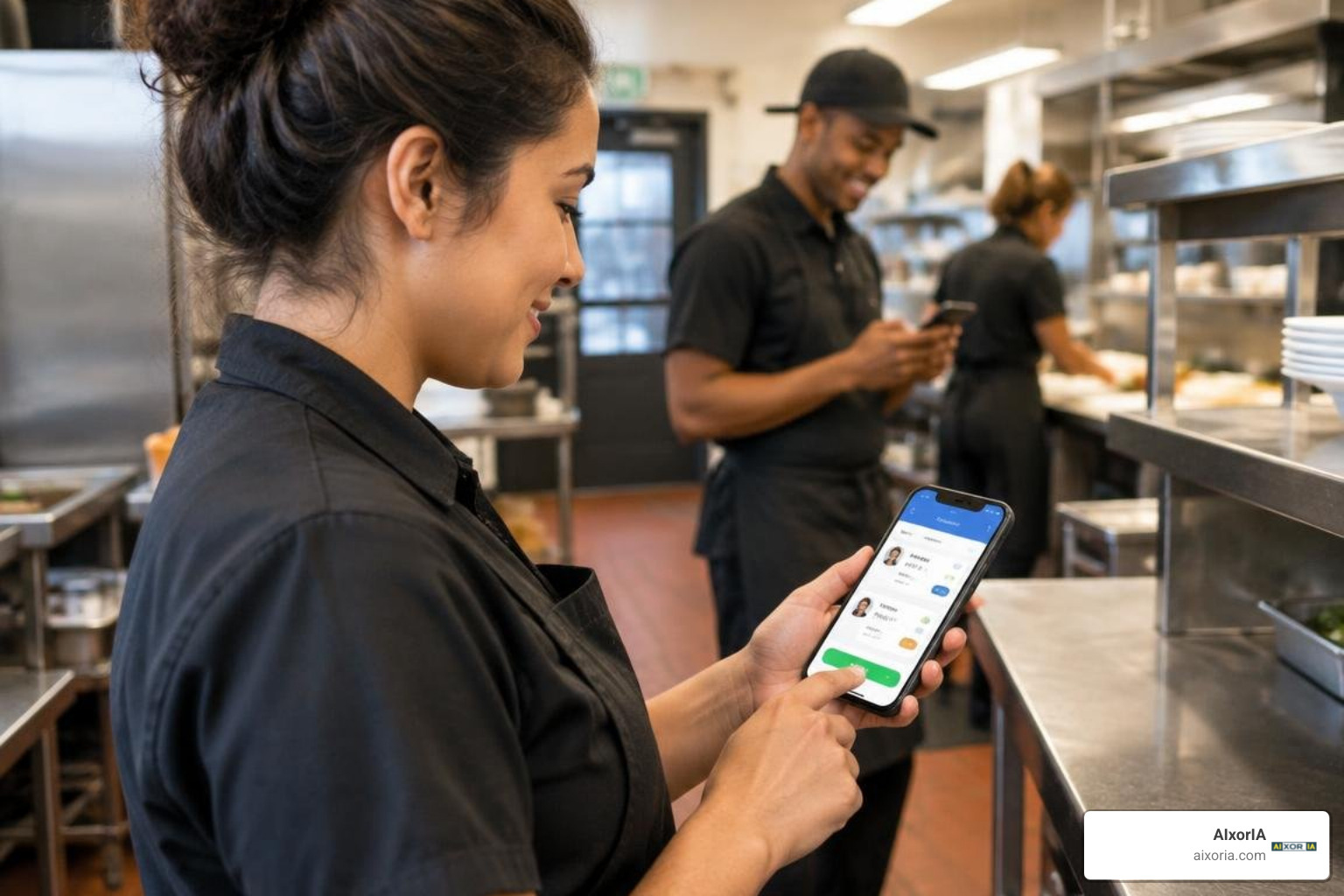
Modern scheduling platforms give frontline employees mobile self-service apps that feature decentralized shift marketplaces. When workers need time off, they can offer shifts directly to eligible coworkers who share the same role certification. The AI engine validates that the accepting worker will not trigger overtime or violate rest intervals before prompting the manager for a quick, one-tap approval. Establishments implementing preference-based scheduling report a 20% to 35% reduction in turnover rates, while staff report 42% higher satisfaction with their overall schedule flexibility.
Critical Capabilities and System Integrations
A scheduling engine cannot work effectively in isolation. To provide actionable intelligence, it must communicate seamlessly with existing operational hardware and software. Modern solutions leverage open APIs and cloud infrastructure to eliminate manual administrative work, functioning as effective workflow automation software across the entire organization.
Essential Capabilities in Modern AI Tools for Shift Scheduling for Restaurants
When evaluating prospective workforce tools, operators should verify the presence of 8 essential scheduling software features in 2026:
- Automated Demand-Led Shift Generation: Creating compliant schedule drafts aligned with hourly sales forecasts.
- Predictive Labor Law Compliance: Enforcing Fair Workweek regulations, mandatory meal breaks, minor curfew limits, and split-shift premiums.
- Dynamic Conflict Detection: Identifying overlapping availability, double-bookings, and approved time-off requests instantly.
- Autonomous Shift Marketplaces: Enabling peer-to-peer shift swaps and open shift claiming with automated rules checking.
- Role and Position Decoupling: Allowing cross-trained employees to work as line cooks during one shift and expos during another.
- Show-Up Reliability Metrics: Factoring historical attendance patterns into schedule allocations to ensure critical shifts remain reliably covered.
- Real-Time Budget Dashboards: Displaying labor cost percentages and scheduled hours against financial targets during schedule creation.
- Multi-Unit Visibility: Providing centralized controls for regional directors while giving store-level general managers local editing flexibility.
Connecting POS Terminals, Timecards, and Payroll Engines
Integrating scheduling directly with POS terminals creates a closed-loop operational workflow. When a team member clocks in, the POS checks the scheduled start time, preventing unapproved early clock-ins that drive up labor costs.
This integrated approach also benefits back-office administration. Shift hours, dynamic tip pooling calculations, and sales figures automatically flow into digital timecards. For growing hospitality concepts, choosing practical tools for small business owners simplifies timecard auditing, reduces payroll dispute risks, and tracks real-time Sales per Labor Hour (SPLH) across every shift.
Practical Roadmap for Deploying AI Scheduling Systems
Switching from spreadsheets or legacy software requires a clear rollout plan. Rushing deployment without clean baseline data or adequate team onboarding can lead to operational frustration.
Data Readiness, Phased Rollouts, and Staff Champion Networks
We recommend following a structured rollout framework:
- Step 1: Cleanse Historical Data: Gather 6 to 12 months of POS sales logs, customer traffic figures, and past wage records to give the AI engine a reliable baseline.
- Step 2: Define Core Constraints: Establish organizational rules for maximum overtime, minor work restrictions, mandatory rest intervals, and target labor cost percentages.
- Step 3: Run a Single-Unit Pilot: Deploy the platform in one high-volume location for 30 to 60 days to evaluate schedule accuracy and refine algorithm parameters.
- Step 4: Train Schedule Champions: Identify experienced shift leads and front-of-house staff to act as peer champions, helping coworkers navigate the mobile app.
- Step 5: Roll Out Across the Estate: Expand deployment across remaining locations, standardizing labor benchmarks across all operational units.
Tracking Labor Benchmarks and Sales per Labor Hour
To evaluate ongoing performance, operators should monitor specific operational metrics:
- Sales per Labor Hour (SPLH): Total gross sales divided by total labor hours worked during a specific shift or daypart.
- Labor Cost Percentage: Total payroll expenses expressed as a percentage of gross sales revenue.
- Forecasted vs. Actual Labor Variance: The percentage difference between scheduled labor hours and actual hours worked on the floor.
- Schedule Change Frequency: The number of manual edits required after a weekly roster is published.
- Shift Fill and No-Show Rates: The speed at which open shifts are claimed and the overall reduction in missed shifts.
Conducting regular weekly post-mortems comparing projected sales against actual labor hours allows management to fine-tune the system’s predictive accuracy over time.
Frequently Asked Questions About AI Restaurant Scheduling
How fast do restaurants realize tangible ROI after deploying AI scheduling?
Most restaurant operations achieve positive return on investment within 2 to 3 months. Immediate savings come from eliminating 5 to 10 hours of weekly managerial scheduling time, while direct labor cost reductions of 8% to 15% and lower turnover rates materialize across the first 90 to 180 days.
How do AI scheduling tools handle sudden employee call-outs?
When an employee reports an absence, the system immediately identifies qualified, available team members whose assignment would not trigger overtime violations. It broadcasts the open shift through mobile push notifications, allowing eligible staff to claim the shift with one-tap manager confirmation.
Can AI scheduling software enforce complex local labor laws automatically?
Yes. Modern systems include pre-configured compliance rules covering federal, state, and municipal labor laws. This includes Fair Workweek advance notice mandates, clopening rest intervals, minor working hour limits, and meal break compliance, alerting managers to potential violations before a schedule is published.
Conclusion
Managing restaurant shifts does not have to mean wrestling with spreadsheets, enduring last-minute call-out panics, and dealing with budget overruns. Modern AI scheduling systems give hospitality operators the tools needed to forecast guest demand accurately, protect operating margins, and build fair, flexible work environments that staff appreciate.
By connecting predictive scheduling algorithms directly with POS hardware, timecards, and payroll workflows, restaurant brands can eliminate administrative bottlenecks and focus on exceptional guest experiences. Discover how our team at AIxorIA helps growing businesses deploy smart automation frameworks, practical AI tools, and scalable operational strategies.