How Small Businesses Can Use AI to Review Contracts
Scr0ll d0wn to D0VVNL0AD
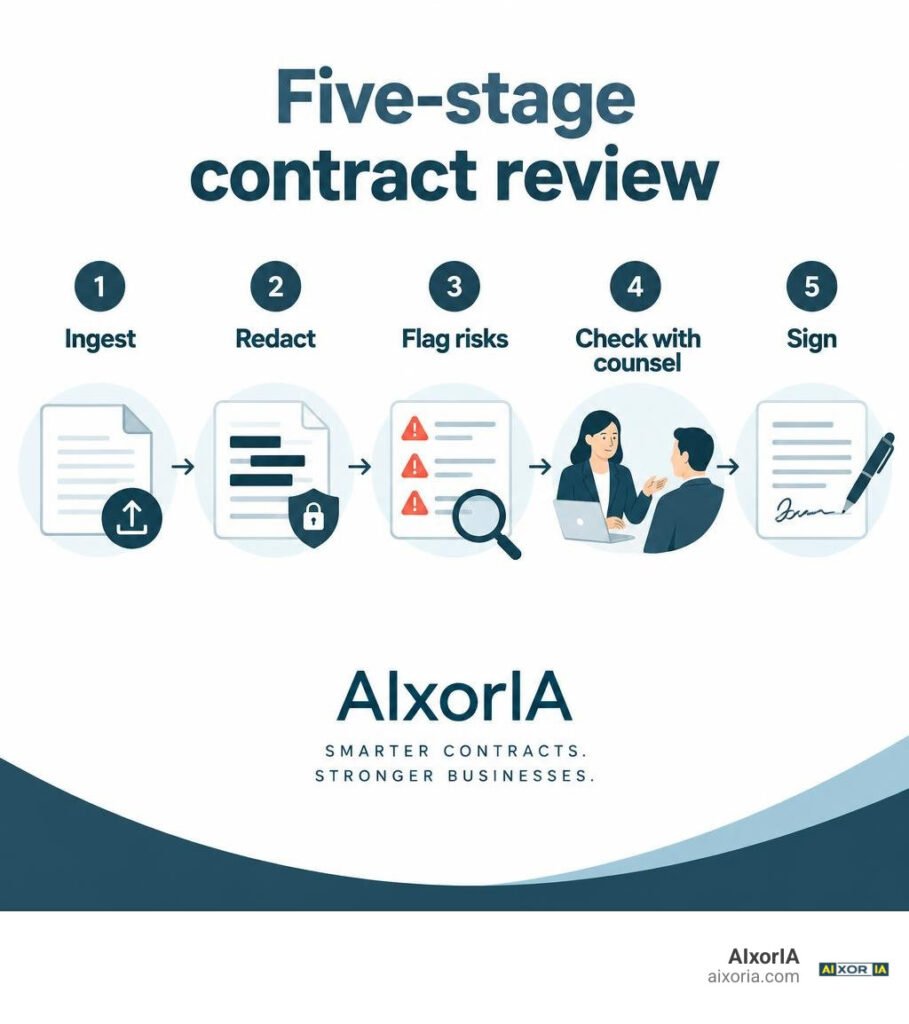
AI tools for contract review for small business owners work best as a first pass. Upload a clean copy of the agreement after removing sensitive details. Ask the tool to flag liability, payment, renewal, and termination terms, with a quote and section reference for each finding. Check those findings against the contract, then take major risks to a lawyer before signing.
This gives you a clearer list of questions to resolve without treating AI output as legal advice.
Why AI Tools for Contract Review for Small Business Owners Are Essential
Contract review is one of the most persistent operational bottlenecks in business. Routine agreements arrive constantly: vendor Master Services Agreements (MSAs), Statements of Work (SOWs), non-disclosure agreements (NDAs), and commercial leases. For most small business operators, reviewing these documents presents a painful dilemma.
If you send every 15-page vendor contract straight to outside legal counsel, billable hours add up rapidly. Outside business attorney billing rates typically run between $300 and $600 per hour. When an attorney spends 90 minutes performing basic document scanning, definitions cross-referencing, and mechanical text analysis, you end up paying hundreds of dollars just to learn what the document says.
Alternatively, if you sign agreements without reading the fine print to maintain deal velocity, you risk taking on one-sided indemnification clauses, uncapped liabilities, or strict multi-year auto-renewals.
Industry data shows why this workload is so intense:
- 43% of corporate counsels report that contract-related tasks represent at least half of their daily work—equating to roughly 120 working days per year spent managing contracts.
- 88% of legal teams have experienced measurable productivity and efficiency gains from adopting artificial intelligence, with 78% naming contract review as the area of highest operational impact.
- By 2027, an estimated 50% of procurement contract management will be AI-enabled.
Using AI for contract analysis acts like an “e-bike for document processing”—it does not replace the rider, but it flattens the steep hills. Using modern AI tools for business productivity enables small teams to conduct a structured initial triage in 20 minutes. You can walk into conversations with legal counsel knowing precisely which clauses deviate from standard commercial practices.
Core Capabilities of AI Tools for Contract Review for Small Business Owners
Dedicated contract review platforms combine natural language processing (NLP), retrieval-augmented generation (RAG), and clause-parsing algorithms specifically trained on commercial agreements. Rather than reading documents as undifferentiated text blocks, these systems perform structured legal analysis:
- Clause Extraction and Classification: The system segments agreements into distinct functional units (indemnity, governing law, termination, intellectual property, representations, warranties).
- Playbook Benchmarking: The tool compares extracted clauses against established organizational standards, statutory baselines, or predefined negotiation rules.
- Plain-English Translation: Complex legalese is translated into clear summaries that outline operational duties, milestone dates, and payment triggers.
- Automated Redlining: The software suggests specific counter-language and inserts tracked changes directly into document formats like Microsoft Word (.docx).
- Key Date and Obligation Extraction: The AI extracts notice windows, termination deadlines, price escalations, and payment terms into calendar views.
Deploying custom AI tools for documents in 2026 gives small teams enterprise-grade parsing capabilities without enterprise overhead.
Business Benefits and Legal Cost Reduction
The primary benefit of AI-assisted contract review is shifting legal spend from basic discovery to high-value strategic advice.
Case studies reveal significant efficiency improvements across commercial teams. Organizations routinely achieve a 50% to 80% reduction in initial review times. In one documented instance, a legal operations team completed an agreement analysis in four days that would have normally required three weeks. Another commercial team reduced document turnaround times from two hours to 15 minutes—a 93% reduction in review duration.
Using essential AI tools for entrepreneurs helps non-lawyers triage routine commercial agreements, reserve external legal budgets for complex matters, and eliminate operational bottlenecks that stall sales or procurement.
High-Risk Contract Traps AI Helps Identify
Founders and operators rarely run into contract disputes because they forgot to read the document. Problems occur because commercial risk is subtly shifted through boilerplate clauses that seem harmless at first glance. Dedicated AI contract risk detection surfaces these hidden exposures by comparing clauses against standard commercial terms.
Hidden Liability and Asymmetric Indemnification
Liability and indemnification sections contain some of the highest financial risks in business contracts:
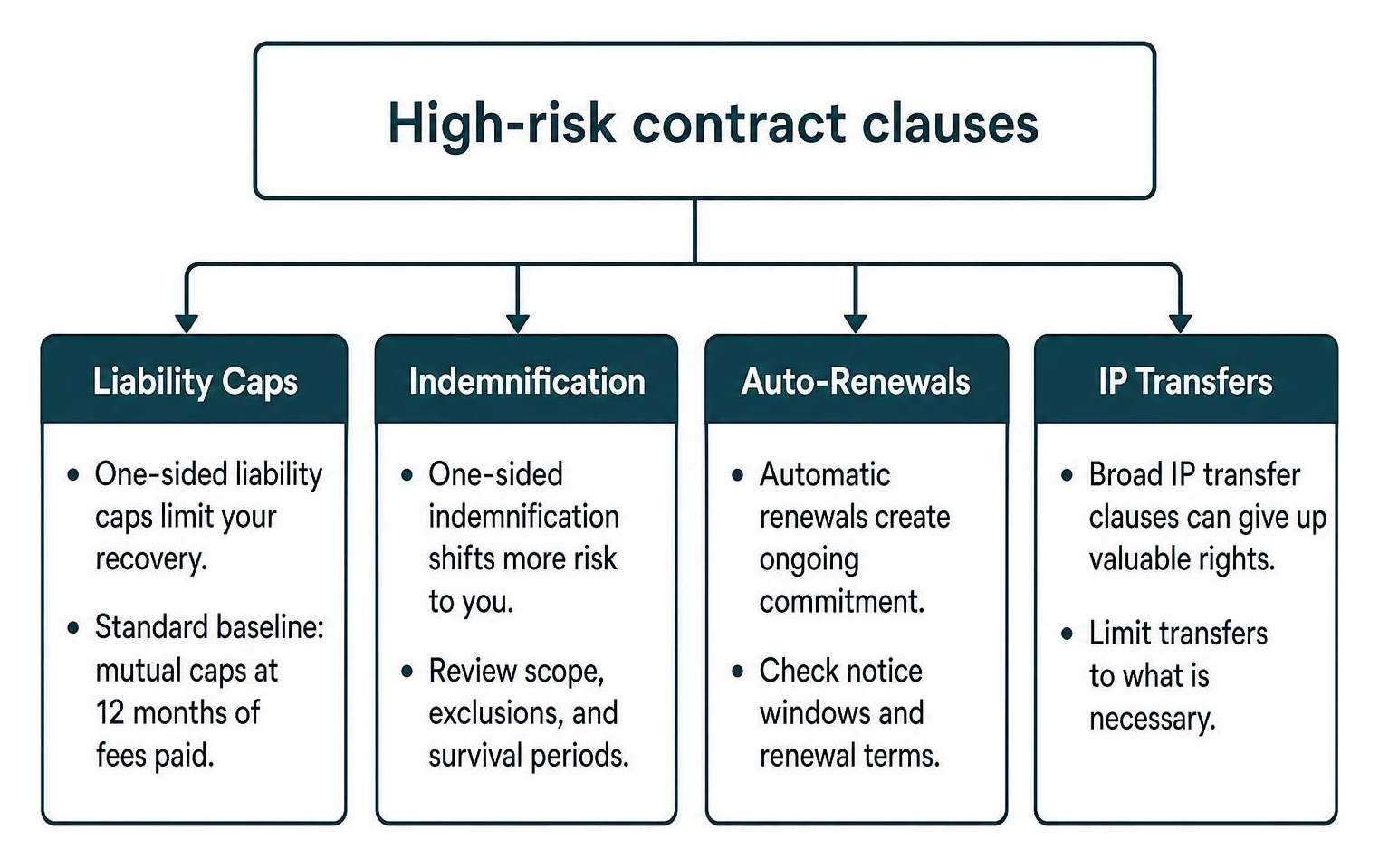
- One-Sided Liability Caps: A vendor may cap their own liability to the fees paid over the previous 30 days (or a nominal $500 fee), while leaving your liability completely uncapped. If their software causes a major operational disruption, your recovery is severely restricted; if your team breaches a minor term, your total assets remain exposed. A standard commercial baseline generally sets mutual liability caps at 12 months of fees paid.
- Asymmetric Indemnification: Indemnification requires one party to cover legal defense costs and financial damages resulting from third-party claims. Unbalanced contracts often force the customer to indemnify the vendor for broad operational issues, including the vendor’s own negligence, while offering no reciprocal protection for intellectual property infringement or data breaches.
- Consequential Damages Waivers: Broad exclusions of indirect, special, or consequential damages can prevent you from recovering lost profits or system downtime costs caused by direct vendor failure.
Auto-Renewal Traps and Termination Penalties
Operational friction often stems from restrictive duration and exit terms:
- Narrow Cancellation Windows: An agreement may contain an evergreen clause that automatically locks you into a new 12-month or 24-month term unless you submit written cancellation notice within a narrow, non-standard window (such as between 90 and 120 days prior to renewal). Missing that date by 24 hours can trigger unwanted multi-thousand-dollar commitments.
- Unilateral Price Escalations: Clauses that permit vendors to adjust recurring subscription or service fees upon renewal without requiring your express written consent or providing a penalty-free right to terminate.
- Asymmetric Termination for Convenience: Terms that allow the counterparty to terminate the contract on 15 days’ notice while requiring you to provide 90 days’ notice with mandatory early-termination buyout fees.
Step-by-Step Workflow to Review Contracts with AI
To establish a reliable review process, avoid pasting entire multi-page documents into a generic chat interface with broad instructions like “Review this contract.” Instead, apply a systematic, modular workflow.
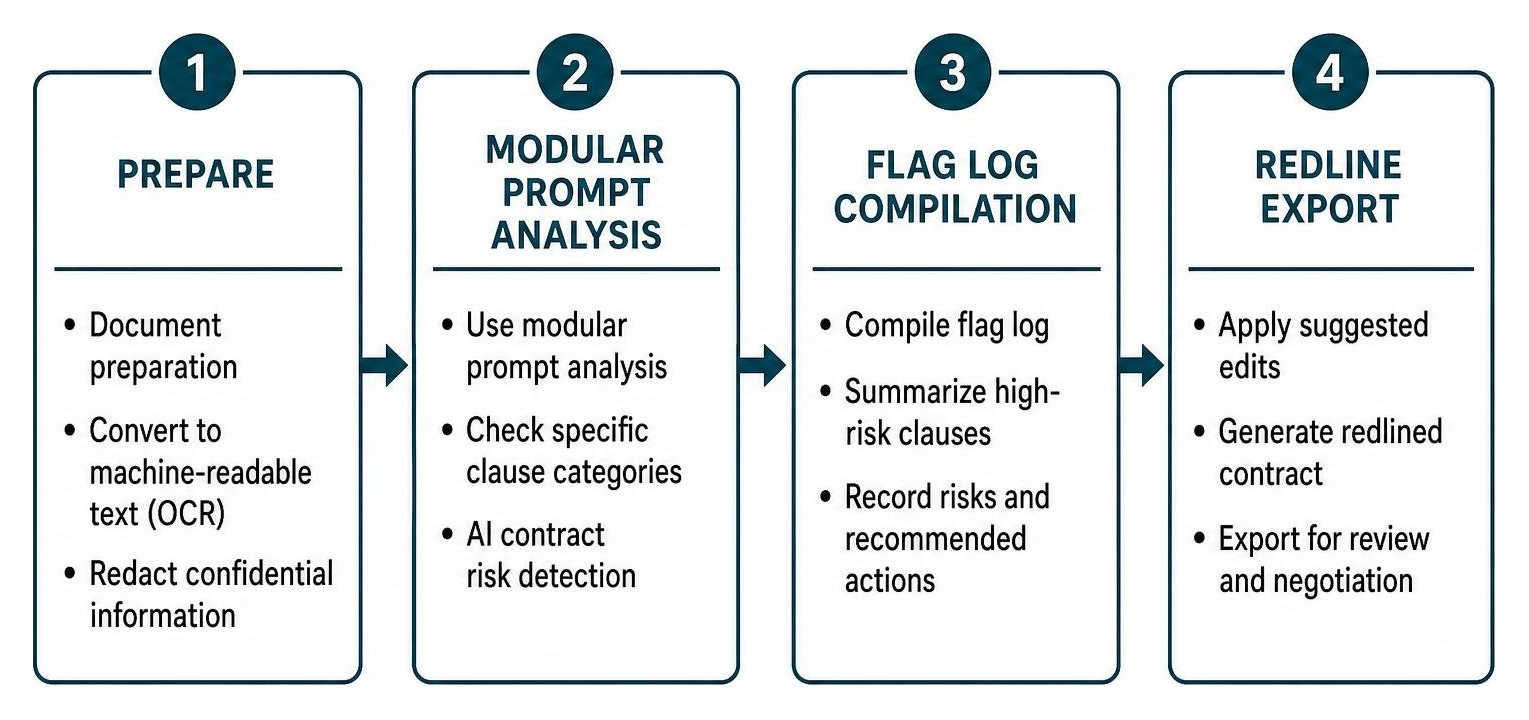
Step 1: Document Preparation and Pre-Processing Redaction
Before uploading any agreement to an AI system, clean the source file and remove confidential information:
- Convert to Machine-Readable Text: If working with a scanned PDF or hard-copy image, process the file through Optical Character Recognition (OCR) to ensure headers, nested tables, and signature blocks extract accurately.
- Redact Sensitive Identifiers: Mask sensitive personal and business information. This includes Social Security numbers, individual banking and routing details, home addresses, employee personal names, and confidential pricing details. Using structured document review frameworks with built-in pre-processing PII redaction ensures personal and corporate data is masked before text is sent to large language models.
- Establish Party Stance and Jurisdiction: Explicitly define your position (for example, Customer/Buyer or Provider/Vendor) and note the governing law stated in the document.
Step 2: Running Targeted Clause-by-Clause Review Prompts
Analyze agreements by running sequential, modular prompts that evaluate specific risk categories individually. This approach delivers more precise, actionable outputs than single, exhaustive prompts.
- Liability and Exposure Audit: “Review Section [X] (Limitation of Liability) from our perspective as the [Buyer/Customer]. Identify whether liability caps are mutual, what the dollar or fee multiplier cap is, and whether exclusions leave us exposed to uncapped risk. Provide direct quotes, section references, and explain any deviations from standard 12-month commercial fee caps.”
- Indemnification and Defense Review: “Analyze all indemnification clauses in the attached text. Is indemnification mutual or one-sided? Does either party indemnify the other for ordinary negligence or standard operational errors? Suggest revised language that makes indemnification mutual and limits obligations strictly to third-party claims arising from gross negligence, willful misconduct, or material breach.”
- Termination and Auto-Renewal Verification: “Identify all initial term lengths, automatic renewal mechanisms, required cancellation notice windows, and termination rights. Does the vendor have the right to unilaterally raise prices upon renewal? Can we terminate for convenience without financial penalties? Quote the relevant clauses directly.”
- Missing Protections Audit: “Examine this contract for standard commercial safeguards that are absent, such as service-level guarantees, audit rights, data ownership protections, confidentiality reciprocity, or dispute mediation requirements prior to litigation.”
Step 3: Compiling a Structured Flag Log
Organize the AI findings into an internal triage log to guide counter-negotiations or direct legal consultations:
| Section & Heading | Contract Text (Direct Quote) | Risk Level | Commercial Issue | Proposed Counter-Language |
|---|---|---|---|---|
| Sec. 8.2: Liability | “Provider’s maximum aggregate liability shall not exceed $500.” | HIGH | Asymmetric cap; limits recovery while our liability remains uncapped. | “Cap liability for both parties at total fees paid in the preceding 12 months.” |
| Sec. 11.4: Renewal | “Renews automatically for 24 months unless notice given 90 days prior.” | MEDIUM | Long lock-in period with a restrictive notice window. | “Amend renewal term to 12 months with a 30-day written cancellation notice.” |
| Sec. 14.1: Indemnity | “Customer indemnifies Provider against all third-party claims.” | HIGH | One-sided indemnity; exposes company to provider’s operational errors. | “Make indemnity mutual; restrict scope to breaches and willful misconduct.” |
Step 4: Generating Redlines and Negotiating Counter-Proposals
Once the flag log is finalized, generate redlined markup drafts. Dedicated contract review tools can export marked-up Word documents (.docx) with inline comments and tracked changes. If using modular AI models, instruct the tool to produce a formal, professional negotiation email outlining the requested adjustments along with plain-language commercial justifications.
How to Evaluate and Implement Legal AI Safely
Selecting the right software requires balancing ease of use, technical functionality, and data security standards.
| Feature / Criteria | Generic LLMs (e.g., Public Chatbots) | Dedicated AI Contract Review Tools |
|---|---|---|
| Document Memory & OCR | Manual pasting; poor table parsing | Native .docx/.pdf parsing with advanced OCR |
| Pre-Processing PII Redaction | Absent unless manually performed | Automated pre-LLM redaction of PII & banking details |
| Playbook Benchmarking | Requires complex custom prompt setups | Pre-configured, attorney-built review standards |
| Tracked Changes (.docx) | Raw text output only | Automated inline redlines and Word change tracking |
| Model Training Guarantees | Often trained on inputs by default | Zero data retention agreements; zero model training |
| Citation Attribution | Prone to ungrounded interpretations | Strict line-by-line quote verification |
When evaluating software options, small business owners can review our comprehensive guide to top AI tools for small business owners in 2026 to identify cost-effective solutions that match their technical requirements.
Choosing the Right AI Tools for Contract Review for Small Business Owners
To choose the best platform for your team, follow an established framework for how to evaluate AI tools across four operational categories:
- Document Workflow Compatibility: Does the tool work directly within Microsoft Word or your existing browser workflow, or does it require managing documents across disconnected interfaces?
- Review Depth Controls: Can you adjust the analysis threshold (e.g., flagging only existential deal-breakers versus running detailed clause-by-clause audits)?
- Onboarding Speed: Can your operational team begin reviewing contracts within 30 minutes without requiring complex IT configuration or lengthy setup calls?
- Export Options: Does the system export clean redlines with tracked changes, negotiation memos, and extracted date schedules?
Privacy, Data Governance, and Model Training Policies
Data privacy is the single most critical consideration when using AI for contract analysis. Uploading an agreement containing proprietary source code, non-public financial terms, or employee personal data to an unsecured consumer chatbot can lead to confidentiality breaches.
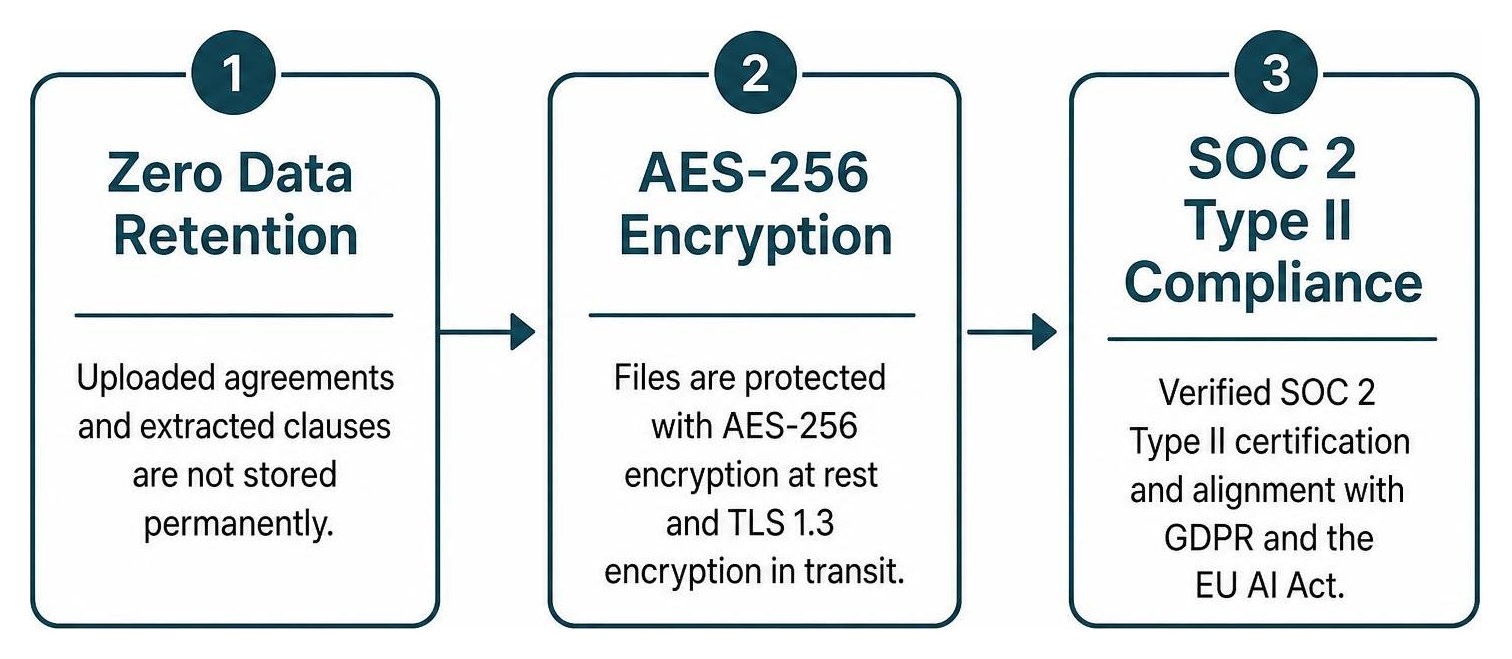
Before deploying any platform, verify the following security standards:
- Zero Data Retention (ZDR): Confirm in writing that your uploaded agreements and extracted clauses are not stored permanently by the LLM provider, used to train foundational AI models, or shared across third parties.
- Encryption Standards: Ensure files are protected with AES-256 encryption at rest and TLS 1.3 encryption in transit.
- Compliance Standards: Look for verified SOC 2 Type II certifications, GDPR compliance, and alignment with the EU AI Act.
- Client Confidentiality: For teams collaborating with outside attorneys, review the legal profession’s regulatory guidance, such as the American Bar Association’s Formal Opinion 512 regarding generative AI, client confidentiality, and data handling protocols.
Knowing When to Escalate to Licensed Legal Counsel
AI contract review is a powerful triage tool, but it is not a replacement for professional legal counsel. AI identifies deviations from standard text patterns; it does not evaluate broader business context or historical negotiation dynamics.
Frequently Asked Questions about AI Contract Analysis
Can AI contract review fully replace a licensed attorney?
No. AI contract tools provide automated document analysis, risk scoring, and legal information in plain English, but they do not provide formal legal advice or create an attorney-client relationship. AI cannot make high-level business judgment calls, understand past counterparty negotiations, or evaluate state-specific enforceability nuances. Use AI to streamline the initial review process so your attorney can focus on strategic, high-stakes advice.
What file formats and agreement types do AI contract tools support?
Most dedicated platforms accept Microsoft Word (.docx), native digital PDFs, scanned PDFs (processed via OCR), and raw text files up to 50 MB. Modern review engines can analyze a broad range of commercial documents, including:
- Master Services Agreements (MSAs) and Statements of Work (SOWs)
- Non-Disclosure Agreements (NDAs)
- Commercial and equipment lease agreements
- Software-as-a-Service (SaaS) and software licensing terms
- Independent contractor and employment agreements
- Vendor and supplier procurement contracts
- Partnership and distribution agreements
How much do AI contract review tools typically cost?
Pricing generally scales based on document volume, feature depth, and organizational size:
- Free or Pay-Per-Use Tiers: Some tools provide introductory free single reviews or micro-token packs (such as $5 to $15 for individual document reviews) without requiring recurring subscriptions.
- Small Business Subscriptions: Self-serve SMB plans typically range from $16 to $149 per month (billed annually), offering monthly contract allowances between 10 and 50 agreements along with automated redlining and obligation tracking.
- Mid-Market and Enterprise Tiers: Advanced software with custom organizational playbooks, multi-seat collaboration, and deep CLM integrations generally ranges from $200 to $400+ per month.
Conclusion
Contract management no longer needs to be a choice between expensive legal retainers and signing risky, unread agreements. Modern AI contract review tools provide small business owners with a practical, cost-effective way to surface hidden liabilities, eliminate auto-renewal traps, and negotiate from an informed position.
By establishing an internal triage workflow—pre-processing documents to protect privacy, running targeted modular prompts, and compiling clear flag logs—small businesses can resolve routine contract issues in minutes while reserving outside counsel for high-stakes decisions.
To continue building efficient, scalable operations across your business, explore AIxorIA’s enterprise automation guides and tools for practical frameworks and tools designed to accelerate growth.