AI Tools for Churn Prediction in Subscription Businesses
Scr0ll d0wn to D0VVNL0AD
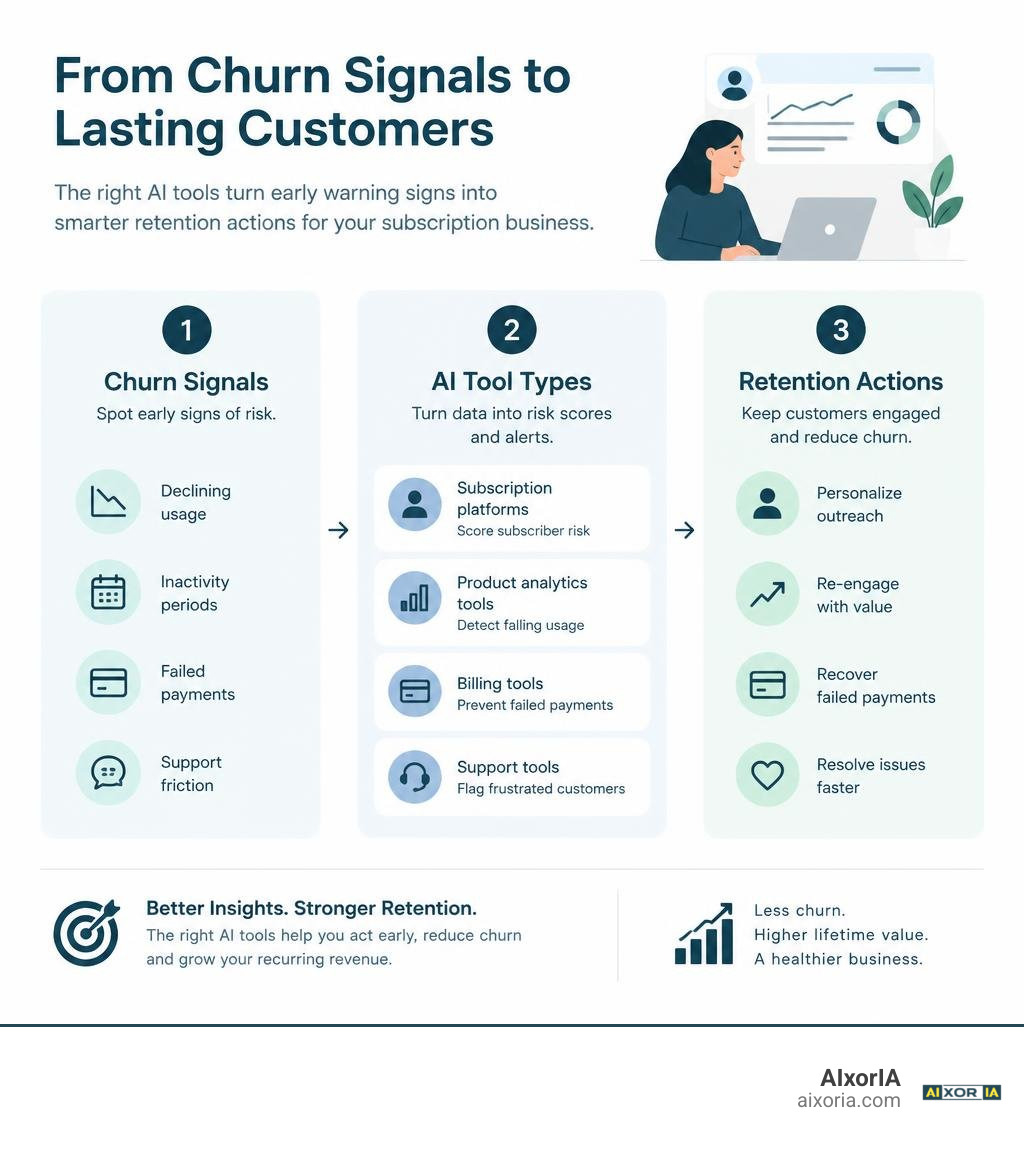
The best AI tools for churn prediction for subscription businesses depend on why customers leave. Subscription-focused platforms score each subscriber’s risk. Customer success and product analytics tools spot falling usage. Billing tools help prevent failed payments from becoming cancellations. Support tools flag frustrated customers before they leave.
Start with the problem you can act on. If customers stop using your service, look for clear risk scores and alerts your team can use. If payments fail, prioritize recovery features. This guide compares those options so you can choose a tool that fits your business, data, and budget.
What Churn Prediction Means for Subscription Businesses
Customer churn happens whenever a subscriber cancels their plan or stops paying for your service. In any recurring revenue model, keeping existing customers is the engine that drives sustainable customer lifetime value. In fact, research shows that a modest 5% improvement in customer retention can increase overall profits by 25% to 95%.
Yet keeping subscribers has become increasingly difficult. Average monthly churn has risen to 20% across the subscription economy, according to Mastercard’s 2026 research. With the global subscription market projected to reach $1.2 trillion by 2030, managing attrition is no longer just a support task—it is a core financial strategy.
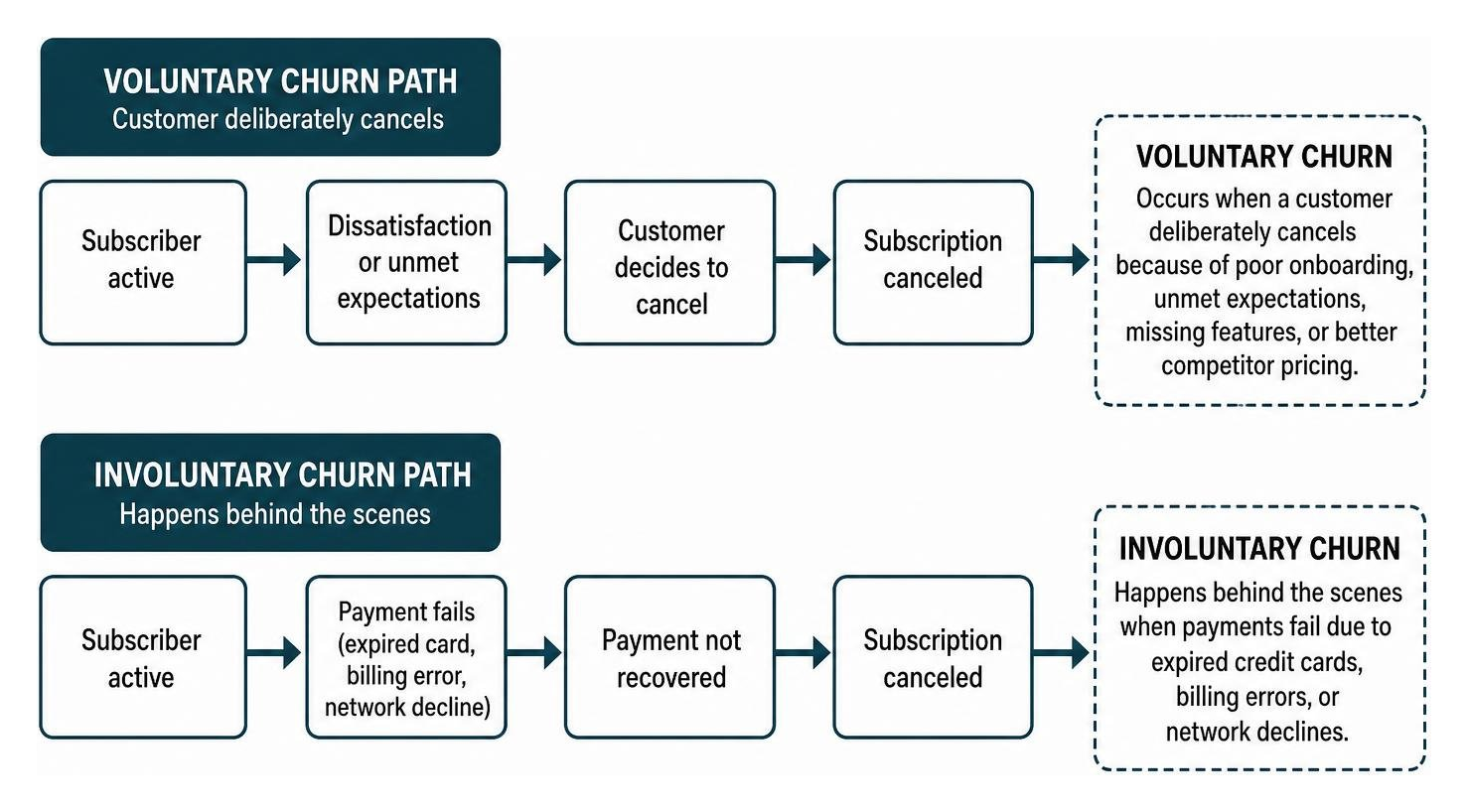
To fix churn, we first have to separate it into its two main forms:
- Voluntary Churn: Occurs when a customer deliberately cancels because of poor onboarding, unmet expectations, missing features, or better competitor pricing.
- Involuntary Churn: Happens behind the scenes when payments fail due to expired credit cards, billing errors, or network declines.
How to Calculate Customer and Revenue Churn
Tracking churn requires looking at both lost accounts (logo churn) and lost dollars (revenue churn).
To calculate the basic Customer Churn Rate for a set time period (such as a month or a quarter):
Customer Churn Rate = (Total Lost Customers during the period / Total Customers at the start of the period) × 100
For example, if you start the month with 1,000 subscribers and lose 40, your monthly customer churn rate is (40 / 1,000) × 100 = 4%.
To calculate Revenue Churn Rate:
Revenue Churn Rate = (Monthly Recurring Revenue Lost from Churn / Total Monthly Recurring Revenue at the start of the period) × 100
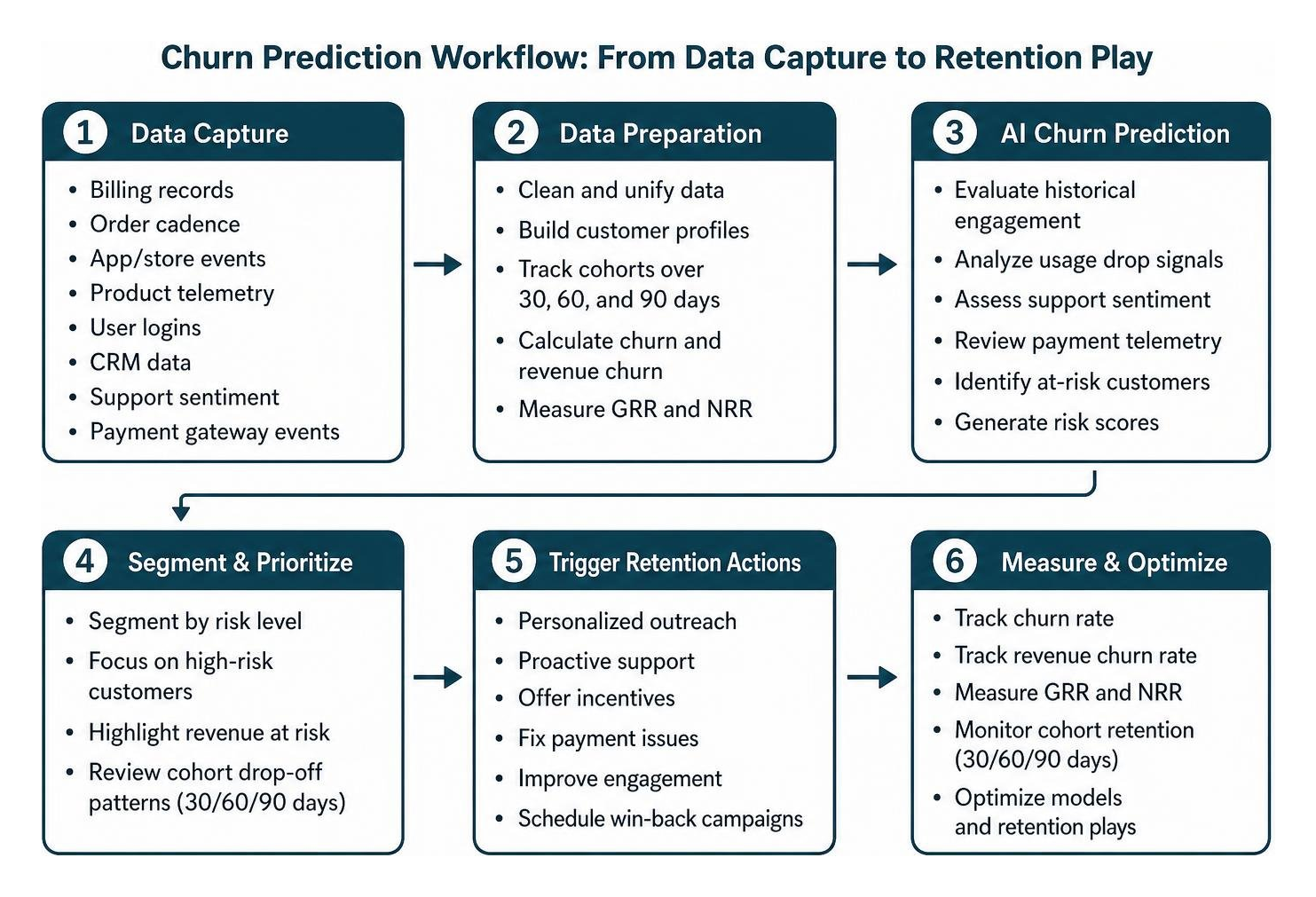
Advanced subscription teams also evaluate:
- Gross Revenue Retention (GRR): The percentage of recurring revenue retained from existing customers, excluding upgrades.
- Net Revenue Retention (NRR): The total retained revenue including expansion, cross-sells, and upgrades. An NRR over 100% indicates strong expansion, while 120%+ represents top-tier enterprise performance.
- Cohort Analysis: Tracking specific groups of signups over 30, 60, and 90 days to identify exactly when customer drop-offs peak.
What Counts as a Good Subscription Churn Rate?
Benchmark expectations vary widely based on your target audience, company maturity, and pricing tier:
- B2B SaaS: Average monthly churn ranges between 3% and 8% (translating to roughly 32% to 50% annually). Mature enterprise SaaS companies often target sub-1% monthly churn.
- Direct-to-Consumer (DTC) and E-commerce Subscriptions: Face higher turnover, where a 4% to 7% monthly churn rate is standard.
- Paid Video Streaming Services: Have sustained a consistent annual churn rate near 37%.
- Telecommunications: Frequently manages roughly 20% annual attrition.
Small numbers can deceive you: just a 1% monthly churn rate compounds to nearly 12% lost revenue across a single year. Relying on generic benchmarks alone can obscure underlying retention problems if you do not track cohort health over time.
AI Tools for Churn Prediction for Subscription Businesses: 2026 Comparison
Modern predictive platforms evaluate historical engagement, support sentiment, and payment telemetry to forecast customer defections before they occur.
| Tool Category | Core Capability | Best Fit | Data Requirements | Typical Buyer |
|---|---|---|---|---|
| Subscription-Native Platforms | Dynamic subscriber risk scoring, automated cancel flows, and win-back timing | DTC brands, digital media, subscription boxes, and app businesses | Billing records, order cadence, and app/store events | Retention Marketers and Growth Leads |
| Customer Success & Analytics | Account health scores, feature adoption depth, and product usage drop alerts | B2B SaaS and product-led businesses | Product telemetry, user logins, CRM data, and seat counts | Customer Success Managers and Product Leads |
| Billing & Recovery Engines | Machine-learning dunning, smart payment retries, and account updater logic | Any recurring billing business facing payment failures | Payment gateway events, card data, and invoice logs | Finance and Operations Teams |
| Support Sentiment Platforms | Natural Language Processing (NLP) conversation intelligence and ticket escalation | High-touch support or high-volume customer service desks | Support tickets, chat logs, call transcripts, and CSAT scores | Support Leads and CX Directors |
AI Tools for Churn Prediction in Subscription Businesses: Subscription-Native Platforms
Subscription-native platforms focus on per-subscriber risk scoring and automated lifecycle interventions. Tools like Chargezen evaluate dozens of behavioral signals to give teams up to a 30-day advance warning before a user hits cancel. Similarly, platforms like Subsets combine machine learning with explainable AI to create predictive cohorts for retention experiments.
For high-volume brands, solutions such as Churned and ZeroToOne.AI process millions of interactions—even incorporating real-world behavioral routines outside mobile apps—to trigger automated next-best actions in tools like Klaviyo, Braze, or Salesforce. If you need simple tabular modeling, dedicated platforms like Churnora can inspect CSV uploads, rank at-risk revenue, and draft customized save outreach. For merchants seeking an integrated commerce foundation, Subbly embeds predictive churn analytics and automated discount triggers directly inside its billing setup. Coupling these specialized systems with flexible AI tools for data analysis and visualization gives growth teams clear visibility into subscriber health trends.
AI Tools for Churn Prediction in Subscription Businesses: Customer Success and Product Analytics
B2B SaaS companies rely on customer success platforms (like ChurnZero, Gainsight, and Vitally) and product analytics tools (such as Amplitude and Pendo) to gauge account health. Rather than just tracking transaction dates, these tools monitor daily active usage, seat utilization rates, and feature adoption drop-offs. When an enterprise account’s login frequency slows or its primary admin stops creating projects, the software alerts account managers to intervene. Integrating customer feedback with modern AI tools for business coaching feedback helps support reps refine their conversational approach when speaking with disgruntled enterprise clients.
Billing Recovery and Support-Sentiment Capabilities
Involuntary churn makes up 20% to 40% of total cancellations for subscription businesses. Smart billing platforms (like Stripe, Recurly, and Paddle) use machine-learning algorithms to schedule smart payment retries at moments when transactions are most likely to succeed, saving billions in recurring revenue.
Meanwhile, support quality directly dictates customer loyalty: 73% of consumers switch brands after multiple poor customer service experiences. Conversation intelligence and support AI platforms analyze ticket sentiment in real time to flag frustrated accounts before they walk away. Using AI tools for improving customer service ensures high-risk tickets get routed instantly to experienced retention specialists.
How AI Predicts Churn and What to Look for in the Software
Machine learning models predict churn by uncovering hidden patterns across historical data. Rather than relying on simple static rules (like “flag users inactive for 14 days”), AI algorithms use supervised binary classification, decision trees, random forests, and gradient-boosted models to compare users who left against those who stayed.
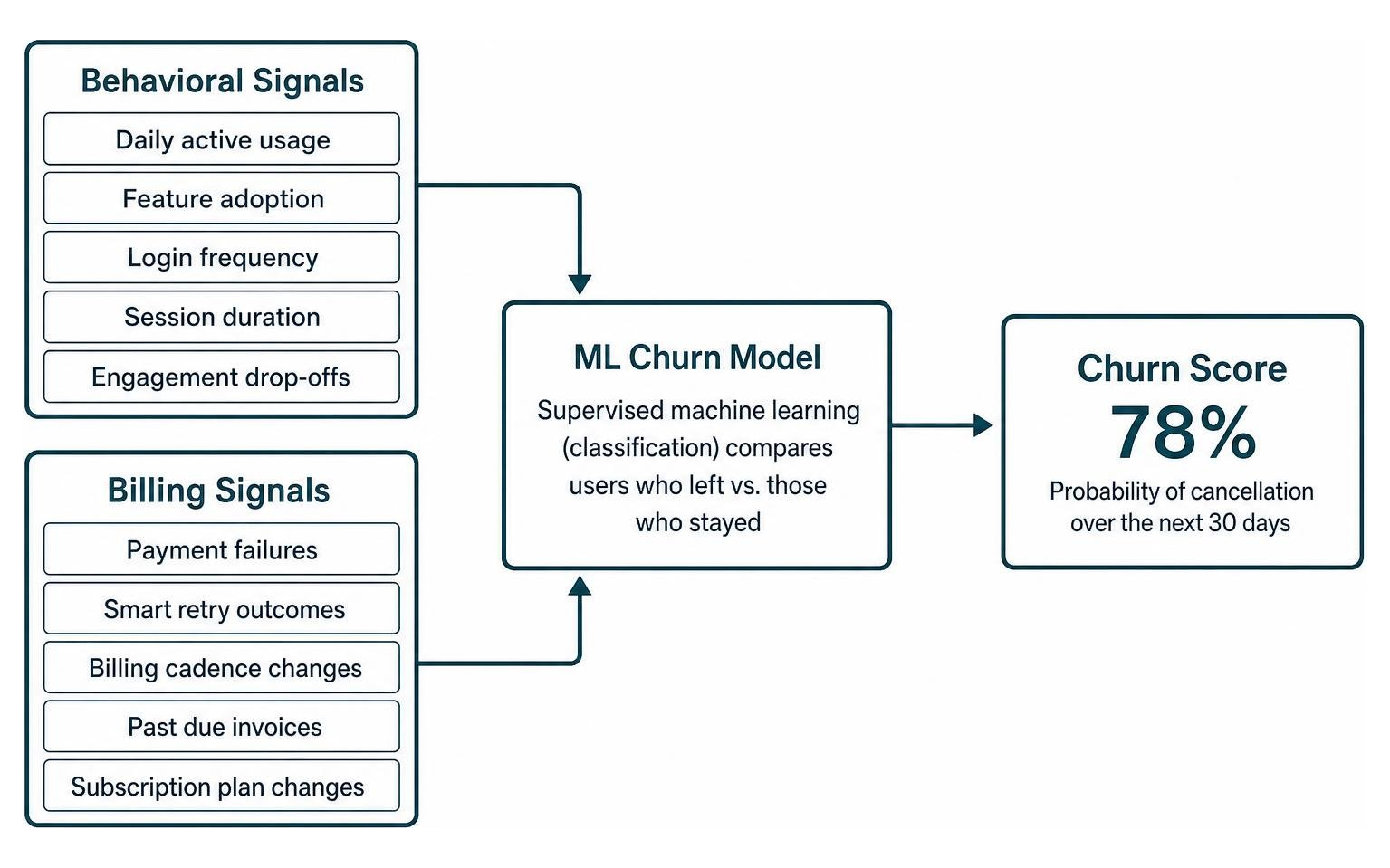
These models calculate a dynamic risk probability score (e.g., a 78% probability of cancellation over the next 30 days). Teams exploring custom predictive modeling often evaluate dedicated AI tools for ML projects to tune feature pipelines and minimize false alarms.
Data and Signals That Reveal Churn Risk
Effective prediction engines ingest signals across several operational layers:
- Product Engagement: Decreases in login frequency, drop in session duration, and abandoned core workflows.
- Onboarding Trajectory: Low onboarding completion rates or delayed time-to-value (TTV).
- Commercial Patterns: Plan downgrades, removing user seats, or viewing cancellation FAQ pages.
- Support & Sentiment: Repeated open tickets, low CSAT ratings, or negative sentiment expressed in chat logs.
- Billing Telemetry: Soft credit card declines, expired payment details, or updated invoice addresses.
Essential Features for Choosing a Churn Prediction Tool
When evaluating churn prediction software, prioritize these core features:
- Explainable Risk Factors: The tool must explain why an account is at risk (e.g., “Seat usage dropped 45% after ticket #1024”) rather than presenting an opaque number.
- Configurable Action Triggers: Automated webhooks or direct integrations that send proactive discounts, emails, or CRM tasks when risk passes a set threshold (such as 65%).
- Real-Time Data Sync: Daily or continuous score recalculation to catch sudden engagement drops.
- Security & Privacy Compliance: Adherence to SOC 2 Type 2, ISO 27001, and GDPR standards, ensuring customer billing data remains strictly protected.
- Manageable Total Cost of Ownership: Transparent pricing that does not heavily penalize your growth as your subscriber count scales.
How to Choose AI Tools for Churn Prediction in Subscription Businesses
Match the software to your operational capabilities:
- Assess Data Readiness: Predictive models require clean historical data. If your usage records are fragmented, start with tools offering built-in data connectors.
- Validate Precision and Recall: An accurate ranking model (identifying who is at highest risk relative to others) is often more useful than a generic binary score.
- Pilot Before Full Deployment: Test the model across a sample cohort to verify whether intervention playbooks actually save accounts before rolling it out across your entire customer base.
How to Implement Churn Prediction and Turn Scores into Retention
Predictive scores are useless if your team does not act on them. Establishing an automated retention workflow ensures that risk signals trigger real saves.
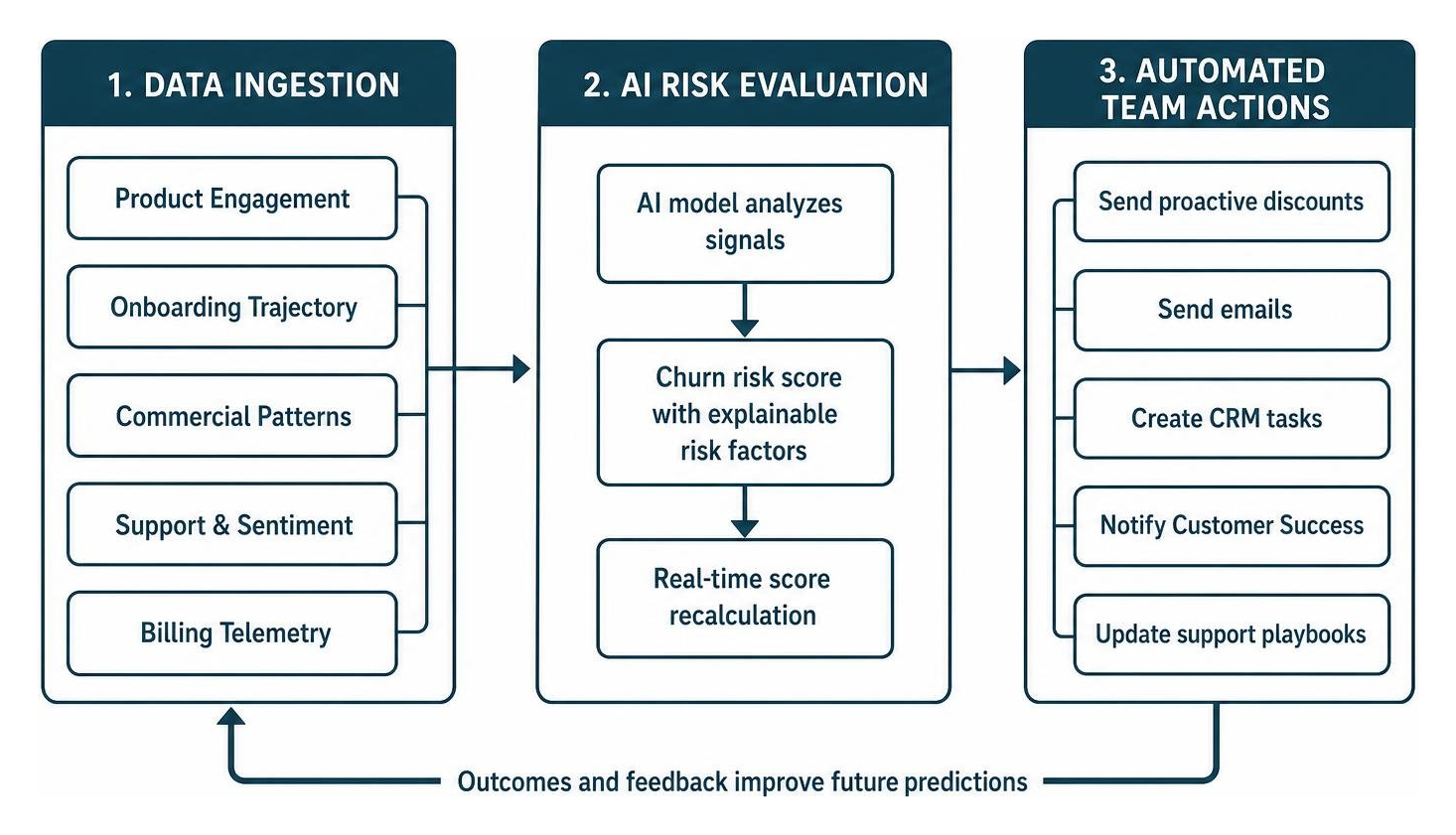
Connecting customer databases using reliable AI tools for data integration helps ensure your prediction models ingest clean, unified data from day one.
Connect Prediction Analytics to Customer Success and Support
Bridge predictive tools with your existing front-line workflows:
- High-Value Account Alerts: Automatically assign a high-priority retention task in your CRM whenever an enterprise account’s risk score exceeds a critical threshold.
- Intelligent Support Escalation: Route support tickets with negative sentiment directly to senior specialists.
- Automated Marketing Playbooks: Sync dynamic risk segments with your email marketing tools to deliver targeted re-engagement campaigns. Modern AI tools for sales and marketing can help automate these outreach cadences without overwhelming your staff.
Match Retention Actions to the Type and Cause of Risk
Tailor your intervention to the root cause of the churn signal:
- For Stalled Onboarding: Trigger an in-app guide, offer a live 1-on-1 walkthrough, or send targeted tutorial videos.
- For Price Sensitivity: Present flexible options during cancellation flows, such as a one-click subscription pause, a plan downgrade, or a temporary discount.
- For Involuntary Payment Drops: Implement automatic account updaters and multi-channel dunning cadences (SMS and email) alongside smart retry logic.
- For Win-Backs: Use machine-learning models to determine the optimal cooldown period before sending re-activation offers to churned subscribers.
Common Implementation Challenges and How to Address Them
Rolling out predictive churn models can run into several common roadblocks:
- Data Fragmentation: Transaction records and product usage logs often live in separate silos. Standardize user IDs across your billing engine, CRM, and analytics software before training models.
- Class Imbalance: In healthy businesses, churned accounts represent a small fraction of total data. Use balanced sampling methods during model training to avoid skewed predictions.
- Model Drift: Customer behavior changes with seasonal trends and product updates. Schedule automated monthly or quarterly model retraining.
- False Positives: A sudden drop in usage might simply mean a user is on vacation. Always preserve human review for high-value enterprise accounts rather than firing off aggressive automated discounts.
Frequently Asked Questions About AI Churn Prediction
Can AI predict customer churn accurately, and how early can it identify risk?
Yes. Depending on your data quality, machine learning models frequently achieve predictive accuracy between 75% and 90%. Most platforms provide reliable advance warnings between 7 and 30 days before a subscriber officially cancels, giving your team sufficient time to launch retention campaigns.
What is the difference between voluntary and involuntary churn?
Voluntary churn happens when a customer deliberately ends their subscription due to dissatisfaction, lack of use, or cost. Involuntary churn occurs when billing attempts fail due to expired cards, bank processing issues, or network errors. Voluntary churn requires engagement and product-led interventions, while involuntary churn requires smart payment retries and dunning tools.
How can sentiment analysis help prevent subscription churn?
Sentiment analysis applies Natural Language Processing (NLP) across customer communications, including support tickets, survey responses, and chat transcripts. By detecting frustration or negative tone early, AI tools can instantly flag accounts at risk and escalate them to support leads weeks before those users formally churn.
Conclusion
Retaining your current subscribers is the single most reliable way to protect margins and build a resilient recurring revenue business. Rather than guessing which accounts are dissatisfied, modern AI platforms analyze real-time usage, sentiment, and payment signals to stop cancellations before they happen.
To start, evaluate your biggest source of lost revenue, pick tools that fit your existing tech stack, and continuously test your retention offers. For more practical software reviews and strategic guidance on applying artificial intelligence across your operations, explore AI tools and business guides on AIxorIA.