What Defines the Best Agency Management System for Small Agencies?
Scr0ll d0wn to D0VVNL0AD

When we talk about the best agency management system for small agencies, we aren’t referring to standard task managers or simple spreadsheet replacements. An Agency Management System (AMS) acts as the central nervous system of an agency’s operations. It unites client records, policy or project workflows, communication history, financial tracking, and team performance into a single source of truth.
For small teams, finding the right software comes down to finding a system that simplifies operational complexity rather than adding to it. Enterprise agencies might have dedicated IT teams and operations directors to manage bloated software setups, but small agencies need speed, clarity, and ease of use.
Key Features of the Best Agency Management System for Small Agencies
To operate efficiently without drowning in administrative work, small agencies should look for core operational capabilities when selecting software:
- Centralized Client & Policy Management: Every client interaction, policy record, expiration date, and contact record must live in one accessible location.
- Workflow Automation & Task Management: Automated triggers for onboarding, renewal outreach, and routine follow-ups save hours of repetitive effort.
- Time Tracking & Billable Hours: Precise background or manual time tracking keeps project budgets honest and ensures billable hours are captured accurately.
- Invoicing & Billing Automation: Built-in payment processing, direct accounting platform syncing, and automated commission reconciliation keep cash flow predictable.
- Dedicated Client Portals: Allowing clients to view deliverables, access policy documents, pay invoices, and approve files directly reduces endless email chains.
- Financial Reporting & Profitability Tracking: Real-time visibility into project margins, client profitability, and team utilization helps leadership make data-driven decisions.
Modern systems like Agency Management Software – CRM, Projects, Time Tracking & Billing | Nymble and specialized platforms like #1 Agency Management Software to Run Successful Agencies highlight how combining CRM functions with operational task tracking creates a friction-free workflow for growing service teams.
Agency Management Systems vs. Generic CRMs
One of the most common dilemmas small agency owners face is deciding whether to buy a specialized AMS or simply customize a generic Customer Relationship Management (CRM) platform like HubSpot or Salesforce.
While generic CRMs excel at early sales pipelines and broad lead nurturing, they fall short once a lead becomes an active client with ongoing service needs.

Generic software requires expensive custom development to handle specific agency needs—such as carrier downloads, policy endorsements, commission tracking, or earned value metrics. On the other hand, an AMS comes out of the box equipped with native field structures for policy numbers, renewal dates, carrier payouts, and project lifecycles.
Using an all-in-one agency platform eliminates the hidden costs of stitching together separate CRM, time tracking, and invoicing subscriptions, drastically lowering your total cost of ownership.
Pricing, Onboarding, and Cloud vs. On-Premise Deployment

Software pricing structures can be confusing, especially when hidden implementation fees or per-client charges enter the equation. Understanding standard pricing models helps small agencies avoid unexpected budget overruns.
Subscription Costs and Implementation Timelines
For most cloud-based agency management systems, software costs range from $85 to $200 per user per month. However, total software costs depend heavily on setup requirements, add-on features, and data migration needs.
Here is what small agencies typically encounter:
- Entry-Level & Niche Platforms: Tools like Jenesis ($70–$100/user/month) or AgencyBloc ($85/user/month) provide cost-effective entry points for small teams focused on essential policy and client management.
- All-In-One Mid-Tier Solutions: Platforms like QQCatalyst ($99/user/month) and AGENCYMATE ($99/user/month with no setup fees) balance full operational capabilities with fast setup times.
- Feature-Dense Systems: Enterprise-tier software or feature-heavy tools like EZLynx ($150/user/month) or HawkSoft ($130/user/month) offer advanced capabilities such as built-in comparative raters.
When it comes to implementation timelines, the gap between legacy enterprise systems and modern agency platforms is massive. Legacy enterprise software often demands 3 to 6 months of onboarding and setup costs reaching $10,000 to $25,000. Modern cloud platforms designed for small agencies, however, can achieve full staff adoption within days or weeks.
Flexible platforms like AgencyKit and Pike | Operating system for agencies and consultancies focus on rapid deployment, allowing teams to soft-book project resources and launch client workspaces almost immediately.
Cloud-Based Platforms vs. On-Premise Software
While legacy agencies once relied on local desktop software and on-premise servers, cloud-based deployment has become the gold standard for modern operations.
| Operational Criteria | Cloud-Based AMS | On-Premise AMS |
|---|---|---|
| Accessibility | 24/7 access from any location or mobile device | Restricted to local office networks or complex VPNs |
| IT Overhead | Handled completely by the vendor; continuous cloud updates | Requires dedicated IT staff for server maintenance and backups |
| Upfront Costs | Low predictable monthly/annual subscription fees | High initial hardware purchase and server setup costs |
| Data Security & Backups | Automated remote backups with SOC 2 / HIPAA standards | Dependent on local manual backup processes and hardware health |
| Onboarding Speed | Immediate account setup measured in days | Hardware installation and network configuration measured in months |
For modern agencies managing remote or hybrid teams, cloud solutions provide crucial flexibility, robust data encryption, and role-based permissions without requiring dedicated IT management.
How to Evaluate AMS Integrations and Avoid Common Selection Pitfalls

Choosing software isn’t just about reviewing feature lists; it’s about ensuring the new system integrates smoothly into your daily operational workflows.
Steps to Evaluate the Best Agency Management System for Small Agencies
We recommend following a structured four-step evaluation process before making a software commitment:
- Audit Existing Workflows and Pain Points: Identify the biggest operational bottlenecks in your current setup. Are you losing time rekeying client data? Are policy renewals slipping through the cracks?
- Verify Native Integrations & API Capabilities: Confirm that the AMS connects seamlessly with your essential tools—whether that means accounting platforms like QuickBooks, communication hubs like Slack, or specialized platforms like Kyo: The complete companyOS for agencies and Agency Management Software for Advertising & Marketing Agencies | Workamajig.
- Confirm Carrier Download & Data Sync Capabilities: For insurance agencies, verify how frequently carrier downloads sync policy, endorsement, and commission data into your system.
- Run a Hands-On Trial Project: Put a live or simulated project through a trial period to test real-world usability, client portal navigation, and reporting accuracy.
Common Pitfalls Small Agencies Make When Choosing an AMS
Small agencies frequently make expensive software mistakes by focusing on the wrong priorities during selection.
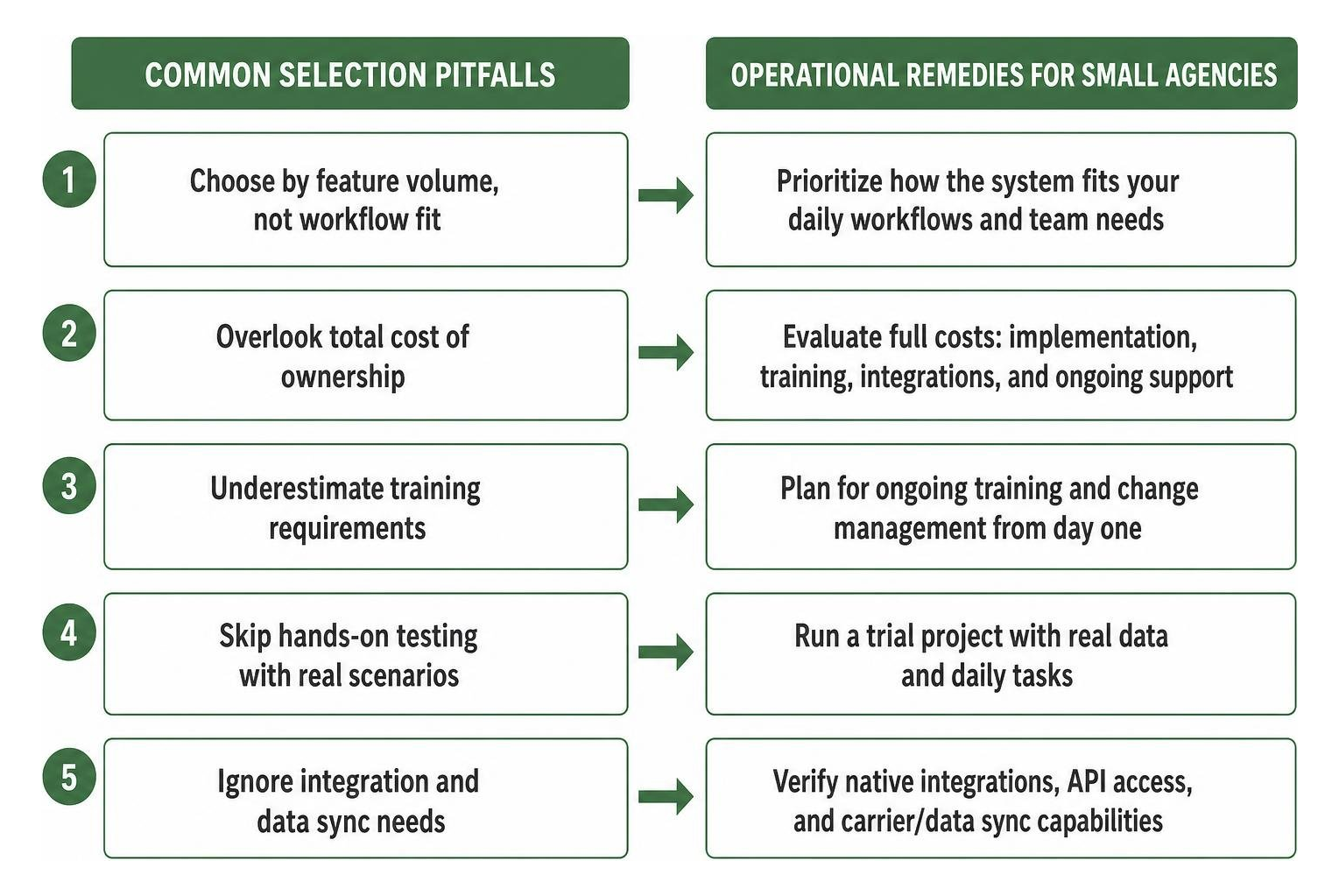
The most common mistake is choosing a system based on feature volume rather than workflow fit. Systems loaded with bloated, complex enterprise features often overwhelm staff, leading to low adoption rates and team frustration.
Another frequent oversight is underestimating training requirements. Software adoption is a continuous management effort, not a one-time setup event. Involving your front-line staff early in the selection process helps build enthusiasm and ensures the system addresses actual daily operational friction.
Frequently Asked Questions About Agency Management Systems
How long does it take to implement an AMS for a small agency?
For most small agencies (under 15 employees), migrating to a cloud-based agency management system takes between one to four weeks. Standard data migration—including client records, policy files, and historic contact notes—can usually be completed within a few business days when supported by vendor onboarding specialists.
How does an AMS help specialized life and health versus P&C agencies?
Specialized life and health agencies require strong compliance automation (such as storing ACA Consent to Contact forms and Medicare Scope of Appointment documentation) along with complex policy commission tracking across individual and group plans.
Property and Casualty (P&C) agencies, on the other hand, prioritize automated carrier downloads, ACORD form generation, and personal or commercial comparative rating integrations. Choosing a system tailored to your line of authority ensures these specialized tasks are supported natively.
What is the typical ROI of adopting an agency management system?
The primary return on investment comes from administrative time recovery and improved client retention.
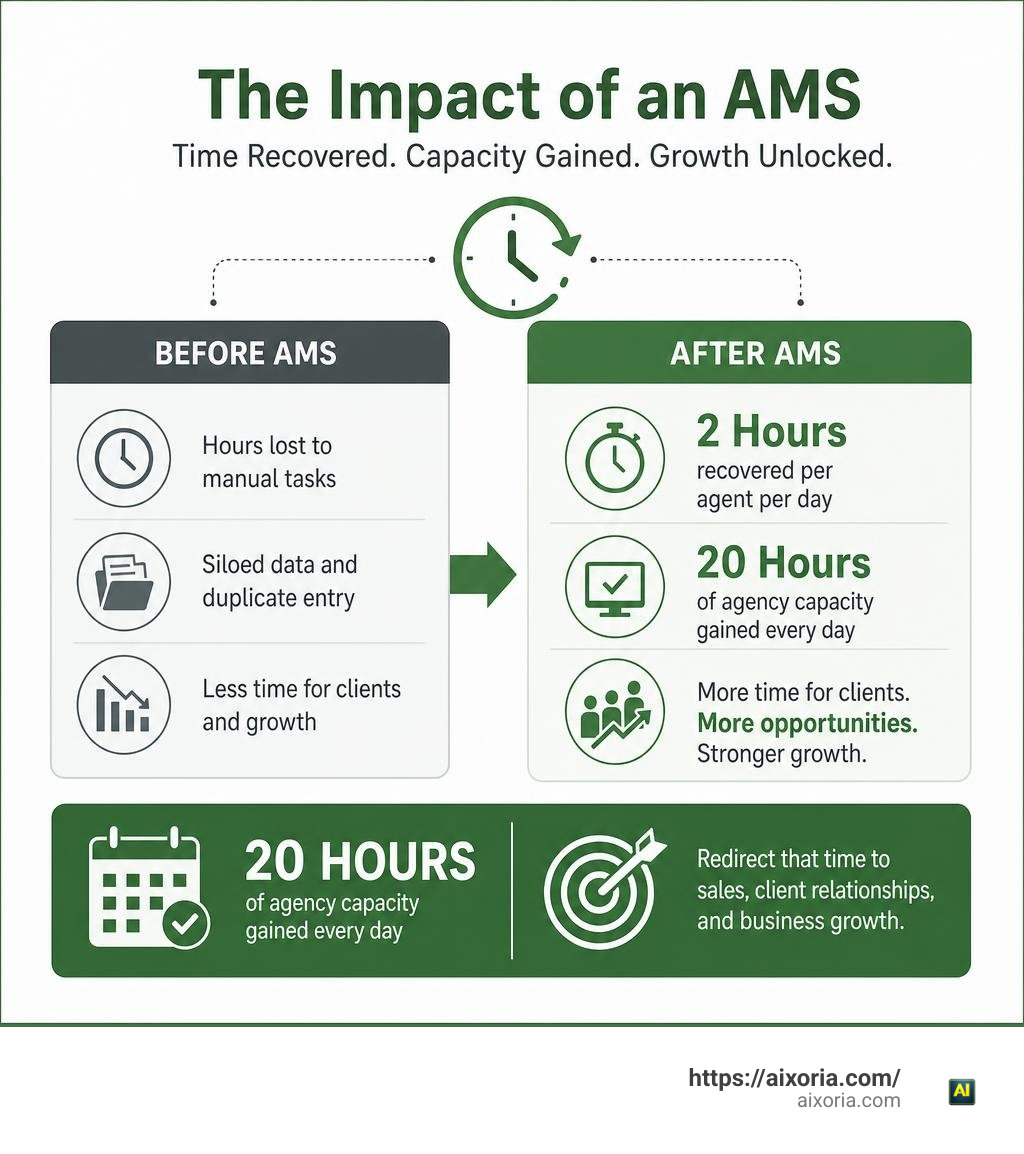
For a 10-person agency, automating routine tasks—like policy renewal reminders, carrier data downloads, and invoice generation—reclaims roughly two hours per agent per day. That frees up 20 hours of agency capacity every day that can be redirected toward sales, client relationships, and business growth. Furthermore, automated policy retention tracking helps agencies maintain consistent client touchpoints, directly lowering churn rates.”https://www.mediafire.com/file/02nxtibqlkqbwyn/TrueRealism_HD_BY_MCMPDL.mcpack/file“;
Conclusion
Finding the best agency management system for small agencies isn’t about buying the most expensive software or picking a tool with the longest list of features. It’s about centralizing your operations into a clear, reliable hub that helps your team deliver excellent client service efficiently.
By moving away from fragmented spreadsheets and bloated legacy tools, your small agency can reduce daily operational noise, protect profit margins, and scale smoothly.
As technology advances, combining your core management system with modern AI productivity tools allows small teams to achieve enterprise-level output while staying lean and agile. Explore how adopting the best AI for productivity can further streamline your workflows, automate routine content creation, and keep your business ahead of the competition.