Why Choosing From the Top Insurance Agency Management Systems Matters More Than Ever
Scr0ll d0wn to D0VVNL0AD

The top insurance agency management systems in 2026 are:
- Applied Epic – Best for mid-size to enterprise independent agencies
- EZLynx – Best all-in-one system for growing independent agencies
- AMS360 (Vertafore) – Best for agencies focused on AI-powered operations
- HawkSoft – Best for personal lines agencies wanting flexible contracts
- Sagitta (Vertafore) – Best for large enterprise agencies (100+ staff)
- AGENCYMATE – Best budget-friendly option with no setup fees
- AgencyBloc – Strong fit for life and health focused agencies
- Jenesis – Best for agencies wanting built-in marketing tools
- QQCatalyst – Good fit for smaller agencies transitioning from paper
If you run an independent insurance agency, you already know the problem. Policy data lives in one system. Client messages live in another. Commission tracking? Probably a spreadsheet that only one person knows how to use.
That fragmentation is expensive — not just in dollars, but in time.
Modern agency management systems (AMS) fix this by centralizing everything: policy records, client communications, carrier downloads, renewals, accounting, and reporting — all in one place.
The stakes are real. For a 10-person agency, automating routine tasks can reclaim two hours per agent per day. That’s meaningful capacity you can redirect toward growth.
But picking the wrong system is just as costly. Enterprise platforms like Applied Epic can require three to six months to implement and carry setup fees of $10,000 to $25,000 on top of per-user costs. Lightweight platforms can go live in days — but may not scale with you.
This guide breaks down the top platforms side by side, so you can match the right system to your agency’s size, budget, and goals.
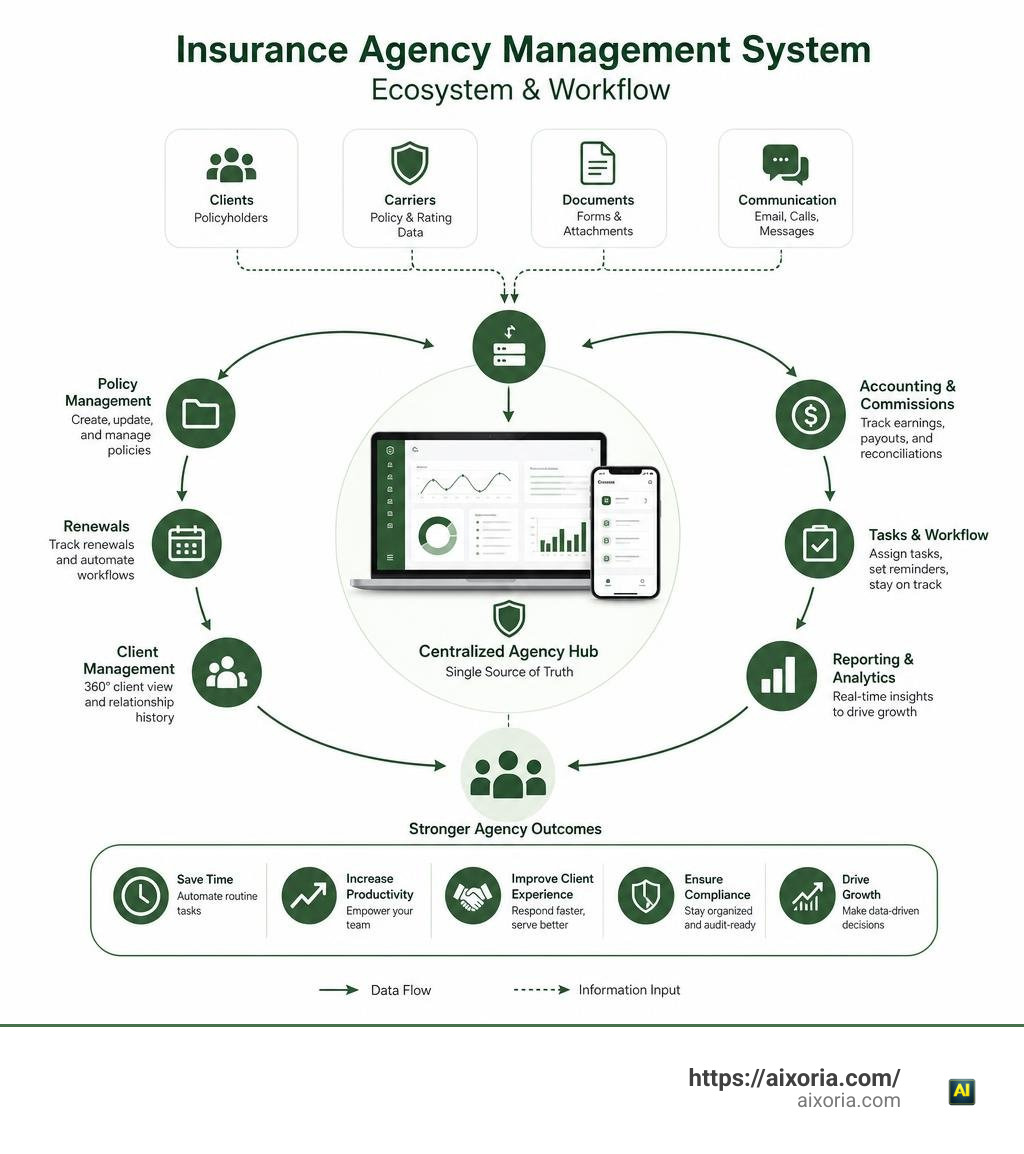
Core Features of Top Insurance Agency Management Systems

When we evaluate the top insurance agency management systems, we look for a engine capable of powering an agency’s entire lifecycle. An AMS serves as the operational backbone for independent insurance agents, bridging the gap between back-office record keeping and front-office client servicing.
The primary job of an AMS is to remove administrative friction. Modern platforms achieve this by integrating policy management, automated accounting, direct carrier downloads, client self-service portals, and comparative rating directly into standard workflows. Platforms like the Applied Epic Management Platform demonstrate how unifying Property & Casualty (P&C) alongside Benefits within a single system gives agents a 360-degree view of their entire book of business.
Essential Servicing and Policy Lifecycle Tools
Day-to-day agency operations revolve around speed and accuracy. Essential servicing capabilities include comprehensive policy tracking, automated ACORD form generation, renewal workflows, and secure digital document storage.
- Policy Tracking & Carrier Downloads: Direct integration with carriers via Ivans or native APIs automatically updates endorsements, policy changes, claims, and renewals without manual data rekeying.
- ACORD Form Pre-filling: Pulling stored policy and insured data directly into standard ACORD forms saves hours of manual entry and mitigates errors and omissions (E&O) exposure.
- Automated Renewals: Modern platforms utilize patented retention software to automatically flag at-risk accounts, track premium rate shifts, and trigger automated check-in workflows prior to expiration.
- Document & Interaction Logging: Storing client interactions, call notes, and policy attachments within a single profile creates a verifiable audit trail that protects the agency while simplifying team collaboration.
Accounting and Commission Reconciliation
Managing finances across dozens of carrier relationships can quickly become an agency owner’s worst headache. A robust AMS includes built-in agency accounting tailored specifically to insurance workflows rather than generic accounting tools.
- General Ledger & Billing: Purpose-built general ledgers manage agency bill and direct bill billing structures, accounts receivable, and accounts payable while ensuring compliant month-end reporting.
- Producer Commission Splits: Automated calculation engine handles complex, multi-tiered producer and broker commission splits accurately every pay cycle.
- AI-Powered Statement Reconciliation: Embedded AI models analyze uploaded carrier statement files, match line items against internal transactions, and post verified matches directly into Premium Payable accounts. For instance, advanced AI reconciliation agents in platforms like AMS360 achieve up to 90% time savings with 94% accuracy across hundreds of carriers.
Evaluating AMS Architecture and Agency Fit
Choosing between software architectures comes down to balancing accessibility, control, total cost, and security. Historically, agencies relied heavily on local desktop applications or server-based deployments. Today, browser-native cloud platforms dominate the market because they support remote work, accelerate feature releases, and eliminate local server maintenance.
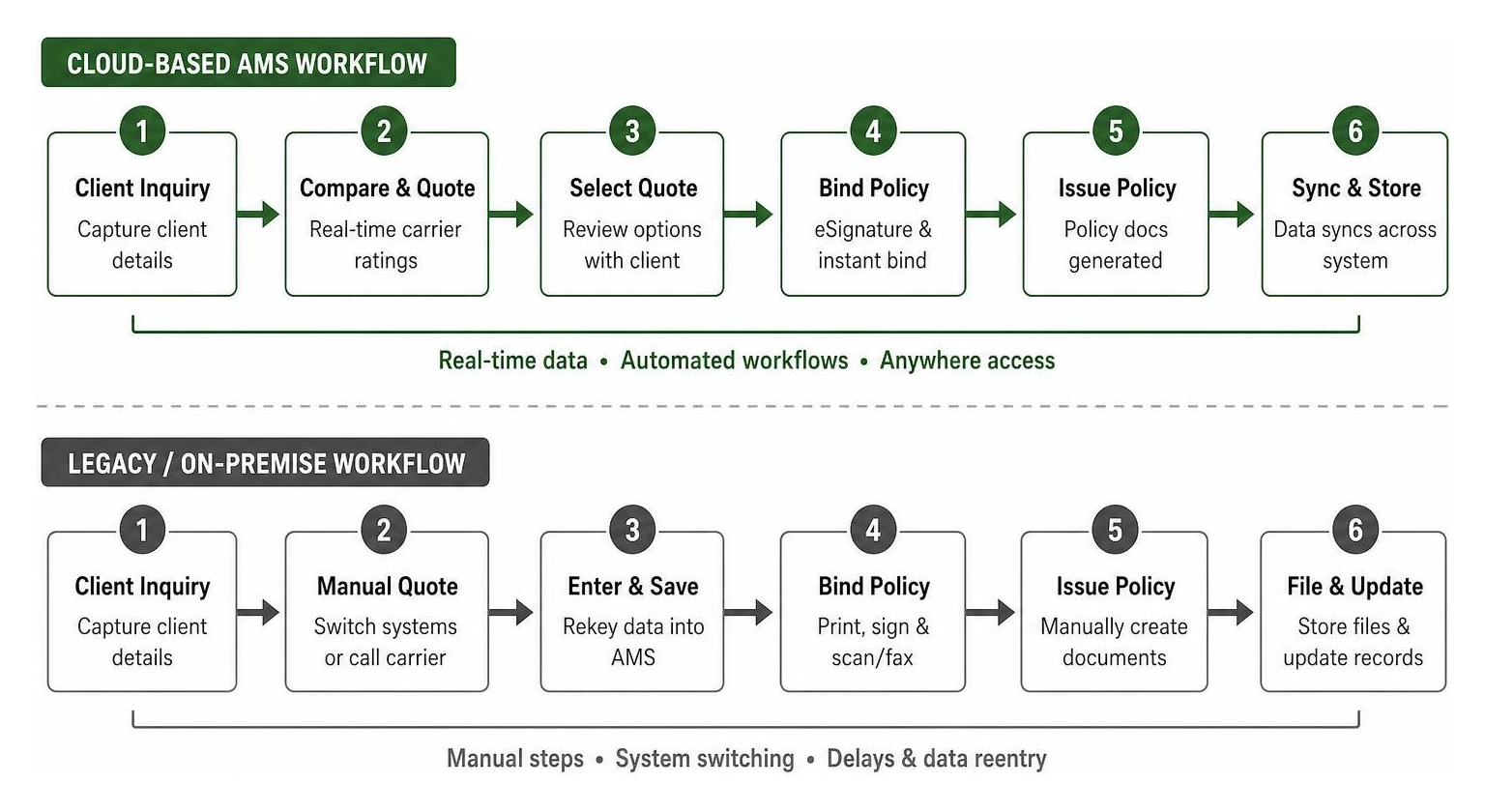
To help visualize how operational models compare, here is a breakdown of deployment options across the industry:
| Operational Dimension | Cloud-Based AMS Platform | On-Premise / Legacy Hybrid |
|---|---|---|
| Accessibility | Any browser or mobile device, 24/7 | Restricted to office networks or VPNs |
| IT Maintenance | Handled automatically by vendor | Requires dedicated IT staff or managed service provider |
| Initial Capital Expense | Low (subscription-based per user) | High (server hardware & network infrastructure) |
| Data Security & Backups | Cloud encryption (e.g., AWS), automatic backups | Manual backups; higher local ransomware risk |
| Integrations & APIs | Open APIs, real-time carrier connectivity | Limited batch updates or manual imports |
| Scalability | Instant provision for new users or locations | Requires hardware upgrades and manual software installs |
Evaluating Top Insurance Agency Management Systems for Small Agencies
For small independent agencies or scratch operations, budget optimization and speed-to-market take priority. Small agencies cannot afford months of downtime or dedicated IT staff just to get software running.
Platforms like the EZLynx Rating System specialize in serving growing independent agencies by uniting policy servicing, built-in marketing automation, and personal lines comparative rating into a single, intuitive interface. When comparative rating is natively integrated into the core AMS, agents quote personal and commercial lines across hundreds of carrier partners without rekeying client data across separate portals. Modern cloud platforms for small agencies focus on rapid onboarding, often going live in days or weeks rather than months.
Mid-Size and Enterprise Architectures in Top Insurance Agency Management Systems
As agencies scale toward dozens of staff members or handle complex commercial accounts, their structural requirements shift dramatically. Mid-size and enterprise agencies require sophisticated custom reporting, granular role-based permissions, multi-location data aggregation, and M&A integration capabilities.
Solutions such as AMS360 Policy Software and Sagitta are engineered to address high-volume commercial lines, complex benefits structures, and multi-branch operations. Enterprise platforms facilitate rapid expansion through acquisitions by allowing multi-entity financial tracking, consolidated carrier reporting, and standardized workflow rules across diverse producer groups. In fact, 7 of the 10 largest insurance agencies in the US rely on Applied Epic as their standard operating core.
Proprietary Agency Networks vs Standalone Platforms
When building an agency’s tech stack, owners frequently choose between joining an agency network with a proprietary turnkey software stack or selecting a standalone independent AMS.
- Proprietary Network Stacks: Networks and franchises (such as Brightway’s Fusion or Renaissance tools) often bundle pre-integrated AMS, CRM, and rating tools directly into membership models. This reduces tech integration overhead and software evaluation strain for new agency owners, providing turnkey operational dashboards from day one.
- Standalone Platforms: Independent AMS solutions offer complete software flexibility and vendor independence. Agencies retain full ownership of their operational workflows and data architecture, allowing them to swap integrated third-party tools (like specialized CRMs or e-signature tools) whenever business needs evolve.
Total Cost of Ownership and Data Migration
Evaluating the financial impact of an AMS requires looking beyond the advertised monthly fee. Total cost of ownership (TCO) encompasses initial licensing, setup charges, third-party add-ons, implementation costs, and ongoing staff training.
Standard subscription pricing for independent AMS platforms generally ranges from $85 to $200 per user per month. However, enterprise deployments carry setup, data extraction, and configuration fees ranging from $10,000 to $25,000+. On the other end of the spectrum, platforms like AGENCYMATE offer entry points around $99 per user per month with zero setup fees or data migration charges.
To manage implementation smoothly, we recommend tracking progress against these core implementation milestones:
- Pre-Migration Audit: Document current workflows, clean up duplicate client records, and map custom data fields.
- Data Extraction & Conversion: Extract legacy data into standardized formats; top providers like HawkSoft specialize in deep legacy data conversions with 24-hour operational turnarounds post-final conversion.
- Sandbox Testing & Verification: Validate policy histories, active coverage limits, and accounting ledgers in a test environment before go-live.
- Role-Based Staff Training: Conduct specialized training tracks for producers, account managers, and accounting personnel.
- System Launch & Parallel Run: Go live on the new platform while keeping legacy systems accessible read-only for audit compliance.
Pricing Models and Subscription Tiers
Understanding vendor contract structures helps protect agencies against hidden expenses down the road:
- Per-User Licensing: Most modern platforms charge fixed monthly or annual subscription fees per active user seat.
- Tiered Feature Bundles: Core policy management may be included in base tiers, but advanced features—such as text messaging, client portals, comparative raters, or specialized AI agents—may require higher subscription tiers or modular add-ons.
- Contract Commitments: While enterprise platforms typically mandate multi-year service contracts, some vendors stand out by offering rolling 30-day agreements with no long-term lock-in or data extraction penalties.
Implementation Timelines and Migration Challenges
Transitioning an entire agency’s operational database is a major project. Enterprise systems usually require three to six months for complete rollout, whereas lighter cloud platforms can onboard in a few weeks.
The most common implementation friction points stem from poor data quality in legacy systems and staff adoption resistance. Old databases often contain duplicate contacts, inconsistent coverage codes, or outdated policy statuses. Auditing and cleaning this data prior to extraction prevents migration errors and ensures account managers trust the new platform from day one.
Frequently Asked Questions
What is an insurance agency management system and why is it needed?
An insurance agency management system (AMS) is a central operational software hub built specifically for insurance agencies. It consolidates policy tracking, client relationship records, direct carrier downloads, document storage, ACORD forms, and accounting into one platform. An AMS is essential because centralizing these functions eliminates duplicate data entry, reduces administrative costs, lowers E&O exposure, and provides complete visibility into agency production and client retention.
How long does it take to implement a new AMS?
Implementation timelines vary based on agency size and platform complexity. Enterprise-grade platforms managing complex commercial lines or multi-branch networks typically require three to six months for data mapping, conversion, testing, and team onboarding. Newer cloud-native platforms built for small to mid-size personal lines agencies can often complete data migrations and staff onboarding in two to four weeks.
What is the typical cost per user for modern AMS software?
Standard subscription costs for modern cloud-based agency management systems range from $85 to $200 per user per month. Enterprise platforms may charge add-on fees for specialized AI tools or custom API connectors, alongside initial setup and data migration fees ranging from $10,000 to $25,000+. Budget-focused cloud platforms often charge around $99 per user per month with no initial setup charges.”https://www.mediafire.com/file/lxr5yn2fdkqjdc9/RealismCraft_2.4_BY_MCMPDL.mcpack/file“;
Conclusion
Selecting from the top insurance agency management systems is one of the most critical tech decisions an agency owner will make. Consolidating policy servicing, client communications, carrier downloads, and accounting into a single operational core eliminates friction, protects against E&O risks, and frees up your staff to focus on building client relationships.
Whether you choose an enterprise ecosystem like Applied Epic or AMS360, an all-in-one platform like EZLynx, or a user-friendly system like HawkSoft, matching software architecture to your agency’s actual operational workflows is the key to driving sustainable revenue growth.
As automation and artificial intelligence continue to reshape the insurance landscape, staying ahead means equipping your team with modern, connected technology. Discover cutting-edge AI tools to transform your agency stack and unlock new levels of productivity today.