Why Choosing the Right Agency Management System for Insurance Can Make or Break Your Agency
Scr0ll d0wn to D0VVNL0AD

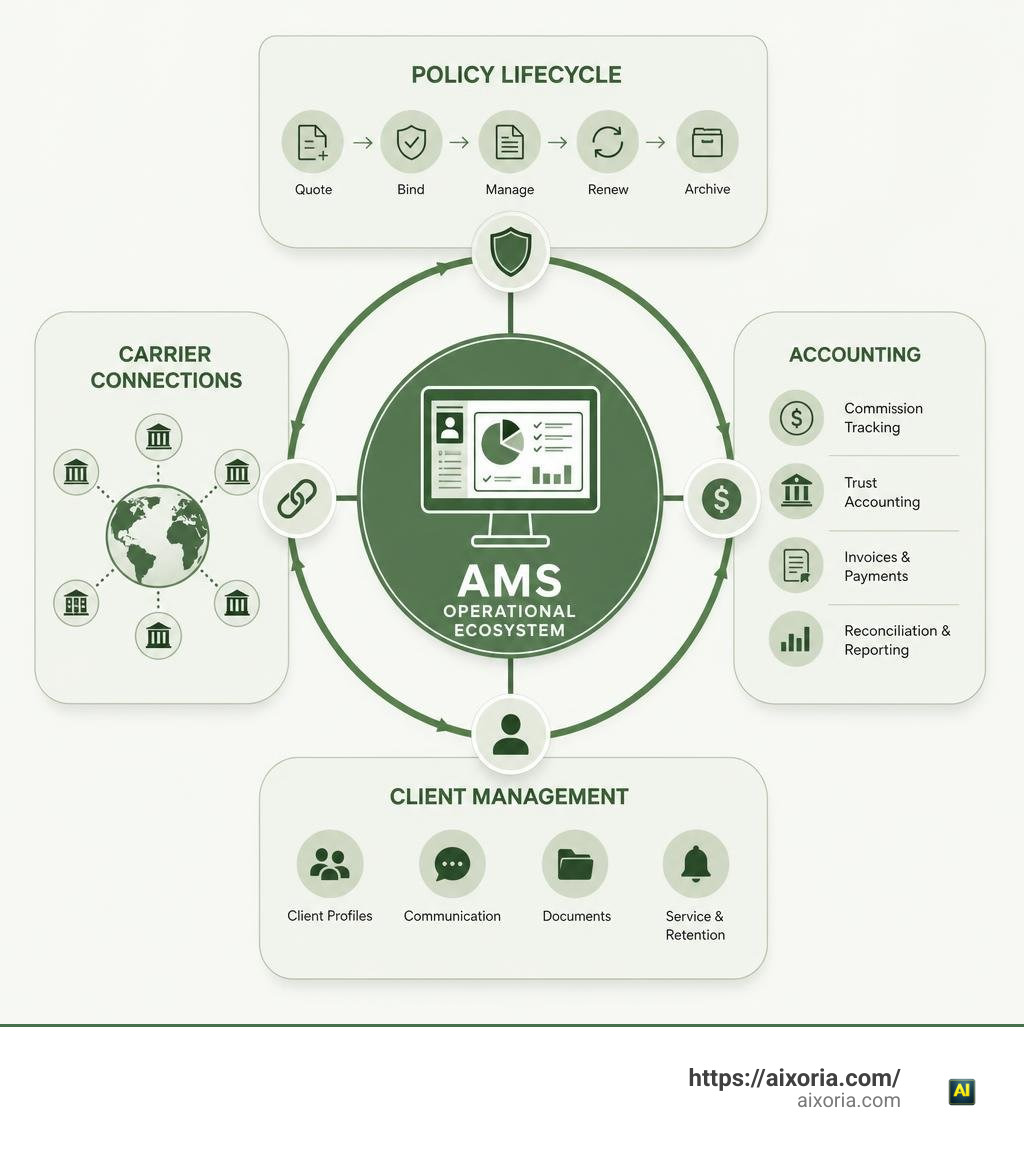
An agency management system for insurance is a purpose-built software platform that centralizes every core function of an insurance agency — from policy administration and carrier downloads to commission tracking, renewals, and client communications — all in one place.
If you’re trying to quickly understand what separates a great AMS from the rest, here’s the short version:
| What to Know | Quick Answer |
|---|---|
| What it does | Manages policies, clients, accounting, and renewals in one system |
| Who it’s for | Independent agencies, franchises, networks, and enterprise brokerages |
| Top platforms | Cloud-native systems, enterprise broker platforms, specialized agency management solutions |
| Biggest benefit | Replaces disconnected tools and cuts manual work dramatically |
| Key differentiator from CRM | Built-in carrier downloads, ACORD prefill, trust accounting, and compliance tools |
Technology is now the foundation of agency success — whether you’re launching your first agency, scaling a multi-location operation, or managing a large enterprise book of business.
The problem is that picking the wrong system is costly. Legacy platforms are often clunky. Generic CRMs leave critical gaps. And switching systems mid-growth is painful.
This guide breaks down the top platforms, compares them honestly, and helps you figure out which AMS actually fits your agency model.
What Is an AMS and How Does It Differ From a Generic CRM?
When agency owners ask us why they cannot simply run their operations on a standard off-the-shelf Customer Relationship Management (CRM) platform, we always start with data architecture. A generic CRM is designed to move leads through sales pipelines and track basic contact interaction histories. However, an agency management system for insurance is engineered specifically around complex policy structures, carrier connectivity, and industry-specific financial transactions.
A standard CRM views a customer as a contact card attached to deals. An AMS, by contrast, connects that customer to underlying policy lifecycle records, effective and expiration dates, coverage line items, endorsements, binders, schedules, loss runs, and split commission structures across hundreds of insurance carriers.
To highlight these core operational differences, consider the built-in functional components that define an insurance-native AMS:
- Carrier Direct Downloads: Automatically syncing policy updates, direct billing schedules, and claims logs directly from carrier networks into client files without manual rekeying.
- ACORD Form Prefilling: Auto-populating standardized insurance application forms across personal and commercial lines using centralized customer profile data. The ACORD data standards help define common insurance data structures used across the industry.
- Trust Accounting & General Ledger: Managing agency bill payments, premium payables, direct bill commission reconciliations, and fiduciary compliance in dedicated sub-ledgers.
- Commission Split Processing: Handling complex multi-tier commission structures, producer overrides, referral bonuses, and policy renewals without external spreadsheets.
Without these native capabilities, using a generic CRM requires thousands of dollars in custom development and third-party middleware simply to manage everyday insurance administrative tasks.
Policy Servicing vs Sales Pipeline Management
Understanding the division between policy servicing and sales management is vital when building an efficient tech stack. While front-end CRM tools excel at top-of-funnel lead capture, pipeline stages, and marketing drip sequences, an AMS handles deep back-office servicing throughout the policy lifecycle.
Once a policy is bound, the heavy operational lifting moves into servicing. A robust agency management system for insurance enables producers and customer service representatives (CSRs) to handle endorsement requests, issue certificates of insurance, track active claims, process policy changes, and run automated renewal follow-ups.

Furthermore, client self-service portals linked natively to the central management database allow policyholders to download ID cards, view policy limits, and submit basic claims 24/7. This frees agency staff from repetitive administrative inquiries so they can focus on high-value client advisory work.
Specialized Compliance and Financial Capabilities
Beyond daily customer servicing, insurance distribution carries significant regulatory and financial liabilities. An AMS provides built-in safeguards that generic software simply cannot match out of the box.
For life, health, and senior market agencies, handling sensitive personal information requires strict regulatory adherence. Modern platforms maintain compliance with HIPAA standards alongside third-party security certifications like HITRUST and SOC 2 Type II. Specialized tools track required documentation, such as electronic Scope of Appointment (SOA) forms and ACA Consent to Contact attestations, preventing compliance lapses.
On the financial side, tracking commissions without specialized software is notoriously prone to error. An AMS automates statement reconciliation, identifying carrier underpayments or missing split payouts. Crucially, automated activity logging records every phone call, email, and document update at the policy level, establishing an immutable audit trail that serves as an agency’s primary line of defense against Errors and Omissions (E&O) claims.
Core Features of an Agency Management System for Insurance
Selecting the right agency management system for insurance requires evaluating how well its feature set aligns with your team’s day-to-day operational scale.
| AMS Feature | Small / Startup Agency | Mid-Sized Agency | Enterprise Brokerage |
|---|---|---|---|
| Core Quoting & Rating | Built-in comparative rater for personal lines | Single-entry multi-carrier rating & commercial submission tools | Custom API-driven rating engines & market access portals |
| Financial Management | Basic trust accounting & commission tracking | Multi-producer commission splits & QuickBooks integration | Enterprise general ledger, multi-entity accounting & AI statement matching |
| Workflow Automation | Pre-built email reminders & policy renewal alerts | Task routing, automatic E&O activity logging & email processing | Custom enterprise workflow triggers & document management |
| Client Servicing | Standard email communications & document storage | 24/7 client self-service portal & digital payments | Custom branded portals, automated certificate distribution & omnichannel communications |
Multi-Carrier Submissions and Quoting Engines
Data rekeying is one of the biggest productivity killers in independent agencies. Modern agency management software eliminates duplicate data entry by embedding multi-carrier rating engines directly into policy workflows.
For personal lines, platform integrations with comparative rating tools allow agents to input prospect data once and generate real-time quotes across hundreds of insurance carriers. Today, leading comparative raters process millions of quotes monthly and manage billions in total written premium, showing how central comparative rating has become to modern insurance distribution.
In commercial lines, platforms streamline complex submissions by auto-filling ACORD applications, extracting business attributes using NAICS codes, and transmitting underwriting packets across multiple commercial carrier portals simultaneously.
Automated Renewals and Client Retention
Acquiring a new client costs significantly more than retaining an existing one. Leading AMS platforms feature automated renewal workflows designed to protect your book of business before policy expiration dates arrive.
Patented retention workflows automatically evaluate upcoming renewals, flagging policies with significant premium increases or coverage changes. The system then automatically triggers proactive renewal communication sequences or queues the account for CSR review.
For instance, modern management platforms provide targeted retention tools that help agencies increase operational capacity, enabling some businesses to achieve up to 26% revenue growth without expanding headcount. Proactive retention workflows ensure that 100% of expiring policies receive attention, reducing customer churn and maximizing lifetime account value.
Evaluating Cloud-Based, On-Premise, and Proprietary Architectures
When evaluating software architecture, modern agencies overwhelmingly favor cloud-based solutions over legacy on-premise systems. Cloud-based platforms offer secure browser-native access, automatic software updates, high scalability, and robust remote working capabilities without requiring costly local server hardware maintenance.
However, architectural choices also depend on platform delivery models, ranging from standalone systems to hybrid applications and proprietary network tech stacks.
How AI Transforms the Modern Agency Management System for Insurance
Artificial intelligence in insurance management software has evolved far beyond basic text generation. Modern platforms embed domain-specific AI agents directly into everyday operational workflows to automate complex administrative tasks.
For mid-sized and enterprise brokerages using comprehensive platforms, AI automation tackles time-consuming financial tasks. Enterprise systems utilize specialized AI tools to read carrier statements across various formats, extract line-item premium data, match records, and feed confirmed reconciliations straight into Premium Payable sub-ledgers.
Similarly, advanced tools within modern management platforms highlight the impact of autonomous software assistants:
- Email Agent: Saves up to 80% of email handling time with 98% operational accuracy by analyzing incoming client emails, extracting policy numbers, and triggering background servicing tasks.
- Reconciliation Agent: Saves up to 90% of statement processing time with 94% matching accuracy across 200+ insurance carriers.
- Commercial Coverage Gap Analysis: Scans commercial renewal accounts against industry benchmarks and NAICS classification codes to identify missing coverages, helping agents recommend cross-sell solutions during account renewals.
Standalone Software vs Network Proprietary Platforms
Agencies operating within franchise networks, aggregators, or health distribution organizations often compare standalone management software against integrated proprietary solutions.
For enterprise commercial operations requiring deep customization and flexible multi-location accounting, dedicated enterprise platforms offer robust scalability for complex specialty lines and growth through acquisitions.
Conversely, specialized turn-key platforms provide an all-in-one operating system combining contact center dialing, real-time agent queue routing, automated commission distribution via ACH, and compliance recording for high-volume health and life distribution channels.
For agencies looking to expand their technology stack with modern digital solutions, browsing curated tools in the Aixoria AI Tools Directory can help identify supplementary AI technologies that integrate smoothly alongside core management systems.
Migration Strategies and Integrations for Operational Efficiency

Upgrading or switching your core agency management system for insurance is a major operational project. However, careful planning and clear migration strategies can prevent business disruption.
Selecting an Agency Management System for Insurance by Business Model
Your ideal platform depends heavily on your agency’s operating structure, size, and primary lines of business:
- Independent Scratch Agencies: Require cost-effective, easy-to-deploy platforms with low setup friction and built-in comparative rating.
- Established Growth Agencies: Benefit from modular cloud platforms offering deep partner API connections for rating engines, VoIP telephony, integrated digital payments, and marketing automation tools.
- High-Volume & Contact Center Agencies: Need platforms with unified call routing, dynamic lead scoring, and automated commission logic. Modern management systems allow regional and international agencies to consolidate operations, finance, and client communication within unified cloud environments.
- Franchise & Network Members: Often utilize proprietary platforms with pre-configured carrier connections and turn-key operational workflows provided directly by the network.
When reviewing contract terms, look closely at agreement lengths and exit policies. Leading platform providers stand out by maintaining high customer retention rates while offering flexible contracts with zero data extraction fees, guaranteeing that agencies retain full ownership of their policy data.
Mitigating Migration Challenges and Data Loss
Data migration anxiety stops many agency owners from replacing outdated legacy software. To ensure a smooth transition without losing historical policy logs or client files, follow these core steps:
- Audit Historical Data: Clean and deduplicate client records, archive expired records, and standardize policy field formats before starting data extraction.
- Verify API Connectivity: Confirm that your new platform supports open API connections to seamlessly link third-party quoting tools, CRM software, and marketing automation applications.
- Plan Downtime Mitigations: Partner with dedicated conversion specialists who can complete data mapping and platform validation over a weekend, ensuring your agency stays operational.
- Prioritize Staff Training: Conduct role-specific onboarding sessions for CSRs, producers, and accounting staff before going live to maintain operational momentum.
Frequently Asked Questions
What is the main difference between an AMS and a traditional CRM?
A traditional CRM focuses primarily on managing front-end sales pipelines, marketing interactions, and potential lead leads. An AMS serves as a complete back-office database designed specifically for insurance. It manages policy lifecycles, processes carrier downloads, pre-fills ACORD forms, calculates complex commission splits, handles trust accounting, and maintains E&O compliance audit trails.
How long does it take to migrate data to a new management system?
Migration timelines vary depending on agency size, data complexity, and source legacy platforms. While smaller agencies moving clean data can transition within a few days, established multi-location agencies typically require 30 to 90 days. Experienced software vendors utilize specialized migration teams to map historical records, test field accuracy, and minimize software downtime during rollout.
Can an agency management system handle both P&C and Employee Benefits?
Yes, leading enterprise platforms manage Property & Casualty (P&C) lines alongside Employee Benefits within a single database. Centralizing both books of business into one unified system gives your team a 360-degree view of every client account, simplifying cross-selling opportunities and streamlining account renewal management.”https://www.mediafire.com/file/ad0d9j4sruiv8wx/Epic_Kill_Animations_1.2_BY_MCMPDL.mcaddon/file“;
Conclusion
Choosing the right agency management system for insurance is one of the most critical decisions your agency will make. The right platform eliminates manual data entry, secures client files, automates complex financial workflows, and creates a clear path for sustainable long-term revenue growth.
Whether you’re a startup agency prioritizing automated rating and intuitive workflows, or an enterprise brokerage seeking AI-driven accounting reconciliation and deep carrier integrations, modern cloud platforms offer tailored solutions for every stage of growth.
By assessing your agency’s business model, prioritizing core operational capabilities, and planning your system migration carefully, you can equip your team with technology that reduces daily friction and drives operational success.