What the Anthropic AI Public Opinion Survey Reveals About How Americans Really Feel About AI
Scr0ll d0wn to D0VVNL0AD
The anthropic ai public opinion survey — known as the Anthropic Public Record — is one of the most comprehensive looks at how Americans think and feel about artificial intelligence today. Fielded in late 2025 with nearly 52,000 Americans, it covers hopes, fears, workplace attitudes, and governance preferences.
Here are the key findings at a glance:

- Top hope: 48% of Americans want AI to cure diseases like cancer or Alzheimer’s
- Top fear: 64% fear AI-induced job loss
- Cognitive dependency: 56% worry about becoming too reliant on AI
- Regulation support: 71% believe government should play a role in regulating AI
- Trust in AI companies: Only 15% trust them to make decisions about AI development
- AI usage: 58% of Americans have used or tried AI tools like ChatGPT or Claude
These numbers tell a clear story: Americans see real promise in AI, but they want guardrails — and they don’t trust the industry to set those guardrails alone.
This survey is also notable for what it isn’t. Most AI research only talks to people who already use AI. The Anthropic Public Record spoke to the general public — users and non-users alike — to get a true picture of where American opinion stands right now.
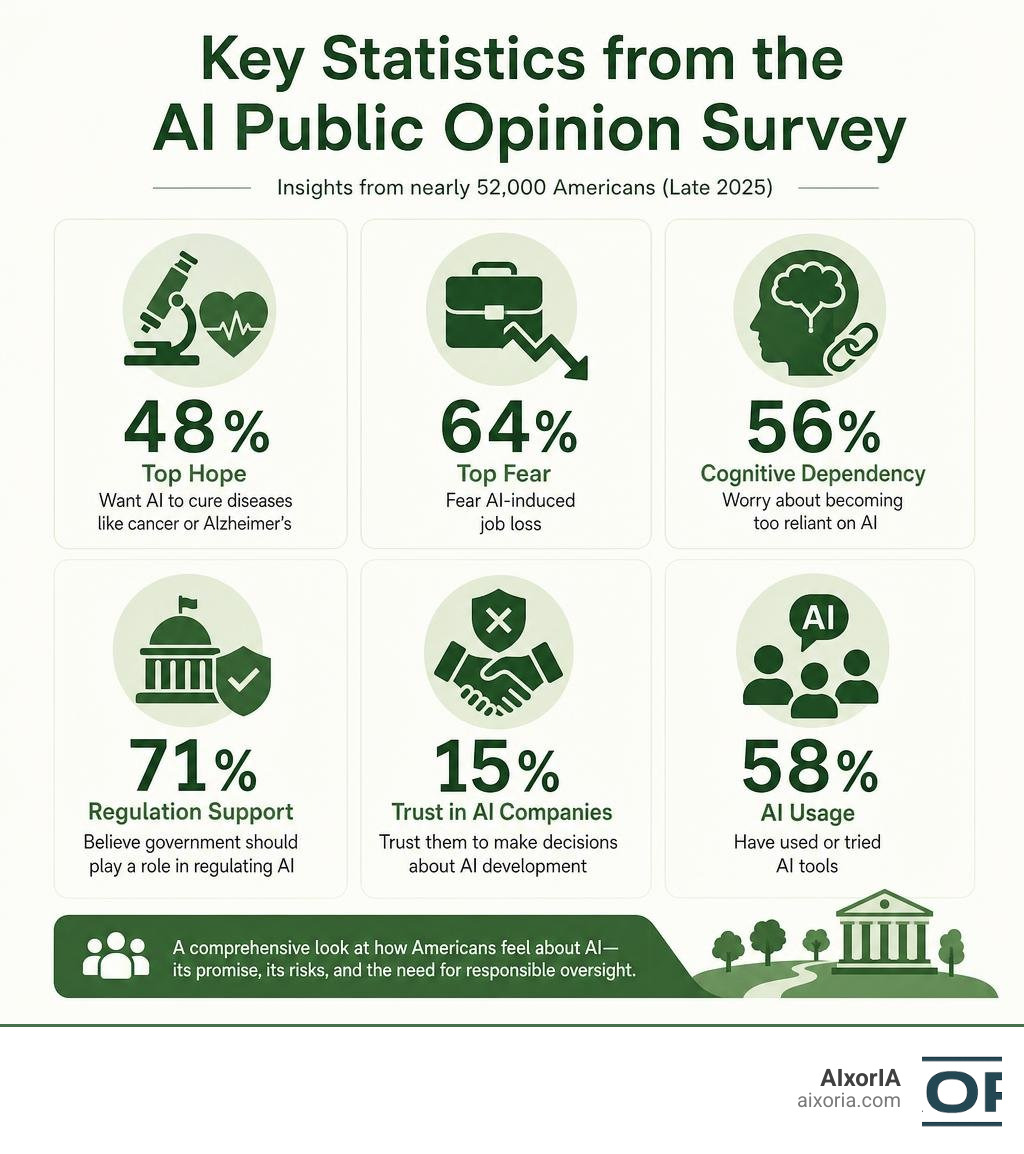
Key Findings from the Anthropic AI Public Opinion Survey

When we look closely at the anthropic ai public opinion survey data, we see a fascinating mix of optimism and deep anxiety. The public is not divided into two neat camps of “tech-lovers” and “doomers.” Instead, hope and alarm coexist within almost every single person.
This duality is even more pronounced when we look at the growing public discussion around artificial consciousness. In recent years, high-profile debates have pushed the concept of digital minds into the mainstream. According to academic research on What Do People Think about Sentient AI?, a surprising 71% of people agree that if an AI were to become sentient, it would deserve to be treated with respect. Yet, this moral concern is balanced by a strong desire for safety: 69% of respondents in that same study support a ban on sentient AI, and 63% support a ban on smarter-than-human systems.
These numbers show that while the public is willing to extend ethical consideration to advanced technology, they are highly cautious about the existential and societal risks of unregulated AI development.
What Americans Hope AI Will Deliver
When asked what they actually want AI to achieve, Americans point first and foremost to healthcare. An impressive 48% of Americans ranked curing devastating diseases like cancer or Alzheimer’s as one of their top three hopes for AI.
Beyond medical breakthroughs, the public hopes AI will:
- Assist people with physical and cognitive disabilities, opening up new avenues for accessibility.
- Simplify daily life by taking over tedious, repetitive administrative tasks.
- Drive positive societal transformation by acting as an educational equalizer and research accelerator.
People want AI to handle the mundane “drudgery” of life so they can focus on what makes them human.
Demographics and Divergent Views in the Anthropic AI Public Opinion Survey
Interestingly, the fears and hopes surrounding AI are not distributed evenly across the population. Demographics like education level, AI usage frequency, and political affiliation heavily influence how people perceive these technologies.
One of the most surprising findings from the anthropic ai public opinion survey is that job loss concerns are actually higher among Americans with more education. This makes sense when we realize that generative AI is uniquely capable of automating tasks previously thought to be the exclusive domain of white-collar professionals.
Usage frequency also plays a major role:
- Frequent Users: Those who use AI daily are significantly less worried about job loss (54%) and cognitive dependency (46%).
- Non-Users: Those who use AI the least are the most terrified, with 70% fearing job displacement and 62% worrying about cognitive atrophy.
Cognitive dependency—the fear that we will lose our ability to think critically—remains largely an anticipatory fear for the general public. However, those on the front lines of education see it differently. Educators are 2.5 to 3 times more likely to report witnessing actual cognitive decline in students who rely too heavily on these tools.
As explored in What 81,000 People Actually Want From AI: Behind Anthropic’s Massive Global Survey | by Mandar Karhade, MD. PhD. | Towards AI, different professional “tribes” want very different things. Scientists view AI as a potential research partner to help design experiments, while creatives experience an existential crisis, worrying that AI-driven decisions will strip them of creative control.
Workplace Integration and the Economics of AI

How AI is actually being used in the office often differs from how managers think it is being used. While companies promote the narrative of AI “augmenting” human workers, many employees are quietly using it to fully automate parts of their jobs. To see how these automation features stack up in practice, check out our detailed guide on Anthropic Ai Automation Tool Features Use Cases How It Compares.
Perceived Capabilities and Acceptance of AI at Work
Americans have a highly nuanced view of what AI can and cannot do well in the workplace:
- The Strengths: 75% of Americans believe AI is as good as or better than humans at synthesising research and identifying data trends.
- The Weaknesses: Only 44% believe AI is as good as or better than humans at service and support roles. When it comes to complex moral or legal decisions—such as judging a criminal trial—humans are preferred over AI by a massive 77-point margin.
These perceived capabilities directly impact wage expectations. A majority of Americans (55%) believe that widespread AI adoption will ultimately bring down wages, and 51% think it will replace human work entirely within the next decade.
According to a massive study on What 81,000 people told us about the economics of AI \ Anthropic, the relationship between AI exposure and job worry is U-shaped. Those experiencing the largest productivity speedups—and those who find themselves slowed down by the technology—are the most anxious about their long-term job security. Interestingly, 48% of users report that the primary benefit of AI is “scope expansion” (allowing them to do more diverse work) rather than just speed.
Comparing the Public Record with the Global Anthropic AI Public Opinion Survey of Claude Users
To understand the full picture, it is helpful to compare the US-focused Public Record (which surveyed the general public) with the global qualitative study of over 80,000 Claude users.
| Metric / Aspect | US Public Record (General Public) | Global Claude User Survey |
|---|---|---|
| Sample Size | ~52,000 Americans | 80,508 people (159 countries, 70 languages) |
| Overall Sentiment | Cautious / Mixed | 67% Net Positive |
| Top Concern | Job Loss (64%) | Unreliability (26.7%) |
| Key Driver | Fear of the unknown / displacement | Desire for professional excellence (18.8%) |
| Regional Divide | Bipartisan skepticism | Global South optimism vs. Western anxiety |
This comparison highlights a fascinating geographic divide. While Western users in North America and Europe express deep anxiety about job security and regulation, users in the Global South (such as India and Sub-Saharan Africa) view AI with immense optimism. For many in tech-disadvantaged countries, AI is seen as an economic equalizer, allowing them to leapfrog traditional educational and professional barriers.
However, both surveys point to the “light and shade” problem. As reported by Light and shade: What 81,000 people want and don’t want from AI, major Anthropic study reveals | Euronews, the very same qualities that make AI an incredible tool—its constant availability, patience, and synthesizing power—are also what make people fear cognitive atrophy, unreliability, and the loss of independent critical thinking.
Public Demand for AI Governance and Trust Deficits
Perhaps the strongest consensus in the anthropic ai public opinion survey lies in the realm of governance. Americans are deeply concerned that the government will do too little to regulate AI dangers (67%) rather than doing too much.
Bipartisan Support for Government Regulation
In a politically fractured landscape, AI regulation is a rare area of bipartisan consensus. Over 70% of Americans believe the government should play an active role in regulating AI. This appetite for safety testing remains strong even when framed against international rivalries.
Most Americans (67%) prefer strict safety regulations over unregulated AI progress, even if it means the United States develops technology slower than global competitors. To understand the geopolitical stakes of this debate, read our analysis on Anthropic Ai Us China Competition.
Furthermore, the public is highly protective of civil liberties. A massive 70% of Americans agree that using AI to monitor citizens without a court-issued warrant violates the Fourth Amendment. This underscores a broader global demand for clear boundaries on AI surveillance, as documented in the qualitative study on What 81,000 people want from AI \ Anthropic.
Corporate Responsibility and the Trust Deficit
The survey reveals a stark trust deficit. Only 15% of Americans trust private AI companies to make decisions about how AI is developed and used.
Instead, the public believes:
- Corporate Limits: 67% believe private technology companies have a strict responsibility to set limits on how their products can be used, even if governments object.
- Human Oversight: 79% say a human being must always make the final decision before any use of lethal force by an AI system.
- Independent Oversight: When asked who they trust most to make decisions about AI, the top choice was an independent scientific or ethics review board.
Frequently Asked Questions About AI Public Opinion
What are the top hopes and fears Americans have regarding AI?
According to the anthropic ai public opinion survey, the top hope is curing major diseases like cancer and Alzheimer’s (48%). The most common fear is AI-induced job loss (64%), followed closely by cognitive dependency (56%) and the spread of digital misinformation (52%).
How does AI usage frequency affect public attitudes toward regulation?
Surprisingly, “integrated users” (those who use AI daily for work and personal life) have the exact same appetite for regulation and oversight as non-users. While daily users are slightly less anxious about immediate job loss (54% vs 70% of non-users), they still overwhelmingly support government-enforced safety standards.
Do Americans trust AI companies to self-regulate?
No. Only 15% of Americans trust AI companies to make self-regulating decisions. There is a strong public belief that while tech companies must build safety limits into their products (67%), independent ethics boards and federal governments must enforce these rules.
Conclusion
The message of the anthropic ai public opinion survey is undeniable: the public wants the benefits of artificial intelligence, but they demand safety, transparency, and human-led governance.
As we navigate this rapidly changing landscape, businesses cannot afford to ignore public sentiment or safety concerns. At AIxorIA, we help businesses implement AI responsibly. We provide custom AI solutions, tool training workshops, and performance audits to ensure your team uses AI safely, ethically,
and highly productively.
Empower your business with custom AI solutions from AIxorIA and let us help you build a future-proof, trust-backed AI strategy today.
Valuable info. Fortunate me I discovered your web site by chance, and I am shocked why this accident didn’t took place earlier!
I bookmarked it.