The AI Layoff Debate Every Business Owner Needs to Understand
Scr0ll d0wn to D0VVNL0AD
The conversation around palantir ceo on ai layoffs has become one of the most important — and most misunderstood — stories in tech right now. Here is the short version before we dig deeper:
Quick Answer: What is Palantir CEO Alex Karp’s position on AI layoffs?
- Karp warns tech executives not to publicly celebrate using AI to cut jobs
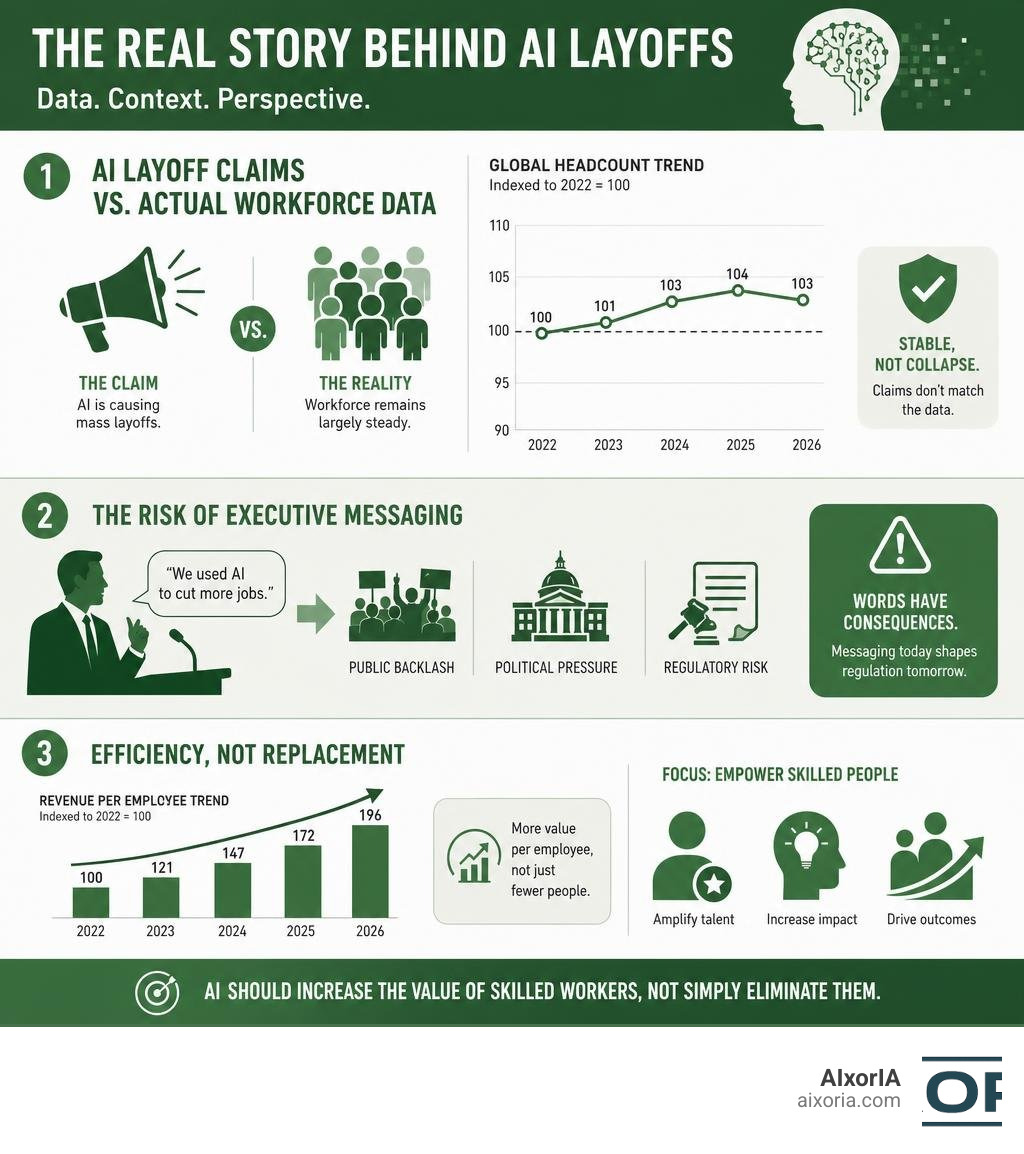
- He argues this messaging is “playing with fire” that could trigger political and regulatory backlash
- He has said executives who brag about AI-driven cuts might as well “sign up for the Bernie Sanders manifesto”
- Palantir itself is reducing headcount — but frames it as efficiency growth, not replacement
- His core belief: AI should increase the value of skilled workers, not simply eliminate them
This debate matters well beyond Silicon Valley. With over 111,000 tech workers already laid off across 147 companies in 2026 alone, and Gen Z anger about AI rising sharply, the way leaders talk about AI and jobs is starting to have real consequences — for employee trust, public sentiment, and government regulation.
The story is messier than most headlines suggest. Some layoffs blamed on AI are actually rooted in pandemic-era over-hiring. Others reflect genuine efficiency gains. And a few executives are using “AI productivity” as a convenient cover story for cuts they were going to make anyway.
Understanding who is saying what — and why — can help you make smarter decisions about AI in your own business.
The Warning: Palantir CEO on AI Layoffs and the Threat of Backlash
Palantir CEO Alex Karp has issued a blunt warning to his fellow Silicon Valley executives: stop bragging about using artificial intelligence to slash your workforce. In an industry where leaders often rush to appease Wall Street by highlighting cost-cutting measures, Karp argues that publicly celebrating AI-driven job cuts is incredibly short-sighted.
According to Karp, executives who boast about replacing humans with algorithms are “playing with fire.” He warns that this careless messaging risks igniting explosive opposition from employees, voters, and policymakers. In fact, Karp went so far as to say that tech leaders who brag about AI cuts might as well sign up for the Bernie Sanders manifesto.
The political and social risks are very real. When corporate leaders frame AI as a direct threat to the average worker, they invite severe regulatory scrutiny and fuel public hostility. This isn’t just a theoretical concern. Between 2025 and 2026, the share of Gen Z respondents who reported that AI made them feel “angry” rose by nine percentage points, while feelings of excitement and hopefulness plummeted. By treating workers as liabilities to be automated away, tech companies are actively turning the next generation of talent and consumers against them.
Palantir’s Paradox: Headcount Reductions vs. Revenue-Per-Employee Goals
While Alex Karp is quick to criticize other CEOs for their messaging, critics have pointed out a apparent paradox: Palantir is also shrinking its own workforce.
In its 2025 annual report, Palantir reported 4,429 full-time employees. However, the company has set a clear target to reduce its headcount to approximately 3,600 employees while simultaneously chasing massive growth.
| Metric | Past Period | 2026 Target / Current |
|---|---|---|
| Total Headcount | 4,429 employees | ~3,600 employees |
| U.S. Revenue per Employee | $884,000 | $1.6 million |
| Growth Target | Baseline | 10x Revenue Growth |
So, how does Karp square his warnings with his own company’s shrinking numbers?
The difference, Palantir argues, lies in the strategy. Instead of conducting sudden, sweeping mass layoffs and blaming AI, Palantir is relying on natural attrition, strict hiring limits, and massive internal productivity gains. The goal is to aggressively scale revenue-per-employee. In the U.S., Palantir’s annualized revenue per employee recently climbed to an astounding $1.6 million, up from $884,000 just a year prior.
Rather than replacing workers, we see companies successfully using the Best AI Productivity Tools for Enterprise in 2026 to empower their existing staff to do more. Palantir’s philosophy is that AI should supercharge the value of creative, highly skilled employees, allowing a lean team to achieve unprecedented scale without needing to continuously balloon corporate headcount.
The “AI Layoff Lie” and the Reality of Tech Restructuring
Many industry experts believe that the narrative of “AI replacing workers” is largely a corporate myth. Palantir co-founder Joe Lonsdale has publicly challenged the rationales used by many tech executives, arguing that companies are using AI as a convenient scapegoat.
Lonsdale points out that many tech giants over-hired dramatically between 2021 and 2023. Now that growth has normalized and interest rates have shifted corporate priorities toward profitability, executives need to trim the fat. Blaming AI for these cuts “sounds a lot better than leadership admitting they failed to manage their growth,” as one industry insider noted. You can read more about this perspective in the breakdown of how Palantir Cofounder Challenges CEOs’ Use of AI Layoff Rationales.
Even other AI pioneers agree that the job-displacement narrative is being weaponized. Leaders like Sam Altman have openly stated that people are blaming AI for layoffs that companies would have executed anyway.

In reality, the roughly 117,000 tech layoffs in 2026 are mostly driven by traditional cost-cutting and organizational restructuring. If you are looking to improve your organization’s efficiency honestly, we recommend focusing on genuine productivity. Check out our guide to the Best AI Tools for Business Productivity to find tools that actually help your team succeed, rather than serving as an excuse for downsizing.
Frontline Reality: Why the Palantir CTO Says We Are Being Lied To
Palantir CTO Shyam Sankar has taken an even stronger stance, warning that the American public is being lied to about AI job displacement fears. Sankar argues that we are listening far too much to the “inventors of AI”—the tech founders and theorists who write dystopian or utopian essays—and not enough to the actual frontline workers using the technology.
Historically, every major technological leap has sparked intense panic. Sankar points to historical examples, like Queen Elizabeth I refusing to grant a patent for a sewing machine out of fear it would create mass unemployment. Yet, just like the power loom, the microscope, and the telescope, AI is proving to be a tools-driven revolution, not a human-replacement machine.
When you look at actual frontline implementations, a very different picture emerges:
- In manufacturing: Factory workers using AI tools report being able to optimize scheduling, eliminate waste, add entire third shifts, and ultimately hire more people.
- In healthcare: ICU nurses leverage AI to handle tedious data-entry tasks. This reduces administrative “deadweight loss” and allows them to spend more direct, quality time with patients.
AI is not a magical entity that can snap its fingers and eliminate jobs. Human agency still decides how technology is deployed. If you want to see how these tools perform under real-world testing, read our hands-on review of the Best AI Tools for Productivity in 2026 Tested Compared.
The “More with More” Strategy: Practical Advice for Modern Executives
Instead of using AI to do “less with less” (cutting staff to save pennies), forward-thinking organizations are adopting a “more with more” strategy. This approach focuses on using AI to expand business capabilities, enter new markets, and elevate existing employees.
As outlined in The AI Layoff Lie: Why the Future Is More With More, the cost of AI infrastructure is incredibly high. Cutting a few mid-level salaries does not offset the massive capital expenditures required to build and run advanced AI models. In fact, a Gartner study revealed that 80% of companies deploying autonomous AI cut staff but saw absolutely no improvement in their overall ROI. Meanwhile, a Federal Reserve survey showed that over 90% of firms reported zero net employment impact from AI over a three-year period.

To successfully navigate this transition, Shyam Sankar advises leaders on what executives and leaders using AI should do:
- Recognize AI as a meritocratic force: AI allows skilled, proactive employees to rise to the top. Reorganize your company around these emerging pockets of talent.
- Eliminate corporate bureaucracy: Do not create bloated “AI governance” committees that slow down operations. Use AI to destroy deadweight processes so frontline workers can move faster.
- Invest in reskilling: Teach your staff how to leverage automation. If you are an independent creator or small business owner, check out the Best AI Productivity Tools for Entrepreneurs 2026 to learn how to scale your output without burning out.
Frequently Asked Questions
What is the core message of the Palantir CEO on AI layoffs?
Alex Karp’s core message is that corporate executives must exercise discipline and social responsibility in how they communicate about AI. He warns that publicly celebrating or blaming AI for mass layoffs is a dangerous narrative that damages employee trust, frightens the public, and invites heavy-handed political backlash.
Why does the Palantir CEO on AI layoffs warn of a Bernie Sanders backlash?
Karp believes that if the tech industry frames AI as a tool designed purely to enrich shareholders at the direct expense of average workers, it will naturally fuel support for highly interventionist, socialist-leaning political policies. He warns that this could lead to aggressive wealth-redistribution tax structures and strict federal regulations on technology development.
Is Palantir cutting its own workforce due to AI?
Palantir is reducing its headcount target from roughly 4,400 to 3,600 employees, but they are doing so through natural attrition and strict hiring limits rather than mass layoffs. Their goal is to use internal AI efficiencies to dramatically scale their revenue-per-employee, proving that a leaner, highly-equipped team can achieve 10x growth.
Conclusion
The debate surrounding the palantir ceo on ai layoffs serves as a vital wake-up call for the business world. Companies that use AI merely as an excuse to cut heads are finding that it rarely improves their bottom line, while severely damaging their corporate reputation and public trust.
At AIxorIA, we believe the true power of artificial intelligence lies in empowerment, not displacement. We provide custom AI solutions, interactive tool training workshops, and performance audits to help your business master these technologies in simple, affordable, and practical ways.
Let’s build a future where we use technology to achieve more together. To learn how to calculate your actual return on investment and build a sustainable, AI-driven corporate strategy, explore our complete AI Tools for Business in 2026: Autonomous Agents ROI Formula Enterprise Guide.
Great content! Keep up the good work!