Choosing AI Tools for Writing Employee Handbooks and SOPs
Scr0ll d0wn to D0VVNL0AD
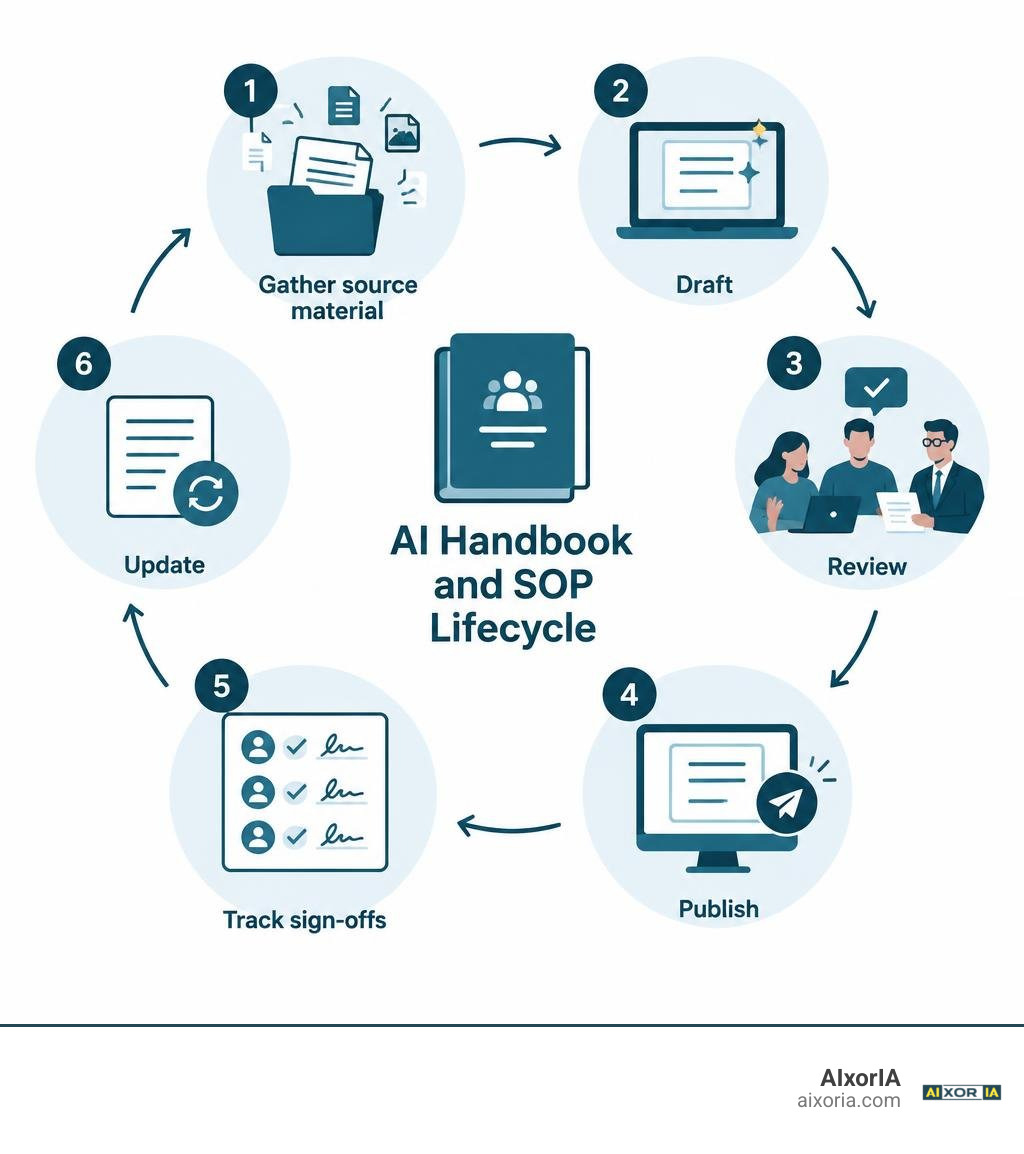
AI tools for writing employee handbooks and SOPs do different jobs. Use an AI writing tool to draft and simplify policies, a process-capture tool to turn real workflows into step-by-step SOPs, and a handbook platform if you need version control, location-specific policies, and employee sign-offs.
Start with your existing policies and actual work steps. Then have HR and the people who do the work check every draft. An employment lawyer should review legal policies before you publish them. The best setup is not the one that writes fastest; it is the one your team can keep accurate, find easily, and update without adding another fragile workflow.
Why Modern Organizations Use AI Tools for Writing Employee Handbooks and SOPs
Writing operational documentation used to mean weeks of staring at empty documents, wrestling with formatting, and hoping an old company policy PDF was not missing critical labor laws. In November 2026, companies are moving away from dusty, static binders. The employee handbook software market is projected to grow from $500 million in 2024 to $1.2 billion by 2033, expanding at a steady compound annual growth rate of 10.5%. Today, roughly 73% of HR professionals use AI-powered platforms to streamline their internal operations.
The appeal comes down to practical operational execution: teams report reducing the time spent creating new SOPs by more than 70%. When exploring the best AI tools for business productivity, business leaders quickly discover that dynamic policy generation eliminates blank-page paralysis while aligning documents with legal standards.
Beyond basic time savings, AI engines help prevent costly operational oversights. Research shows knowledge workers spend an average of 2.5 hours per day searching for internal information. Missing, scattered, or disorganized documentation can cost a 50-person team upwards of 30,000 lost hours each year. Modern platforms turn tribal knowledge into organized operational assets that align with statutory guidelines, such as equal opportunity and anti-discrimination standards.
Traditional Manual Drafting vs. Automated Policy Generation
Traditional handbook drafting relies on fragmented emails, disconnected templates, and costly outside consulting fees. When companies adopt modern AI documentation systems, the drafting lifecycle changes across several operational metrics:
| Metric | Traditional Manual Drafting | AI-Assisted Policy Generation |
|---|---|---|
| Initial Drafting Velocity | 2 to 6 weeks per document | Minutes to hours for a complete first draft |
| Consulting & Retainer Costs | $500 to $2,000+ per HR consultant draft | $97 one-time to flexible annual platform tiers |
| State & Jurisdictional Updates | Manual tracking across state legal portals | Automated statutory alerts and dynamic policy rules |
| Employee Access & Distribution | Static PDF attachments via email | Searchable web portals, Slack commands, and mobile apps |
| Audit Trails & Sign-offs | Paper forms or untracked digital signatures | Timestamped e-signatures with real-time CSV audit logs |
Living Documentation and Real-Time Compliance Monitoring
A common failure mode in corporate governance is policy decay. A company might spend thousands of dollars drafting a stellar handbook, only for local leave laws or overtime thresholds to shift a year later.
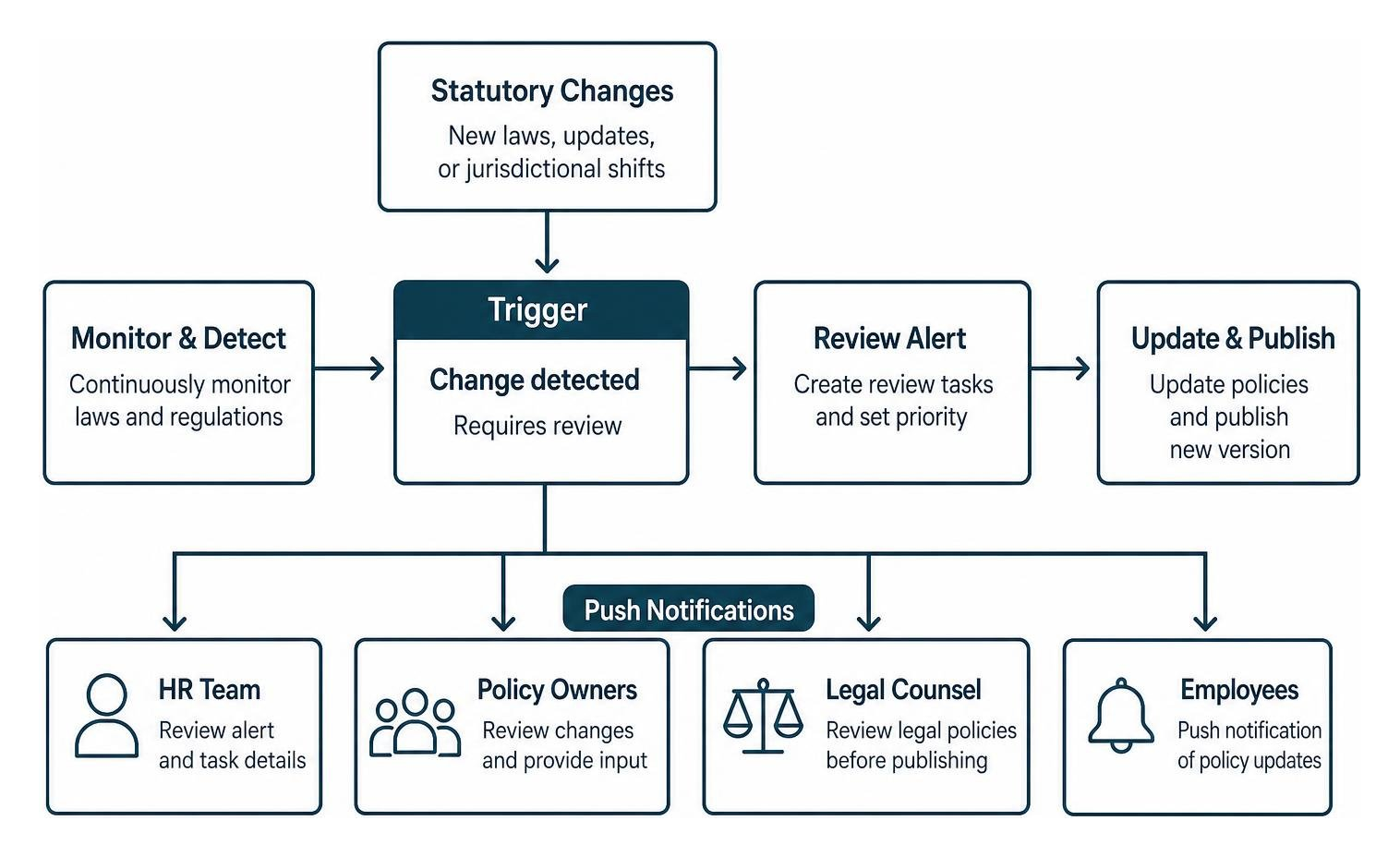
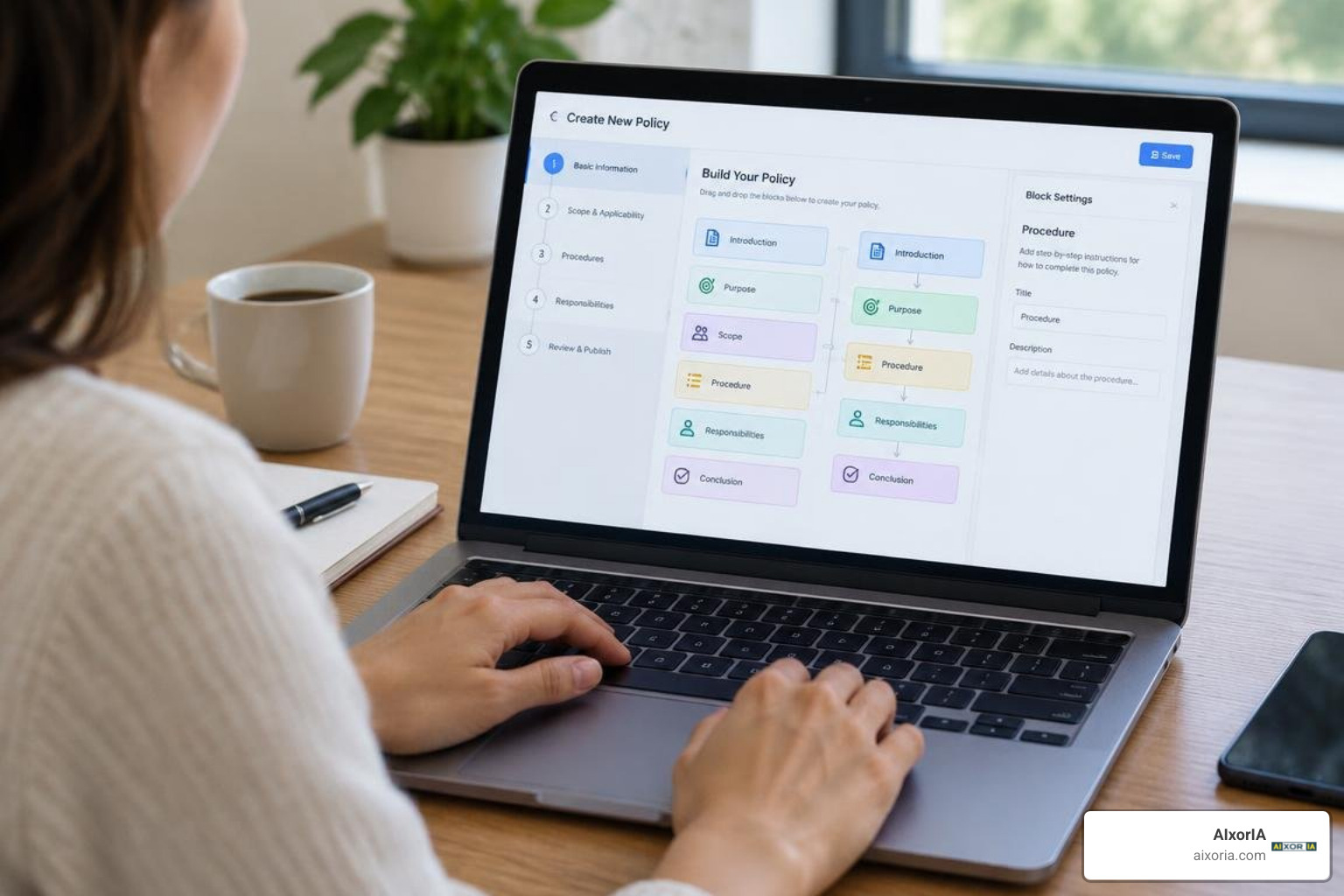
Modern software transforms static handbooks into living digital workspaces. Instead of circulating rigid PDFs that drift out of sync across regional offices, cloud-based tools allow administrators to edit policies once and push notifications across the organization. Solutions like the Free Employee Handbook Builder illustrate how automated process capture and modular templates simplify real-time updates while preserving clean version histories.
Key Categories and Architecture of Policy Automation Software
Not all AI documentation tools serve the exact same function. Deploying the right solution requires understanding the software archetypes powering workplace policies and standard operating procedures. Finding the best AI tools for work involves mapping your primary business needs to the correct architectural category.

Evaluating Specialized AI Tools for Writing Employee Handbooks and SOPs
Understanding tool classifications ensures you do not force a high-level policy engine into an interactive step-by-step technical task:
- Dedicated Compliance & Handbook Engines: Platforms built on verified legal databases. These systems use guided questionnaires to automatically adapt workplace policies to specific state and national labor regulations, preventing compliance hallucinations.
- Visual Process-Capture & SOP Tools: Extensions and desktop clients that record screen clicks and keyboard interactions, automatically turning manual tasks into illustrated, step-by-step guides with annotated screenshots.
- Generative AI Documentation Writers: Platforms like the AI Documentation Generator: SOPs, Manuals and Process Docs that take natural language notes and convert them into formatted manuals, technical playbooks, and structured SOPs.
- General-Purpose LLMs: Conversational models capable of rapid first drafts and tone adjustments, but requiring structured prompting and external human validation for legal accuracy.
Integration Ecosystems: HRIS, Chat, and Knowledge Bases
Policy documentation delivers no value if staff cannot find it when questions arise. High-performing organizations integrate policy generators directly into their Human Resource Information Systems (HRIS) like BambooHR, Rippling, and Workday, as well as communication channels like Slack and Microsoft Teams.
When a team member needs to check bereavement leave rules or shift swap protocols, they can ask a simple question in an internal chat app and receive an immediate answer citing the approved policy. Exploring the best AI tools for small business owners in 2026 helps growing teams assemble integrated tech stacks that automate new-hire onboarding without excessive software sprawl.
Step-by-Step Implementation and Prompting Best Practices
Creating an effective operational framework requires combining generative speed with structural rigor. Using the best AI tool to create a document is only half the battle; how you structure the underlying inputs determines the quality of your policies.
Prompt Engineering Strategies for AI Tools for Writing Employee Handbooks and SOPs
To generate precise, on-brand documentation without generic filler, use structured prompting techniques:
- Establish Clear Role Personas: Direct the model to act as a senior HR director or technical documentation specialist.
- Define Audience & Operational Context: State the exact company size, operating jurisdictions, and communication tone (e.g., warm, direct, professional).
- Set Concrete Behavioral Rules: Instruct the AI to avoid abstract advice (“treat clients well”) in favor of clear, observable actions (“respond to inbound client inquiries within 2 business hours”).
- Enforce Negative Constraints: Explicitly tell the model what to avoid (e.g., “Do not use passive voice; do not imply a guarantee of permanent employment; avoid third-person references”).
Managing Multi-State and Multi-Country Jurisdictions
Managing distributed teams requires accounting for localized paid sick leave, overtime calculation rules, meal breaks, and required statutory notices. Tools like the AI Employee Handbook Generator — Build a Complete Employee Handbook in 30 Seconds | EZdoc show how rapid customization workflows can generate modular addenda for specific states without breaking core company-wide culture policies.
Best practices call for keeping universal culture, behavioral standards, and core company values in a central section, while placing state-specific wage and leave disclosures into dedicated jurisdiction addenda.
Risk Mitigation, Security Standards, and Governance
Automating policy writing requires clear governance boundaries. Generative models can invent details or misinterpret local statutory language if unguided. When crafting compliance documentation, teams often apply frameworks from the best AI tools for technical report writing in 2026 to maintain structural precision.
Attorney Review Workflows and Human-in-the-Loop Oversight
AI should be treated as an efficient drafting assistant rather than a licensed employment attorney. To protect your business:
- Include Standard Disclaimers: Clarify that the handbook does not constitute a legally binding employment contract and affirms at-will employment (where applicable).
- Require Subject-Matter Sign-Off: Have department leads review procedural SOPs and HR counsel validate statutory leave policies.
- Maintain Data Security Standards: Choose enterprise platforms with SOC 2 compliance and GDPR alignment that ensure company policy data is not used to train public language models.
Digital Signatures, Audit Trails, and Employee Comprehension
Distributing an operational manual is only legally defensible if you can prove receipt and comprehension. Modern handbook platforms include timestamped e-signatures, dynamic version tracking, and quick comprehension quizzes to verify that employees understand critical workplace policies.
Frequently Asked Questions About AI Policy Generation
Can AI tools replace the need for an employment lawyer?
No. AI tools dramatically accelerate the drafting process and reduce legal consulting hours by organizing core information ahead of time. However, qualified legal counsel should always review policies to verify multi-state compliance and address industry-specific liability.
How do AI generators handle updates when employment laws change?
Dedicated handbook platforms monitor federal, state, and local statutory changes and trigger automated alerts when updates are required. Administrators can review the revised language, update the live document, and automatically request new employee acknowledgments.
What is the typical cost and time investment for AI handbook creation?
Standard setups range from $97 one-time tools to $20 to $250 monthly subscriptions for integrated SOP and compliance suites. An initial handbook draft can be generated in under 10 minutes, with complete customization, team review, and publication typically wrapping up in a few hours.
Conclusion
Building compliant, readable, and engaging employee handbooks and SOPs no longer requires months of manual writing or expensive consultant retainers. By combining specialized AI generation tools, automated process capture, and human legal oversight, modern organizations can build scalable documentation that keeps teams aligned.
At AIxorIA, we help businesses implement practical artificial intelligence frameworks, practical tool training workshops, and performance audits to streamline operations while avoiding vendor lock-in. To transform your company’s operational workflows and document management, explore our scalable AI automation solutions today.