How AI Tools Help General Contractors Bid and Schedule Work
Scr0ll d0wn to D0VVNL0AD
AI tools for bids and scheduling for general contractors can measure quantities from drawings, flag missing scope in bids, and test schedules against crew and material limits. Start with the task that slows your team down most. Then compare the tool’s output with an estimate or schedule your team has already checked.
A faster bid is only useful if its numbers hold up. The same goes for a shorter schedule that ignores trade conflicts. Keep estimators and project managers responsible for reviewing quantities, prices, and dates before anyone commits to them.
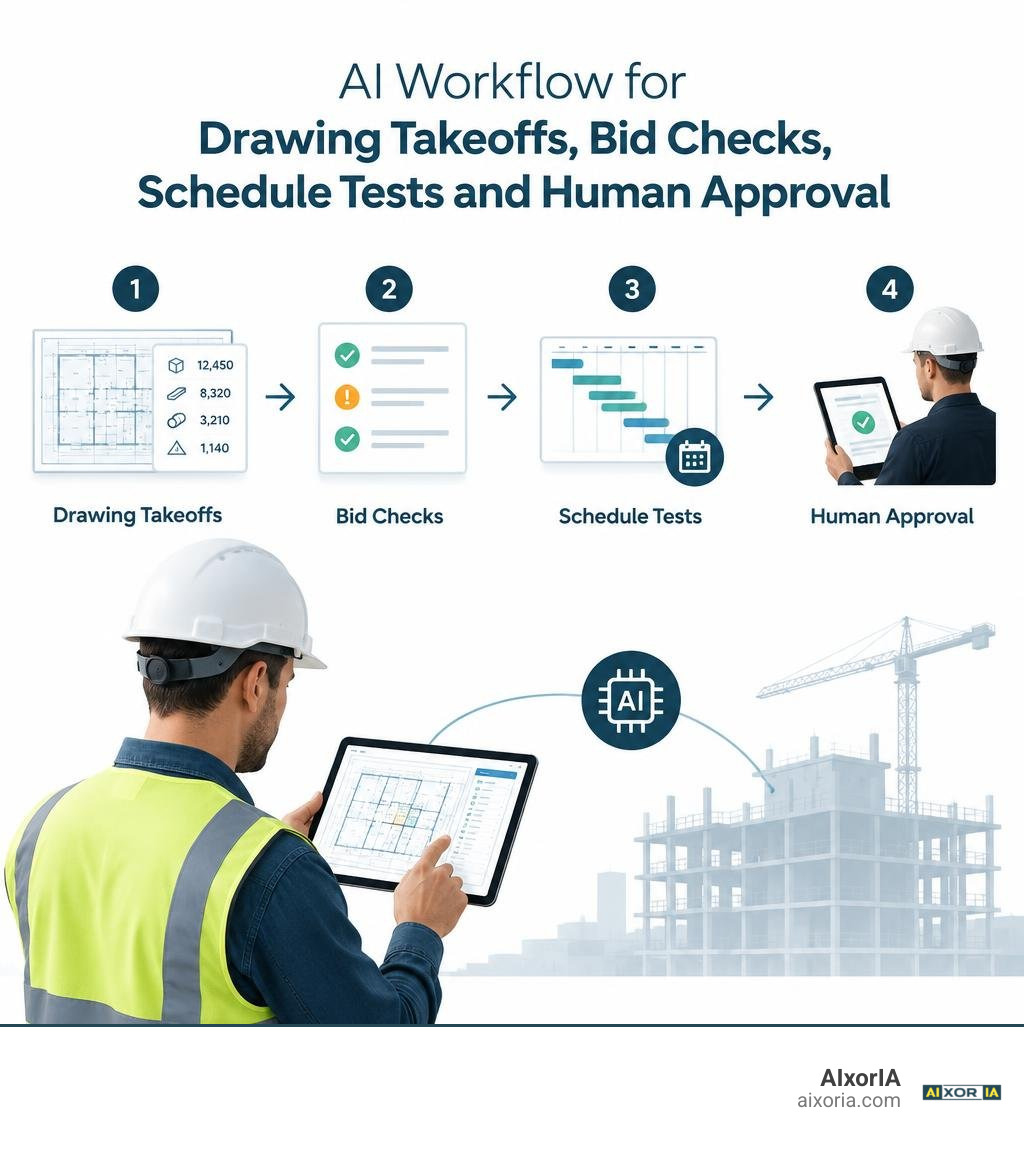
Tight margins define modern commercial construction, with industry averages hovering near 5%. Furthermore, roughly 80% of projects experience cost overruns or schedule delays. Many of these issues stem directly from preconstruction blind spots, including manual measurement errors, missing sub-tier trade scopes, and unrealistic schedule sequences. Inaccurate takeoffs alone often cause material overruns accounting for 5% to 10% of total project costs.
By pairing machine learning algorithms with construction workflows, general contractors can speed up administrative throughput and protect profitability from preconstruction through project closeout.
How AI Tools for General Contractors for Bids and Scheduling Transform Preconstruction
Preconstruction traditionally relies on estimators and project managers sifting through hundreds of drawing sheets, specification books, and subcontractor quotes. Using ai tools for general contractors for bids and scheduling transforms this manual grind into an automated workflow. Platforms process plan sets using optical character recognition (OCR) and computer vision, identifying physical measurements, equipment requirements, and schedule constraints in a fraction of the usual time.
These technologies reduce estimation time by up to 50% while improving bid turnaround speeds. When teams eliminate repetitive data entry, they can focus on value engineering and trade coordination. To learn how automated systems support broader project workflows, see our breakdown of the best AI tools for construction project management.
Specialized subcontractors and prime contractors experience similar advantages. By replacing ruler-and-highlighter processes with automated geometry recognition, teams eliminate takeoff errors, capture missing scope, and lower material waste.
Accelerating Material Takeoffs and Bid Accuracy with AI
Manual takeoff processes are slow and prone to human error, especially under tight bid deadlines. AI-driven takeoff tools use computer vision to analyze 2D PDF drawing sets and 3D BIM models simultaneously. They extract linear footages, area counts, and fixture quantities across every standard CSI division.
Modern estimating solutions auto-detect drawing scales, extract structural, architectural, and MEP elements, and assign confidence scores to each measurement. If a sheet contains ambiguous line work or missing callouts, the system flags the item for review rather than guessing.
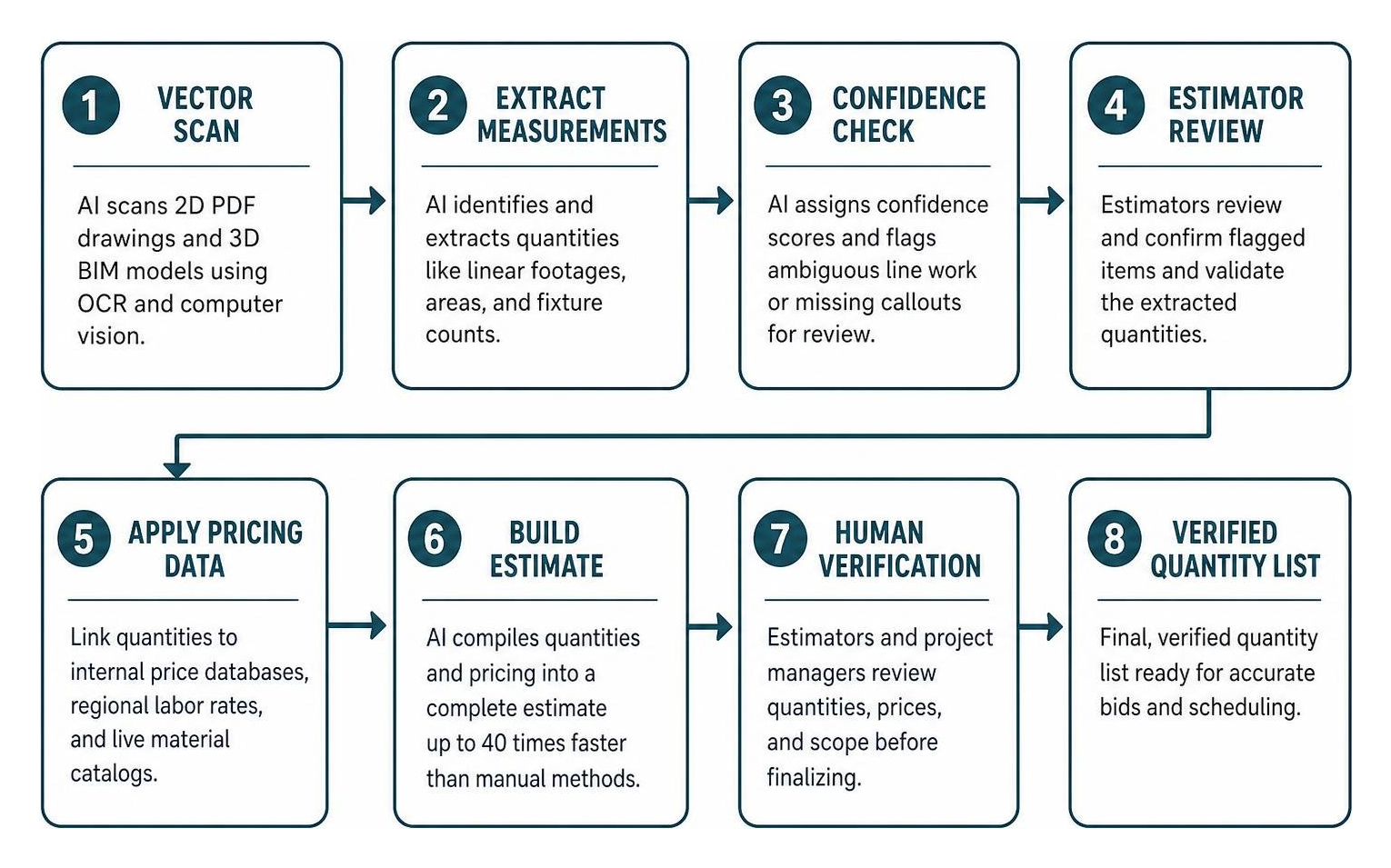
Estimators can link these physical counts directly to custom internal price databases, regional labor rates, and live material catalogs, building accurate estimates up to 40 times faster than manual methods.
Automated Subcontractor Bid Leveling and Scope Gap Detection
A standard commercial general contractor bid package often involves 30 to 40 distinct trade scopes and hundreds of individual subcontractor proposals. Manually comparing these quotes under tight deadlines frequently leads to missed exclusions, duplicate line items, and unbudgeted scope gaps.
Specialized platforms automate bid leveling by parsing incoming subcontractor bids across PDFs, spreadsheets, and emails. The AI standardizes disparate formats into a normalized side-by-side comparison matrix, automatically highlighting trade exclusions, tax discrepancies, and scope overlaps. If an electrical quote leaves out low-voltage conduits or HVAC controls, the software flags the gap before bid submission, allowing teams to issue targeted RFIs immediately.
Optimizing Construction Timelines: Generative Scheduling and Risk Prediction
Traditional Critical Path Method (CPM) tools generate static schedules that model only one execution sequence at a time. Generative AI scheduling platforms analyze millions of sequencing combinations, resource constraints, and site rules to generate optimized time-versus-cost execution baselines.

These engines analyze historical site production rates and trade dependencies to predict delays up to 45 days before field crews encounter them, giving teams ample time to adjust manpower and procurement.
| Scheduling Capability | Traditional CPM Software | Generative AI Scheduling Platforms |
|---|---|---|
| Scenario Modeling | Single, manual scenario evaluation | Millions of automated ‘what-if’ simulations |
| Schedule Generation Time | Days to weeks of manual input | Generated in minutes from quantities and rules |
| Delay Prediction | Reactive, manual variance tracking | Up to 90% predictive accuracy for delays |
| Resource Leveling | Manual crew and equipment adjustments | Automated constraint-based multi-trade leveling |
| Schedule Quality Audits | Manual review against best practices | Automated DCMA-14 quality score analysis |
AI Tools for Bids and Scheduling for General Contractors: Dynamic CPM and What-If Simulations
During preconstruction and active build phases, dynamic CPM scheduling engines allow project managers to stress-test their timelines against real-world disruptions. Using Monte Carlo simulations and constraint modeling, these tools evaluate how inclement weather, equipment shortages, or labor availability will impact final completion dates.
Project teams can simulate trade handoffs to optimize crew flow across floors and work zones. For contractors looking to improve administrative turnaround beyond scheduling, exploring our guide to the best AI tools for proposal writing can help streamline client presentations.
Integrating AI Engines with Established CPM Scheduling Software
Adopting AI scheduling does not require replacing established project controls. Modern platforms offer bi-directional integrations with standard enterprise CPM suites and desktop scheduling applications.
Teams import their baseline CPM schedules via standard XML or XER files. The AI engine audits the schedule against DCMA-14 quality metrics (checking for open ends, unrealistic leads or lags, and invalid constraints), runs parametric scenario simulations, and exports the optimized logic directly back into the primary scheduling system.
Key Features to Evaluate in Contractor Bidding and Scheduling Platforms
Selecting the right preconstruction and field management stack requires evaluating how well each tool handles unstructured construction data. To see how these solutions fit into a modern office stack, explore our top picks for business productivity software.
Evaluating Core Capabilities in AI Tools for Bids and Scheduling for General Contractors
When auditing prospective AI software, general contractors should confirm the platform supports these practical operational capabilities:
- Semantic Document Search: Natural language search engines that index thousands of drawing revisions, project specifications, and addenda, cutting document research time by up to 75%.
- Zero-Login Subcontractor Portals: Bilingual, mobile-friendly portals that allow trade partners to submit pricing, review drawings, and acknowledge change orders without cumbersome app downloads.
- Structured Data Hierarchies: Systems that organize information into clear Property, Scope, and Work Item categories rather than free-text notes fields.
- Interactive Web Proposals: Digital bid deliverables featuring itemized scope options, client view tracking, and built-in electronic sign-offs.
Mitigating Preconstruction and Scheduling Risks with Predictive Analytics
Predictive analytics allow contractors to identify financial and operational vulnerabilities before signing subcontracts or mobilizing field crews. Automated contract review engines scan owner agreements and subcontractor quotes for indemnification clauses, liquidated damages triggers, and insurance discrepancies.
By analyzing historical subcontractor performance (such as past change-order frequency, safety compliance, and schedule adherence), AI platforms help teams build reliable bidder lists. For deeper insights into leveraging operational metrics, check out our review of the best AI data analysis and visualization tools.
Implementation Strategy, Measurable ROI, and Common Adoption Challenges
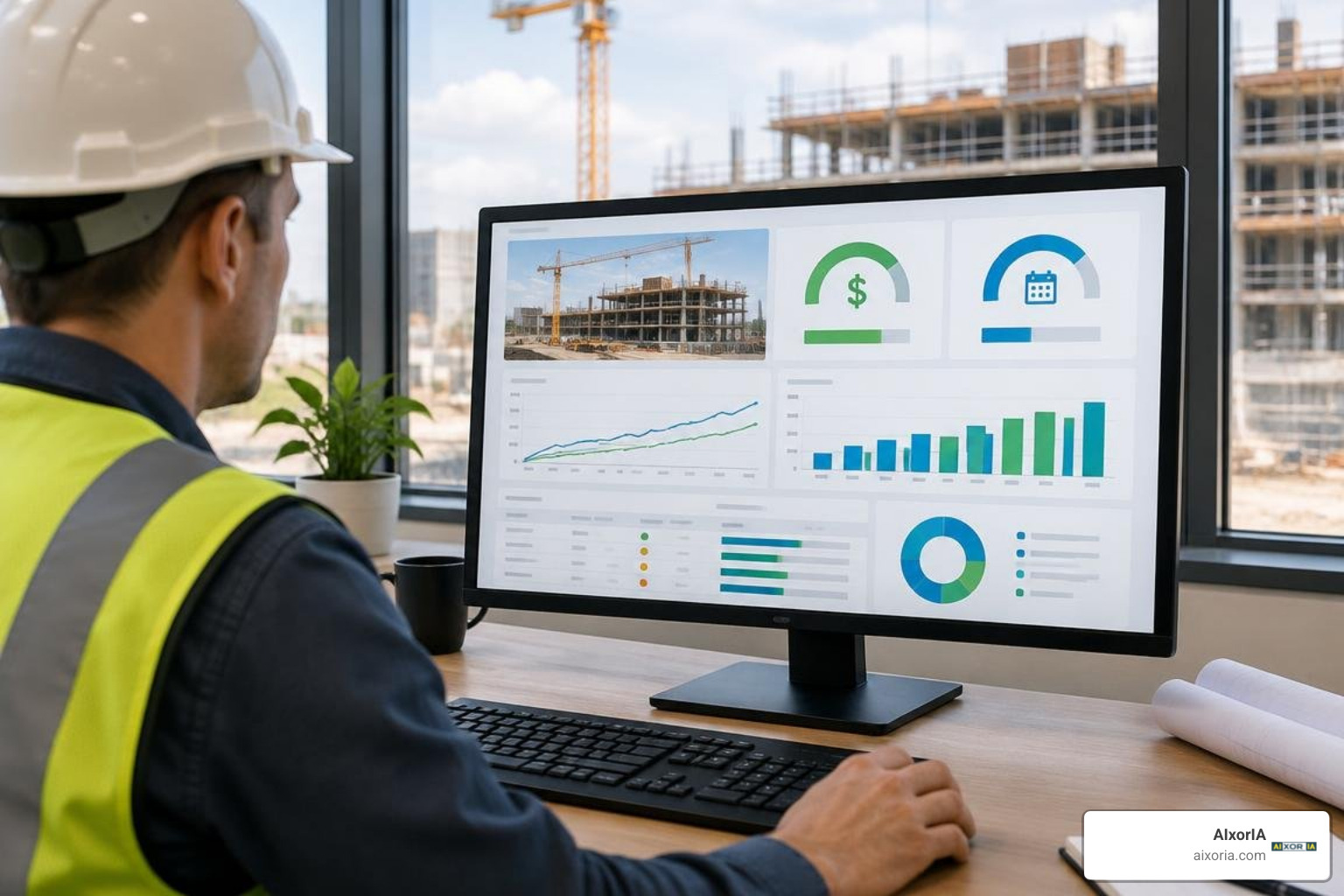
Implementing AI in construction preconstruction and project management yields tangible financial benefits across project lifecycles:
- Bid Win Rates: Contractors using AI estimating software report an average 20% improvement in bid win rates due to faster submissions and sharper unit pricing.
- Administrative Overhead: Automated RFI drafting, submittal logging, and daily field summaries cut manual administrative work by 30% to 40%.
- Schedule Compression: Generative scheduling tools have been deployed on over $410 billion in construction projects worldwide, delivering average project duration reductions of 17%, labor cost savings of 14%, and equipment cost reductions of 12%.
- Project Overrun Reductions: Predictive tracking and real-time labor analytics drive a 22% reduction in average project overruns.
Measuring Financial ROI and Operational Time Savings
The return on investment from AI adoption comes from recovered estimator hours and avoided site delays.
When an estimating team uses automated vector takeoffs, bid turnaround times drop by up to 50%. The resulting bandwidth allows firms to bid on more work without increasing headcount. On the jobsite, catching schedule slippage 45 days in advance prevents trade stacking and costly overtime.
Practical Steps for Small and Mid-Sized GCs to Get Started
Small and mid-sized contractors should take an incremental approach rather than attempting a full operational overhaul overnight:
- Audit Preconstruction Bottlenecks: Identify the single workflow consuming the most non-billable hours—whether that is blueprint takeoffs, subcontractor chasing, or daily field logging.
- Pilot a Single Point Solution: Implement one tool focused exclusively on that bottleneck for a 30-day trial on an active or recently completed project.
- Benchmark Against Manual Controls: Run the AI tool alongside your traditional spreadsheet or manual workflow to compare accuracy, speed, and confidence.
- Clean and Centralize Historical Data: Consolidate past cost codes, subcontractor directories, and completed schedules into structured digital formats.
- Establish Human-in-the-Loop Safeguards: Train estimators and project managers to audit AI outputs, ensuring that all quantities, prices, and schedule logic receive professional approval before commitment.
Frequently Asked Questions About Construction AI Bidding and Scheduling
How accurate are AI-driven material takeoffs and cost estimates compared to manual methods?
AI takeoff software processes vector drawings and digital plan sets with high precision, identifying line geometry, area dimensions, and component counts directly from source documents. However, accuracy depends on drawing clarity and scale calibration. Reliable tools provide confidence scores for every quantity and link line items directly to source drawing sheets so human estimators can verify the figures before submission.
Can AI scheduling tools adapt to unexpected jobsite disruptions like weather or material delays?
Yes. Unlike static CPM charts, generative AI scheduling engines integrate live weather forecasts, delivery schedules, and field production logs. When a disruption occurs, the platform recalculates downstream task dependencies, re-sequences non-critical paths, and suggests optimal recovery strategies to keep final completion dates on target.
Do general contractors need large historical datasets to implement AI bidding software?
No. Most modern construction AI platforms use pre-trained industry models capable of reading standard architectural blueprints, extracting CSI divisions, and parsing sub bids from day one. While uploading historical project data, past price books, and local labor rates sharpens bid accuracy over time, it is not required to start generating takeoffs or basic schedule simulations.
Conclusion
The construction industry is moving away from manual takeoff highlighters, static CPM schedules, and fragmented spreadsheets. By adopting modern AI tools for bidding and scheduling, general contractors can protect their margins, eliminate costly scope gaps, and optimize field execution. The most competitive builders will not replace their human talent with technology; they will equip their estimators and project managers with automated tools that turn complex drawing sets and trade constraints into actionable, profitable plans.
To discover how modern automation frameworks and workflow strategies can elevate your operations, explore AIxorIA’s enterprise workflow automation and consulting solutions to build your competitive edge.