What AI-Based Automation Testing Tools Do
Scr0ll d0wn to D0VVNL0AD
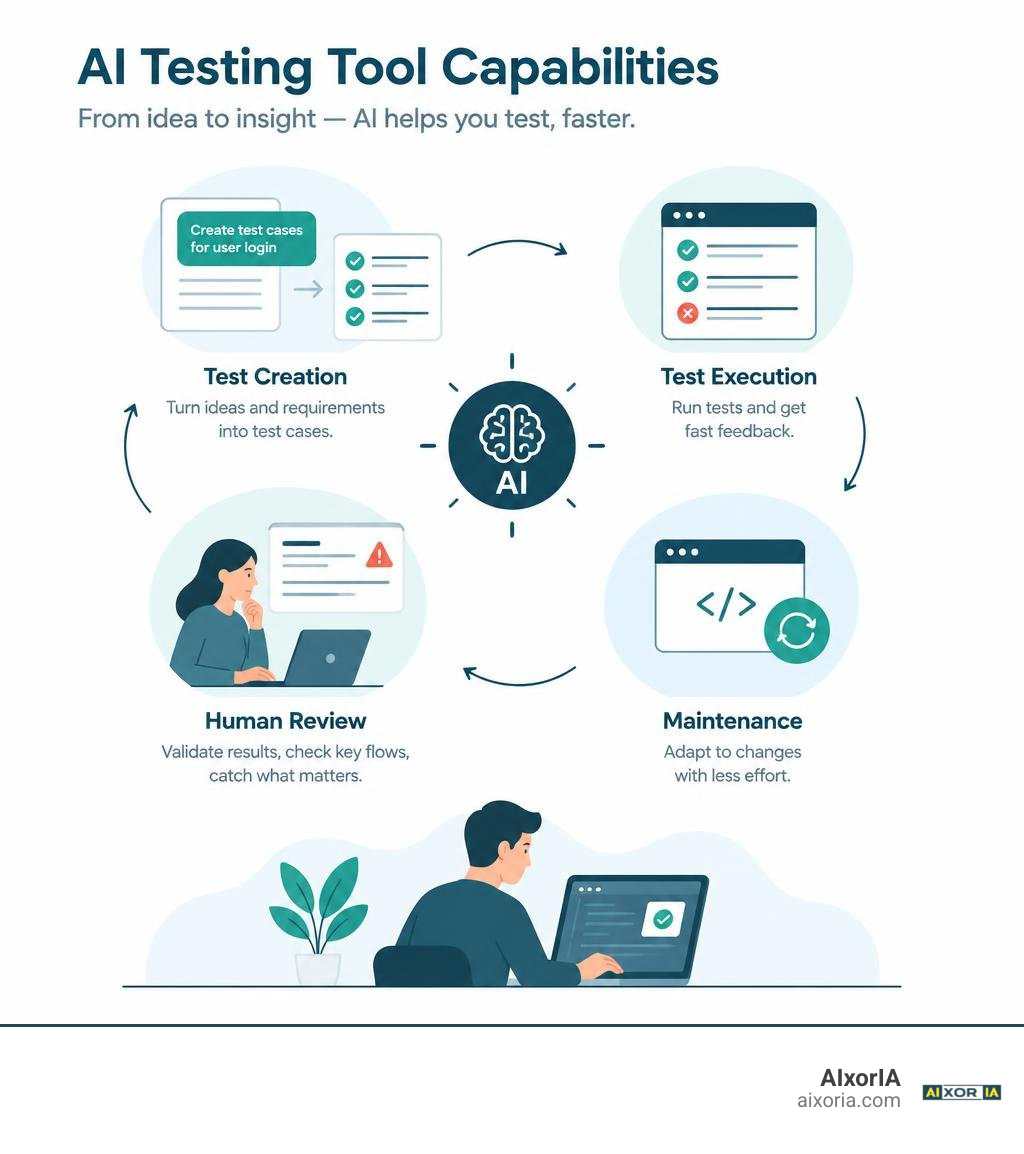
AI-based automation testing tools help teams create, run, and maintain software tests with less manual work. They can turn plain-language requirements into test cases, spot failed tests, and suggest fixes when an app changes. To choose one, start with the work that slows your team down most: writing tests, keeping them up to date, or finding the cause of failures.
In 2026, these tools can help small teams test more often without writing every check by hand. But AI does not decide what quality means for your users. People still need to review test results, check important user journeys, and catch issues the tool was not told to look for.
Understanding the Automation Continuum: Where AI Fits In
Automation is not a single leap from manual clicking to fully self-aware software. Instead, it exists along an evolving spectrum of technical maturity. To understand how testing tools have transformed our development cycles, we need to look at how basic task execution evolved into cognitive decision-making.
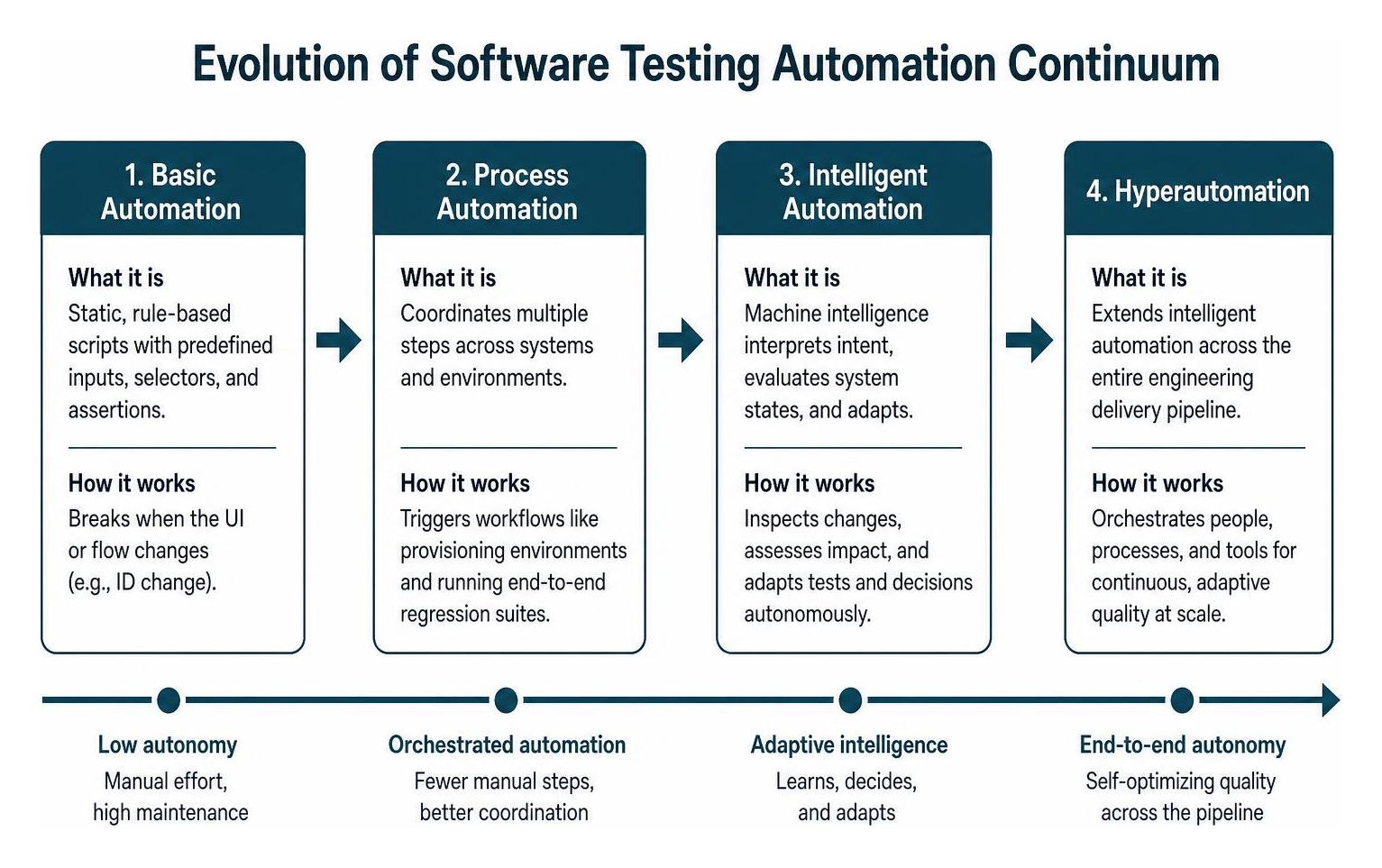
At the foundation lies basic automation. This tier relies on static, rule-based scripts where every input, selector, and assertion must be predefined. If a button changes its ID from #submit-btn to #order-submit, the script breaks immediately. Next is process automation, where systems coordinate multiple steps across disparate systems, such as spinning up staging environments and running end-to-end regression suites via continuous integration triggers.
The breakthrough occurs at the intelligent automation tier. Here, machine intelligence combines with workflow execution to interpret intent, evaluate system states, and make autonomous decisions. Instead of blindly executing hardcoded commands, intelligent testing platforms inspect application changes, assess whether a difference is intentional, and adapt accordingly. Exploring the deeper relationship between modern AI and automation reveals how these technologies bridge the gap between static scripting and dynamic environment management, culminating in hyperautomation across entire engineering delivery pipelines.
Cognitive Capabilities in AI-Based Automation Testing Tools
Modern AI testing frameworks utilize specialized cognitive capabilities to handle test creation, execution, and ongoing maintenance:
- Natural Language Processing (NLP): Parses user stories, Jira tickets, and plain-English prompts into structured, multi-step test scripts without requiring developers to write boilerplate code.
- Computer Vision: Employs pixel matching, layout analysis, and optical character recognition (OCR) to evaluate user interfaces just as a human eye would, detecting visual regressions and missing UI components.
- Machine Learning (ML) Prediction: Analyzes historical run logs, source code diffs, and execution timing to prioritize high-risk test paths and predict code vulnerabilities.
- Multi-Agent Architectures: Deploys coordinated AI agents where specialist roles (such as explorers, script writers, healers, and triage agents) collaborate to build and repair suites.
In these agentic loops, specialized open-source tools highlight the power of collaborative AI. Projects exploring open-source multi-agent testing architectures demonstrate how distinct agents can crawl an application, write tests, validate assertions, and heal selectors on a shared blackboard. Similarly, advanced developer solutions implementing self-healing selector memory frameworks utilize multi-tier caching and local language models to automatically repair broken UI locators without incurring massive API latency or cloud costs.
Categorizing Modern Quality Assurance Frameworks
Testing is not one-size-fits-all, and different layers of the software stack demand specialized tools. When evaluating different types of testing tools, organizations must balance several critical testing domains:
- Functional & E2E Testing: Simulates user journeys across web and mobile platforms, validating that business logic, authentication flows, and data entry paths function seamlessly.
- API & Backend Validation: Tests endpoint contracts, payloads, and microservice communications under various system states.
- Visual Regression Testing: Compares rendered snapshots against design baselines to flag unexpected CSS shifts, text clipping, and responsive layout flaws.
- Performance & Security Benchmarking: Simulates concurrent traffic loads and scans for common injection vulnerabilities or authentication gaps before release.
Core Advantages and Architectural Capabilities of AI Testing
Traditional test automation has long suffered from high initial setup costs and brittle locators. The primary advantage of AI-driven testing is resilience. By moving from hardcoded Document Object Model (DOM) queries to intent-aware testing, modern platforms understand what an element represents rather than just where it sits in the HTML tree. Integrating these frameworks alongside streamlined AI-driven debugging workflows allows developers to diagnose root causes instantly when tests fail.
| Capability Dimension | Traditional Automated Testing | AI-Based Automation Testing |
|---|---|---|
| Test Creation | Manual scripting in code frameworks (Selenium, raw Cypress) | Plain English generation, zero-code intent mapping, auto-crawling |
| Selector Stability | Brittle; breaks on attribute or layout changes | Resilient; uses multi-attribute waterfalls and visual fallbacks |
| Maintenance Burden | High (often 40%+ of QA engineering sprint time) | Low; automated self-healing updates cached locators |
| Execution Strategy | Static, full-suite regression runs | Dynamic, risk-based prioritization driven by code diffs |
| Triaging Failures | Manual log parsing and stack trace reviews | Automated classification distinguishing real bugs from flaky tests |
Integrating AI-Based Automation Testing Tools with CI/CD Pipelines
To deliver real value, AI-driven testing must integrate directly into modern deployment pipelines. Autonomous platforms run in headless mode on every pull request, executing test suites in parallel and feeding live telemetry into platforms like GitHub Actions, GitLab CI, and Jenkins.
By leveraging autonomous QA agents in deployment pipelines, engineering teams can generate and validate complete test suites locally or in CI environments, catching regressions before code merges to main branches. Connecting these testing harnesses with comprehensive enterprise workflow automation software ensures that failure reports, video recordings, and triage tickets sync directly with project management boards without human intervention.
Autonomous Test Execution and the Lights-Out QA Model
In industrial manufacturing, the “lights-out” concept refers to factories operating completely autonomously without human presence on the floor. In software engineering, lights-out testing represents the continuous execution of synthetic user journeys, automated regression sweeps, and self-healing validation around the clock.
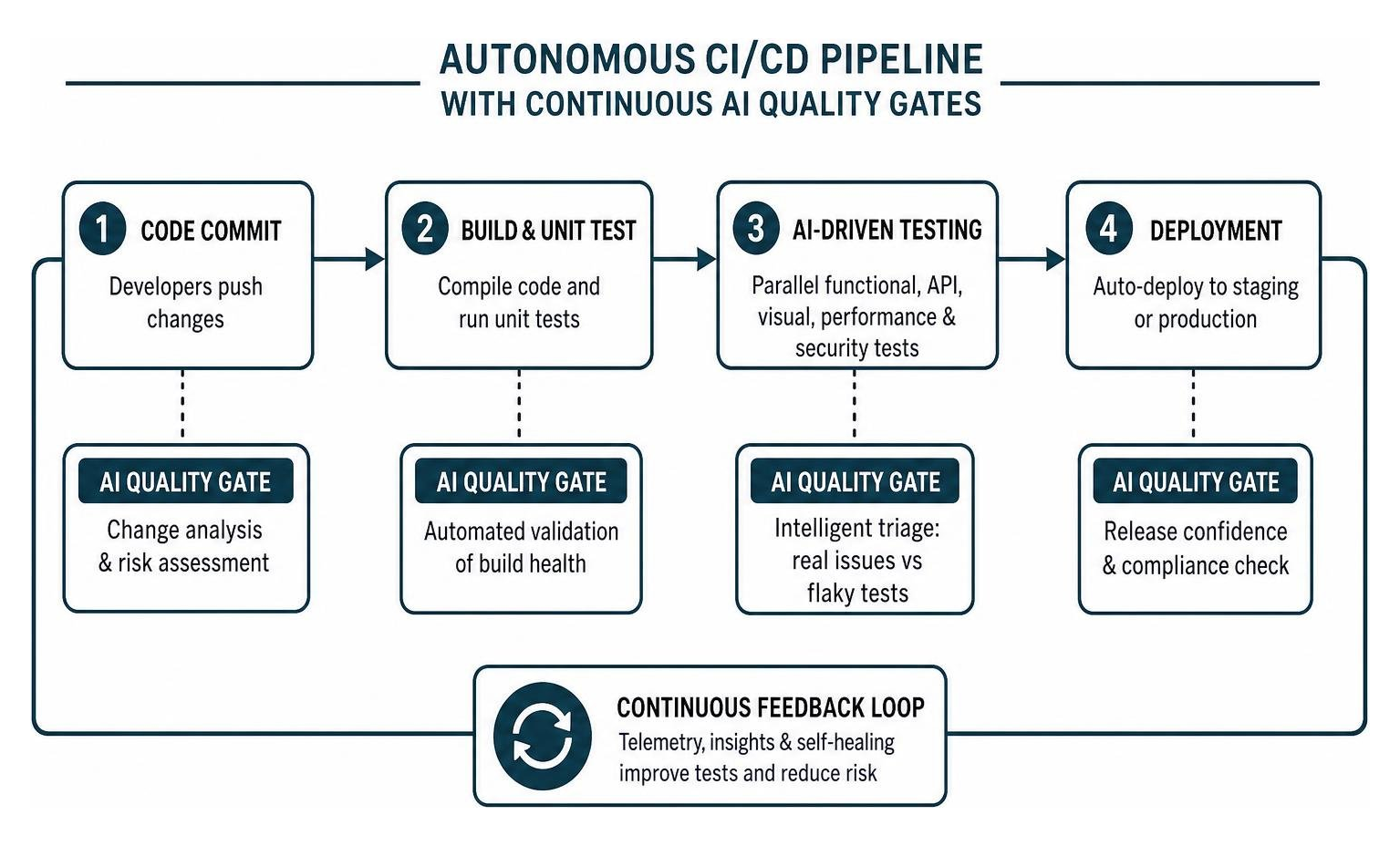
Using platforms designed for scriptless end-to-end test execution, teams can describe complex user behavior in natural language and let intelligent runners navigate application updates, verify domain criteria, and heal broken paths automatically. This delivers 24/7 testing coverage, enabling continuous delivery even when engineering teams are offline.
Managing Risks, the Paradox of Automation, and Technical Limits
Despite these remarkable advances, intelligent testing brings distinct challenges. The most prominent is the paradox of automation: as automated systems become more reliable and capable, human oversight becomes both less frequent and far more critical. When tests run seamlessly for weeks, teams risk falling into complacency. When an unexpected edge case slips through, engineers who have not engaged in manual validation may struggle to diagnose the root issue quickly.

Furthermore, AI models have definite technological boundaries:
- Subjective UX Assessments: An AI agent can verify that a button is clickable, but it cannot genuinely assess whether an interface feels intuitive, delightful, or aesthetically pleasing.
- Unpredictable Edge Cases: Machine learning models rely on statistical likelihoods derived from training patterns; novel user behaviors or rare environmental race conditions often escape synthetic generation.
- Complex Sensory & Real-Time Data: Applications relying on streaming audio, specialized spatial computing, or analog inputs still present significant verification hurdles for pure software agents.
- Hardware and Industrial Systems: While web and cloud applications thrive under AI testing, embedded systems and manufacturing floors still depend heavily on Programmable Logic Controllers (PLCs) and industrial control hardware. In these environments, physical feedback loops and deterministic timing constraints require specialized testing instrumentation beyond standard software agents.
Maintaining a rigorous human-in-the-loop strategy ensures that AI handles repetitive execution while human engineers focus on exploratory testing, threat modeling, and high-level architectural quality.
Societal Impact, QA Career Evolution, and Measuring Business ROI
The rapid expansion of AI automation naturally sparks discussions surrounding technical employment. Economic studies, such as research published in the Journal of Political Economy (2020), have documented labor reallocation effects from industrial automation, finding that one additional robot per thousand workers reduced the employment-to-population ratio by 0.2 percentage points. Similarly, a landmark 2013 Oxford Martin School study projected that 47% of US jobs faced automation potential by 2033.
However, a comprehensive 2015 McKinsey study revealed a more nuanced reality: very few occupations face complete automation; instead, specific repetitive activities within jobs are automated. For quality engineering, this distinction is transformative. AI eliminates the repetitive grind of writing boilerplate selectors, updating broken class names, and manually verifying standard form fields.
This shift elevates QA professionals into Quality Architects. Rather than spending 40% of their sprints fixing flaky test scripts, engineers now design test strategies, orchestrate multi-agent test environments, enforce security baselines, and evaluate complex business logic. In modern development stacks, teams pairing quality harnesses with the latest AI software development tools build faster, more resilient release pipelines without expanding team overhead.
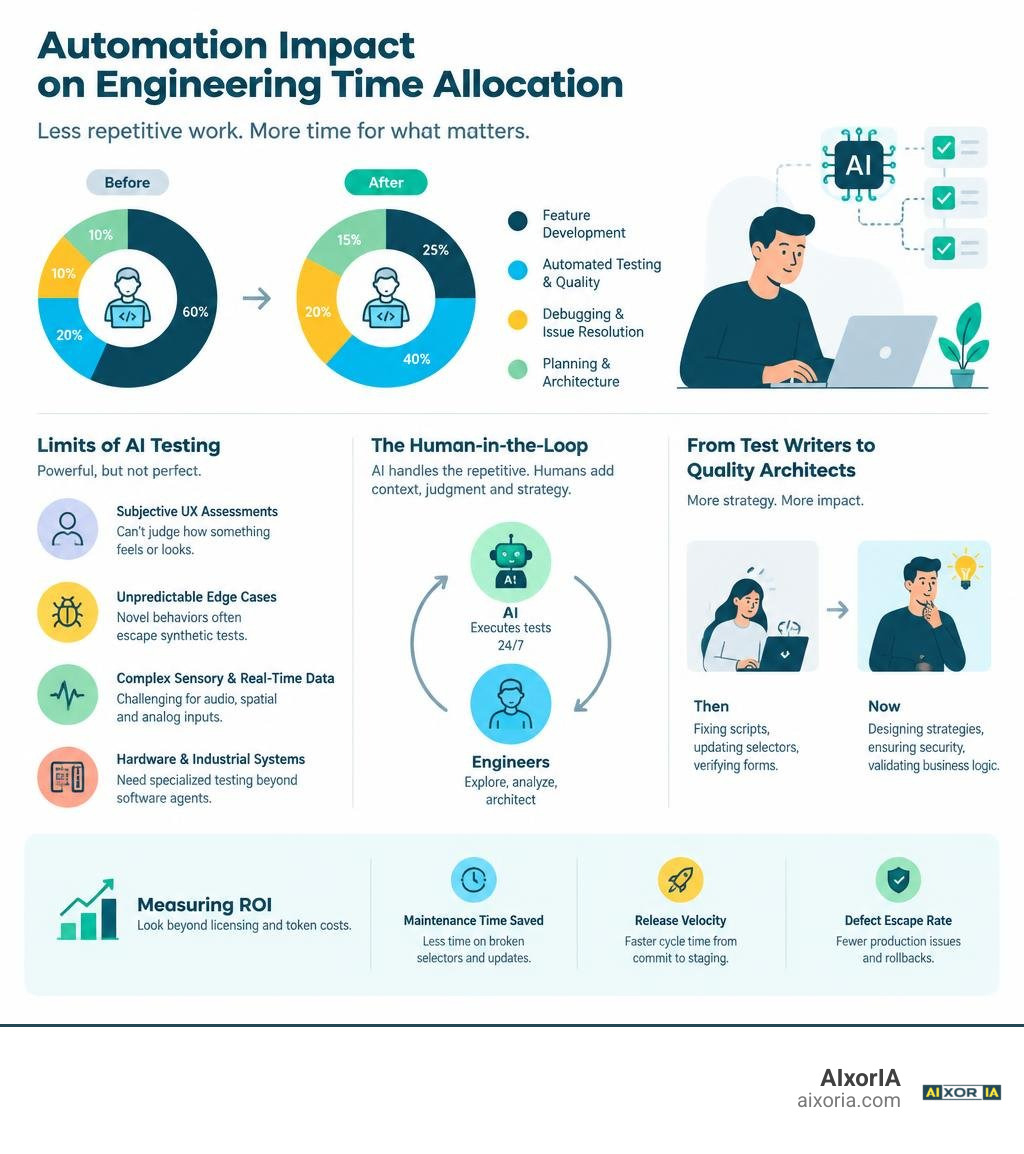
To calculate the return on investment (ROI) when adopting these tools, organizations must look beyond initial licensing and token costs:
- Maintenance Time Saved: Measure the reduction in engineering hours spent updating broken test selectors each sprint.
- Release Velocity: Track cycle time improvements from code commit to staging verification.
- Defect Escape Rate: Monitor production incidents and regression rollbacks before and after AI adoption.
- Token Spend & Infrastructure Costs: Balance API model token consumption against cloud testing infrastructure efficiency gains.
Strategic Framework for Selecting AI-Based Automation Testing Tools
Selecting the right testing tool requires evaluating architecture, security, and developer ergonomics rather than falling for surface-level marketing claims. When integrating with your stack, look for platforms that support multi-model routing (preventing vendor lock-in across OpenAI, Anthropic, and local LLMs), deterministic audit trails, and strict data privacy boundaries that keep proprietary source code on your local runners.
Developers actively using the best AI coding tools will appreciate platforms that fit natively into Git-based review workflows. For comprehensive quality enforcement, deploying agentic test verification platforms provides independent verification loops and CI quality gates that prevent untested code from reaching production. Furthermore, modern solutions utilizing AI agents testing on real browsers demonstrate how teams can achieve expansive end-to-end test coverage across real browser engines using natural language specifications and automated session recordings.
Frequently Asked Questions
How do self-healing selectors work in AI testing tools?
Self-healing mechanisms monitor test execution steps in real time. When an element cannot be found using its primary locator, the tool inspects surrounding DOM attributes, accessibility labels (ARIA), hierarchy positions, and visual bounding boxes. If a confident match is found, the test proceeds without failing, and the new locator is stored in a local cache with a confidence score that automatically updates over time.
Will AI-based automation testing tools replace QA engineers?
No. AI testing tools automate specific repetitive activities—such as selector maintenance, boilerplate script generation, and regression sweeps—rather than the entire discipline of quality engineering. Human engineers remain essential for defining quality criteria, conducting exploratory and accessibility testing, modeling edge cases, and interpreting complex user requirements.
What is the paradox of automation in software quality assurance?
The paradox of automation describes how increasing system reliability makes human intervention less frequent but significantly more critical. When automated test suites run reliably without manual interaction, engineers may lose immediate familiarity with the codebase. If an unprecedented failure occurs, diagnosing and resolving the issue requires deeper expertise and immediate, high-level technical oversight.
Conclusion
The shift toward intelligent, agentic quality assurance is transforming software delivery. By handling repetitive test creation, stabilizing flaky selectors, and triaging execution failures, modern testing tools empower teams to build and ship with unprecedented speed. Yet, true software excellence still relies on human insight to guide testing strategies and uphold user trust.
To stay ahead of emerging testing frameworks, developer productivity workflows, and practical implementation guides, discover expert-curated AI and automation resources at AIxorIA and explore our latest industry tutorials.