How Long Does It Take to Build a Landing Page? Realistic Timelines by Build Method
Scr0ll d0wn to D0VVNL0AD
When planning a campaign, asking the right question sets expectations: how long does it take to build a landing page? The answer depends heavily on the build method you choose, the tools involved, and the level of customization required. In 2026, modern tooling and AI assistants have drastically compressed raw development time, but project calendars still vary from a single afternoon to several months.
| Build Method | Active Work Hours | Calendar Duration | Typical Complexity & Use Case |
|---|---|---|---|
| Pre-Built Template (e.g., Next.js / HTML) | 4–12 Hours | Few hours to 2 Days | Simple lead gen, early-stage waitlists, minimal custom styling |
| Modern No-Code / AI Builder | 8–20 Hours | 1–3 Days | Product launches, event registration, paid ad landing pages |
| Freelance Designer & Developer | 24–40 Hours | 1–3 Weeks | Custom brand assets, tailored conversion funnels, bespoke UI |
| Full-Service Digital Agency | 40–80+ Hours | 3–8 Weeks | Enterprise campaigns, multi-stakeholder corporate approval, deep backend CRM logic |
As shown in this realistic timeline analysis, active work hours rarely match calendar duration. A solo creator might put in 30 hours of work over five business days, whereas an agency spreading that same 30 hours across multiple departments and feedback cycles might require six calendar weeks.
Pre-Built Templates and Rapid Frameworks
Using a production-ready Next.js template or a modern static HTML theme offers the fastest route to market. For teams with basic coding skills, you can grab a pre-structured repository, connect your repository to a hosting platform, swap out text strings, insert product photography, and point your DNS records within a few hours to 1–2 days.
Because the underlying layout, grid system, responsive breakpoints, and CSS classes already exist, you bypass the entire visual wireframing and prototyping phase. If you are looking for simple ways to get started without heavy engineering, exploring some of the best affordable landing page builders can help you select cost-effective platforms tailored for rapid deployment.
How Long Does It Take to Build a Landing Page Using Modern AI and No-Code Stacks?
Visual page builders and AI-assisted layout generators have reshaped conversion design. Today, a marketer or designer working in a visual canvas can assemble a polished, mobile-responsive page in 1 to 3 days.
AI generation tools allow teams to generate initial section wireframes, draft placeholder value propositions, and style components in minutes. The bulk of your remaining time goes toward fine-tuning typography, connecting lead capture forms to your email marketing tool, and running mobile audits. If you want to test product ideas quickly without upfront software subscriptions, testing the best free landing page builder tool in 2026 lets you build functional landing pages rapidly.
Freelance Designers and Dedicated Developers
Hiring an experienced solo freelancer typically takes between 1 and 3 weeks (around 24 to 40 hours of focused labor). Freelancers create bespoke visual layouts matched to your brand identity, delivering high-converting aesthetics that avoid looking like a cookie-cutter template.
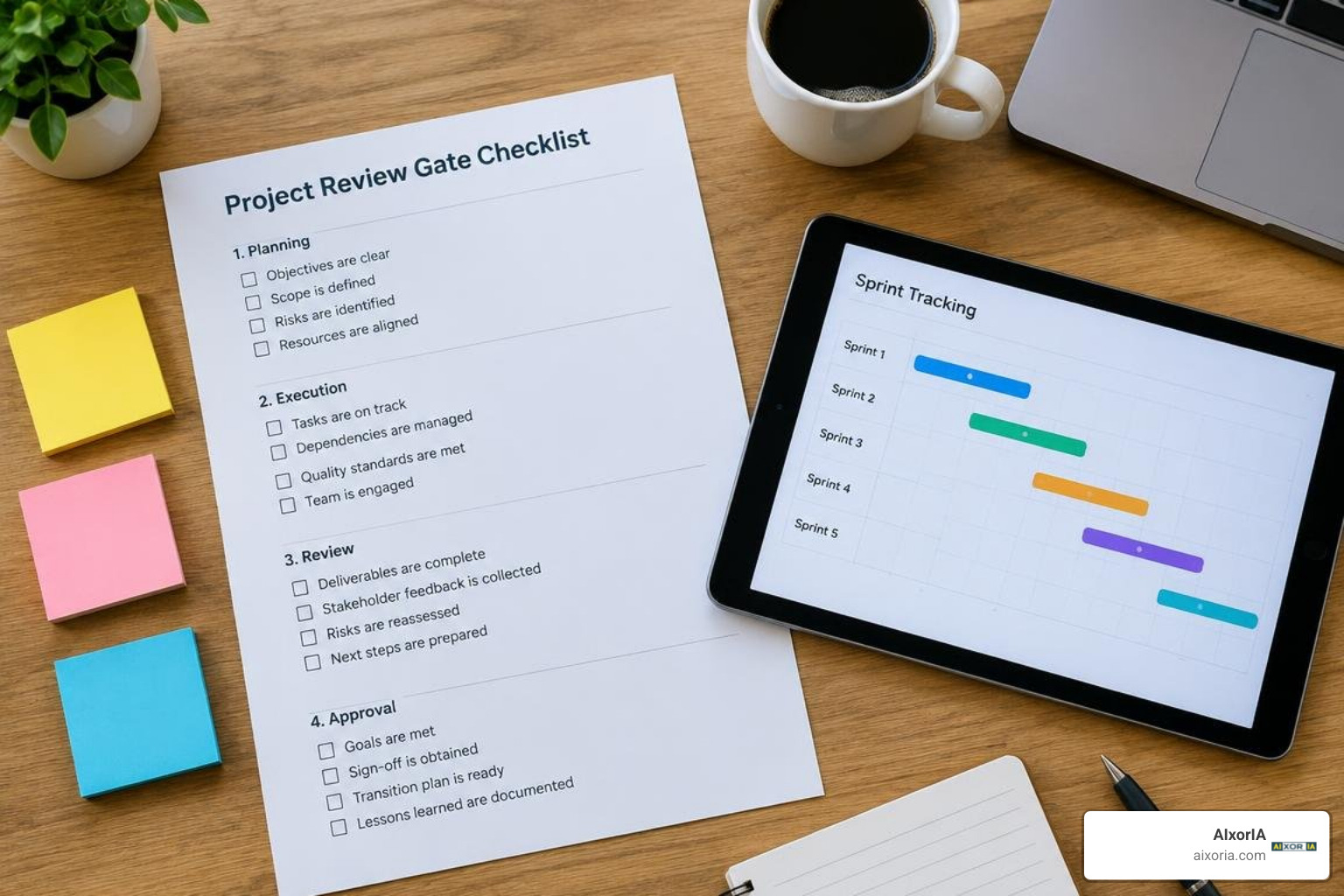
The freelance calendar breaks down into distinct sprints:
- Days 1–2: Creative brief review, customer persona research, and strategy alignment.
- Days 3–5: High-fidelity wireframes and visual design mockups in design software.
- Days 6–8: Client review gate and initial revision round.
- Days 9–12: Frontend build, animations, and form plumbing.
- Days 13–15: Final cross-device testing, analytics integration, and DNS cutover.
Freelancers offer a balanced middle ground: high design fidelity without the bureaucratic overhead of a full agency.
Full-Service Design Agencies and Custom Development
If you commission a traditional design agency, quotes typically land between 3 and 8 weeks. Clients are often surprised that a single webpage can take nearly two months, but agency timelines account for extensive discovery phases, competitive audits, dedicated art direction, multi-round copy workshops, and specialized development.
Agencies also balance multiple enterprise accounts simultaneously. Your landing page moves through account managers, art directors, junior copywriters, senior developers, and QA engineers. Each transition introduces queue time, where files sit waiting for the next specialist’s availability.
The 5 Core Stages of a Landing Page Build and Where Time Is Spent
Every high-performing landing page moves through five foundational phases. Understanding where time naturally concentrates helps you identify bottlenecks before they derail your campaign schedule. Following modern web development best practices in 2026 ensures your build stays lean and performant across every stage.
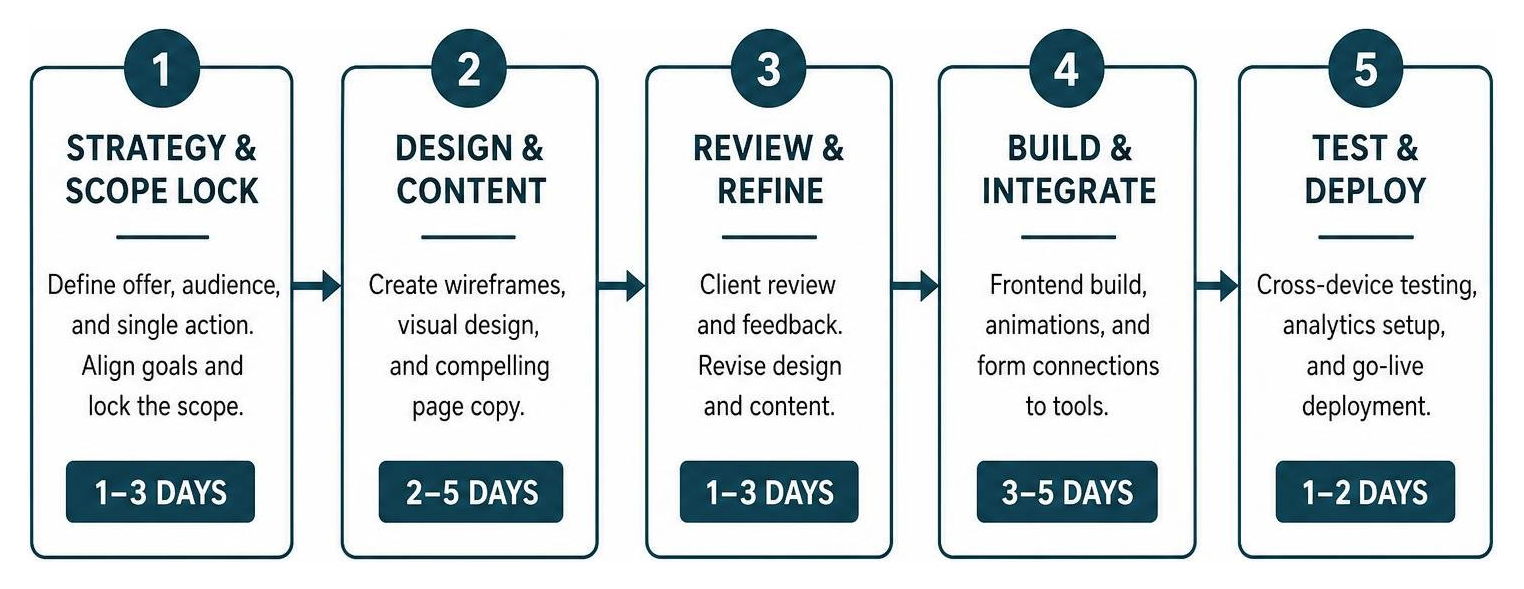
Stage 1: Strategy, Offer Definition, and Scope Lock
Typical Time: 1 to 3 Days (2–6 hours of active work)
Before opening any design canvas, you must establish what you are selling, to whom, and what single action you want visitors to take. This stage includes:
- Audience pain point analysis and competitive differentiation.
- Primary offer structuring (e.g., free demo, early-bird discount, whitepaper download).
- A formal scope lock defining the exact page sections (Hero, Social Proof, Features, FAQs, Footer CTA).
Locking the scope in writing early prevents endless mid-project feature additions that inflate timelines.
Stage 2: Copywriting and Message Hierarchy (The Biggest Time Sink)
Typical Time: 2 to 5 Days (8–16 hours of active work)
Copywriting represents 40% to 60% of the total project time, regardless of your build method. Great design cannot rescue vague, unconvincing copy. Writing persuasive sales text involves crafting high-impact headlines, articulating value propositions, structuring objection-handling FAQs, and polishing call-to-action buttons.
Investing in the best website content writing strategies before touching visual design eliminates expensive layout redesigns later, as design should always frame the message—not the other way around.
Stage 3: Wireframing and Visual UI Design
Typical Time: 2 to 6 Days (6–14 hours of active work)
In this stage, your raw text transforms into visual hierarchy. Designers map out the structural wireframes to ensure smooth visual flow before applying colors, custom typography, brand photography, icons, and interactive hover states. Mobile layout planning happens here to ensure headlines and forms scale cleanly on smaller screens.
Stage 4: Frontend Development and Technical Integrations
Typical Time: 1 to 4 Days (6–16 hours of active work)
Once visual mockups receive approval, developers translate layouts into responsive HTML/CSS/JavaScript or build them inside a no-code visual engine. This stage includes technical “plumbing”:
- Connecting form endpoints to your CRM or email newsletter software.
- Configuring custom events for analytics and conversion tracking pixels.
- Integrating cookie consent banners and security headers.
- Setting up transactional confirmation emails or redirect thank-you pages.
Stage 5: Quality Assurance, Hardening, and Deployment
Typical Time: 1 to 2 Days (4–8 hours of active work)
The final phase protects your ad spend. Testing teams run functional audits across multiple operating systems, screen sizes, and browser engines (Chrome, Safari, Firefox, Edge). They verify page load speeds, optimize image compression, populate OpenGraph meta tags for social sharing, and connect your custom domain via DNS records.
Critical Factors That Delay or Accelerate Your Project Timeline
Even well-funded projects encounter unexpected delays. Understanding project dynamics highlighted in real-world 48-hour development case studies helps you steer clear of common operational traps.
The Planning Fallacy and Unrealistic Estimation
Human beings possess an inherent cognitive bias known as the planning fallacy—we consistently underestimate the time needed to complete tasks, even when we have completed similar tasks before. When planning a landing page, teams often assume that if a developer can code a page in eight hours, the project will launch tomorrow. This ignores review delays, copy revisions, DNS propagation, and missing asset handoffs. Adding a 20–30% time buffer to your schedule creates a realistic safety net.
Why Traditional Agency Timelines Stretch to Several Weeks
Agencies do not take six weeks because a single webpage requires 240 hours of continuous coding. Their timelines expand due to:
- Resource Leveling: Designers and engineers juggle multiple accounts, shifting between tasks based on weekly utilization targets.
- Approval Committees: When feedback requires consensus from marketing managers, product leads, and legal teams, approval cycles drag on for days.
- Batch Revisions: Agencies usually package feedback into scheduled review rounds rather than resolving small tweaks on the fly.
Building in 24 to 48 Hours: Rush Builds vs Cutting Corners
Can a landing page launch in 24 to 48 hours? Absolutely—provided you understand the difference between efficiency and corner-cutting.
- Fast and Efficient: A senior designer uses a battle-tested component system or no-code tool, working from fully approved copy and pre-sized brand photography with a single decision-maker clearing approvals within two hours.
- Fast and Sloppy: Skipping mobile responsive checks, ignoring form error states, forgoing tracking pixels, and pasting generic AI copy that fails to speak to buyer pain points.
Speed should never sacrifice technical validation or conversion fundamentals.
Actionable Steps to Drastically Shorten Your Launch Date
To compress your launch window by up to 50%, complete these prerequisites before kickoff:
- Draft Your Copy Skeleton First: Finalize your headline, value propositions, and offer terms before design begins.
- Audit Visual Assets: Collect high-resolution product screenshots, founder headshots, SVG logos, and customer testimonials in a shared folder.
- Appoint a Single Stakeholder: Designate one person with ultimate veto and sign-off authority to eliminate committee deadlocks.
- Enforce a 24-Hour Review SLA: Commit to returning actionable, consolidated design feedback within one business day.
- Pre-Configure DNS and Tooling: Ensure you have administrative access to your domain registrar and marketing software integrations before launch week.
Project Scope Benchmarks: Landing Pages vs Full Websites
Understanding project scale helps maintain realistic expectations across different types of web builds.
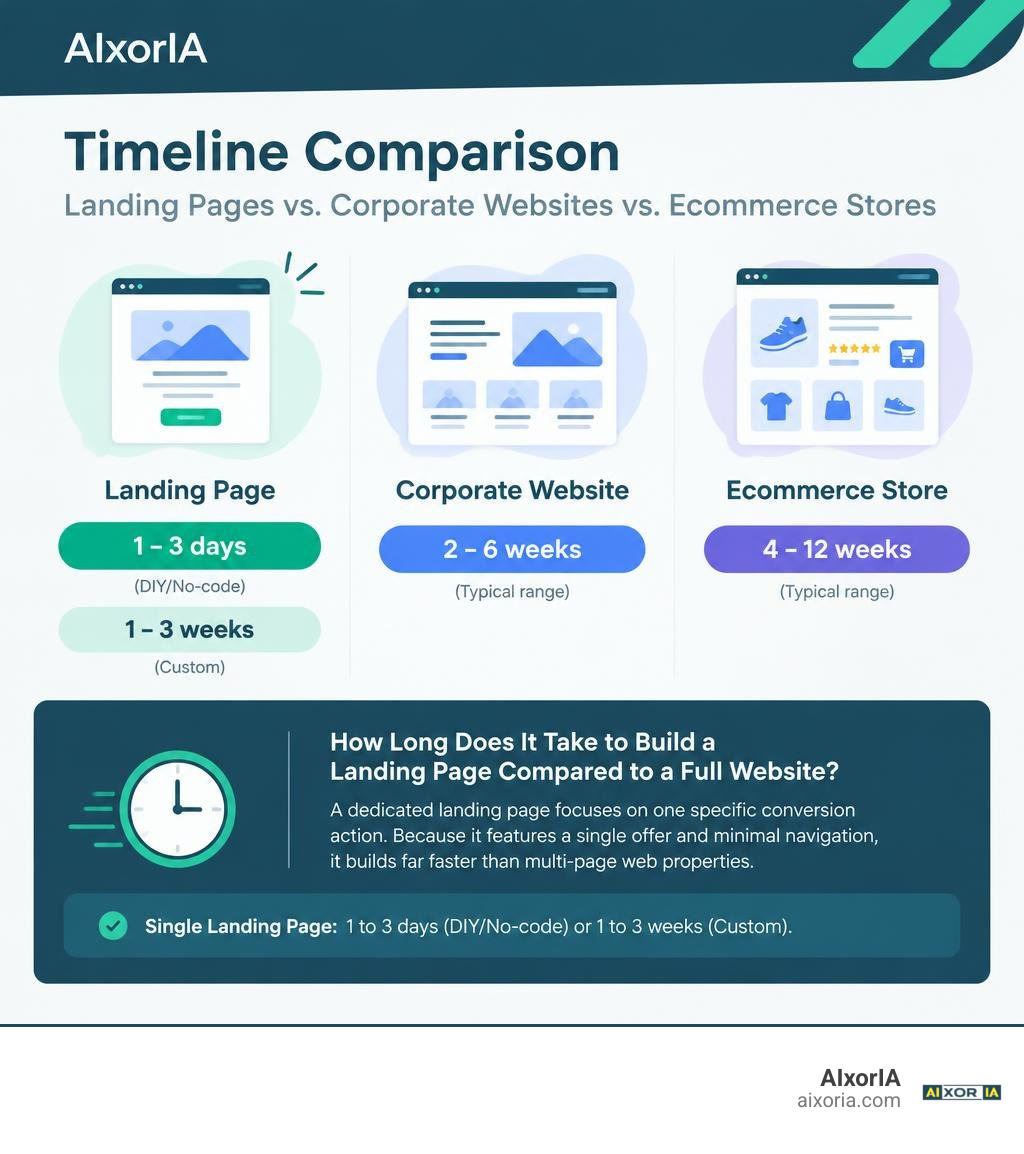
How Long Does It Take to Build a Landing Page Compared to a Full Website?
A dedicated landing page focuses entirely on driving one specific conversion action. Because it features a single offer, one narrative thread, and minimal navigational complexity, it builds far faster than multi-page web properties:
- Single Landing Page: 1 to 3 days (DIY/No-code) or 1 to 3 weeks (Custom).
- Small Business Website (5–10 Pages): 2 to 6 weeks. Requires site-wide navigation architecture, multiple service templates, a dynamic blog setup, and broader SEO keyword mapping.
- Full E-Commerce Store: 6 to 16 weeks. Involves product catalog databases, inventory management, shipping calculators, payment gateways, customer account portals, and transactional email systems. If you are planning a storefront build, review the 7 best eCommerce website building platforms for online stores in 2026 to select a stack that aligns with your timeline.
Key Questions to Ask Before Signing a Development Contract
Before hiring an external partner, ask these vetting questions to ensure their quoted timeline is authentic:
- “Does your quoted timeline represent calendar days or active business days?”
- “How many active projects will the primary designer and developer be juggling alongside ours?”
- “What specific assets do you need from our team on Day 1 to avoid halting work?”
- “What is your policy for mid-project scope adjustments or extra revision rounds?”
- “Are full cross-browser QA, mobile optimization, and conversion tracking included in this timeframe?”
Frequently Asked Questions About Landing Page Timelines
Can you realistically build a high-converting landing page in a single day?
Yes, provided your strategy, messaging, and visual assets are completely locked before you begin. By utilizing an intuitive no-code tool or pre-built template, you can assemble sections, style typography, wire up lead forms, and deploy to your custom domain within 6 to 10 hours of focused work.
Does writing landing page copy really take longer than designing the layout?
In most successful campaigns, yes. Structuring persuasive messaging, distilling value propositions, and addressing user objections usually demands 40% to 60% of total project effort. Assembling visual containers is straightforward once you know exactly what words belong inside them.
Should you delay launching a landing page to wait for complete social proof?
No. It is almost always better to launch with minimum viable social proof—such as early beta metrics, a founder quote, or relevant industry certifications—and update the page with fresh customer testimonials and case studies as your campaign gathers momentum.
Conclusion
Building a high-converting landing page does not have to drag on for months. By locking your offer early, finalizing your copy before designing layouts, and choosing the right build method for your technical requirements, you can comfortably ship a campaign-ready page in anywhere from 24 hours to 2 weeks.
To keep exploring modern marketing stacks, visual workflows, and automation setups, discover curated AI productivity guides and marketing workflows at AIxorIA to help streamline your next digital launch.
1 thought on “How Long Does It Take to Build a Landing Page?”