What Is the Most Common Renters Insurance Coverage — and Do You Have It?
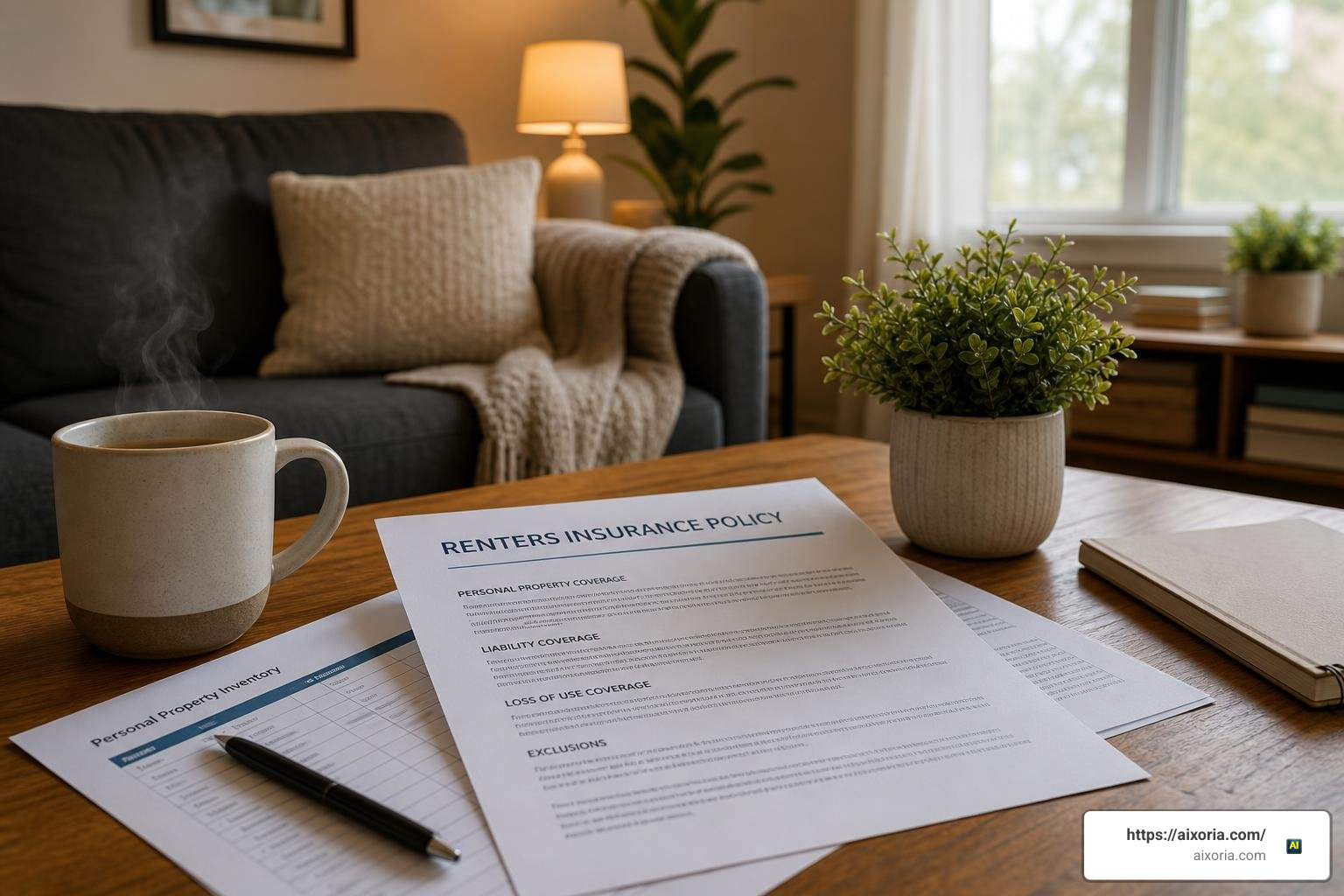
What is the most common renters insurance coverage? A standard renters policy (called an HO-4) includes three core protections:
| Coverage Type | What It Pays For | Typical Limit |
|---|---|---|
| Personal Property | Your belongings (theft, fire, etc.) | $30,000–$50,000 |
| Personal Liability | Injuries or damage you cause to others | $100,000–$300,000 |
| Additional Living Expenses | Hotel, meals if your unit is uninhabitable | 20–30% of property limit |
Most policies also include medical payments to others (typically $1,000), which covers minor guest injuries without a lawsuit.
Here’s something most renters get wrong: your landlord’s insurance covers the building — not your stuff, not your liability. If a fire destroys your furniture, a thief takes your laptop, or a guest slips and sues you, that’s entirely on you unless you have your own policy.
Despite how affordable it is — around $15 per month on average — about 43% of U.S. renters have no coverage at all. That means nearly half of all renters are one bad incident away from a potentially devastating out-of-pocket loss.
Consider this: a graduate student in Cambridge skipped renters insurance to save money. When a pipe burst in the unit above hers, she lost her laptop, books, clothes, couch, and guitar — roughly $9,400 she had to replace herself.
The good news? A basic HO-4 policy is one of the most affordable and high-value financial products available to renters today.
What Is the Most Common Renters Insurance Coverage?

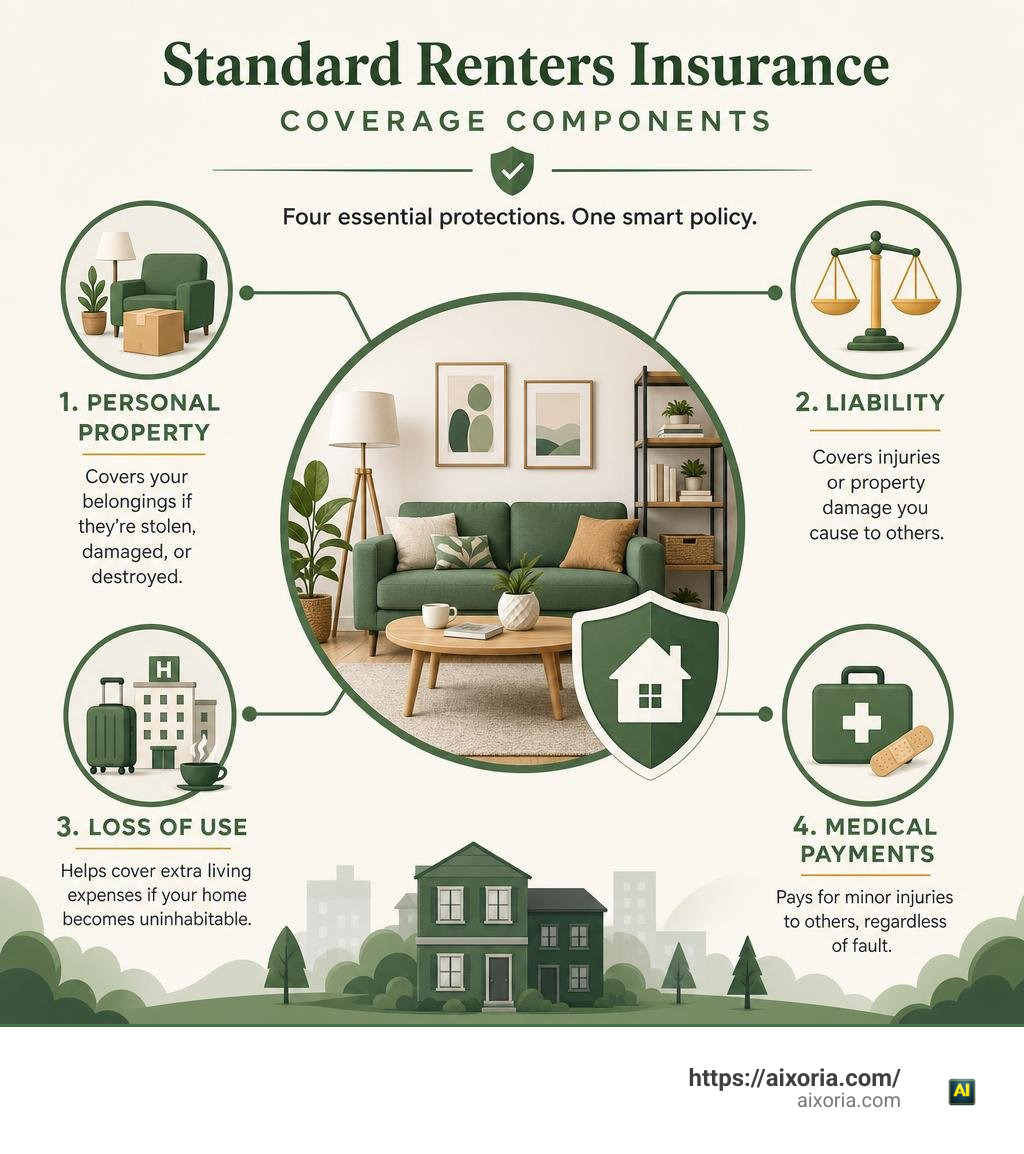
When we talk about the standard protection that most tenants carry, we are referring to the industry-standard HO-4 policy. This is the technical blueprint that insurance companies use to design renters insurance. Whether you live in a high-rise apartment in the city or rent a cozy suburban townhouse, the core components of this policy remain remarkably consistent.
A standard policy is not a single safety net; rather, it is a bundle of distinct coverages designed to protect your wallet from different angles. To understand What Is Renters Insurance? 2026 Guide | Coverage Classroom, we must look at how these parts work together to shield you from the unexpected. If you are wondering how these elements apply specifically to tenants across the country, our guide on What does renters insurance cover in the USA provides a great localized overview.
Essentially, the most common renters insurance policy consists of three primary pillars: personal property coverage, personal liability protection, and loss of use coverage. A minor but highly useful fourth element, medical payments to others, is also bundled into almost every standard policy. Together, these coverages ensure that if your apartment is damaged by a burst pipe, a kitchen fire, or a break-in, you will not have to drain your savings to rebuild your life.
Understanding What Is the Most Common Renters Insurance Coverage for Personal Property
At its heart, personal property coverage (often called Coverage C) is designed to protect “your stuff.” This includes everything that would fall out of your rental unit if you were to pick it up, turn it upside down, and shake it. Your clothes, furniture, electronics, kitchen appliances, books, and even your bedsheets are all covered under this category.
For the average renter, standard contents coverage limits typically range from $30,000 to $50,000. This is generally the default tier because most people underestimate how much their belongings are actually worth. If you sit down and add up the cost of replacing your entire wardrobe, your mattress, your television, and your kitchen gadgets, you will quickly find that the total easily surpasses $20,000.
However, your policy does not cover your belongings against absolutely everything. Instead, it protects them against a list of specific “covered perils” outlined in your policy documents. The most common perils covered by a standard policy include:
- Fire and lightning
- Windstorm and hail
- Explosions
- Smoke damage
- Theft and vandalism
- Water damage from plumbing or appliance overflows (like a burst pipe or a leaking washing machine)
According to the analysis in Renters insurance in 2026: what it covers, what it doesn’t, and the math on whether to buy it, one of the most valuable aspects of personal property coverage is that it is global. This means your belongings are protected even when they are outside your home. If your laptop is stolen while you are working at a local coffee shop, or if your suitcase is swiped from a hotel lobby while you are traveling, your renters policy can step in to cover the loss, subject to your deductible.
Standard Liability and Medical Payments Limits
While protecting your physical belongings is important, many insurance experts argue that personal liability coverage (Coverage E) is actually the most critical part of your policy. Why? Because while the value of your physical belongings is finite, your potential liability exposure is theoretically infinite. If you accidentally cause major damage to the building or if someone is seriously injured in your home, you could face a lawsuit that threatens your future earnings and personal savings.
The standard starting limit for personal liability coverage in most renters policies is $100,000, though we highly recommend upgrading to $300,000. The price difference to make this jump is incredibly small—often just $10 to $30 more per year—making it one of the highest-leverage upgrades you can make.
Liability coverage kicks in when you are held legally responsible for bodily injury or property damage to others. Classic examples include:
- A guest slips on a wet kitchen floor in your apartment and breaks their wrist.
- You accidentally leave a bathtub running, causing water to leak through the floor and ruin your downstairs neighbor’s expensive leather sofa.
- Your dog bites a delivery driver or a guest, resulting in medical bills. (That the average dog bite claim nationally reached $65,450 in 2025, which would easily wipe out a basic savings account without insurance).
To learn more about how liability limits protect your financial future, you can check out the breakdown on What Does Renters Insurance Cover?.
Alongside liability, standard policies include medical payments to others (Coverage F), which typically carries a limit of $1,000 to $5,000. Unlike liability coverage, medical payments coverage pays out regardless of who is at fault. It is designed to cover minor medical bills—like an urgent care visit or an X-ray—if a guest suffers a small injury in your home. By quickly taking care of these minor costs, this coverage often prevents small accidents from turning into major, stressful lawsuits.
Additional Living Expenses and Loss of Use
Imagine waking up to the sound of fire alarms. A kitchen fire in the apartment next door has filled your unit with thick, toxic smoke, and the firefighters have used hundreds of gallons of water to put it out. Your landlord tells you that it will take at least six weeks of professional restoration before your apartment is safe to live in again. Where do you go? How do you pay for it?
This is where Loss of Use coverage (Coverage D), also known as Additional Living Expenses (ALE), becomes an absolute lifesaver. If a covered peril makes your home temporarily uninhabitable, this coverage pays for the increase in your living expenses while you are displaced.
According to the Renters Insurance Guide: Coverage, Costs, and Claims | USRentPrices, Loss of Use limits typically default to 20% to 30% of your personal property coverage limit. For example, if you have a $30,000 personal property limit, your Loss of Use limit would be around $6,000 to $9,000.
This coverage pays for:
- Hotel stays or temporary rental apartments of comparable size.
- The extra cost of eating out at restaurants if your temporary lodging does not have a kitchen.
- Storage unit fees to keep your undamaged belongings safe while your apartment is being repaired.
- Incremental transportation costs if your temporary home forces you to commute further to work.
It is important to remember that ALE only covers the difference between your normal expenses and your temporary ones. If your normal grocery bill is $150 a week, but you have to spend $250 a week eating out because you do not have a kitchen, your policy will reimburse you for the extra $100. Always keep every single receipt during a displacement to ensure a smooth claims process!
Key Exclusions: What Standard Policies Do Not Cover
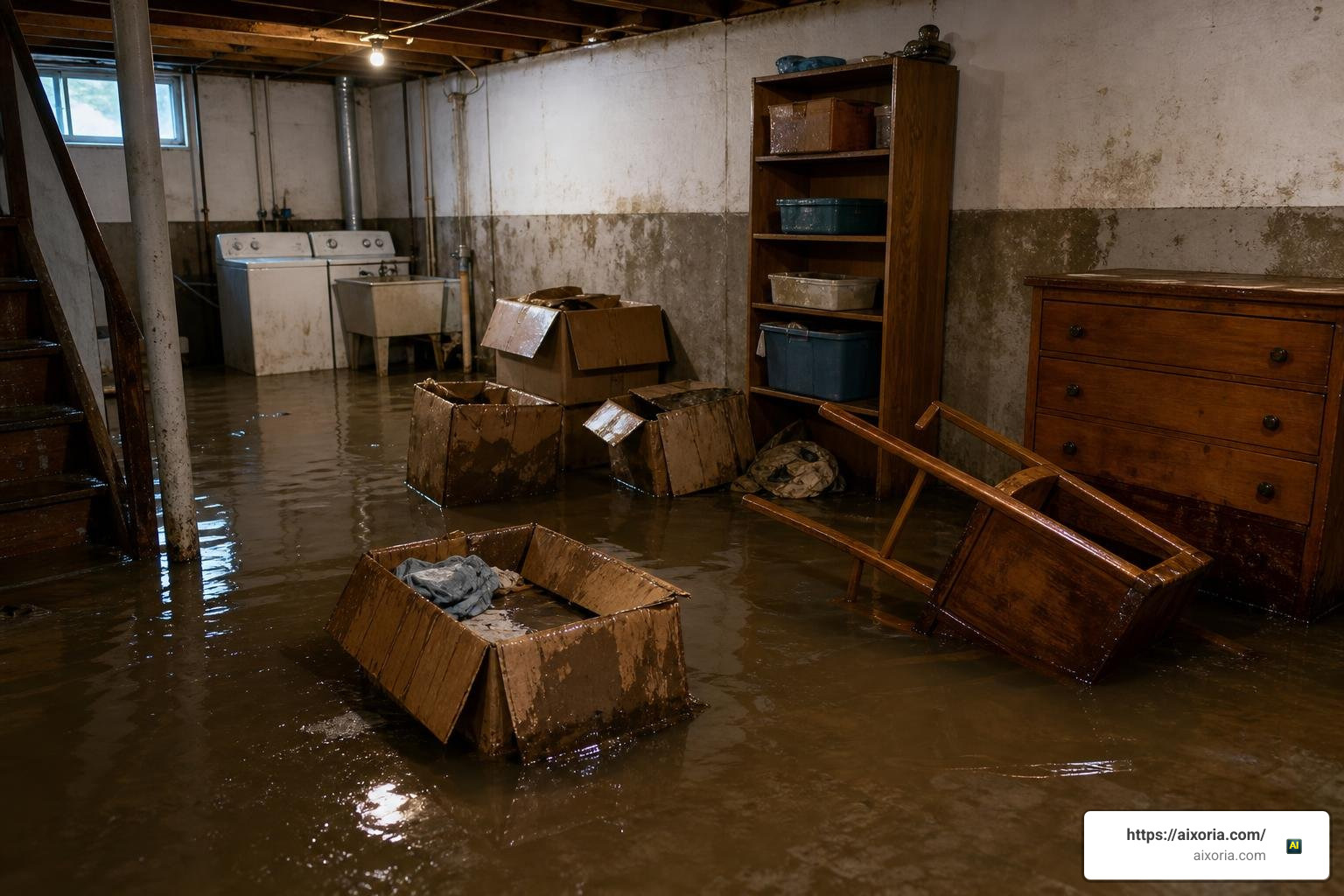
While a standard renters insurance policy offers incredible peace of mind, it is not an all-powerful shield. There are several major scenarios that standard HO-4 policies explicitly exclude. Understanding these gaps is crucial so you do not get caught off guard when trying to file a claim. If you are looking to secure a policy that balances these exclusions with the absolute best rates, take a look at our analysis of the Cheapest monthly renters insurance.
First and foremost, standard renters insurance universally excludes natural disasters like floods and earthquakes. If a local river overflows and floods your ground-floor apartment, or if a water main breaks in the street and floods your basement, a standard policy will not pay to replace your ruined belongings. To protect yourself from these events, you must purchase separate flood insurance or add an earthquake endorsement to your policy.
Additionally, standard renters insurance does not cover:
- Pest infestations: Bedbugs, mice, termites, and cockroaches are considered maintenance issues. The cost to exterminate them and replace damaged furniture is entirely your responsibility.
- Your roommate’s belongings: Unless your roommate is explicitly named on your policy (which is rarely recommended), their belongings are not covered. They must purchase their own separate policy.
- Damage to the building structure: If a fire damages the walls or roof of your apartment building, your landlord’s commercial property insurance covers those repairs, not your policy.
- Your car: While renters insurance covers items stolen from your car, it does not cover damage to the vehicle itself or car theft. That falls under your auto insurance policy.
Sub-Limits on High-Value Items
Another detail that catches many renters off guard is the concept of category sub-limits. Even if you have a generous $40,000 personal property limit, your policy places strict caps on specific categories of high-value items, particularly when it comes to theft.
According to data compiled in the Renters Insurance Guide: Coverage, Costs, and Claims | USRentPrices, typical sub-limits include:
- Cash and coins: Capped at $100 to $200.
- Jewelry, watches, and furs: Capped at $500 to $1,500.
- Firearms: Capped at $2,500.
- Business property (items used for work): Capped at $2,500.
If you own an engagement ring worth $8,000 or a professional camera setup worth $5,000, a standard policy will not fully protect them if they are stolen. To get full coverage, you need to purchase an endorsement called scheduled personal property (or a “personal property floater”). This requires you to get the item professionally appraised and pay a small additional premium, but it guarantees you will be reimbursed for the item’s full, actual value without a deductible. For more details on standard limits and the insurance landscape, check out the Renters Insurance Statistics in US 2026 | Average Cost, Best Companies & Key Facts – The World Data.
Landlord Requirements vs. Legal Mandates
Is renters insurance required by law? The short answer is no. No state or federal law requires tenants to carry renters insurance.
However, landlords are legally permitted to require renters insurance as a condition of your lease agreement. In fact, in 2026, it is incredibly common for property managers and individual landlords to mandate a minimum level of coverage before handing over the keys.
Most landlord-required policies demand a minimum of $100,000 in personal liability coverage. Landlords do this to protect themselves; if you accidentally cause a fire or flood that damages their building, they want to make sure your insurance company can pay for the repairs rather than having to drag you through a lengthy court battle.
Even if your landlord does not require it, skipping coverage is a massive financial risk. If you want to find the most budget-friendly way to satisfy a lease requirement, check out our guide on How to get the cheapest renters insurance.
Actual Cash Value vs. Replacement Cost Value
When you purchase a renters insurance policy, you will have to make a crucial decision that directly impacts your payout after a disaster: choosing between Actual Cash Value (ACV) and Replacement Cost Value (RCV).
| Feature | Actual Cash Value (ACV) | Replacement Cost Value (RCV) |
|---|---|---|
| How it’s calculated | Current retail value minus depreciation | Cost to buy the exact same item brand new today |
| Payout amount | Lower payout (reflects age and wear) | Higher payout (reflects actual replacement cost) |
| Premium cost | Baseline cost (cheapest option) | Roughly 10% to 15% more expensive |
| Best for | Strict budgets with few high-value items | Renters who want full financial recovery |
To understand how this works in the real world, let’s look at a classic laptop example. Imagine you bought a high-end laptop for $1,300 three years ago. Today, due to normal wear and technological obsolescence, that laptop is only worth about $500.
If that laptop is stolen and you have an ACV policy, the insurance company will write you a check for $500 (minus your deductible). Good luck finding a comparable new laptop for $500!
If you have an RCV policy, the insurance company will pay you the actual cost to buy a brand-new, comparable laptop today—meaning you get the full $1,300 (minus your deductible) to replace what you lost.
As noted in the Average Renters Insurance Cost in 2026 | InsuranceCostGuide, choosing RCV only increases your premium by about 10% to 15%. For most renters, this tiny monthly cost is well worth avoiding the headache of depreciated payouts. If you are comparing specific carriers and want to see how these valuation choices affect your monthly bill, check out our breakdown of How much does Allstate renters insurance cost.
Why Knowing What Is the Most Common Renters Insurance Coverage Helps You Choose Limits
Once you understand how the different components of a standard policy work, you can strategically build a policy that fits your life perfectly without overpaying. You do not want to buy too little coverage and find yourself underinsured, but you also do not want to buy far more coverage than you actually need.
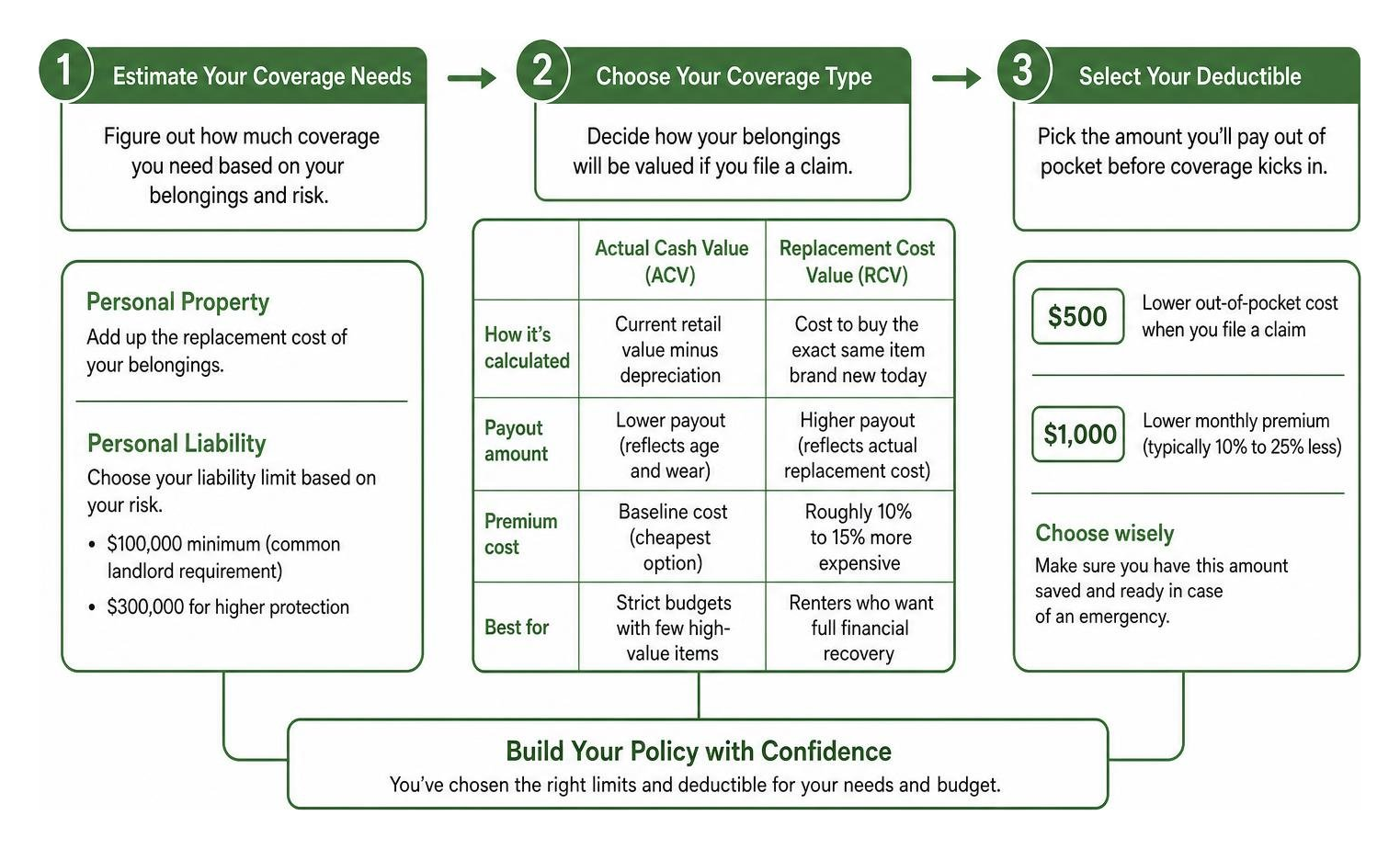
To find your perfect coverage sweet spot, we recommend taking these three actionable steps:
- Conduct a room-by-room home inventory: Walk through your apartment with your phone and record a video of everything you own. Open drawers, closet doors, and cabinets. Note down brand names and approximate purchase dates of major items. This video serves as indisputable proof of ownership if you ever need to file a claim, and it helps you estimate the total replacement cost of your belongings.
- Evaluate your personal liability needs: If you have significant personal savings, own pets, or host guests frequently, you have a higher risk profile. Opting for a $300,000 liability limit is a smart, cheap way to protect your assets.
- Choose the right deductible: Your deductible is the amount you must pay out of pocket before your insurance coverage kicks in. Standard deductibles are usually $500 or $1,000. If you are a disciplined saver with a healthy emergency fund, raising your deductible from $500 to $1,000 can reduce your monthly premium by 10% to 25%. Just make sure you actually have that $1,000 on hand in case of an emergency!
For a deeper dive into adjusting your limits and maximizing policy savings, take a look at our State Farm renters insurance review 2026 coverage cost discounts.
Frequently Asked Questions about Renters Insurance
Does renters insurance cover theft of personal belongings outside the home?
Yes! As we mentioned earlier, the personal property portion of a standard policy features “off-premises coverage.” This means your belongings are protected globally. If your bicycle is stolen from outside a grocery store, or if your phone is swiped while you are on vacation, your policy can help cover the cost of replacement.
However, keep in mind that many insurance companies cap off-premises coverage at 10% of your total personal property limit (or $1,500, whichever is higher). If you have a $30,000 personal property limit, your off-premises theft protection might be capped at $3,000 per incident. For more insights on how these limits operate globally, you can read more at What does renters insurance cover in the USA.
What is the average cost of a standard renters insurance policy in 2026?
Renters insurance is incredibly affordable. In 2026, the national average cost of a standard renters insurance policy is approximately $15 per month (about $174 per year).
Your actual premium will depend heavily on your location, your claims history, and your credit score (in states where credit-based insurance scores are allowed). For example, renters in Texas pay slightly more—averaging about $20 a month—due to a higher frequency of severe weather events like windstorms and hail. To get a detailed look at how to secure the lowest possible rate, check out our guide on the Cheapest monthly renters insurance.
Can roommates share a single renters insurance policy?
Technically, yes, some insurance companies allow roommates to be listed as “named insureds” on a single policy. However, we almost never recommend sharing a policy with a roommate.
Sharing a policy means you must split the coverage limits. If your roommate’s laptop and your television are both stolen, you might easily exceed your personal property limit. Furthermore, if your roommate files a claim, that claim goes on your insurance record, which could raise your premiums for years to come. It is much cleaner, safer, and highly affordable for each roommate to carry their own individual policy.
Conclusion
At the end of the day, renters insurance is the ultimate high-leverage financial safety net. For the price of a single streaming subscription or a couple of fancy coffees a month, a standard policy protects you from catastrophic losses that could otherwise take years to recover from. Whether your landlord requires it or you are simply looking for peace of mind, securing the right policy is one of the smartest financial moves you can make.
At Aixoria, we believe that navigating the complexities of modern living—from protecting your home to understanding the latest technological shifts—should be simple and stress-free. If you want to stay ahead of the curve and protect your lifestyle in our rapidly changing world, Explore our latest AI updates and tech insights to see how we are leveraging cutting-edge technology to make life easier.