Why the Oldest Insurance Companies Still in Business Matter Today
What is the oldest insurance company still in business? Here’s a quick answer:
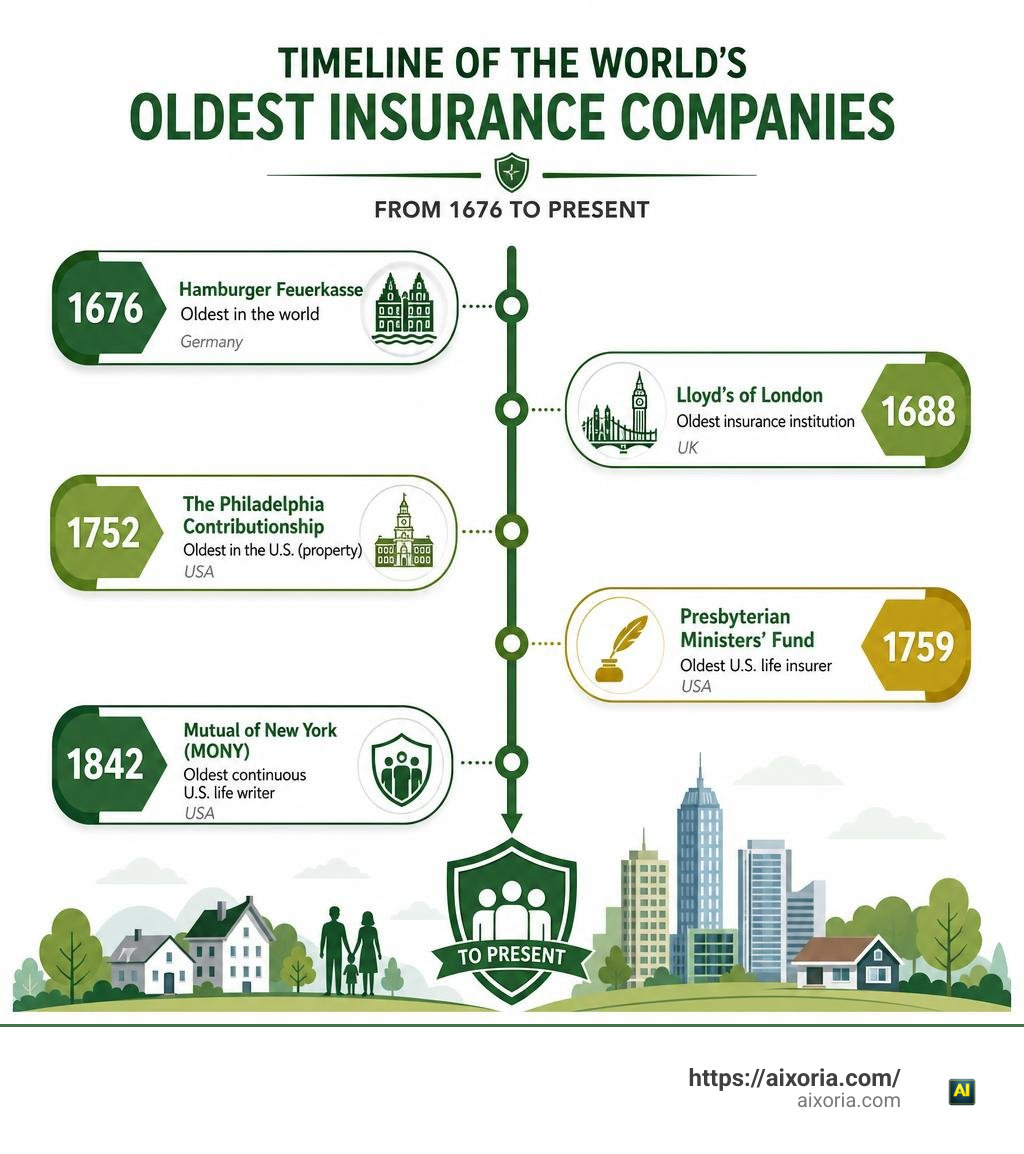
| Category | Company | Founded | Country |
|---|---|---|---|
| Oldest in the world | Hamburger Feuerkasse | 1676 | Germany |
| Oldest insurance institution | Lloyd’s of London | 1688 | UK |
| Oldest in the U.S. (property) | The Philadelphia Contributionship | 1752 | USA |
| Oldest U.S. life insurer | Presbyterian Ministers’ Fund | 1759 | USA |
| Oldest continuous U.S. life writer | Mutual of New York (MONY) | 1842 | USA |
Some of these companies have been protecting people from financial loss for over 350 years. That’s longer than the United States has existed.
Think about that for a second. When Benjamin Franklin helped found America’s oldest active insurance company in 1752, he did it 24 years before he signed the Declaration of Independence.
These institutions didn’t survive by accident. They survived because they solved a real problem — helping ordinary people share risk so that no single person faces total financial ruin alone. That same idea still drives modern, budget-friendly insurance today.
What is the oldest insurance company still in business?
When we ask, “What is the oldest insurance company still in business?”, we have to look across the Atlantic to Germany. The absolute oldest surviving insurance enterprise in the world available to the general public is the Hamburger Feuerkasse (Hamburg Fire Office), established on November 30, 1676.
Long before formal corporate boardrooms existed, people managed risk through community-driven mutual aid. In the medieval era, European merchants and farmers realized that a single fire or shipwreck could wipe out an entire family’s livelihood. This realization birthed the predecessors of modern insurance:
- Fire Guilds (Brandgilden): As early as the 15th century, rural communities in Schleswig-Holstein formed local fire guilds. These were mutual assistance programs where members pledged to help rebuild a neighbor’s home if it burned down.
- Brewers’ Fire Contracts: On December 3, 1591, a group of 101 beer brewers in Hamburg signed a formal mutual agreement. Brewing beer was a highly flammable profession in the Middle Ages, and these brewers agreed to financially support any member who suffered a fire, provided they rebuilt the property within one year to restore the city’s economic capacity.
These early community pacts laid the groundwork for the first official state-backed insurer. To understand how these ancient organizations compare, let’s look at the oldest global insurance institutions still operating today:
| Company / Institution | Founding Year | Country of Origin | Original Focus |
|---|---|---|---|
| Hamburger Feuerkasse | 1676 | Germany | Public Fire Insurance |
| Lloyd’s of London | 1688 | Great Britain | Marine Insurance / Underwriting |
| Sun Fire Office (now part of RSA) | 1710 | Great Britain | Property Fire Insurance |
| The Philadelphia Contributionship | 1752 | United States | Property Fire Insurance |
| Presbyterian Ministers’ Fund | 1759 | United States | Clergy Life Insurance |
| Equitable Life Assurance Society | 1762 | Great Britain | Scientific Life Insurance |
These pioneers proved that by spreading risk across a large, diverse pool of participants, individuals could protect their assets without paying exorbitant costs. You can explore this fascinating transition in the World’s oldest insurer history.
Hamburger Feuerkasse: The World’s Oldest Insurer
The Hamburger Feuerkasse was originally established as the General-Feuer-Cassa in 1676. It was created as a public, non-profit insurer to protect the citizens of Hamburg from the devastating economic consequences of urban fires.
For centuries, the Feuerkasse operated under a model of compulsory building insurance, which was officially codified into law in 1817. This meant every property owner in Hamburg was required to participate, creating a massive, stable risk pool that kept individual costs incredibly low.
The ultimate test of this system came during the Great Fire of Hamburg in 1842. The catastrophic blaze destroyed approximately 20% of the city’s housing stock, causing total damages estimated at 135 million marks. In a desperate bid to halt the flames, city officials even blew up the old City Hall to create a firebreak. To cover the astronomical claims, the Hamburger Feuerkasse and the city of Hamburg had to take out a massive state bond. Demonstrating incredible institutional resilience, the insurer honorably paid out every claim, and the state bond was finally paid off in full in 1888.
Today, the Hamburger Feuerkasse operates as a private, highly competitive insurer under the Provinzial NordWest group. Interestingly, its historical records are a goldmine for historians. Because the company kept meticulous records of property ownership, building values, and heirs sorted by address, the Genealogical records of Hamburger Feuerkasse remain a vital resource for family history research in Germany.
Lloyd’s of London: The Oldest Insurance Institution
While Hamburger Feuerkasse is the oldest public insurance company, Lloyd’s of London (established in 1688) is widely recognized as the oldest active insurance institution or market.
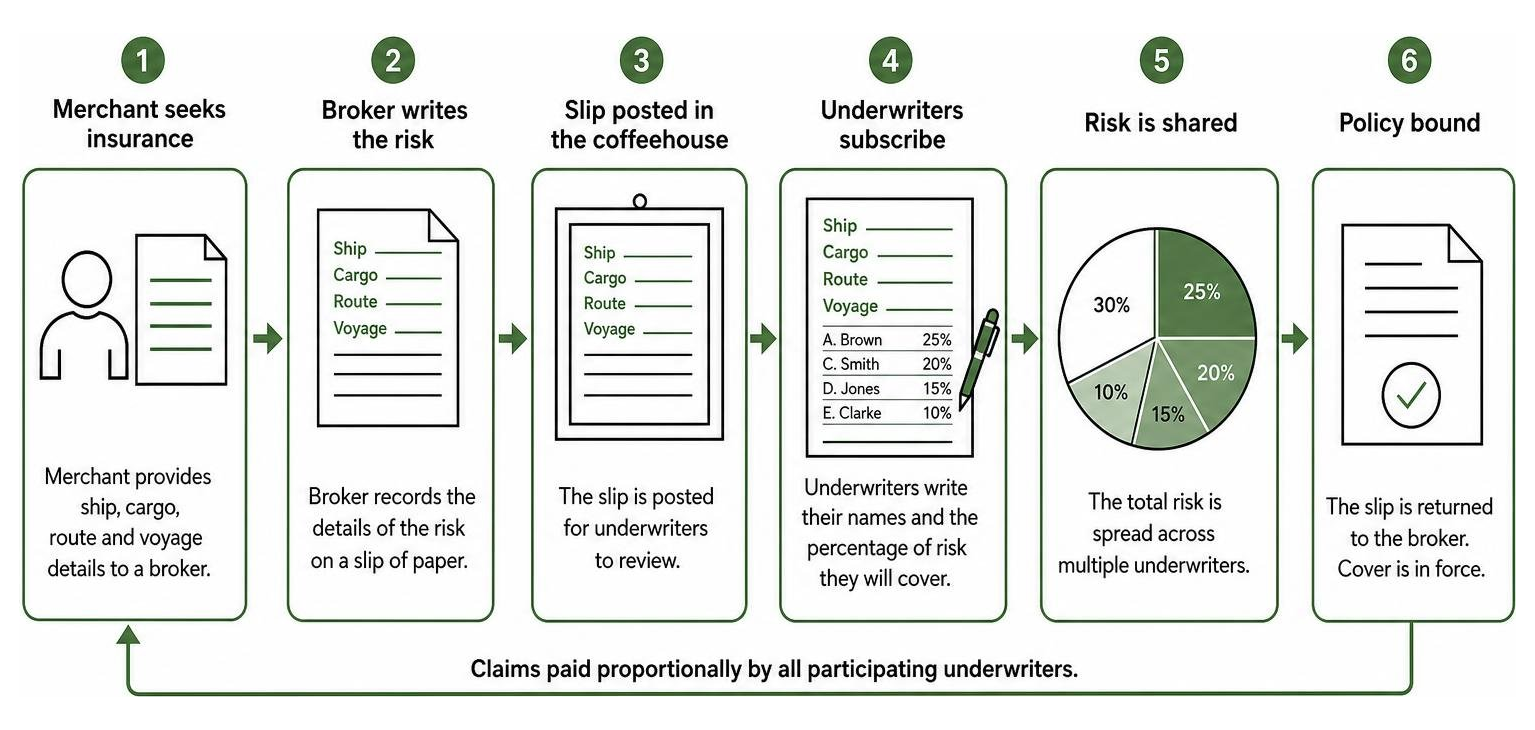
Lloyd’s did not start in a corporate skyscraper, but rather in Edward Lloyd’s humble coffeehouse near the River Thames. In the late 17th century, merchants, ship captains, and wealthy investors gathered there to share maritime news and trade gossip.
If a merchant wanted to insure a ship cargo heading across the Atlantic, an insurance broker would write the details of the vessel, cargo, and destination on a sheet of paper. Investors who were willing to take on a portion of the financial risk in exchange for a fee (premium) would write their names and the percentage of risk they were willing to cover directly under the ship’s details. This is the literal origin of the term “underwriter.”
Lloyd’s of London pioneered many of the foundational legal concepts used in modern property and commercial insurance. For example, the landmark legal dispute over the Mills Frigate in 1764 established the legal precedent of seaworthiness. It ruled that an insurer is not liable to pay a claim if a vessel departs port in a structurally compromised, unseaworthy condition. This early focus on loss prevention helped keep the Lloyd’s market solvent through centuries of global maritime trade and conflict.
The Oldest Insurance Companies in the United States
Before formal insurance offices existed in the American colonies, merchants and shippers faced immense financial risks. If a cargo ship sank, a merchant could go bankrupt overnight. Initially, colonists relied on private underwriters in London. However, this process was slow, expensive, and highly unreliable—shippers often had to wait months for loss reimbursements.

To solve this, early American entrepreneurs sought local solutions:
- First Public Insurance Office: In 1721, John Copson opened the first public insurance office in Philadelphia to arrange local marine underwriting, sparing merchants from sending risk requests to London.
- Benjamin Franklin’s Influence: In 1725, Franklin printed the first book in America that referenced insurance. He recognized early on that a growing nation required structured financial safety nets to thrive.
- The Charleston Attempt: In 1735, a mutual property insurance organization was established in Charleston, South Carolina. However, it was completely liquidated and went bankrupt following a catastrophic city-wide fire in 1740, highlighting the danger of localized risk pools without adequate capital reserves.
- The Insurance Company of North America (INA): In 1792, a group of investors attempted to launch a speculative investment scheme called the Universal Tontine. When the tontine failed to attract enough subscribers, the organizers pivoted, redirecting the accumulated capital to form the Insurance Company of North America. Formally incorporated in 1794, INA became the first joint-stock fire and marine insurance company in the United States, successfully adapting traditional British insurance customs to fit a rapidly expanding young nation.
What is the oldest insurance company still in business in the U.S.?
The undisputed titleholder of the oldest active insurance company in the United States belongs to The Philadelphia Contributionship for the Insurance of Houses from Loss by Fire. Founded in 1752 by Benjamin Franklin and his fellow volunteer firefighters, it is older than the United States itself!
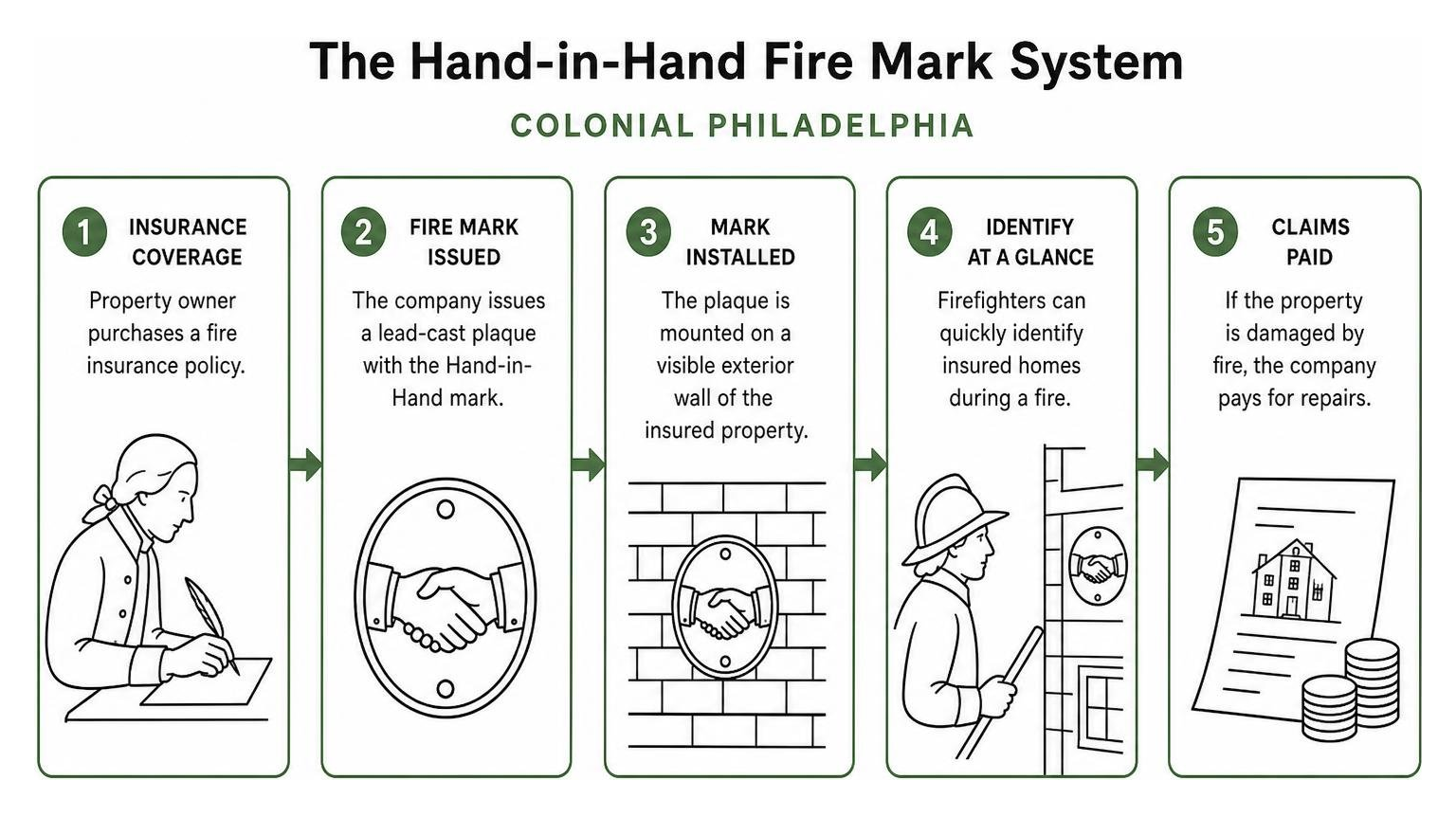
To protect their community, Franklin and his directors established a mutual insurance model. Under this system, property owners pooled their resources to share risks. If a member’s home was damaged by fire, the shared pool paid for the repairs. In 1753, the company paid out its first-ever claim to a local resident whose home was damaged by fire; the property was fully repaired without costing the owner a single penny out of pocket.
To identify which homes were insured, the company issued lead-cast plaques known as fire marks featuring a “Hand-in-Hand” logo. Interestingly, the craftsman commissioned to cast these original fire marks was John Stow—the very same local silversmith who recast the Liberty Bell!
As the company grew, it pioneered strict underwriting guidelines to manage risk:
- Strict Building Standards: The company refused to insure high-risk wooden structures, heavily favoring solid brick and stone construction.
- The Tree Policy Dispute: In the 1780s, the Contributionship passed a rule refusing to insure homes with green trees planted in front of them, as the branches obstructed early, hand-pumped firefighting equipment.
- The Green Tree Spinoff: This tree ban was incredibly unpopular. Policyholders who refused to cut down their trees rebelled and left to form a competing company in 1784 called The Mutual Assurance Company (popularly known as “The Green Tree”), which charged a slightly higher premium to cover homes with trees. This competitor operated successfully for 213 years before being acquired in 1997.
The Philadelphia Contributionship’s historic Greek Revival headquarters at 212 South 4th Street in Philadelphia was designed by Thomas U. Walter—the famous architect who also designed the dome of the United States Capitol. Today, the company still operates in Pennsylvania, New Jersey, Delaware, Maryland, and Virginia. You can learn more about its fascinating journey by reading the Philadelphia Contributionship history and reviewing additional America’s oldest insurer details.
What is the oldest insurance company still in business for life insurance?
While property insurance took off in the mid-18th century, life insurance evolved on a slightly different timeline.
The first life insurance company established in the United States was the Presbyterian Ministers’ Fund, founded in 1759. Created by religious synods, this fund was designed to ensure that the widows and children of deceased Presbyterian ministers would not fall into poverty. It operated successfully for over two centuries before eventually being merged into other financial institutions.
If we look at the oldest continuous writer of life insurance in the United States available to the general public, that honor goes to the Mutual of New York (MONY). Chartered in 1842 and beginning business in 1843, MONY pioneered the mutual life insurance model in America, where policyholders legally owned the company and shared in its financial success.
Shortly after, other historic life insurers emerged to shape the industry:
- New York Life Insurance Company (1845): Originally founded as the Nautilus Insurance Company, New York Life has operated continuously for over 180 years. As a mutual insurer, it remains a major industry giant, famously paying out billions of dollars in dividends to its policyholders even during tough economic times.
- Manhattan Life Insurance Company (1850): Manhattan Life pioneered several major industry firsts. It issued the first-ever group life insurance contract in the U.S. to protect a collective group of workers, and it was one of the first companies to issue a life insurance policy directly to a woman. During the Civil War era, Manhattan Life paid out the first-ever Civil War widow’s pension, earning a reputation for reliability.
- Northwestern Mutual (1857): Originally founded in Janesville, Wisconsin, the company’s early growth was driven by a top agent in the 1850s who gathered so many client voting proxies that he drove the board crazy! The company eventually bought him out, and he moved on to help establish major competitive firms in the Midwest.
How Early Insurance Models Shaped Modern Budget-Friendly Coverage
At first glance, 300-year-old insurance history might seem irrelevant to your monthly household budget. But the truth is, the exact same risk-sharing principles invented by Benjamin Franklin and the early Hamburg brewers are what keep your modern insurance premiums affordable today.
Mutual Insurance and Risk Pooling
The oldest insurers in the world did not operate to maximize Wall Street stockholder profits; they were structured as mutual insurance companies.
In a mutual model, the policyholders are the actual owners of the company. Instead of profits being funneled to external investors, any surplus capital generated during a financially strong year is returned directly to the policyholders in the form of dividends or lower premium rates.
This model encourages conservative stewardship. Because the company is run for the long-term benefit of its members, mutual insurers tend to avoid highly speculative investments, ensuring they remain solvent to pay claims during major economic downturns. This community-pooled risk model is the foundation of modern, budget-friendly coverage.
Perpetual Policies and Loss Control
One of the most innovative budget-friendly concepts introduced by The Philadelphia Contributionship in 1810 was the perpetual insurance policy.
Instead of paying an annual premium every single year, a policyholder made a single, large deposit. The insurer invested this capital fund, using the investment yields to cover administrative costs and pay out claims. The policy remained in effect permanently until it was canceled, at which point the original deposit was fully refunded to the policyholder! While rare today, perpetual policies proved that smart capital management could eliminate the ongoing burden of recurring premium payments.
Furthermore, early insurers realized that the best way to keep premiums low was to prevent losses from happening in the first place. This is called loss control:
- Risk-Based Rates: Insurers physically surveyed properties and charged lower rates to homeowners who built with fire-resistant materials (like brick instead of wood).
- Preventative Maintenance: During the British occupation of Philadelphia in 1777, the Contributionship actually hired a professional chimney sweep to clean and maintain the chimneys of insured houses to prevent chimney fires.
- Proactive Mitigation: Refusing to insure homes with fire-obstructing trees or high-risk fireplaces forced the community to adopt safer building habits, dramatically driving down the overall number of claims and keeping the cost of coverage highly affordable for everyone in the pool.
Frequently Asked Questions about Historic Insurers
Who founded the oldest property insurance company in the U.S.?
The Philadelphia Contributionship, the oldest active property insurance company in the United States, was co-founded by Benjamin Franklin and his fellow volunteer firefighters in 1752. Franklin was a passionate advocate for civic safety, having previously established Philadelphia’s first volunteer fire brigade, the Union Fire Company, in 1736.
What was the purpose of early fire marks?
In Great Britain, early private insurance companies ran their own private fire brigades. These brigades would literally watch a building burn to the ground if it did not display their company’s specific metal fire mark!
In colonial Philadelphia, however, the fire brigades were collaborative volunteers. The lead-cast “Hand-in-Hand” fire marks were used to identify insured properties before street numbers were common, discourage arson, and alert neighbors to help save the building, as everyone in the mutual pool had a shared financial interest in minimizing the damage.
How did the Great Fire of London impact modern insurance?
The Great Fire of London in 1666 was the ultimate catalyst for the modern property insurance industry. The catastrophic four-day blaze destroyed over 13,000 homes, leaving tens of thousands of citizens homeless and financially ruined.
This disaster transformed property insurance from a luxury into an absolute necessity. In 1881, Nicholas Barbon established the “Insurance Office for Houses,” which was the first formal office dedicated to insuring buildings against fire, paving the way for the corporate insurance models we rely on today.
Conclusion
The insurance industry has survived for centuries because it is built on a timeless, simple truth: we are stronger and safer when we share our risks. From the medieval German brewers who pledged to rebuild each other’s businesses, to Benjamin Franklin’s strict building inspections in colonial Philadelphia, history shows that smart risk management is the key to long-term financial survival.
At Aixoria, we believe in combining this rich heritage of trust and stability with the power of modern technology to help you secure the absolute best coverage for your budget. Learn more about modern AI and insurance updates to see how we are leveraging cutting-edge tools to simplify your coverage and keep your hard-earned money in your pocket.