Why Finding the Top 5 Insurance Companies in the USA Actually Matters

Who is the top 5 insurance company in USA? — it’s one of the most searched insurance questions online, and the answer depends on how you measure it.
Here’s a quick answer based on Property & Casualty (P&C) market share — the broadest and most commonly used benchmark:
| Rank | Company | Market Share | Net Premiums Written |
|---|---|---|---|
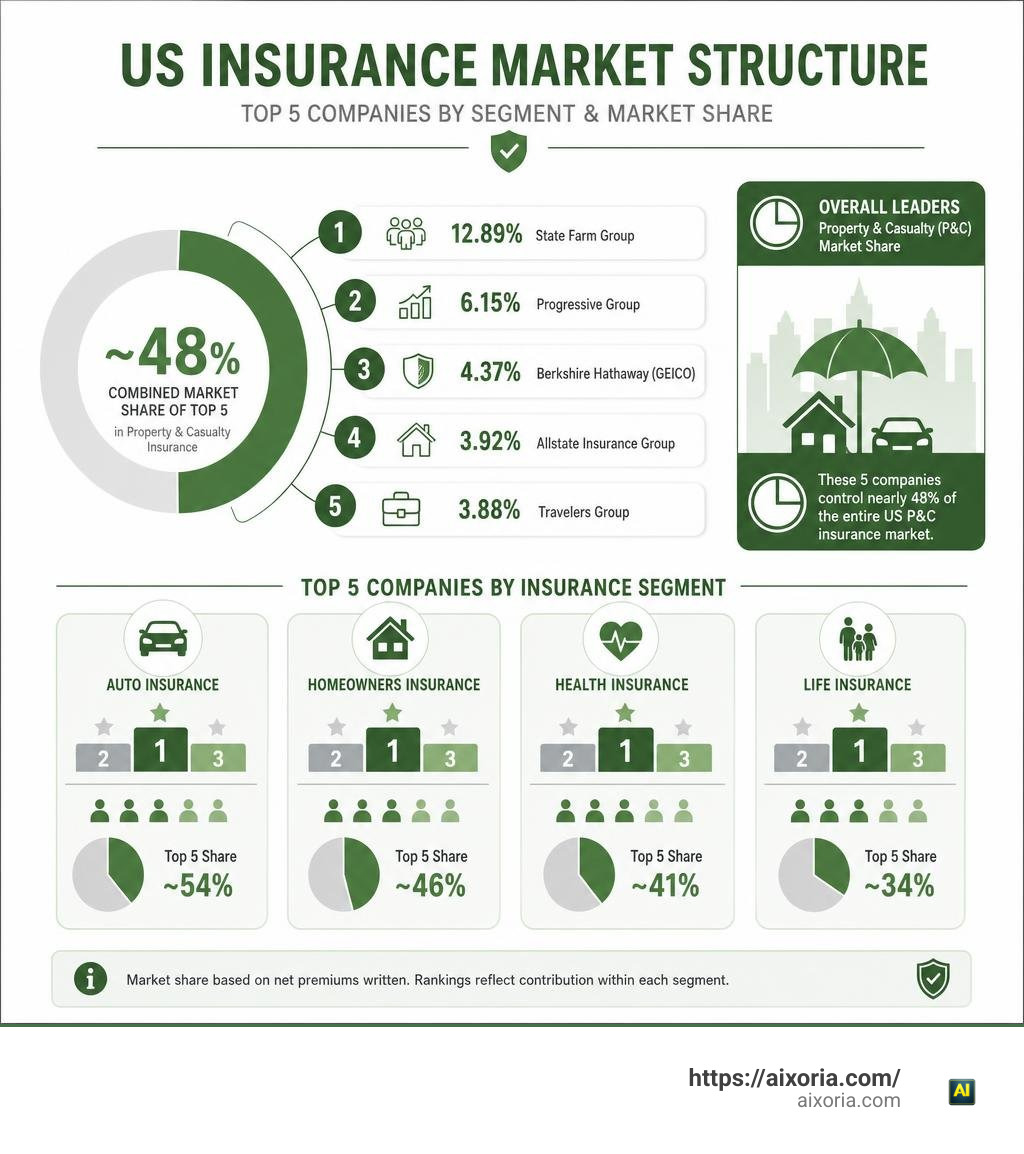
| 1 | State Farm Group | 12.89% | $107.76 billion |
| 2 | Progressive Group | 6.15% | $74.41 billion |
| 3 | Berkshire Hathaway (GEICO) | 4.37% | $80.32 billion |
| 4 | Allstate Insurance Group | 3.92% | $52.72 billion |
| 5 | Travelers Group | 3.88% | $41.10 billion |
Together, these five companies control nearly 48% of the entire US property and casualty insurance market.
But here’s the thing — “top” means something different depending on what you need. Are you shopping for auto insurance? Health coverage? Life insurance? A policy to protect your home? The leaders shift dramatically across each category.
This guide gives you 5 practical keys to make sense of those differences, so you can compare insurers the smart way and find the right fit for your situation.
Key 1: Define Metrics and Analyze Who is the top 5 insurance company in USA?

When we ask ourselves Who is the top 5 insurance company in USA?, the first hurdle is deciding what “top” actually means. Are we talking about the company that writes the most policies, the one with the largest vault of cash, or the one that makes customers smile when they file a claim?
To run a proper comparison, we have to look at three main metrics:
- Net Premiums Written (NPW): This represents the total amount of money customers pay the company for coverage, minus any money the insurer pays to reinsurance companies. It tells us how much active business the insurer is writing right now.
- Total Non-Banking Assets: This measures the overall financial size and investment power of the company. It is a great indicator of long-term solvency—meaning, do they have the financial muscle to pay out claims if a massive natural disaster hits?
- Customer Satisfaction & Reputation: This is how real people feel about their claims process, customer service, and overall reliability.
Let’s look at how the top five Property & Casualty (P&C) insurers stack up when we measure them by market share and net premiums written:
| Company Group | P&C Market Share | Net Premiums Written (NPW) | Unique Structural Feature |
|---|---|---|---|
| State Farm Group | 12.89% | $107.76 Billion | Mutual Insurance Company (owned by policyholders) |
| Progressive Group | 6.15% | $74.41 Billion | Publicly Traded (heavy focus on digital-first telematics) |
| Berkshire Hathaway Group | 4.37% | $80.32 Billion | Public Conglomerate (utilizes a massive $170B investment “float”) |
| Allstate Insurance Group | 3.92% | $52.72 Billion | Publicly Traded (hybrid captive agent and digital model) |
| Travelers Group | 3.88% | $41.10 Billion | Publicly Traded (the only P&C insurer in the Dow Jones) |
Each of these giants has a completely different business model. For example, State Farm operates as a mutual insurance group, meaning its policyholders technically own the company. On the other hand, Berkshire Hathaway (which owns GEICO) relies heavily on generating a massive $170 billion “float”—investable premium capital that Warren Buffett uses to fund long-term investments before claims are paid out.
Meanwhile, Travelers Group stands out as a commercial powerhouse and is the only property-casualty insurer included in the prestigious Dow Jones Industrial Average.
If you want to dive deeper into how these corporate structures affect their business, you can check out the TOP 100 Property & Casualty Insurance Companies in 2026 – P&C Insurers report, or see who made the cut for the Most Reputable Car Insurance Companies in 2026 – Top 10 Ranked.
Key 2: Segment by Insurance Type (Auto, Home, Life, and Health)

A common mistake is assuming that a company that is fantastic at auto insurance will be equally dominant in health or life insurance. In reality, the insurance landscape is highly specialized. A company like State Farm might dominate your driveway, but they are not the ones managing your employer-sponsored health plan or your retirement annuity.
For most families, the smartest financial move is to look at where these coverage lines intersect—especially if you want to bundle your policies to save money. If you are looking to protect both your car and your house under one roof, take a look at our guide on the Best Homeowners Car Insurance Bundle in 2026 – Save More on Home & Auto.
Let’s break down how the “top 5” changes when we look at specific insurance categories.
Auto vs. Home: Who is the top 5 insurance company in USA for personal lines?
When it comes to personal lines—the insurance we buy to protect our personal cars and homes—the market is incredibly concentrated. In fact, the top ten largest car insurance companies control roughly 77% of the entire U.S. auto insurance market.
However, the leaders in auto do not align perfectly with the leaders in homeowners insurance:
- In Auto Insurance: State Farm and Progressive are locked in an incredibly tight, neck-and-neck race for the crown. State Farm holds an 18.64% market share, while Progressive is right on its heels with 18.60%. GEICO sits comfortably in third place with 11.56%, followed by Allstate (10.15%) and USAA (6.19%).
- In Homeowners Insurance: State Farm is the undisputed king, commanding an 18.2% market share (writing over $31.4 billion in direct premiums). The rest of the top five is filled out by companies like Allstate, Liberty Mutual, USAA, and Farmers. Progressive, while a giant in auto, has a much smaller footprint in the homeowners space, often outsourcing its home policies to third-party underwriters.
If you want to see a detailed analysis of the auto market players, check out the 10 Largest Car Insurance Companies in the U.S. report.
Life and Health: Who is the top 5 insurance company in USA for medical and life coverage?
If we pivot over to life and health insurance, the P&C giants completely disappear from the top rankings, replaced by massive financial conglomerates and healthcare specialists.
In the health insurance sector, the market is dominated by national giants that handle hundreds of billions of dollars in annual premiums:
- UnitedHealth Group: The undisputed leader with roughly 16.0% market share and $269.4 billion in annual premiums.
- CVS Health (including Aetna): Sitting at a 7.22% market share ($121.2 billion in premiums) after CVS acquired Aetna to build an integrated pharmacy-and-insurance model.
- Centene Corporation: Holding a 6.74% market share ($113.1 billion), Centene is the largest Medicaid managed care organization in the country.
- Humana: Controlling 6.59% of the market ($110.5 billion), with a massive focus on Medicare Advantage plans for seniors.
- Elevance Health (formerly Anthem): Holding a 6.44% market share as one of the largest Blue Cross Blue Shield licensees.
To see how these health giants compare to regional non-profit powerhouses, read the Top 20 Health Insurance Companies in the USA (2026 Ranking) – Insurance Guide Book .
In the life insurance and annuity sector, the metrics shift to total assets under management, as these companies must hold enough capital to pay out policies decades into the future. The top players here include:
- MetLife Inc.: The leading writer of life and annuity products with over $114.5 billion in direct premiums.
- Prudential Financial: A financial colossus holding over $721 billion in total assets.
- New York Life Insurance Company: One of the largest mutual life insurers in the world with over $428 billion in assets.
- Northwestern Mutual: The leader in individual net life insurance premiums, highly praised for its financial strength.
Key 3: Account for Regional Variations and Unique Offerings
National market shares are great for corporate boardrooms, but insurance is regulated at the state level. This means that a company that dominates the country might not be the best—or even the biggest—option in your specific city.
Take Texas, for example. While State Farm and Progressive are close nationally, their local entities behave differently in the Lone Star State:
- In Texas Personal Auto, Progressive County Mutual Insurance Company takes a commanding lead with a 20.97% market share ($7.42 billion in premiums), leaving State Farm in second place at 16.85%.
- In Texas Homeowners, State Farm Lloyds dominates with a 19.47% market share ($3.69 billion in premiums).
This is why looking at hyper-local data is so important. If you live in Texas, for instance, you’ll want to check out the Best Car Insurance Rates in Houston to see how local rates actually play out.
Finding the Right “Flavor” of Insurance
Beyond location, each of the top companies has developed a unique “superpower” or digital tool to attract different types of drivers and homeowners:

- Progressive is widely praised for its digital budgeting flexibility, specifically its “Name Your Price” tool and its telematics program, Snapshot, which rewards safe driving behavior in real-time.
- Allstate offers Drivewise and Milewise (a pay-per-mile plan), which appeal heavily to low-mileage drivers and remote workers.
- GEICO is consistently highlighted in editorial reviews (like Forbes and U.S. News) as the best option for direct-to-consumer discounts.
- State Farm relies on its massive network of local captive agents, making it the preferred choice for people who want a dedicated human being to talk to down the street.
To see how these unique offerings translate into actual savings, you can compare them using our lists of the Top 10 Cheapest Car Insurance Companies and the Top 10 Cheapest Car Insurance Quotes.
Frequently Asked Questions About Top US Insurers
How have the top 5 rankings changed in the last year?
The most notable trend in the last year is the rapid premium growth of Progressive Group. Driven by its advanced telematics underwriting and aggressive pricing adjustments, Progressive saw a massive 21% year-over-year increase in net premiums written, bringing its total to $74.41 billion. This has put it in a virtual dead heat with State Farm for the number-one spot in the auto insurance market.
Additionally, we are seeing massive market consolidation. The top ten P&C insurers now command nearly half of the entire US market, making it harder for smaller regional carriers to compete on price. For a full breakdown of these shifts, explore the Facts + Statistics: Insurance company rankings | III report.
What is the difference between direct premiums and net premiums?
When researching insurance rankings, you will often see two different numbers: Direct Premiums Written and Net Premiums Written.
- Direct Premiums Written is the total amount of premium cash an insurer collects directly from policyholders. It represents the raw market share of the company before any corporate financial maneuvering.
- Net Premiums Written is the amount of premium the company keeps after paying for reinsurance. Reinsurance is essentially “insurance for insurance companies”—large carriers pay reinsurance groups to absorb some of their catastrophic risk. Net premiums give a more accurate picture of an insurer’s actual financial retention and underwriting liability.
Is USAA open to the general public?
No, USAA (United Services Automobile Association) is not open to the general public. Membership is strictly limited to active-duty military members, veterans, and their immediate families.
Structurally, USAA is unique because it operates as a reciprocal insurance exchange. In this setup, policyholders are technically members who insure one another, and any excess profits are often returned to the members in the form of dividends or lower rates. Despite its restricted membership, USAA’s incredible customer loyalty and cheap rates make it the fifth-largest auto insurer in the country.
Conclusion
When asking Who is the top 5 insurance company in USA?, we quickly find that size is only one piece of the puzzle. While State Farm, Progressive, Berkshire Hathaway, Allstate, and Travelers dominate the national P&C landscape, the “best” company is the one that aligns with your specific location, vehicle, home, and budget.
At Aixoria, we believe that the best way to navigate the complex world of insurance is through data-driven comparisons and clear, simple education. By understanding how these giants measure up, you can make informed decisions that protect your family and your wallet.
To stay ahead of the curve on how technology, underwriting, and artificial intelligence are changing the insurance industry, Explore the latest AI updates and industry trends on our platform today!