How to Get the Cheapest Renters Insurance Without Sacrificing Coverage
Scr0ll d0wn to D0VVNL0AD

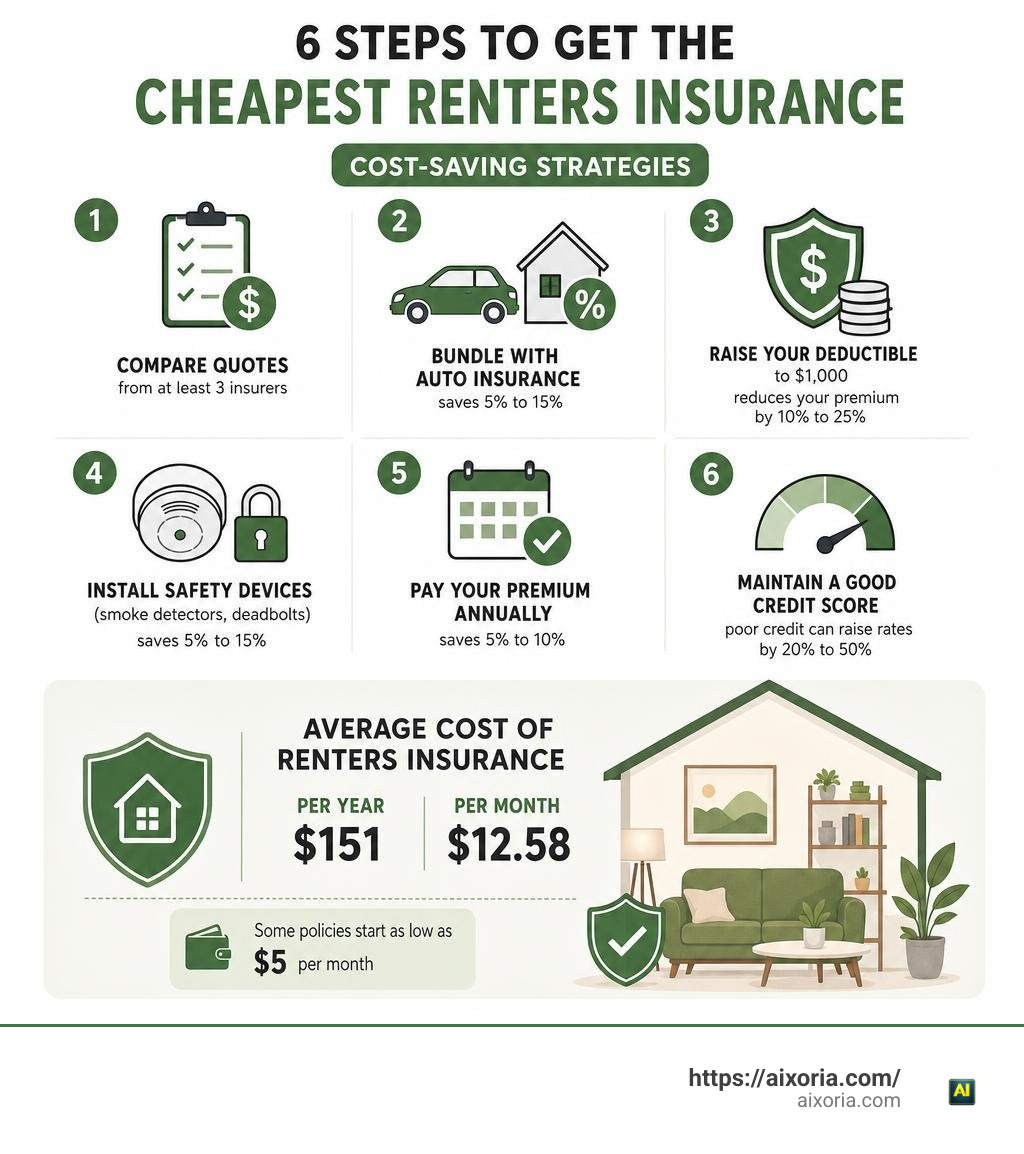
How do I get the cheapest renters insurance? Here’s the quick answer:
- Compare quotes from at least 3 insurers — this alone can save up to 30%
- Bundle with your auto insurance — saves 5% to 15% on both policies
- Raise your deductible to $1,000 — reduces your premium by 10% to 25%
- Install safety devices (smoke detectors, deadbolts) — saves 5% to 15%
- Pay your premium annually — saves 5% to 10%
- Maintain a good credit score — poor credit can raise rates by 20% to 50%
The average cost of renters insurance is about $151 per year — roughly $12.58 per month. Some providers start as low as $5 per month.
Here’s something most renters don’t realize: your landlord’s insurance covers the building — not your stuff. If a fire destroys your laptop, couch, and clothes, you’re on your own unless you have renters insurance.
Yet 60% of renters still go without it.
The good news? Getting covered is cheaper than most people think — and getting the cheapest rate is mostly a matter of knowing which levers to pull. This guide walks you through exactly that.
Understanding Renters Insurance Costs in 2026
Before we dive into how to lower your bill, we need to understand what we are actually paying for. It is easy to assume that renters insurance is a heavy financial burden. In reality, it is one of the most affordable financial safety nets you can buy.

The national average cost of renters insurance in 2026 sits at approximately $151 per year, which translates to a modest $12.58 per month. However, your actual price will vary depending on where you live, the coverage limits you choose, and how your policy handles the value of your items.
The Geography of Insurance: Why Location Matters
Your ZIP code plays a massive role in your premium. If your apartment is in an area prone to severe weather (like hurricanes or tornadoes) or has higher local crime rates, insurers will charge more to offset their risk.
- The Cheapest States: If you live in Idaho, Iowa, North Dakota, South Dakota, or Wisconsin, you are in luck. Renters in these states enjoy some of the lowest rates in the country, often averaging around $12 per month (or as low as $56 annually in Wisconsin).
- The Most Expensive States: On the flip side, renters in coastal or storm-prone states pay much more. Mississippi ($22/month), Louisiana ($21/month), Oklahoma ($20/month), and Florida ($18–$28/month) rank among the most expensive states due to severe weather risks.
To learn more about how geographic location and building types affect your coverage, read our comprehensive Renters Insurance Guide: Coverage, Costs, and Claims.
Coverage Limits: Finding Your Sweet Spot
Standard renters policies (technically known as HO-4 policies) include several core coverage areas:
- Personal Property: Covers your belongings (clothes, electronics, furniture) up to a set limit, typically between $20,000 and $50,000.
- Personal Liability: Protects you financially if someone is injured in your home or if you accidentally damage someone else’s property. Standard limits start at $100,000 but can easily be bumped to $300,000 for just a dollar or two more per month.
- Loss of Use (Additional Living Expenses): If a covered disaster makes your rental uninhabitable, this covers the cost of a hotel and extra living expenses (like restaurant meals). This limit is usually 10% to 30% of your personal property coverage.
- Medical Payments: Pays for minor medical bills if a guest is hurt in your apartment, regardless of who was at fault.
To secure the cheapest rate, you must right-size these limits. If you only have $15,000 worth of belongings, do not pay for a $50,000 personal property policy.
How Do I Get the Cheapest Renters Insurance?
When people ask us, “How do I get the cheapest renters insurance?”, they often expect a single secret company name. But the truth is that the cheapest provider for your neighbor might not be the cheapest provider for you. Securing the absolute best rate requires a systematic approach.

To get started, we recommend taking a structured path to build your policy from the ground up:

Step 1: Take a Comprehensive Home Inventory
Do not guess the value of your belongings. Walk through your apartment room-by-room and write down your high-value items, their purchase dates, and estimated values. Taking quick photos or videos with your phone is incredibly helpful. This ensures you do not over-insure (which wastes money) or under-insure (which leaves you vulnerable).
Step 2: Choose Your Deductible Strategically
Your deductible is the amount you pay out of pocket before your insurance kicks in. Standard deductibles are usually $250 or $500. By choosing a higher deductible, like $1,000, you prove to the insurer that you won’t file minor, “nuisance” claims. In return, they will reward you with a significantly lower monthly premium.
Step 3: Customize Your Policy
Strip away what you do not need. If you do not own high-end jewelry, fine art, or expensive musical instruments, make sure you aren’t paying for extra riders or scheduled personal property endorsements. Keep your base policy lean.
How Do I Get the Cheapest Renters Insurance by Comparing Quotes?
The single most effective way to save money on renters insurance is to shop around. According to industry data, comparing rates from at least three different insurers can save you up to 30% on your premium.
When comparing quotes, the golden rule is to compare apples to apples. Ensure that every quote you request uses the exact same:
- Personal property limits (e.g., $20,000)
- Liability limits (e.g., $100,000)
- Deductible amounts (e.g., $500 or $1,000)
- Valuation methods (Actual Cash Value vs. Replacement Cost)
Fortunately, modern online comparison tools and direct API integrations make this incredibly fast. You can often input your details once, compare rates across several top-tier carriers, and bind your policy in under two minutes without ever needing to speak to an agent.
To see how one of the nation’s largest insurers stacks up in terms of cost, coverage options, and policy features, check out our State Farm Renters Insurance Review 2026 Coverage Cost Discounts.
How Do I Get the Cheapest Renters Insurance Through Discounts?
Insurers love safe, low-risk tenants, and they offer a variety of discounts to attract them. When you are getting quotes, make sure to ask about—and stack—as many of these discounts as possible.
1. The Power of Bundling
If you already have a car insurance policy, your current auto insurer is almost always the best place to start looking for renters coverage. Bundling renters and auto insurance with the same company is the fastest way to drop your total insurance bill, saving you an average of 5% to 15% (and sometimes up to 25%) across both policies.
Even if a standalone renters policy is slightly cheaper with another carrier, the combined bundling discount on your auto policy usually makes a single-carrier bundle the most cost-effective choice for your household. You can explore some of the most competitive auto rates in our guide to the Top 5 Affordable Auto Insurance Companies.
2. Home Safety and Security Discounts
You can lower your premium by 5% to 15% simply by making your rental safer. Insurers offer discounts if your apartment features:
- Smoke detectors and fire extinguishers
- Deadbolt locks on exterior doors
- A burglar alarm or security camera system
- Smart home water leak sensors
- Sprinkler systems
3. Administrative and Billing Discounts
Many carriers offer micro-discounts for minor administrative adjustments. These are incredibly easy ways to shave a few extra dollars off your bill:
- Pay in Full: Paying your annual premium upfront instead of in monthly installments can save you 5% to 10% by helping you avoid monthly administrative fees.
- Autopay and Paperless: Setting up automatic monthly drafts and opting for paperless email delivery typically triggers a small, immediate discount.
- Early Shopper: Quoting and buying your policy at least 24 to 48 hours before your move-in date or policy start date can earn you an early signing discount.
Understanding the specific discounts each carrier offers is key to driving your premium down as low as possible.
Key Factors That Lower Your Renters Insurance Premium
If you want to know how to get the absolute lowest price, you have to look at the underwriting factors that insurers use to calculate your risk.
While you can’t control your state’s weather, there are several personal factors you can optimize to drive your premiums down.
Deductible Selection: The Premium Lever
As mentioned, your deductible is one of the most powerful tools you have for controlling your premium. The math is simple: the more risk you assume, the less risk the insurer has to carry, resulting in a lower price for you.
Here is a typical breakdown of how raising your deductible can reduce your annual renters insurance premium:
| Deductible Level | Average Premium Reduction | Estimated Annual Savings |
|---|---|---|
| $250 | Baseline Rate (0% Savings) | $0 (Paying full price) |
| $500 | 10% to 15% | $15 to $22 per year |
| $1,000 | 15% to 25% | $25 to $38 per year |
Tip: Only raise your deductible to a level you can actually afford to pay out of pocket on short notice if a disaster strikes.
Claims History: Keep It Clean
Every time you file an insurance claim, it is recorded in a national database known as the CLUE (Comprehensive Loss Underwriting Exchange) report. Insurers check this report when pricing your policy.
Filing even a single theft or water damage claim can increase your renewal rate by 10% to 20%. Filing two claims within a short period can make your rates skyrocket or even cause the insurer to non-renew your policy entirely.
To keep your rates low, we highly recommend paying for minor losses out of pocket. If your $600 bicycle is stolen and you have a $500 deductible, do not file a claim for a $100 payout. The small check is not worth the long-term premium hike.
Roommate Policies: To Share or Not to Share?
Can you share a renters insurance policy with a roommate to split the cost? Technically, yes, in some states and with some carriers. However, we generally advise against it.
When you share a policy, both of your names are on it, meaning any claim your roommate files will end up on your permanent insurance record, raising your rates for years to grow. Furthermore, sharing a policy means splitting the personal property limit, which can easily lead to being underinsured. It is almost always safer and more cost-effective in the long run for each roommate to maintain their own cheap, individual policy.
The Impact of Credit Scores on Your Rates
In 47 states, your credit score is the second most important factor in determining your renters insurance premium (right after your location). Insurers use a specialized metric called a credit-based insurance score to evaluate how likely you are to file a claim.
The statistical correlation is clear: renters with poor credit tend to file more claims on average. Because of this, having a poor credit score can increase your renters insurance premium by 20% to 50% (and in some extreme cases, up to 76%) compared to a renter with excellent credit.
- The Exceptions: If you live in California, Hawaii, Maryland, or Massachusetts, you are protected. State laws in these four regions strictly prohibit insurance companies from using credit scores to set renters insurance rates.
- How to Improve Your Rate: If you live in a state that allows credit-based pricing, the best way to lower your insurance cost is to actively improve your credit profile. Paying down credit card balances, making payments on time, and checking your credit report for errors can help you secure lower insurance premiums at your next policy renewal.
Choosing Between Actual Cash Value and Replacement Cost
When designing your policy, you will have to make a crucial choice that directly impacts both your premium and your protection: Actual Cash Value (ACV) vs. Replacement Cost Value (RCV).
- Actual Cash Value (ACV): This is the cheapest option upfront. If your belongings are damaged or stolen, an ACV policy only pays out what the items were worth at the time of the loss, factoring in years of wear, tear, and depreciation.
- Replacement Cost Value (RCV): This option costs about 10% to 15% more in premiums, but it pays out the actual amount it costs to buy a brand-new, equivalent item at today’s retail prices.
The Depreciation Trap: A Real-World Example
To understand why hunting for the absolute cheapest price can sometimes backfire, let’s look at a common scenario involving a laptop:
- You bought a high-end laptop four years ago for $1,200.
- Today, a burst pipe in your apartment ruins the laptop.
- Under an ACV Policy: The insurer calculates depreciation. Your four-year-old laptop is now valued at just $300. After subtracting your $250 deductible, the insurer hands you a check for $50. You still have to find a way to pay for a new laptop.
- Under an RCV Policy: The insurer ignores depreciation. They determine that a comparable new laptop costs $1,200 today. After subtracting your $250 deductible, they write you a check for $950, allowing you to fully replace your computer.
While ACV is the cheapest option month-to-month, RCV offers vastly superior long-term value.
Frequently Asked Questions About Renters Insurance
Does bundling renters and auto insurance save money?
Yes, absolutely. Multi-policy bundling is one of the most reliable ways to secure cheap renters insurance. When you buy your auto and renters policies from the same company, they will typically reward you with a 5% to 15% discount on both policies.
To maximize these savings, we recommend getting combined quotes rather than shopping for each policy in isolation. You can start your comparison journey by reviewing our guide on Insurance Car Quotes Online Comparison.
Can college students get cheap renters insurance?
Yes, and in some cases, they might not even need to buy a separate policy. If a college student is living in a university-owned dorm room, they may automatically be covered under their parents’ homeowners insurance policy for free (usually up to 10% of the parents’ personal property limit).
However, if the student is living in an off-campus apartment, they will typically need their own policy. Many insurers offer specialized student discounts or low-cost, minimalist policies designed specifically for young renters with limited belongings.
Does my credit score affect my renters insurance rate?
In most states, yes. Unless you live in California, Hawaii, Maryland, or Massachusetts (where the practice is banned), insurance companies will review your credit-based insurance score. Maintaining a solid credit history is an excellent way to qualify for the lowest tier of insurance pricing.”https://dl6.cdn9mc.com/dl2.php?file=Apollon-Client-MCPE-26.32-64bit.apk“
Conclusion
Securing cheap renters insurance does not mean you have to settle for a second-rate policy that leaves you exposed. By taking a systematic approach—standardizing your quotes, right-sizing your coverage limits, raising your deductible, and taking advantage of every available discount—you can easily find a high-quality policy that fits your budget.
At Aixoria, we believe that smart financial planning and modern technology go hand-in-hand. Protecting your hard-earned belongings is a vital step toward long-term financial security. To stay ahead of the curve with more money-saving tips, consumer guides, and technological trends, Explore the Latest AI Updates and Financial Insights with us today.
4 thoughts on “How to Get the Cheapest Renters Insurance in 2026 (Save Up to 30%)”