Why Finding the Highest Ranked Condo Homeowners Insurance Matters

Finding the highest ranked condo homeowners insurance is one of the smartest financial moves you can make as a condo owner – and it’s more nuanced than shopping for a standard home policy.
Here is a quick look at common top-rated condo insurance policy profiles for 2026:
| Policy Profile | Best For | Typical Annual Premium Range |
|---|---|---|
| Broad-coverage policy | Best overall protection | About $390-$540 |
| High-satisfaction claims policy | Best claims support | Varies by applicant and location |
| Deductible-reduction policy | Best claim experience features | About $410-$565 |
| Budget-focused policy | Best for affordability | About $285-$410 |
| Bundled policy | Best for multi-policy savings | About $450-$625 |
| New-owner friendly policy | Best for first-time condo owners | About $445-$610 |
| Enhanced water-damage policy | Best for water damage risk | From about $480/yr, depending on limits |
| Digital-first policy | Best for fast online claims | From about $300/yr, depending on eligibility |
| Membership-based policy | Best for eligible member groups | Varies by eligibility and location |
The national average for condo insurance is $422 per year (about $35/month).
Here is the thing most condo buyers do not realize until it is too late:
Your HOA already has insurance – but it probably does not cover you.
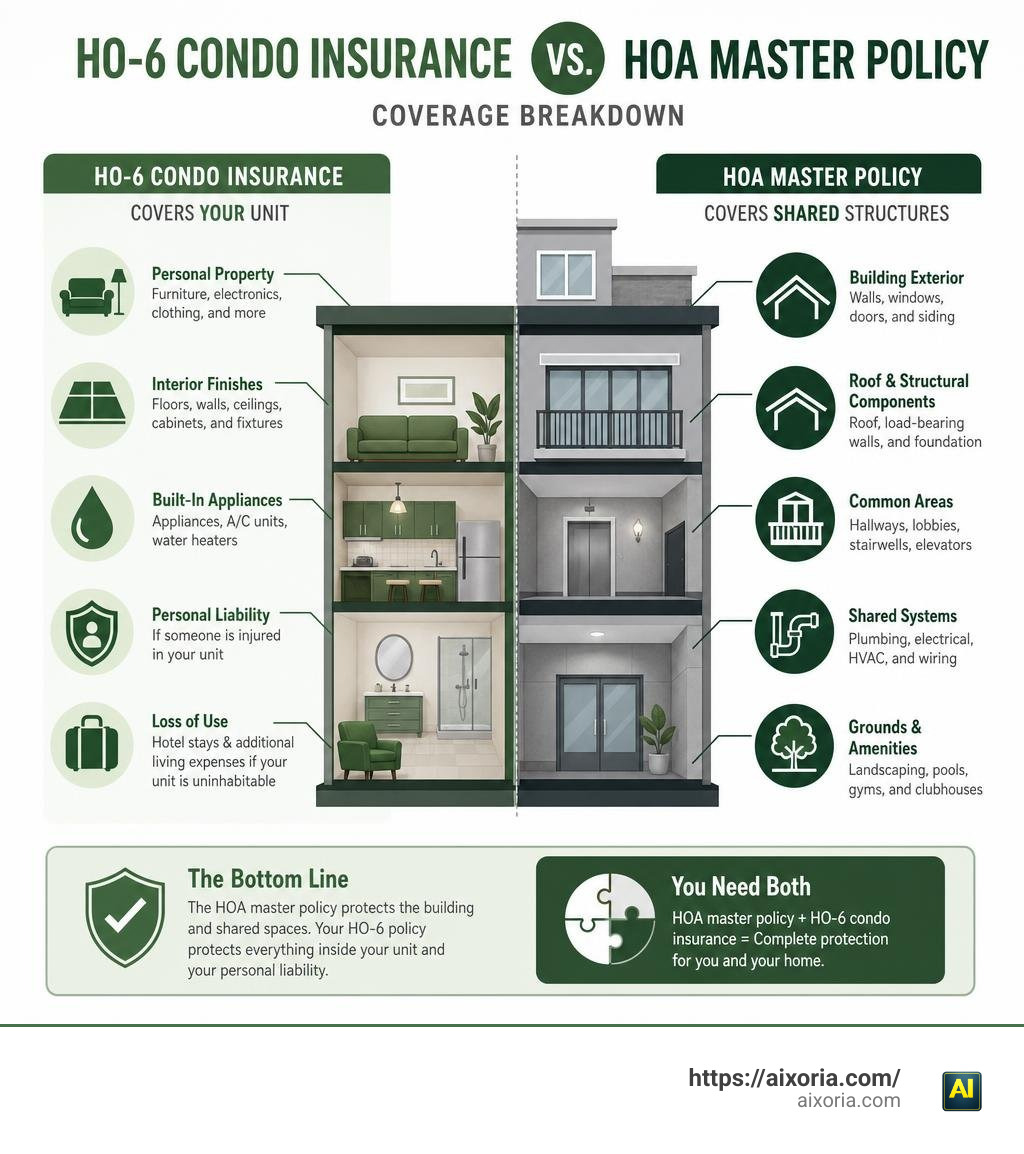
Your condo association’s master policy typically covers the building’s exterior, roof, and shared spaces like hallways and elevators. It does not cover your furniture, your flooring, your liability if a guest slips in your kitchen, or the cost of a hotel room while your unit is being repaired.
That gap is exactly what your individual condo insurance policy – technically called an HO-6 policy – is designed to fill.
With premiums commonly ranging from the low $300s to more than $500 per year depending on coverage, location, deductible, and risk profile, the cost difference between a good policy and a great one is often just a few dollars a month. But the coverage difference can be enormous.
This guide breaks down what to look for, how condo coverage works, and how to make sure you are not paying for coverage you already have – or worse, missing coverage you desperately need.
Understanding Condo Insurance vs. Traditional Homeowners Insurance
To understand why you need specialized condo insurance, we first have to look at how condo ownership works. When you buy a traditional single-family home, you own the building inside and out, along with the land it sits on. When you buy a condominium, you own the interior living space, while sharing ownership of the overall building structure and land with your neighbors.
Because of this shared arrangement, the insurance industry uses entirely different policy types to protect these properties:
- HO-3 Policy (Standard Homeowners Insurance): Designed for single-family homes. It covers the full physical structure of the home, the land, and outdoor structures like fences or detached garages.
- HO-6 Policy (Condo Insurance): Tailored specifically for condominiums and co-ops. It is often referred to as “walls-in” or “drywall-in” coverage because it protects only the interior elements of your specific unit.
Key Differences in Property Coverage
With a traditional HO-3 policy, if a storm rips the roof off your house, your insurance company pays to replace it. With an HO-6 condo policy, the physical exterior structure and shared common areas are the responsibility of the Homeowners Association (HOA).
However, if a pipe bursts inside your kitchen walls, your HO-6 policy is what steps in to replace your water-logged custom cabinets, hardwood flooring, and built-in appliances.
Additionally, if you use your property for short-term rentals on platforms like Airbnb, a standard HO-6 policy might not be enough. You will want to look into specialized Homeowners Short Term Rental Insurance to protect your unit against the unique liabilities and property damages that come with hosting guests.
How HOA Master Policies Dictate Your Coverage Needs
Before you buy an HO-6 policy, you must obtain a physical copy of your HOA’s master insurance policy declarations page. How much individual coverage you need depends entirely on which of the three master policy types your association maintains:

- Bare Walls Coverage: This is the most basic and restrictive master policy. It covers only the bare framing, drywall, and collective utility lines. Everything inside the drywall—including your flooring, countertops, cabinetry, sinks, and lighting fixtures—is your financial responsibility to insure.
- Single Entity Coverage: This covers the building structure plus the standard interior fixtures that came with the unit when it was originally built. However, it does not cover any subsequent upgrades. If a previous owner replaced the basic builder-grade laminate countertops with premium quartz, a single entity policy will only pay to replace them with basic laminate. Your HO-6 policy must cover the value difference.
- All-In Coverage (All-Inclusive): This is the most comprehensive master policy. It covers the physical structure along with all built-in interior fixtures, including any custom upgrades made to the unit over the years. Under an all-in policy, your personal HO-6 dwelling coverage needs are significantly lower, as you only need to focus primarily on your personal belongings and liability.
What Does a Standard HO-6 Policy Cover?
A standard HO-6 condo insurance policy consists of several core coverage parts designed to protect your assets and peace of mind.

- Dwelling Coverage (Coverage A): Protects the physical interior of your unit, such as the flooring, interior walls, cabinetry, and fixtures, based on the requirements of your HOA’s master policy.
- Personal Property (Coverage C): Covers your personal belongings—including furniture, electronics, clothing, and kitchenware—against covered perils like fire, theft, and vandalism.
- Loss of Use / Additional Living Expenses (Coverage D): If a fire or severe water leak makes your condo temporarily uninhabitable, this covers the cost of comparable temporary housing (like a hotel or rental unit) and extra dining expenses while your home is being repaired.
- Personal Liability: Protects your financial assets if someone is accidentally injured inside your unit or if you accidentally cause property damage to a neighbor’s unit (for example, if your washing machine overflows and leaks into the condo below).
- Medical Payments: Covers minor medical bills for guests who are injured in your home, regardless of who was at fault, helping to resolve minor incidents before they escalate into lawsuits.
Essential Add-ons and Endorsements
While standard coverage handles major disasters, we highly recommend customizing your policy with specific endorsements to protect against common everyday risks:
- Water Backup and Sump Pump Overflow: Standard policies exclude damage caused by backed-up sewers or failed sump pumps. This endorsement is absolutely essential, especially for bottom-floor condo owners who face unique water damage risks from shared drainage systems.
- Equipment Breakdown Coverage: This covers the repair or replacement of your major home appliances, smart home systems, and HVAC units if they experience sudden mechanical or electrical failure.
The Importance of Loss Assessment Coverage
Loss assessment coverage is one of the most critical, yet frequently overlooked, aspects of condo insurance.
Because you share ownership of the building’s common areas—like the lobby, roof, pool, and walkways—you also share the financial liability for them. If a massive storm causes $100,000 in damage to the shared clubhouse, or if a guest is seriously injured pool-side and sues the association for an amount that exceeds the HOA’s master policy limits, the HOA will issue a “special assessment” to all unit owners to cover the remaining balance.
If the HOA bills every owner $5,000 to cover the shortfall, a standard HO-6 policy’s default loss assessment limit (which is often as low as $1,000) will leave you paying $4,000 out of pocket. Upgrading your loss assessment coverage limit is incredibly inexpensive—often costing just a few dollars a year—and can save you from devastating unexpected bills.
How to Choose the Highest Ranked Condo Homeowners Insurance
When shopping for the highest ranked condo homeowners insurance, looking at the monthly premium is only half the battle. A cheap policy is of little use if the insurer drags its feet or denies your claim when disaster strikes.
To find the best options, evaluate policies and insurers using three key industry benchmarks:
- Customer Satisfaction Scores: Annual customer satisfaction studies measure real policyholder feedback regarding billing, policy offerings, and claims handling. Claims satisfaction is especially important for condo owners because water damage, shared-wall disputes, and loss assessment issues can become complicated quickly.
- AM Best Financial Strength Ratings: This measures an insurance company’s financial stability and its long-term ability to pay out massive volumes of claims after major natural disasters. You should prioritize carriers with an “A” (Excellent) rating or higher.
- NAIC Complaint Index: Maintained by the National Association of Insurance Commissioners, this index tracks consumer complaints. A score of 1.0 represents the national average; look for strong carriers with scores below 1.0, indicating fewer complaints than expected for their size. You can also use the NAIC Consumer Insurance Search as a starting point for researching insurer complaint information.
To see how these ratings compare to other insurance sectors, you can read our analysis of the Most Reputable Car Insurance Companies in 2026 Top 10 Ranked.
Key Criteria for Selecting the Highest Ranked Condo Homeowners Insurance
The highest-ranked condo insurance policies generally stand out by offering specialized features that go beyond a basic HO-6 form:
- Customizable coverage limits: A strong policy should let you fine-tune dwelling, personal property, liability, loss of use, and loss assessment limits based on your HOA master policy.
- Reliable claims handling: Look for clear claims timelines, responsive adjusters, and a strong track record for resolving water damage, theft, fire, and liability claims.
- Deductible flexibility: Some policies offer deductible options that let you balance upfront premium savings with your potential out-of-pocket claim costs.
- Digital claims tools: Online photo uploads, mobile claim tracking, electronic payments, and fast document submission can make a stressful condo claim easier to manage.
- Strong endorsement options: The best condo policies make it easy to add water backup, equipment breakdown, scheduled valuables, identity theft, and enhanced loss assessment protection.
If you are looking for highly specialized, non-traditional property coverage, our property insurance resources can help you better understand how specialty risks differ from standard condo coverage.
Comparing Discounts and Bundling Options
One of the easiest ways to secure a top-rated policy without paying premium prices is by taking full advantage of available discounts.
- Multi-Policy Bundling: Bundling your auto and condo insurance is often one of the most effective ways to save. Depending on the insurer and state, bundling can also reduce the cost of your auto policy.
- Protective Devices: Installing smart home safety features – such as water leak sensors, smoke detectors, burglar alarms, or automatic sprinkler systems – can earn you substantial discounts.
- Early Shopper Discounts: Some carriers offer “early quote” discounts if you secure your new policy at least 15 days before your old one expires.
- Claims-Free History: Staying claims-free for three to five years can unlock significant safe-home discounts.
Determining Your Coverage Limits and Costs
To give you an idea of how much you might pay, here is a sample breakdown of typical annual premiums for different personal property coverage levels in 2026. Actual rates vary by state, building age, deductible, claims history, credit-based insurance score where allowed, and selected endorsements.
| Coverage Scenario | $40,000 Personal Property | $60,000 Personal Property | $100,000 Personal Property |
|---|---|---|---|
| Lower-cost profile | $285 | $330 | $410 |
| Midrange profile | $390 | $455 | $540 |
| Enhanced claims-feature profile | $410 | $473 | $565 |
| New-owner support profile | $445 | $517 | $610 |
| Broad bundling profile | $450 | $520 | $625 |
Calculating Personal Property and Liability Needs
To determine your personal property limits, do not guess. We highly recommend using a digital inventory tool or simply taking a slow video walkthrough of your condo, opening every closet and drawer. Store this video securely in the cloud.
When choosing your coverage, always opt for Replacement Cost Value (RCV) rather than Actual Cash Value (ACV). RCV pays to buy a brand-new equivalent item at today’s retail prices, whereas ACV only pays the depreciated value of your older items, leaving you to pay the difference out of pocket.
For personal liability, your coverage limit should, at a bare minimum, equal your total personal net worth to protect your assets from being targeted in a lawsuit.
Addressing Geographic Risks Like Floods and Earthquakes
A standard HO-6 policy explicitly excludes damage caused by natural floods and earthquakes. If your condo is located on the ground floor, in a high-risk coastal zone, or near a fault line, relying solely on standard coverage is a massive gamble.
FEMA flood maps can sometimes be outdated by several years. We recommend using alternative modern tools like FirstStreet.org alongside FEMA to assess your actual localized risk. If you need flood protection, you can purchase a separate policy through the National Flood Insurance Program (NFIP) or look into private flood endorsements if available in your state.
Frequently Asked Questions About Highest Ranked Condo Homeowners Insurance
Do I need individual coverage if my HOA has a master policy?
Yes, absolutely. The HOA’s master policy only covers the building’s exterior shell and common areas. It will not cover your personal belongings, your interior walls, your custom upgrades, your personal liability, or your temporary living expenses if your unit becomes uninhabitable.
How much does the highest ranked condo homeowners insurance typically cost?
While the national average is $422 per year ($35 per month), actual rates vary significantly depending on your location, your building’s age, and your selected coverage limits. Many condo owners see annual premiums ranging from the low $300s to more than $500, with higher limits, lower deductibles, and added endorsements increasing the total cost.
What is loss assessment coverage and why is it critical?
Loss assessment coverage helps pay your share of a collective bill if the HOA assesses all unit owners for property damage to common areas or liability lawsuits that exceed the master policy’s limits. Without this coverage, you could be held personally responsible for thousands of dollars in shared building deductibles or repair costs.
Conclusion
Securing the highest ranked condo homeowners insurance is all about finding the perfect balance between robust coverage, stellar customer service, and affordable premiums. By taking the time to review your HOA’s master policy, calculating your personal property limits using a digital inventory, and utilizing bundling discounts, you can protect your slice of condo paradise without overpaying.
At Aixoria, we are dedicated to helping you stay ahead of the curve with modern financial strategies and protective planning. To learn more about how emerging technology is shaping the future of property protection, explore our latest insights on AI Updates and Insurance Trends.

2 thoughts on “Highest Ranked Condo Homeowners Insurance in 2026: Best Policies Compared”