Scr0ll d0wn to D0VVNL0AD
Why Custom Enterprise Software Development Is a Make-or-Break Decision in 2026

Custom enterprise software development is the process of designing and building software applications from scratch — or significantly extending existing ones — to match the exact workflows, data structures, compliance requirements, and integration needs of a specific organization, rather than forcing the business to adapt to a generic off-the-shelf product.
Here’s what you need to know at a glance:
| Question | Quick Answer |
|---|---|
| What is it? | Software built specifically for your business processes, not adapted from a generic product |
| Who needs it? | Mid-market and enterprise organizations with complex workflows, compliance needs, or deep integration requirements |
| When to build vs. buy? | Build when off-the-shelf tools create workarounds, limit differentiation, or can’t meet compliance needs |
| What does it cost? | Typically $80,000–$500,000+ depending on complexity; maintenance adds 15–25% annually |
| How long does it take? | MVPs: 2–4 months; full enterprise systems: 8–12+ months |
| Biggest risks? | Scope creep, integration failures, legacy modernization failure (74% of projects fail) |
| Key benefit? | Software that encodes your proprietary processes — giving you an advantage competitors can’t simply buy |
The numbers tell a clear story about why this matters right now. The global custom software development market is projected to grow from $50.94 billion in 2026 to $115.95 billion by 2031. At the same time, the average enterprise manages 897 applications — but only 29% of them are integrated. That gap between the tools companies run and the systems that actually talk to each other is exactly where operational drag lives.
Off-the-shelf software works well when your processes are standard. But when your workflows cross departments, your compliance requirements are specific, or your competitive advantage is the process itself — packaged tools start to fight you instead of help you.
As one industry framing puts it: teams spending more time discussing workarounds than outcomes is a reliable signal that the software is wrong for the business, not the other way around.
This guide is written for technology and operations leaders who are evaluating whether to build custom enterprise software, how to do it well, and how to choose the right development partner to execute it.
Understanding Custom Enterprise Software Development
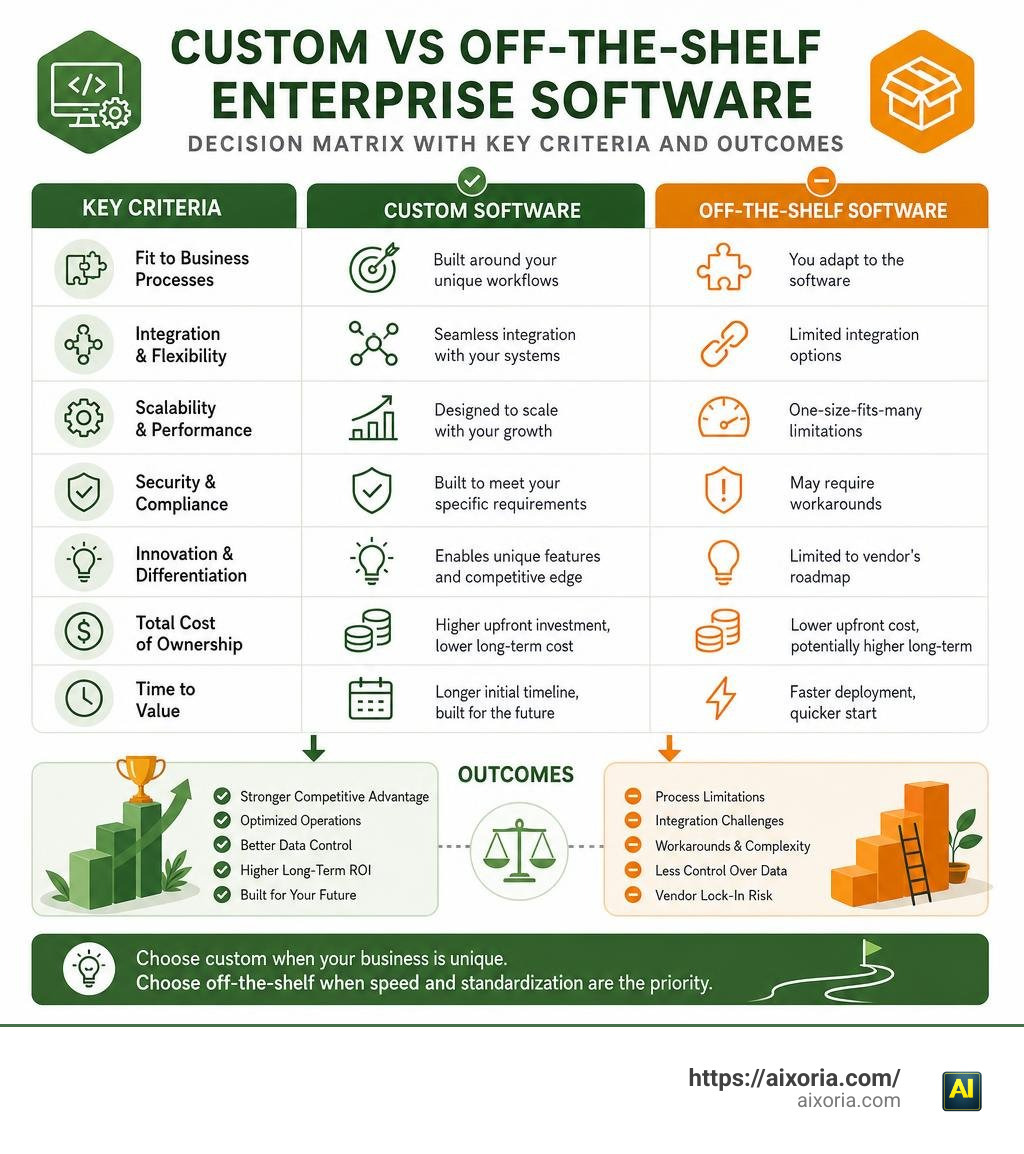
To understand why custom enterprise software is so critical, we must first look at how it differs from packaged software. Many business leaders assume that configured SaaS (Software as a Service) is the same as custom software. It is not. Configuration lets you change cosmetic features, field names, and standard dashboards. True custom software development means you write code specifically to handle your unique operational rules, database schemas, and external data pipelines.
| Feature | Custom Enterprise Software | Off-the-Shelf / Packaged Software |
|---|---|---|
| Workflow Alignment | Fits exactly how your business operates. | Forces your teams to adapt to vendor-defined processes. |
| Data Ownership | 100% ownership of database schemas, code, and IP. | Tied to vendor hosting, API limits, and subscription tiers. |
| Integration Capability | Built-to-order API layers connecting legacy and modern tools. | Limited to pre-built app store connectors and brittle plugins. |
| Financial Model | Higher upfront CapEx; zero per-seat subscription fees. | Lower upfront cost; compounding monthly per-user OpEx. |
| Competitive Edge | Competitors cannot buy or replicate your system. | Competitors can purchase the exact same tool and capabilities. |
When we talk about “enterprise-grade” software, we are referring to systems designed for high availability, absolute data security, and the ability to scale without falling apart. Enterprise software does not live in a vacuum; it is the digital backbone of an organization’s operations, customer experience, and revenue generation.
Core Pillars of Custom Enterprise Software Development
Building software at this scale requires a strict engineering approach. Modern systems cannot afford to be monolithic black boxes. Instead, we focus on four core architectural pillars:
- Cloud-Native Architectures: Building specifically for cloud environments allows applications to scale dynamically, utilize serverless execution where appropriate, and run with high availability across hybrid or multi-cloud setups.
- API-First Design: By designing application programming interfaces (APIs) before writing the user interface, we ensure that every system component can easily share data with other applications. This is critical for breaking down internal data silos.
- Microservices: Instead of a single massive codebase, we break applications into smaller, independent services (e.g., billing, inventory, customer notifications). If one service experiences a spike in demand or a bug, the rest of the application remains fully operational.
- Security-by-Design: Security cannot be an afterthought or a “layer” added at the end of a project. It must be woven into the system architecture from day one through role-based access control, end-to-end data encryption, and automated vulnerability scanning.
When these four pillars are executed correctly, organizations dramatically reduce their long-term architectural complexity and maintenance overhead.
Common Types of Enterprise Applications
Custom software is not a single product; it is a spectrum of targeted solutions designed to solve specific operational bottlenecks. The most common custom applications we see enterprises build include:
- ERP/CRM Extensions: Off-the-shelf systems like Salesforce or SAP are incredibly powerful, but they often lack industry-specific modules. Custom extensions bridge these gaps, handling unique pricing engines or complex multi-step approval workflows.
- Workflow Automation Platforms: These systems replace fragmented manual tasks, spreadsheets, and endless email chains with unified digital workflows. For example, a custom manufacturing workflow can automate drawing validations and approvals, turning a manual process that used to take days into an automated routine completed in seconds.
- System Integration Platforms: These platforms serve as the middle tier that translates and syncs data between legacy mainframe databases and modern cloud applications, ensuring a unified source of truth.
- Legacy Modernization Initiatives: Rather than attempting a risky “rip-and-replace” strategy, we incrementally extract business logic from aging monolithic platforms and re-platform them on modern, cloud-native infrastructures.
When to Build vs. Buy: The Strategic Decision Framework
Deciding to build custom software is a major commitment. To make the choice logically, we recommend using a simple strategic framework based on competitive advantage and process complexity.
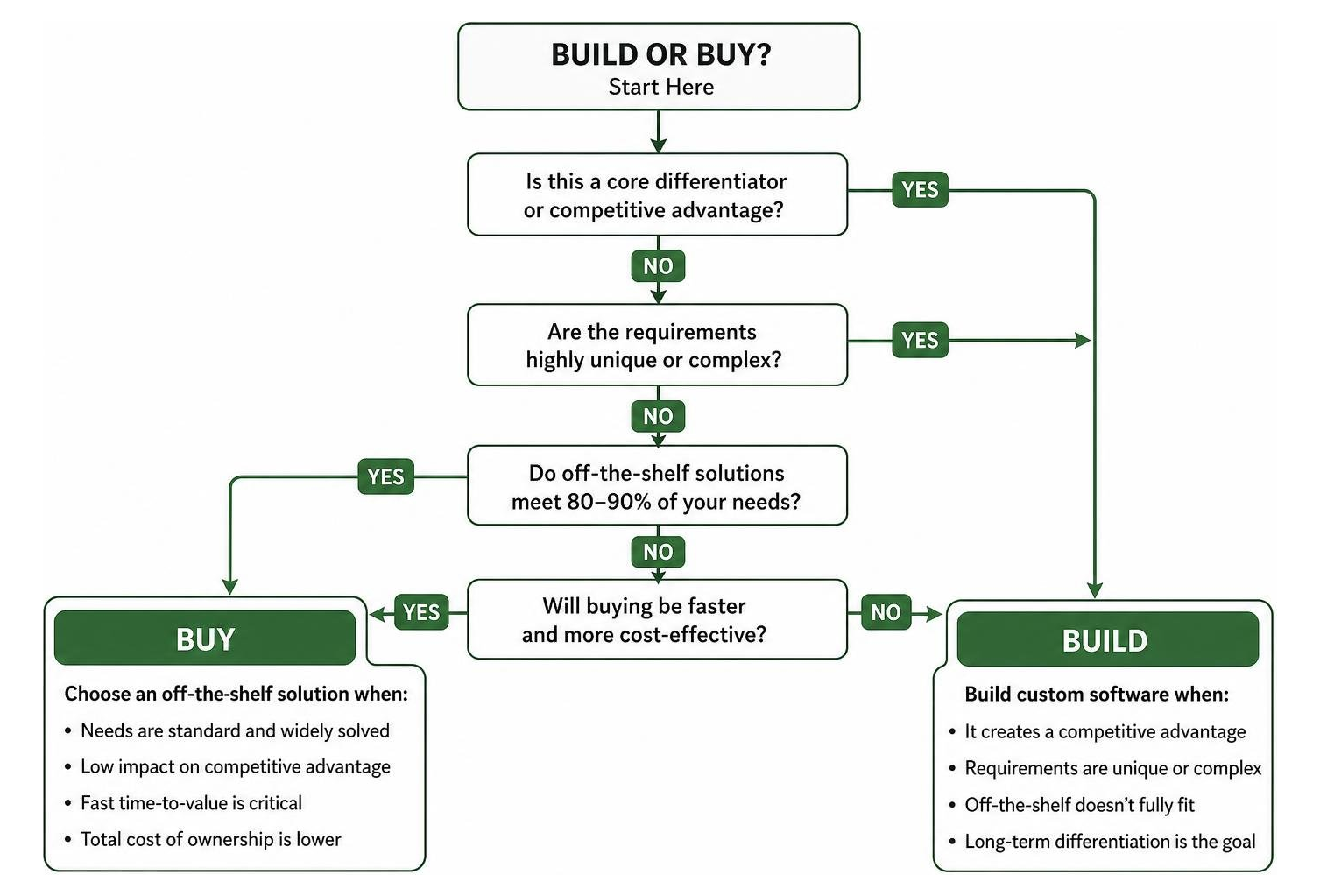
The basic rule of thumb is simple: Buy your utilities, build your differentiators.
You should buy software for processes that are standardized and do not contribute directly to how your company makes money or defends its market position. For example, there is rarely a strategic reason to build a custom payroll or corporate email system. Off-the-shelf tools do this perfectly.
However, you should build custom software when:
- The process is a core differentiator: If your proprietary pricing algorithm, logistics routing, or customer onboarding flow is why clients choose you over competitors, that process must be encoded in custom software.
- The integration reality is too ugly: If connecting an off-the-shelf tool to your existing systems requires building so many custom middleware wrappers that the integration layer becomes larger than the SaaS tool itself, building custom is often more efficient.
- Vendor roadmaps create existential risk: If your operations depend entirely on a third-party software vendor, you are at the mercy of their price hikes, feature deprecations, and business stability.
Evaluating Your Integration and Legacy Modernization Needs
In an ideal world, every application would easily connect to every other application. In reality, the average enterprise manages 897 applications, but only 29% of them are integrated. This lack of connection creates massive data silos and forces employees to manually copy-paste data between systems, leading to high error rates and operational delays.
When legacy systems are left unmodernized, they accumulate technical debt that acts as a tax on every new feature or operational change. In fact, 74% of organizations fail to successfully complete legacy system modernization projects because they attempt to rebuild everything at once instead of taking an incremental approach.
To overcome these hurdles, modern enterprises rely on structured data integration strategies. Utilizing the Best Ai Tools For Data Integration In 2026 allows organizations to automate data mapping, clean legacy databases, and build resilient API layers that make legacy systems highly accessible to modern web applications.
Assessing the ROI of Custom Enterprise Software Development
Custom software requires a larger upfront investment, but its long-term financial return is often significantly higher than SaaS. Over a five-year period, custom software has been shown to deliver up to 3.2x higher ROI than SaaS subscriptions.
This return is driven by three main factors:
- Elimination of Seat Licensing Fees: As your company grows, SaaS costs scale linearly with your headcount. Custom software costs remain flat regardless of how many employees, partners, or customers use the system.
- Process Automation Savings: By eliminating manual workarounds, businesses save thousands of staff hours. For example, automating drawing validation routines can lead to a 91% increase in process efficiency, freeing up highly skilled engineers to focus on high-value tasks.
- Reduced Operational Drag: When your systems are integrated, data flows instantly. This reduces processing times, improves customer satisfaction, and allows your leadership team to make decisions based on real-time business intelligence.
To maximize these savings, forward-thinking enterprises use the Best Ai Productivity Tools For Enterprise In 2026 to identify operational bottlenecks, optimize workflows, and measure the direct impact of custom tools on daily output.
Key Challenges and Risk Mitigation in Enterprise Projects
Managing Technical Debt and Security Vulnerabilities
Technical debt is the hidden cost of choosing quick, messy software fixes over clean, well-architected engineering solutions. When technical debt is left unmanaged, it slows down development and introduces critical security vulnerabilities. However, leaders who actively manage and reduce technical debt are expected to achieve at least 50% faster service delivery to the business.
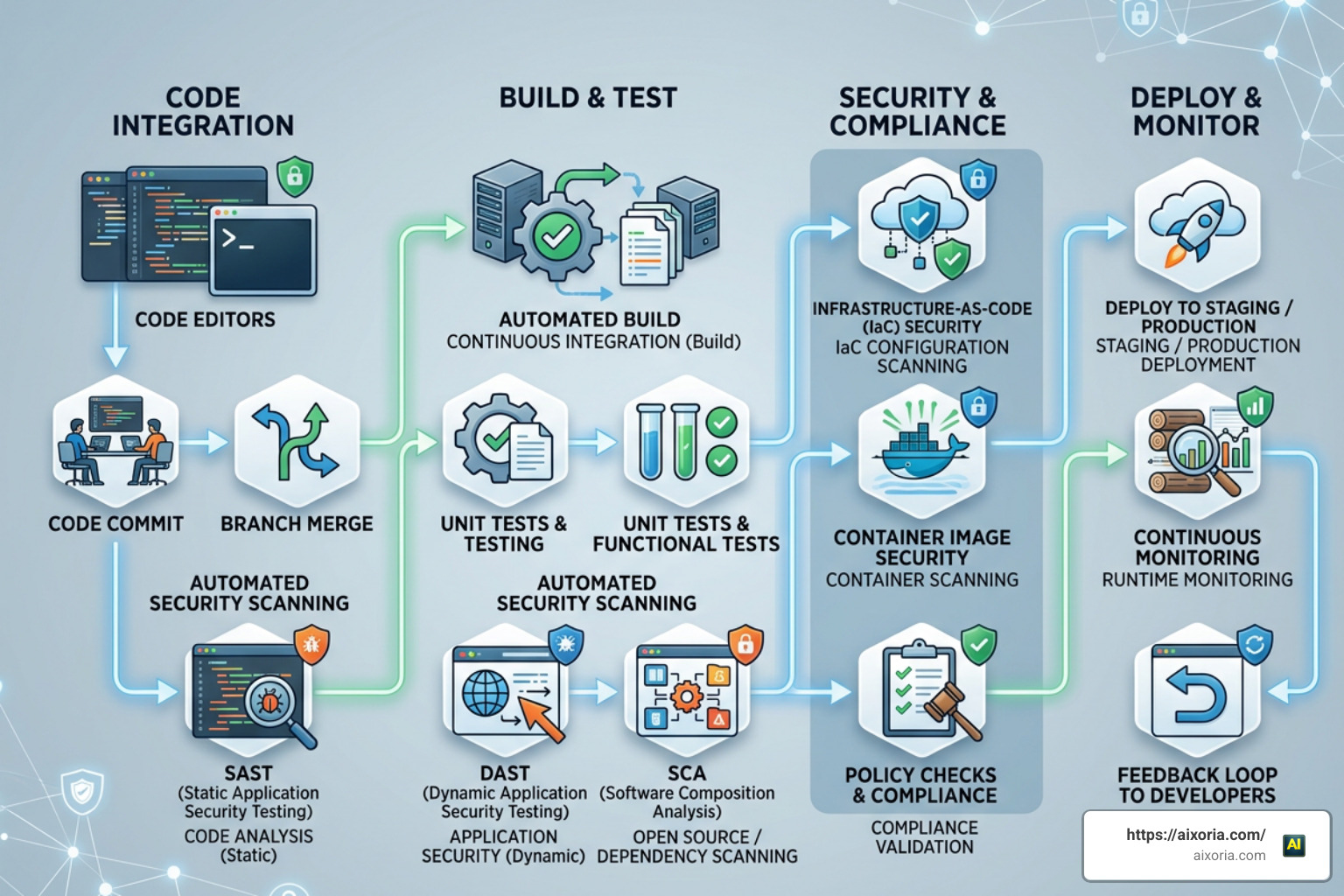
Security is another massive risk. The global average cost of a data breach reached $4.88 million, with 70% of breached organizations reporting significant operational disruption. To mitigate this, custom software must be built using a DevSecOps approach, where security checks are automated and run every time code is written. For additional secure development guidance, enterprise teams can align their practices with the NIST Secure Software Development Framework. This includes:
- Data Encryption: Encrypting all sensitive data both when it is stored on servers and when it is being sent over networks.
- SOC 2 Compliance: Designing systems to meet strict security, availability, and processing integrity standards.
- Static & Dynamic Vulnerability Scanning: Using automated tools to scan the codebase for security flaws before the software is deployed to production.
By embedding these practices directly into the development lifecycle, organizations build resilient digital platforms that protect their customers and their brand.
Overcoming Integration and Scalability Hurdles
A common reason custom software projects stall is the difficulty of integrating with legacy databases and third-party tools. To prevent this, we recommend building on a modern, scalable technology stack and using a structured architecture-first approach.
Choosing the right database, backend languages, and frontend frameworks is critical. For instance, using modern React or Next.js frontends combined with robust .NET, Node.js, or Python backends ensures that your systems are fast, reliable, and easy to maintain.
Modernizing legacy systems incrementally — such as using the “strangler fig” pattern to slowly replace legacy monolithic modules with microservices — allows enterprises to update their systems without disrupting daily operations.
The End-to-End Custom Enterprise Software Development Process
A successful custom software project is the result of a highly structured, repeatable engineering process. We break this process down into six key phases to ensure complete transparency and predictable delivery:
Discovery, Architecture, and Rapid Prototyping
Before a single line of code is written, we must deeply understand your business processes and technical constraints. This is the Discovery and Requirements Engineering phase.
During this phase, we map out every user role, workflow step, data integration, and compliance rule. We then create interactive, clickable UI/UX prototypes. This allows business stakeholders to see exactly how the software will look and feel before engineering begins, preventing costly changes later in the project.
To streamline this phase, project managers often use the Best Ai Tools For Project Reports to analyze stakeholder requirements, generate comprehensive system blueprints, and establish clear release roadmaps.
Iterative Delivery, QA, and Deployment
Once the architecture is approved, we move into Agile Development. We build the software in two-week “sprints.” At the end of every sprint, we demonstrate working software to your team, ensuring that the project remains perfectly aligned with your business goals.
We also use CI/CD (Continuous Integration and Continuous Deployment) pipelines. This means that every time an engineer writes code, it is automatically tested, checked for security vulnerabilities, and prepared for deployment.
When it is time to launch, we use blue-green deployments to ensure zero downtime. This technique runs two identical production environments; we update the idle environment, test it thoroughly, and then instantly route user traffic to it, eliminating the risk of operational disruptions.
How to Select the Right Enterprise Development Partner
Because custom enterprise software is a long-term investment, selecting the right development vendor is one of the most critical decisions you will make. The right partner acts as an extension of your internal team, while the wrong vendor can lead to missed deadlines, poor code quality, and wasted budget.
Key Qualities of a Reliable Custom Enterprise Software Development Partner
When evaluating potential development partners, look for these five non-negotiable qualities:
- Proven Enterprise Scale Experience: They must have a track record of building applications that handle high transaction volumes and complex enterprise workflows.
- A Security-First Mindset: They must follow secure coding standards (like OWASP guidelines) and have experience building systems that meet strict compliance standards (like SOC 2, HIPAA, or GDPR).
- Full IP Ownership from Day One: A reliable partner will explicitly state in their contract that you own 100% of the source code, database schemas, and intellectual property from day one, with no vendor lock-in or licensing fees.
- Transparent Delivery and Governance: They should provide you with real-time visibility into their development tasks, sprint progress, and budget burn rates.
- Long-Term Support and Maintenance: They must offer clear Service Level Agreements (SLAs) for post-launch support, bug fixes, and continuous system optimization.
Aligning Business Strategy with Engineering Execution
A major reason enterprise software projects fail is a lack of alignment between the business leaders who understand the operational goals and the engineers who write the code. In fact, 65% of tech leaders rate the alignment between their business and engineering teams as ‘strong’ only when their development partner deeply understands their specific industry requirements.
To ensure this alignment, we recommend starting with a clear business strategy. Utilizing the Best Ai Tools For Business Strategy In 2026 helps leadership teams model operational outcomes, define key performance indicators (KPIs), and clearly communicate the project’s strategic goals to the engineering team.
Furthermore, we must design our tools with the end-user in mind. This is why we leverage the Best Ai Tools For Work and the Best Ai Tools For Business Productivity to ensure that our custom applications are intuitive, easy to use, and actively reduce daily work strain, leading to fast user adoption across the entire organization.
Frequently Asked Questions about Custom Enterprise Software
What is the average cost and timeline for custom enterprise software development?
The cost and timeline of custom enterprise software vary based on the project’s complexity, scope, and integration requirements:
- Focused MVPs / Internal Workflows: Typically cost $50,000 to $100,000 and take 2 to 4 months to launch.
- Standard Enterprise Applications: Typically range from $150,000 to $400,000 and take 6 to 12 months.
- Complex Legacy Modernization Programs: Can range from $150,000 to $500,000+ and take 8 to 18+ months.
Additionally, organizations should budget 15% to 25% of the initial build cost annually for ongoing support, security updates, cloud hosting, and minor feature iterations.
How does custom enterprise software support AI integration?
Custom software allows you to build an AI-first architecture, where machine learning models and intelligent automation are woven directly into the core database and workflows, rather than being added as a generic third-party chatbot.
For organizations looking to build highly autonomous workflows, exploring the Best Ai Agent Builder Software In 2026 Tested and understanding how to deploy the Best Ai Tools For Building Ai Agents In 2026 provides a massive competitive advantage. These custom AI agents can automate complex decision-making, optimize supply chains, and supercharge your sales operations when integrated with the Best Ai Tools For Sales And Marketing In 2026 Expert Reviews Use Cases.
Can custom software integrate with our existing legacy ERP and CRM systems?
Yes. In fact, this is one of the primary reasons enterprises choose custom development. A skilled engineering partner can design custom API layers, middleware connectors, and event-driven data sync platforms that allow modern cloud applications to read and write data to legacy ERPs and CRMs without disrupting your daily operations.”https://www.mediafire.com/file/infv3ad5r3brgnm/ZOMBIES_BY_MCMPDL.mcaddon/file“;
Conclusion
In July 2026, relying on standard off-the-shelf software is no longer enough to stay ahead. As business processes become more complex and data-driven, the organizations that win are those that encode their unique operational knowledge into custom digital platforms.
By choosing to build custom enterprise software, you eliminate painful manual workarounds, break down internal data silos, and build a scalable foundation for long-term growth.
At Aixoria, we believe that your software should fit exactly how your business runs — not the other way around. If you are ready to eliminate operational drag, modernize your legacy systems, and build a highly productive, AI-ready enterprise, we are here to help.
Take the first step toward transforming your operations today. Explore our comprehensive guide to the Best AI for Productivity in 2026 or contact our team to discuss your custom enterprise software requirements.
Your posts are always so well-written and thought out It’s evident that you put a lot of effort into each and every one