Finding the best auto loan rates in July 2026 means knowing where to look — and what to expect before you walk into a dealership.
Scr0ll d0wn to D0VVNL0AD
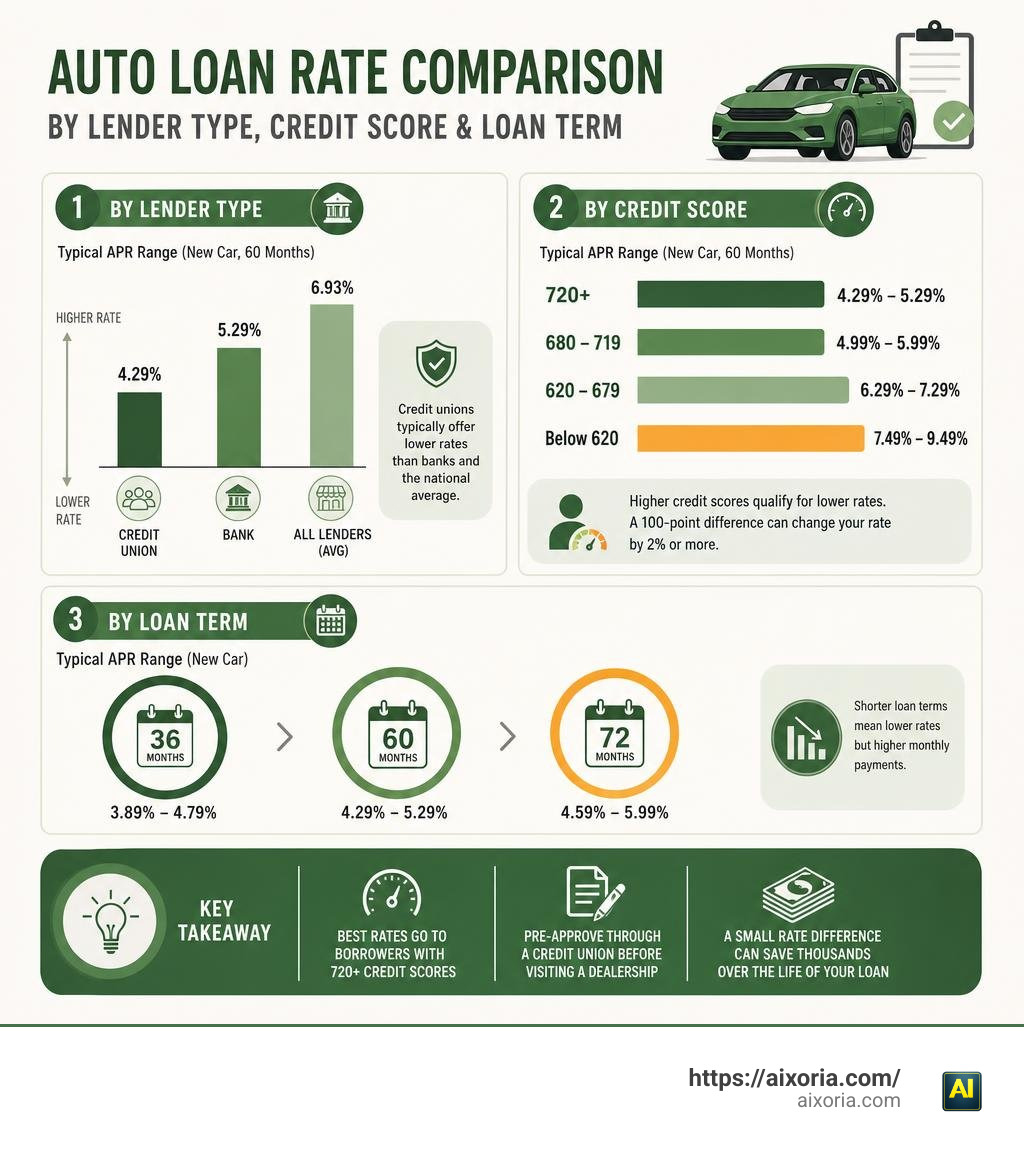
Here’s a quick snapshot of the lowest rates currently available:
| Loan Type | Best Available APR | Lender Type |
|---|---|---|
| New car (36 months) | From 3.89% | Credit union |
| New car (60 months) | From 4.29% | Credit union |
| New car (72 months) | From 4.59% | Credit union |
| Used car (36 months) | From 4.79% | Credit union |
| Used car (60 months) | From 5.29% | Credit union |
| Refinance | From 4.67% | Refinance specialist |
| National average (60 mo, new) | 6.93% | All lenders |

The bottom line: The best rates go to borrowers with 720+ credit scores who pre-approve through a credit union before visiting a dealership.
Your actual rate depends on three things:
- Your credit score — a 100-point difference can shift your rate by 2% or more
- Your loan term — shorter terms almost always mean lower rates
- Your lender — credit unions typically beat banks by 0.5% to 1.5%
To put that in real dollars: financing $25,000 at 5.5% for 60 months costs roughly $3,500 in total interest. Stretch that to 72 months at 6.5%, and your monthly payment drops — but you end up paying around $4,520 in interest overall.
A small rate difference adds up to thousands of dollars over the life of a loan.
How to Secure the Best Auto Loan Rates in July 2026

Securing a competitive auto loan rate in today’s market is not a matter of luck. It is the result of strategic planning, timing, and understanding current economic indicators. As of July 2026, the Federal Reserve’s monetary policies continue to exert a strong influence on consumer borrowing costs. The current average auto loan interest rate sits at 6.93% for a 60-month new car loan. While this benchmark serves as a baseline, individual borrowers can secure significantly lower rates by optimizing their financial profiles before applying.
To position ourselves for the absolute lowest APR, we must understand how lenders calculate their offers. Lenders establish their “buy rates” using a combination of the national cost of capital, the borrower’s risk premium, and their own administrative overhead. By analyzing live market data from resources like Monitor Bank Rates, we can see that rates fluctuate weekly. Staying informed on these trends allows us to lock in a rate when the market dips, rather than accepting whatever a dealership offers on a whim.
Comparing Lender Types for the Best Auto Loan Rates
Where you get your money matters just as much as your credit history. Borrowers generally have four main avenues for securing auto financing:
- Credit Unions: Because credit unions are member-owned cooperatives, they return their earnings to members in the form of lower interest rates and reduced fees. Historically, credit union rates are about 0.5% to 1.5% lower than traditional banks. For example, institutions like Navy Federal Credit Union offer highly competitive rates starting as low as 3.89% APR for new cars.
- National Banks: Large institutions such as Bank of America Auto Loans provide convenient online portals and relationship discounts (often a 0.25% to 0.50% reduction for existing checking or savings account holders). However, their baseline rates tend to range from 5.5% to 7.5% for prime borrowers.
- Online Lenders and Aggregators: Platforms like Auto Loan Rate Comparison allow you to compare multiple offers simultaneously. Online lenders often have lower overhead costs, passing those savings to you with flexible term lengths and rapid funding.
- Dealer Financing: While convenient, financing directly through the dealership can be a financial minefield. Dealerships act as intermediaries; they secure a wholesale rate from a lender and then add a “dealer markup” (typically 1.0% to 2.5%) before presenting the offer to you. Unless you qualify for a genuine manufacturer-sponsored 0% APR promotional event, dealer financing is usually the most expensive path.
Understanding the Best Auto Loan Rates by Credit Score
Your credit score is the single most influential factor determining your final APR. Lenders categorize borrowers into distinct risk tiers, and the rate differences between these tiers can be staggering.
Borrowers with super prime credit (scores between 781 and 850) receive the absolute best auto loan rates, averaging 4.66% for new cars and 7.70% for used cars. On the opposite end of the spectrum, deep subprime borrowers (scores between 300 and 500) face average rates of 16.01% for new vehicles and 21.85% for used vehicles.
Here is how credit tiers currently translate to interest rates and monthly payments for a $20,000 loan over 60 months:
| Credit Tier | FICO Score Range | Avg. New Car APR | Monthly Payment | Total Interest Paid |
|---|---|---|---|---|
| Super Prime | 781 – 850 | 4.66% | $374.37 | $2,462.20 |
| Prime | 661 – 780 | 6.00% | $386.66 | $3,199.60 |
| Near Prime | 601 – 660 | 9.00% | $415.17 | $4,910.20 |
| Subprime | 501 – 600 | 12.50% | $449.95 | $6,997.00 |
| Deep Subprime | 300 – 500 | 16.01% | $486.42 | $9,185.20 |
As shown above, a 100-point credit score difference can shift your auto loan rate by 2% or more, resulting in thousands of dollars of extra interest over time. If your credit score is currently in the subprime range, it may be beneficial to explore debt consolidation loans for bad credit to streamline your monthly obligations and boost your score before shopping for a vehicle.
Analyzing Auto Loan Terms and Vehicle Types

When shopping for a vehicle, we must look beyond the sticker price to evaluate how the loan structure, vehicle age, and depreciation impact our overall financial health. A car is a depreciating asset; new vehicles typically lose 15% to 25% of their value in the first year alone, and 30% to 40% by the third year. Because of this steep depreciation curve, lenders carefully evaluate the loan-to-value (LTV) ratio — the amount of the loan compared to the actual retail value of the car — to mitigate their risk.
How Loan Terms Impact Monthly Payments and Total Interest
Choosing the right loan term is a delicate balancing act between monthly affordability and long-term interest costs. While longer terms like 72, 84, or even 96 months lower your monthly payments, they dramatically increase the total interest you will pay over the life of the loan.
Consider these realistic payment scenarios for a $20,000 new auto loan at different term lengths:
- 36-Month Term: Financed at an attractive 3.39% APR, your monthly payment would be approximately $586.35, with total interest costs of just $1,108.60.
- 60-Month Term: Financed at 4.44% APR, your monthly payment drops to approximately $373.41, but your total interest rises to $2,404.60.
- 72-Month Term: Financed at 5.74% APR (rates typically increase for longer terms), your monthly payment is $329.00, while total interest climbs to $3,688.00.
- 96-Month Term: Offered by specialized lenders like FIGFCU Auto Loans for larger loan balances, a 96-month term at 6.49% APR lowers the monthly payment of a larger purchase but keeps you in debt for nearly a decade, often leaving you “upside-down” (owing more than the car is worth) for the majority of the term.
If you are looking to finance other types of recreational vehicles, it is important to remember that rates and terms differ significantly from standard auto loans. You can read more about specialized financing in our guide on RV loans.
Differences Between New, Used, Refinance, and Lease Buyout Loans
The type of loan you apply for changes how lenders assess risk and price their interest rates:
- New Car Loans: These loans carry the lowest interest rates because the vehicle serves as excellent collateral. Lenders define “new” as vehicles from the current or upcoming model year with minimal mileage (typically under 7,500 to 30,000 miles, depending on the lender).
- Used Car Loans: Used car interest rates are generally 0.5% to 1.5% higher than new car rates. This is because older vehicles depreciate unpredictably and carry a higher risk of mechanical failure. Average used car interest rates range from 6.82% to 21.58%, with the mean for all borrowers sitting at 11.87%.
- Auto Refinancing: If interest rates have dropped since you bought your car, or if your credit score has improved, refinancing can save you a substantial amount of money. Working with a national network of lenders, the average customer saved over $1,118 last year through refinancing.
- Lease Buyouts: A lease buyout loan allows you to purchase the vehicle you have been leasing at the end of your contract. While rates are slightly higher than standard used car loans, it is an excellent option if the car has been reliable and its market value exceeds the residual value stated in your lease agreement.
Step-by-Step Guide to Applying and Getting Pre-Approved
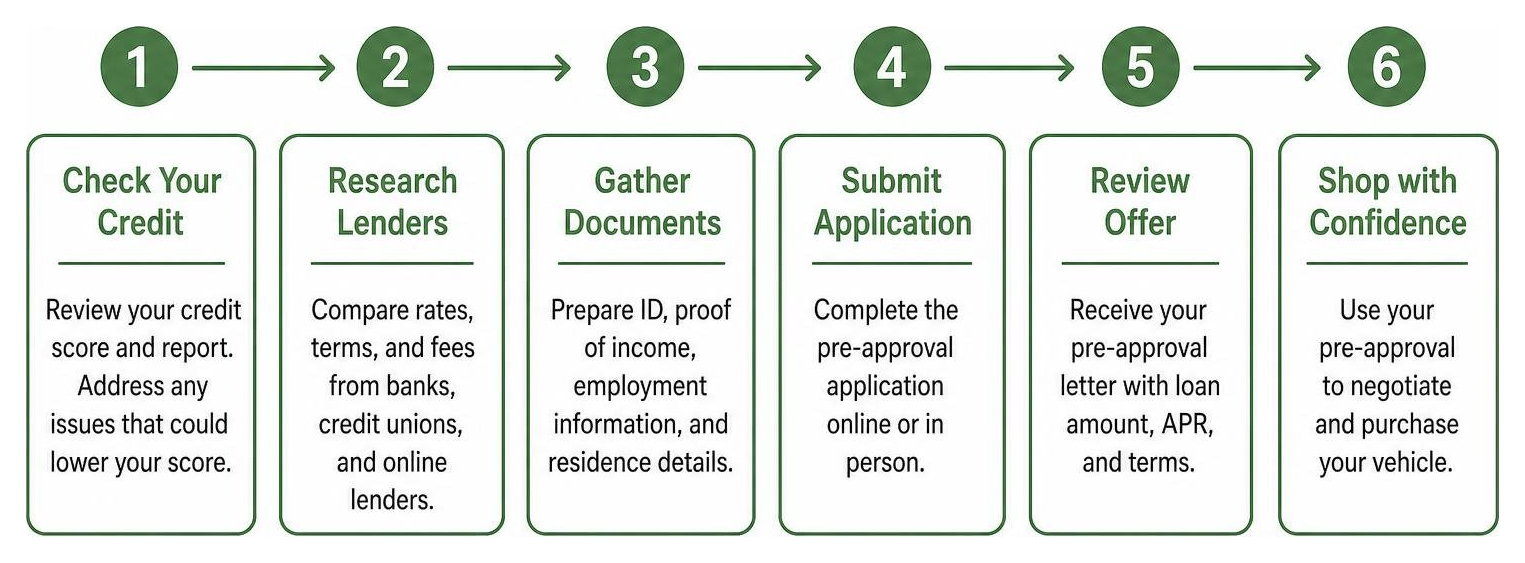
Navigating the car-buying process without a plan is a surefire way to overpay. To get the best auto loan rates, we must follow a structured timeline that prioritizes pre-approval before we ever set foot on a dealership lot.
The Power of Pre-Approval Before Visiting the Dealership
Getting pre-approved is the single highest-leverage move you can make. A pre-approval is a formal offer from a direct lender (like a bank or credit union) that states exactly how much they are willing to lend you and at what APR. This effectively turns you into a “cash buyer” in the eyes of the dealer, completely removing their ability to mark up your interest rate.
Furthermore, multiple inquiries for the same type of loan within a 14-day rate-shopping window are treated as a single inquiry by FICO scoring models. This means you can apply at three to five different lenders to compare offers, and your credit score will only take a minor, temporary hit of 5 to 10 points.
To streamline your pre-approval process, gather the following documents before applying:
- Proof of Identity: A valid driver’s license or passport.
- Proof of Income: Your two most recent pay stubs, W-2 forms, or tax returns if self-employed.
- Employment History: Contact information for your current employer.
- Housing Information: Your current address, housing status (own or rent), and monthly housing payment.
- Vehicle Details (if known): The VIN, mileage, and purchase agreement if you have already identified a specific car.
How to Use an Auto Loan Calculator to Compare Offers
Before committing to any loan agreement, we must run the numbers ourselves using an online auto loan calculator. Dealerships often try to focus the negotiation entirely on the “monthly payment” to hide the total cost of the loan. By using a calculator, you can shift the focus back to the total cost of ownership.
To use a calculator effectively:
- Input the Purchase Price: Start with the negotiated price of the vehicle, not the MSRP.
- Subtract Your Down Payment and Trade-In Value: Aim to put down at least 10% to 20% to reduce your loan balance and avoid going upside-down.
- Adjust the Term Length and APR: Compare different scenarios (e.g., 36 months vs. 60 months) to see how much total interest you will save by choosing a shorter term.
- Verify the Math: For example, a $20,000 used auto loan financed at 5.34% APR should result in 60 monthly payments of approximately $381.89. If the dealer’s sheet shows a higher payment for the same terms, they have likely packed hidden fees or add-ons into the loan.
(Note: If you are purchasing a vehicle for your business, you might also want to compare these terms against commercial financing options like SBA loans to see which structure provides the best tax advantages and cash flow preservation.)
Fees, Restrictions, and Additional Loan Protections
When finalizing an auto loan, the devil is always in the details. The Federal Truth in Lending Act requires lenders to clearly disclose the Annual Percentage Rate (APR), finance charges, amount financed, and total payments before you sign. However, we must remain vigilant to ensure no unexpected fees or restrictive clauses slip into the final contract.
Hidden Fees and Vehicle Restrictions to Watch Out For
Not all auto loans are created equal, and some come with strings attached:
- Prepayment Penalties: Some predatory lenders charge a fee if you pay off your loan early. Always choose a lender that allows you to make extra payments or clear the balance early with zero penalties.
- Vehicle Age and Mileage Limits: Many lenders will not finance vehicles that are more than 10 years old or have over 100,000 to 125,000 miles.
- Weight and Usage Restrictions: Standard auto loans cannot be used for commercial vehicles, heavy-duty trucks exceeding certain weight limits, or vehicles used for ridesharing unless specifically disclosed.
- Administrative and Title Fees: Watch out for excessive documentation or loan processing fees. While standard state title transfer fees are normal, direct application fees from the lender are rare among top-tier institutions.
Evaluating GAP Insurance and Vehicle Protection Plans
During the signing process, the dealership’s Finance and Insurance (F&I) manager will likely try to sell you several optional protection products. While some of these products offer genuine value, purchasing them directly from the dealer is almost always the most expensive route.
We should carefully evaluate these common protection options:
- GAP (Guaranteed Asset Protection) Coverage: If your car is totaled or stolen, standard auto insurance only pays the actual cash value of the vehicle. If you put down a small down payment, you might owe more on the loan than the car is worth. GAP insurance covers this “gap.” However, instead of paying $800+ at the dealership, check with your auto insurance provider or credit union, where it often costs a fraction of the price.
- Mechanical Breakdown Protection (Extended Warranties): These plans cover repairs after the manufacturer’s warranty expires. Read the fine print carefully to understand what is excluded, and consider saving a monthly emergency fund instead of financing a costly warranty.
- Debt Protection: This program cancels or suspends your monthly auto loan payments if you experience involuntary job loss, disability, or physical loss.
Frequently Asked Questions about Auto Loans
Will shopping around for an auto loan hurt my credit score?
No, as long as you do it within a concentrated timeframe. While each formal loan application triggers a “hard pull” on your credit report, credit scoring models recognize that consumers shop around for the best rates. All auto loan inquiries made within a 14-day window (and up to 45 days under newer FICO versions) are consolidated and treated as a single inquiry. This minimizes the impact on your credit score while allowing you to secure the lowest possible APR.
Can I get an auto loan with a co-signer if I have bad credit?
Yes. If your credit score is in the subprime range, adding a co-signer with excellent credit (720+) can help you qualify for a loan and secure a significantly lower interest rate. A co-signer legally promises to take over the payments if you default on the loan. Because this reduces the lender’s risk, they are willing to offer prime-tier rates. However, keep in mind that any late payments will negatively impact both your credit score and your co-signer’s credit score.
How do autopay and direct deposit discounts work?
Many banks and credit unions offer “relationship discounts” to encourage you to keep your primary banking business with them. By enrolling in automatic monthly payments (autopay) from a checking account at the same institution, you can often secure a 0.25% to 0.50% reduction on your interest rate. Some credit unions offer discounts as high as 1.00% if you also maintain a qualifying direct deposit of a certain amount each month.
Conclusion
Securing the best auto loan rates in July 2026 is entirely within your control. By checking your credit score early, comparing lender types, securing a pre-approval, and resisting high-pressure dealership markups, you can save thousands of dollars over the life of your vehicle loan. Always remember to negotiate the actual purchase price of the car separately from your financing options, and use an auto loan calculator to verify every calculation.
At Aixoria, we are dedicated to helping you make smart, highly informed financial decisions. Explore our latest financial and AI updates to stay ahead of market trends and optimize your personal economy today!
3 thoughts on “What Are the Best Auto Loan Rates Right Now? (July 2026)”