Why the Difference Between SBA 7(a) and 504 Loans Can Make or Break Your Financing

What is the difference between SBA 7(a) and 504 loans? Here’s the short answer:
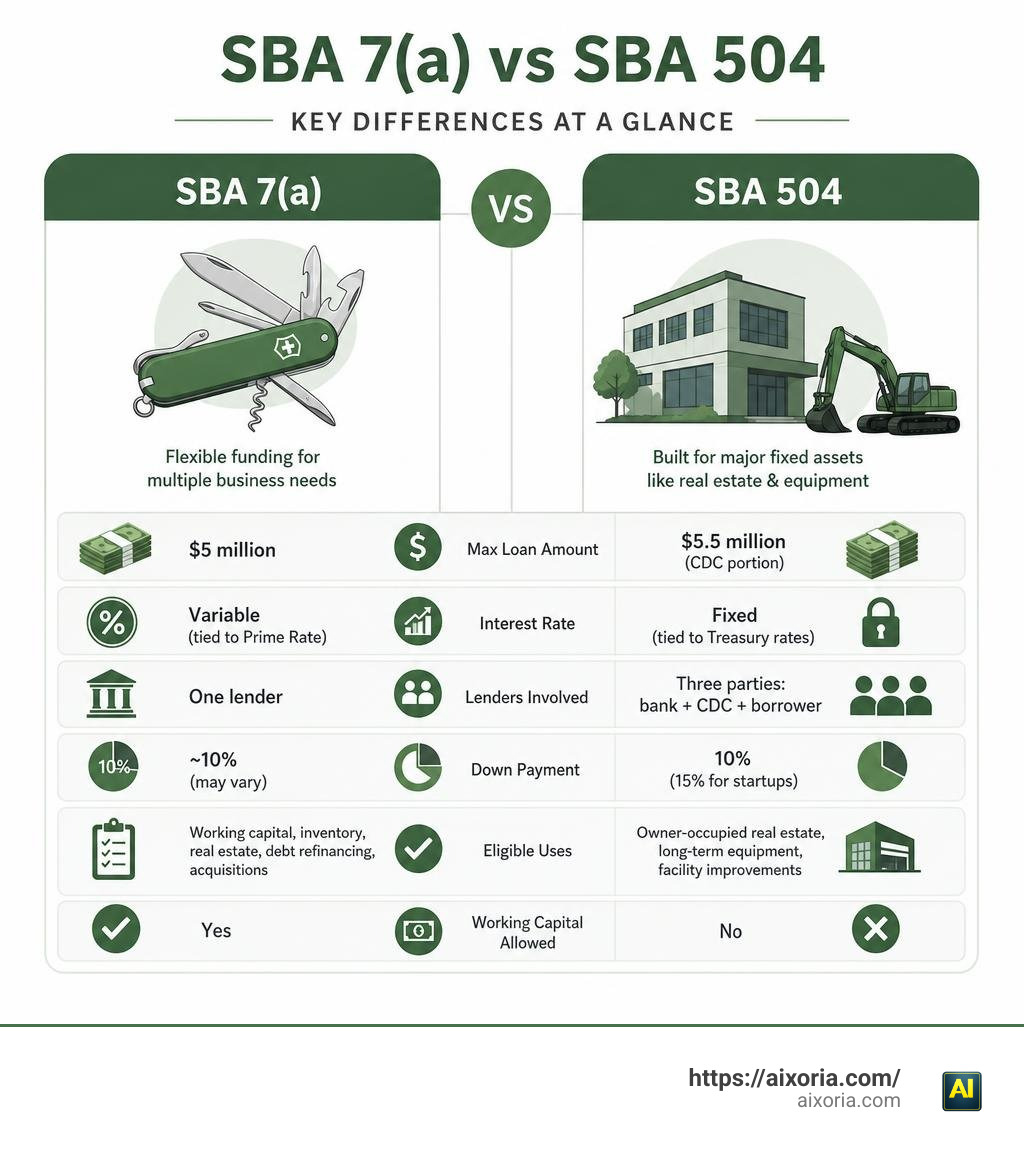
| Feature | SBA 7(a) | SBA 504 |
|---|---|---|
| Best for | Working capital, acquisitions, flexible needs | Commercial real estate, heavy equipment |
| Max loan amount | $5 million | $5.5 million (CDC portion) |
| Interest rate | Variable (tied to Prime Rate) | Fixed (tied to Treasury rates) |
| Lenders involved | One lender | Three parties: bank + CDC + borrower |
| Down payment | ~10% (may vary) | 10% (15% for startups) |
| Eligible uses | Working capital, inventory, real estate, debt refinancing, acquisitions | Owner-occupied real estate, long-term equipment, facility improvements |
| Working capital allowed | Yes | No |
The SBA runs two very different loan programs, and picking the wrong one is a bigger deal than most people realize. According to industry data, 55% of SBA applications are denied partly because borrowers choose the wrong program or submit incomplete documentation.
Think of it this way: the SBA 7(a) loan is the Swiss Army knife — flexible, broad, handled by a single lender. The SBA 504 loan is the specialist — built specifically for major fixed assets like buildings and equipment, with lower fixed rates and a more complex three-party structure.
In 2024, more than 70,000 SBA 7(a) loans were approved compared to just under 6,000 SBA 504 loans — a gap that reflects how much broader the 7(a) program’s use cases are.
This guide breaks down every key difference so you can walk into a lender conversation knowing exactly which program fits your situation.
What is the difference between SBA 7a and 504?
When you look at the fundamental framework of government-backed business funding, the choice usually boils down to these two heavyweight programs. To understand what is the difference between SBA 7a and 504, we must look beyond the surface-level numbers. The distinction lies in how the money is structured, who holds the risk, and what the funds are legally allowed to buy.
For a complete breakdown of how these programs operate in today’s lending market, you can read the SBA 7(a) vs SBA 504 Loans: The Complete 2026 Guide for Small Business Owners.
Core Purpose and Loan Structure
The core purpose of the SBA 7(a) loan is to provide general-purpose funding. It is designed to be highly versatile, allowing us to fund almost anything a small business needs to grow. Whether we need to purchase inventory, bridge a cash flow gap, buy out a business partner, or refinance high-interest debt, the 7(a) program is the default option. The maximum loan amount for an SBA 7(a) loan is strictly capped at $5 million.
In contrast, the SBA 504 loan program is built strictly for fixed asset financing. It is designed to help small businesses acquire long-term, high-value assets like commercial real estate or heavy industrial machinery. The maximum loan amount for the SBA 504 program is structured differently: the SBA-backed portion (the CDC debenture) is capped at $5.5 million. However, because of how the program is structured with a participating private lender, the total project size can easily exceed $10 million or even $15 million.
Number of Lenders and Parties Involved
One of the most practical operational differences is the number of hands in the cookie jar during the underwriting process.
An SBA 7(a) loan uses a single-lender structure. We work directly with a commercial bank, credit union, or non-bank SBA lender. The lender approves the loan, funds it, and services it. The SBA does not lend us the money; they simply guarantee a portion of the loan (usually 75% to 85%) to reduce the bank’s risk in case of default.
The SBA 504 loan program, however, uses a unique three-party structure. A typical 504 project is funded using a 50/40/10 split:
- The Commercial Bank (50%): A private lender provides a first mortgage covering 50% of the total project cost.
- The Certified Development Company or CDC (40%): A local nonprofit partner certified by the SBA provides a second mortgage covering up to 40% of the project, which is funded by an SBA-guaranteed debenture.
- The Borrower Equity Injection (10%): We contribute a 10% down payment (which can increase to 15% for startup businesses or special-use properties).
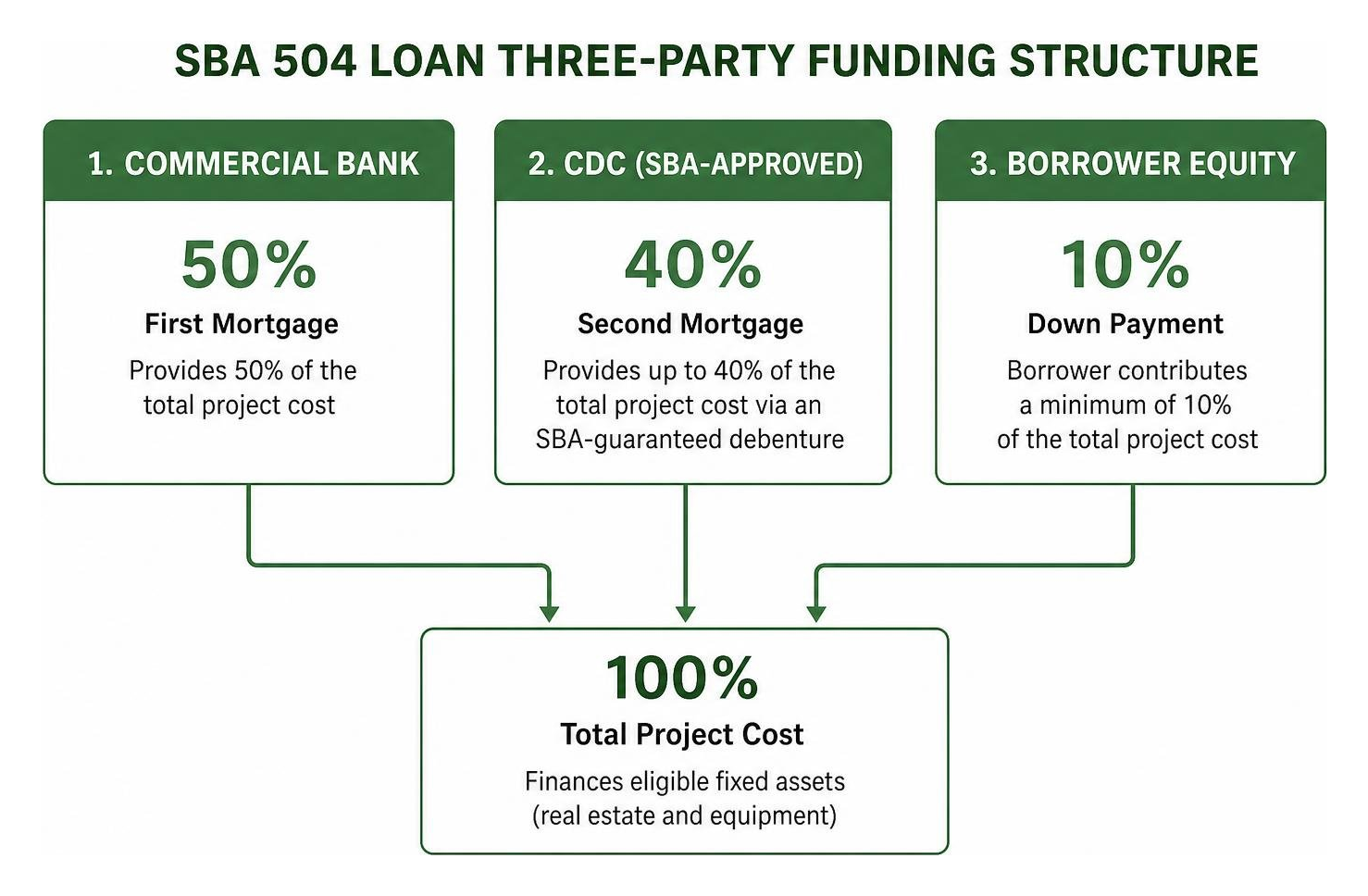
This multi-party structure means we must secure approvals from both the participating private bank and the CDC, which can add administrative steps but often results in highly favorable terms.
Loan Terms, Interest Rates, and Down Payments Compared
When choosing between these two programs, the financial math of repayment terms, interest rates, and upfront fees will play a major role in your decision. For a deeper look at which option is right for your balance sheet, check out the SBA 504 vs. 7a Loans: Which Is Right for Your Business?.
Interest Rate Structures and Fees
Interest rates for SBA 7(a) loans are predominantly variable. They are typically tied to the Prime Rate plus a lender spread, which is capped by the SBA. For example, if the Prime Rate is high, our 7(a) interest rate will adjust upward accordingly, often putting the effective rate between 10.75% and 13.25% depending on the loan size. While fixed-rate 7(a) options exist, they are relatively rare and carry a premium.
SBA 504 loans offer highly attractive, below-market fixed rates on the 40% CDC debenture portion. These rates are pegged to 10-year and 20-year U.S. Treasury yields, making them incredibly stable and immune to rate hikes. The private bank’s 50% portion can carry either a fixed or variable rate, but the blended rate of a 504 loan is almost always significantly lower than a standard 7(a) loan for real estate purchases.
Fees also differ between the programs:
- SBA 7(a) Fees: In FY 2026, the SBA charges an annual service fee of 0.55% on the guaranteed portion of the loan, alongside upfront guarantee fees that scale with the loan size.
- SBA 504 Fees: The upfront guarantee fee is 0.50% in FY 2026, and the annual service fee is approximately 0.209% for standard loans. However, 504 loans carry closing costs associated with two separate loans (the bank loan and the CDC loan), which can make them more expensive upfront for projects under $500,000.
Repayment Terms and Down Payment Requirements
Repayment terms are designed to match the useful life of the assets being financed:
- SBA 7(a) Terms: Up to 25 years for real estate, up to 10 years for equipment and business acquisitions, and 5 to 7 years for working capital.
- SBA 504 Terms: Amortized over 10 years for heavy machinery, and 20 or 25 years for real estate (the 25-year option has been available since April 2018).
Down payment requirements are a major selling point for both programs compared to conventional commercial loans, which often require 20% to 30% down. An SBA 504 loan allows us to secure commercial property with just a 10% down payment (rising to 15% if the business is a startup or if the building is a “single-use” facility like a hotel or car wash). SBA 7(a) loans also typically require a 10% equity injection for business acquisitions, though the down payment for real estate can sometimes be rolled into the loan if there is sufficient collateral.
Prepayment penalties are another critical factor. SBA 7(a) loans only carry prepayment penalties for terms of 15 years or longer. If we pay off more than 25% of the loan within the first three years, we face a declining fee (5% in year one, 3% in year two, and 1% in year three). SBA 504 loans carry a more rigid prepayment penalty that declines over the first 10 years of a 20- or 25-year loan term, making them less ideal if we plan to sell or refinance the property in the short term.
Eligibility, Collateral, and Use of Funds
To qualify for either program, we must navigate strict SBA guidelines regarding how the money is spent, how large our business is, and what we must pledge as security.
Eligible and Prohibited Uses of Funds
The SBA is very specific about what we can and cannot do with their backed funds:
- SBA 7(a) Eligible Uses: Purchase of an existing business, working capital, inventory, debt refinancing, leasehold improvements, and commercial real estate.
- SBA 504 Eligible Uses: Buying land, purchasing existing buildings, ground-up construction, physical plant modernization, and buying long-term machinery with a useful life of 10+ years.
- Prohibited Uses for 504: We cannot use 504 funds for working capital, inventory, business acquisitions, or refinancing standard operational debt (unless it meets highly specific qualified debt refinancing guidelines under 13 CFR 120.882).
- General Prohibitions: Neither program can fund speculative real estate investments, passive businesses, or non-profit organizations.
Business Eligibility and Underwriting Standards
To qualify for either loan, our business must operate as a for-profit entity in the United States and meet the SBA’s size standards.
For the SBA 504 program, the business must have a tangible net worth of less than $20 million and an average net income of less than $6.5 million after federal income taxes for the two preceding years.
For the 7(a) program, the size standards are typically based on annual revenue (e.g., less than $7.5 million for many retail industries) or employee count (fewer than 500 employees).
Underwriters for both programs will heavily scrutinize our Debt Service Coverage Ratio (DSCR). Lenders generally want to see a historic or projected DSCR of 1.15x to 1.25x or higher, meaning the business generates $1.15 to $1.25 in net operating income for every $1.00 of debt payment. Strong personal credit scores (typically 680+) and proven management experience are also standard requirements.
Collateral and Personal Guarantee Requirements
Both programs require a personal guarantee from any individual who owns 20% or more of the business. However, their approach to collateral is vastly different.
The SBA 7(a) program enforces the “All Collateral Available Test.” If a 7(a) loan is not fully collateralized by business assets, the lender is required by SBA policy to seek additional collateral. This often means the lender will place a lien on the borrower’s personal residence or other personal real estate.
The SBA 504 program is much friendlier to our personal assets. Because the 504 loan is used to buy major fixed assets, the real estate or equipment being purchased serves as the primary collateral. In most cases, CDCs do not require liens on personal residences or outside collateral, making it an excellent structure for businesses with multiple partners who want to avoid unequal personal financial exposure.
Strategic Decision-Making: When to Choose Which Program
Choosing between these two options is a strategic decision that depends on your immediate business goals, cash flow, and asset requirements. For a deep dive into real-world decision frameworks, review SBA 7(a) vs. 504: Choosing the Right SBA Program | Business Financing Guide.
When to Choose SBA 7(a) for Your Business
The SBA 7(a) loan is the clear winner if your business needs flexibility. We should choose the 7(a) program when:
- We are acquiring an competitor or buying an existing business (the 504 program cannot fund business goodwill).
- We need working capital to hire staff, buy inventory, or launch a marketing campaign.
- The total project size is under $500,000 (where 504 closing costs would be prohibitively expensive).
- We need to close quickly (7(a) loans typically close in 30 to 60 days, whereas 504 loans often take 60 to 90+ days due to the involvement of the CDC and third-party appraisals).
When to Choose SBA 504 for Fixed Assets
The SBA 504 loan is the superior tool for asset-heavy expansions. We should choose the 504 program when:
- We are buying commercial real estate that our business will occupy (at least 51% for existing buildings, or 60% for ground-up construction).
- We are purchasing heavy, long-term machinery.
- We want the peace of mind of a long-term, below-market fixed interest rate.
- The project is over $1 million, allowing us to absorb the dual-closing costs while enjoying massive long-term interest savings.
Combining SBA 7(a) and 504 for Maximum Funding
What if we need to buy a building and need $1 million in working capital to get it running?
We do not necessarily have to choose just one. As of our current year of July 2026, SBA policies allow eligible borrowers to combine both programs. The SBA has doubled the cumulative 7(a) and 504 loan limit to $10 million.
This is incredibly beneficial for capital-intensive industries and small manufacturers. We can use a 504 loan to purchase a state-of-the-art facility at a low fixed rate, and simultaneously secure a 7(a) loan to cover the inventory, equipment, and working capital needed to operate the new plant.
Frequently Asked Questions about SBA Loans
What is the difference between SBA 7a and 504 interest rates?
SBA 7(a) interest rates are generally variable and pegged to the Prime Rate plus a lender margin, meaning they fluctuate with the market. SBA 504 interest rates on the CDC portion are fixed and pegged to 10-year or 20-year U.S. Treasury rates, offering long-term rate stability. The private bank portion of a 504 loan can be fixed or variable, resulting in a highly competitive blended rate.
Can I use an SBA 504 loan for working capital?
No. SBA 504 loans are strictly limited to fixed assets like land, buildings, and long-term machinery. Working capital, inventory, and operational expenses are prohibited uses of 504 funds. If you need working capital, you should apply for an SBA 7(a) loan or pair your 504 loan with a separate commercial line of credit.
What is the difference between SBA 7a and 504 collateral requirements?
SBA 7(a) loans require the lender to take all available collateral, which often includes personal assets and liens on your primary residence if the business assets do not fully cover the loan amount. SBA 504 loans are secured by the fixed asset being financed (the real estate or machinery), meaning they rarely require personal residence liens or outside collateral.
Conclusion
Understanding what is the difference between SBA 7a and 504 loans is the first step toward securing the right fuel for your business’s growth. Whether you need the flexible, all-purpose coverage of the 7(a) “Swiss Army knife” or the low-cost, fixed-rate power of the 504 real estate specialist, matching your funding to your strategic goals is vital.
As we navigate the business landscape of July 2026, staying ahead of financial and technological trends is more important than ever. To keep your business competitive and informed on the latest strategic shifts, Explore the latest AI updates and business trends at Aixoria.
2 thoughts on “SBA 7(a) vs 504 Loans: Key Differences Explained (2026 Guide)”