Why Finding the Best Tax Refund Calculator Matters This Filing Season

Finding the best tax refund calculator before you file can be the difference between a surprise tax bill and a confident, prepared filing season.
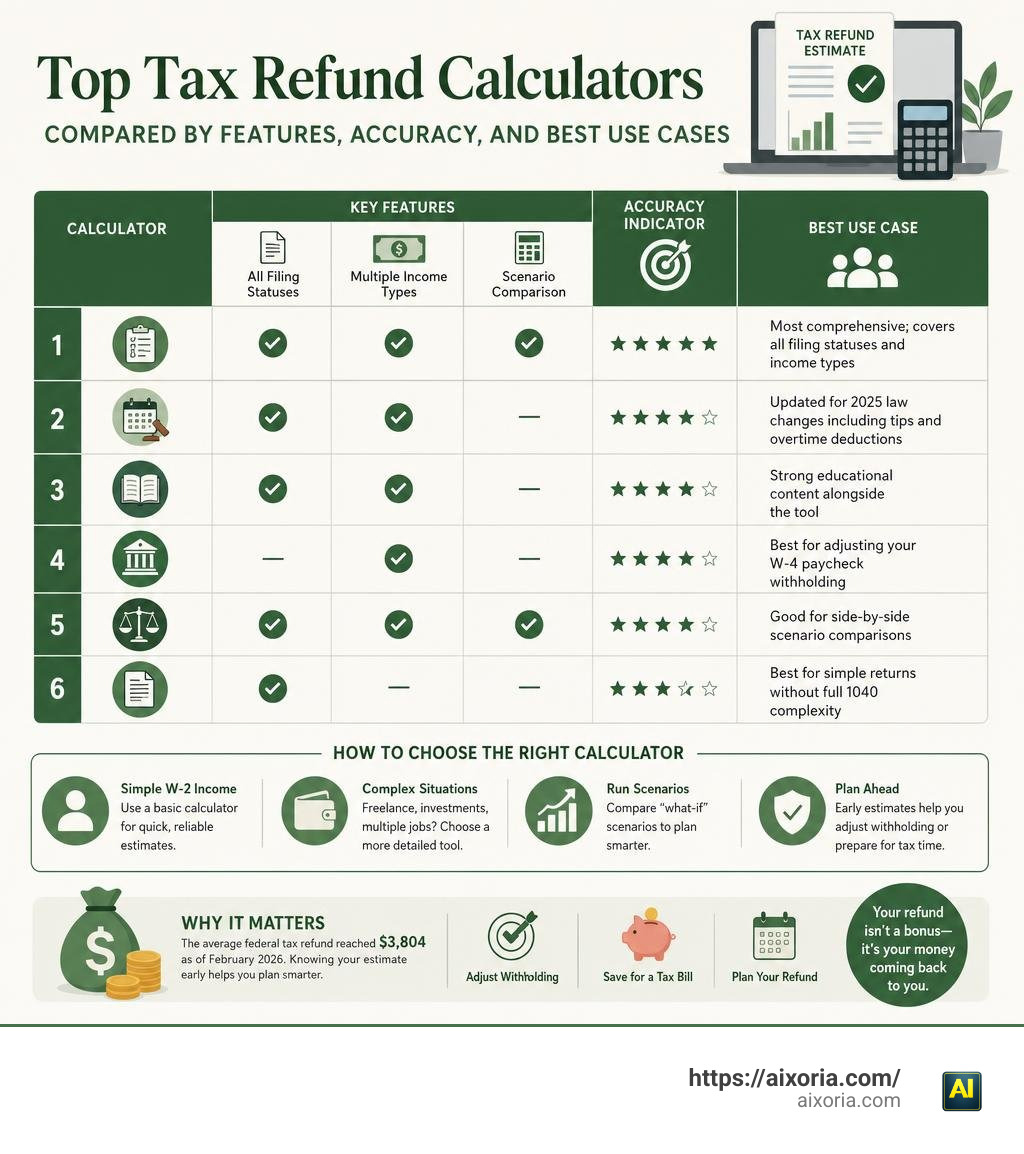
Here are the top ways to estimate your tax refund in 2026:
- Official IRS Tax Withholding Estimator – Best for adjusting your W-4 paycheck withholding and ensuring accurate federal tax payments.
- Comprehensive Commercial Calculators – Ideal for running detailed scenarios covering all filing statuses, investments, and diverse income types.
- Simple Online Estimators – Best for straightforward returns without full Form 1040 complexity.
The right calculator depends on your situation. Most free tools give reliable estimates for straightforward W-2 income. More complex situations — freelance income, investments, multiple jobs — need a more detailed tool.
Here’s why this matters right now: the average federal tax refund reached $3,804 as of February 2026. That’s real money. Knowing your estimate early lets you plan smarter — whether that’s adjusting withholding, saving for a tax bill, or deciding how to use your refund.
At its core, a tax refund isn’t a bonus. It’s your own money coming back to you because more was withheld from your paychecks than you actually owed in taxes. A good calculator helps you see that number before April 15 arrives.
What Is a Tax Refund Calculator and How Does It Work?
At its simplest, a tax refund estimator is an interactive tool that mimics the math of the IRS Form 1040. It acts as a digital scale: on one side, it weighs your total tax liability (what you actually owe the government based on your income); on the other side, it weighs your tax withholding and estimated payments (what you have already paid throughout the year).
If your withholding is heavier than your liability, the calculator shows a refund. If your liability is heavier, you get a balance due.

To understand this balance, we have to look at the mechanics of federal taxation. The U.S. operates on a “pay-as-you-go” tax system. Employers automatically deduct federal income taxes from your paycheck based on the parameters you entered on your W-4 form. If you are self-employed, you make these payments yourself via quarterly estimated tax payments. At the end of the year, the calculator takes your gross income, subtracts deductions to find your taxable income, applies the progressive tax brackets, and compares the resulting tax liability to the payments you already made.
Key Tax Terms to Know Before Estimating
Before you start typing numbers into the best tax refund calculator, it helps to speak the language of the IRS. Here are the core terms you will encounter:
- Adjusted Gross Income (AGI): This is your total gross income (wages, interest, dividends, freelance earnings) minus specific “above-the-line” adjustments, such as student loan interest, HSA contributions, or traditional IRA contributions. AGI is the starting point for determining your eligibility for many tax credits.
- Standard Deduction: A fixed dollar amount that reduces your taxable income, varying by filing status. Most taxpayers take the standard deduction because it is simpler and usually larger than their itemized expenses.
- Tax Credits: These are highly valuable because they reduce your final tax bill dollar-for-dollar. For example, a $1,000 tax credit wipes out exactly $1,000 of taxes owed. Credits are divided into refundable credits (which can trigger a refund even if your tax liability is zero) and non-refundable credits (which can only reduce your liability to zero).
- Tax Brackets: The U.S. uses a progressive tax system. Your income is sliced into segments, and each segment is taxed at a different rate (ranging from 10% to 37%). Being in the “22% tax bracket” does not mean you pay 22% on all your income; it only means the last portion of your income is taxed at that rate.
Key Features of the BEST tax refund calculator
What separates an average estimator from the best tax refund calculator? A truly useful tool should offer:
- Real-Time Calculation: As you enter your details, the estimated refund or balance due should update instantly. This allows you to run “what-if” scenarios, such as seeing how a traditional IRA contribution affects your final tax bill.
- Up-to-Date Progressive Brackets: Tax laws change every year. The best tools are pre-configured with the exact IRS tax brackets and standard deduction limits for the current filing season.
- A User-Friendly Interface: You shouldn’t need a CPA license to navigate the tool. Clear prompts, helpful tooltips, and a logical flow from personal info to income, deductions, and credits make the process stress-free.
To see how these elements combine in a live environment, you can test your numbers on a reliable online tax estimator, which offers a clean, straightforward interface for fast estimations.
How to Choose the BEST tax refund calculator for Your Needs
Not all tax calculators are built for the same user. Some are designed for quick, five-minute ballpark figures, while others are built to handle complex multi-state returns and freelance business expenses. Choosing the right one depends heavily on your income sources and tax complexity.

When evaluating tools for the 2025-2026 tax cycle, your primary focus should be accuracy and currency. The federal government passed major tax updates under the One Big Beautiful Bill Act (OBBBA), which altered standard deductions, child tax credits, and introduced new deductions for tips and overtime. If a calculator hasn’t been updated to reflect these 2025 and 2026 rules, its estimate will be highly inaccurate.
IRS Estimator vs. Commercial Software Calculators
A common point of confusion is deciding whether to use the official IRS Tax Withholding Estimator or a commercial tax preparation tool.
The IRS Tax Withholding Estimator is specifically designed for mid-year checkups. It does not calculate your final tax return package; instead, it looks at your current pay stub and projects whether you will owe money or get a refund by the end of the year. Its primary output is a pre-filled Form W-4 that you can print and submit to your employer to adjust your paycheck withholding.
On the flip side, commercial software calculators are built to mirror the final tax-filing experience. They ask comprehensive questions about your life changes, donations, investments, and business expenses. They are ideal for use in January and February when you have your final tax documents in hand and want to know exactly what to expect before you officially file.
Free Tax Calculators Without Hidden Fees
Many taxpayers worry that using an online calculator will lock them into a paid tax-prep product. Fortunately, several independent, high-quality tools offer completely free estimations without requiring you to create an account or input sensitive personal data like your Social Security number.
These tools process your calculations entirely in-browser, meaning your financial data never leaves your device, providing a quick, secure way to run your federal tax math without sign-up walls.
What Information Do You Need to Use a Tax Calculator Effectively?
A tax refund calculator operates on a simple rule: garbage in, garbage out. To get an accurate estimate, you need to gather your financial documents beforehand.
If you are calculating your taxes before your official forms arrive in late January, you can use your final pay stubs of the year. Look for the “Year-to-Date” (YTD) figures for both your gross earnings and the federal income tax withheld.
Here is a quick checklist of the documents you should gather:
- W-2 Forms: From all employers you worked for during the year.
- 1099 Forms: Including 1099-NEC for freelance work, 1099-INT for bank interest, and 1099-DIV for investment dividends.
- Form 1098: For mortgage interest paid.
- Form 1098-T: For college tuition payments.
- Records of deductions: Such as charitable donation receipts, medical expenses, and traditional IRA contribution receipts.
To help you visualize how the tax landscape shifts between years, we have compiled the standard deduction amounts for the 2025 and 2026 tax years below:
| Filing Status | 2025 Standard Deduction | 2026 Standard Deduction |
|---|---|---|
| Single | $15,750 | $16,100 |
| Married Filing Jointly | $31,500 | $32,200 |
| Head of Household | $23,625 | $24,150 |
| Married Filing Separately | $15,750 | $16,100 |
How Calculators Handle Filing Statuses and Dependents
Your filing status is the foundation of your tax return. It determines your standard deduction amount and the income thresholds for your tax brackets. The best tax refund calculator will ask you to choose from the five federal statuses: Single, Married Filing Jointly, Married Filing Separately, Head of Household, or Qualifying Surviving Spouse.
Dependents also play a massive role in your final refund. The Child Tax Credit (CTC) provides up to $2,200 per qualifying child under age 17 for the 2025 tax year, with up to $1,700 of that being refundable. For the 2026 tax year, the credit is set at $2,000 per child.
If you support an older child in college or an elderly parent, the calculator will apply the Credit for Other Dependents (ODC), which provides a non-refundable credit of up to $500.
Inputting Diverse Income Sources and Deductions
Modern careers are rarely simple. Many of us juggle a standard W-2 job alongside a side hustle or freelance business. When using a calculator, you must input your freelance income (net of business expenses) alongside your standard wages.
If you are trying to figure out how to price your freelance work to cover these self-employment taxes, our Best Freelance Hourly Rate Calculator In 2026 is an excellent tool to ensure you are charging enough to stay profitable after Uncle Sam takes his cut.
For a deeper dive into how these various income sources and deductions interact with the updated tax brackets, you can use a comprehensive online tax estimator to run detailed scenarios.
Understanding the Accuracy and Limitations of Tax Estimates
It is important to remember that a tax refund calculator provides an estimate, not a legal guarantee. While the math behind these tools is highly accurate, the output is only as good as the data you provide.
Calculators can easily handle standard situations, but they can struggle with highly complex, niche tax scenarios. If you are subject to the Alternative Minimum Tax (AMT), have complex international assets, or are dealing with passive activity loss limitations, a basic online calculator will likely fall short. For those situations, full tax-preparation software or a certified public accountant (CPA) is required.
Why Your Actual Refund Might Differ From the Estimate
If you file your taxes and discover your actual refund is different from your calculator estimate, a few common factors are usually at play:
- The Dual-Income W-4 Trap: If both you and your spouse work, and you both checked “Married Filing Jointly” on your W-4 forms without adjusting for multiple jobs, your employers likely under-withheld tax. A calculator will show a painful balance due that you might not have expected.
- PATH Act Delays: If you claim the Earned Income Tax Credit (EITC) or the Additional Child Tax Credit (ACTC), the IRS is legally required to hold your entire refund until mid-February. This doesn’t change the amount, but it significantly changes when the money hits your bank account.
- State Tax Variations: Most simple calculators only estimate federal taxes. If your state has a high income tax rate, your combined state and federal refund might look very different from a federal-only estimate.
When to Use a Refund Calculator vs. the IRS Withholding Estimator
Knowing which tool to use depends entirely on the calendar.
During tax filing season (January through April), you should use a comprehensive tax calculator or the official IRS Tax Withholding Estimator to see your final tax year results.
During mid-year planning (May through December), you should use the official IRS Tax Withholding Estimator. Checking your withholding in the summer gives you plenty of time to submit a new W-4 to your employer, spreading any necessary tax adjustments across multiple paychecks rather than facing a massive bill in April.
Strategic Financial Planning with Tax Estimators
Using the best tax refund calculator shouldn’t just be an annual chore; it should be a key part of your broader financial planning.
By estimating your liability early, you can make strategic moves to lower your taxable income before the tax year closes. For example, if your estimate shows you are close to a higher tax bracket, you can choose to maximize your pre-tax contributions to a 401(k), HSA, or traditional IRA.
Why Using the BEST tax refund calculator Prevents Tax Season Surprises
No one likes an unexpected tax bill. By running your numbers through an estimator, you can ensure you meet the IRS “safe harbor” guidelines to avoid underpayment penalties. Generally, you will not face penalties if you pay at least 90% of your current year’s tax liability or 100% of your prior year’s tax liability through withholding.
Just like planning for home maintenance costs using a Roof Cleaning Cost Calculator prevents unexpected structural bills, using a tax estimator keeps your financial house in order. Once you know your projected refund or liability, you can use our Best Monthly Savings Calculator In 2026 to plan how to save for a tax bill or strategically invest your incoming refund.
To get a clear, comprehensive picture of your federal tax liability and explore these planning options, you can use a reliable online tax calculator that supports the latest tax parameters.
Frequently Asked Questions about Tax Refund Calculators
How long does it take to get a tax refund after filing?
If you file your return electronically and choose direct deposit, the IRS issues more than 9 out of 10 refunds in less than 21 days. If you file a paper return or request a physical paper check, the process can take anywhere from six to eight weeks.
Is it better to get a big refund or a zero balance?
Mathematically, it is best to aim for a zero balance (or a very small refund). A large refund means you gave the federal government an interest-free loan with your paychecks throughout the year.
However, from a psychological perspective, many taxpayers enjoy getting a large refund because it acts as a “forced savings account” that they can use for major purchases or emergency funds.
How did the One Big Beautiful Bill Act affect 2025 and 2026 taxes?
The OBBBA introduced significant changes. It raised the standard deduction limits, increased the Child Tax Credit, and raised the State and Local Tax (SALT) deduction cap to $40,000 for the 2025 tax year (though it is scheduled to return to $10,000 for 2026). It also introduced new above-the-line deductions for seniors, overtime pay, and tips.
Conclusion
Preparing your taxes doesn’t have to be a guessing game. By utilizing the best tax refund calculator for your specific financial situation, you can take control of your financial health, optimize your paycheck withholding, and enter tax season with complete confidence.
At Aixoria, we are dedicated to simplifying complex financial and technological topics so you can make smarter decisions. Explore our latest AI updates and tools to see how modern technology can help streamline your personal finances.