What Happens When Student Loan Bills Arrive After GraduationScr0ll d0wn to D0VVNL0AD

If you’re wondering who should you contact if you have trouble making payments once you leave school, the answer is clear: your loan servicer.
That’s the company assigned to manage your student loan account. They handle your billing, process your payments, and — most importantly — they’re the only ones who can change your repayment terms.
Quick answer:
- Federal loans: Contact your loan servicer (find them at StudentAid.gov)
- Private loans: Contact the lender or servicer listed on your billing statement or credit report
- If your servicer won’t help: Escalate to the Federal Student Aid (FSA) Ombudsman or file a complaint with the CFPB
That first bill can feel like a gut punch. You may not have a job yet. Rent is due. And suddenly there’s a student loan payment on top of everything else.
You’re not alone. 63% of student loan borrowers have reported difficulty making payments at some point, and more than one in three have missed at least one payment. Total U.S. student loan debt now exceeds $1.8 trillion, with the average federal borrower owing nearly $40,000.
The good news? There are real options available — but only if you reach out before things spiral. Ignoring the problem is the one thing that makes every outcome worse.
This guide walks you through exactly who to call, what to say, and what options are on the table.
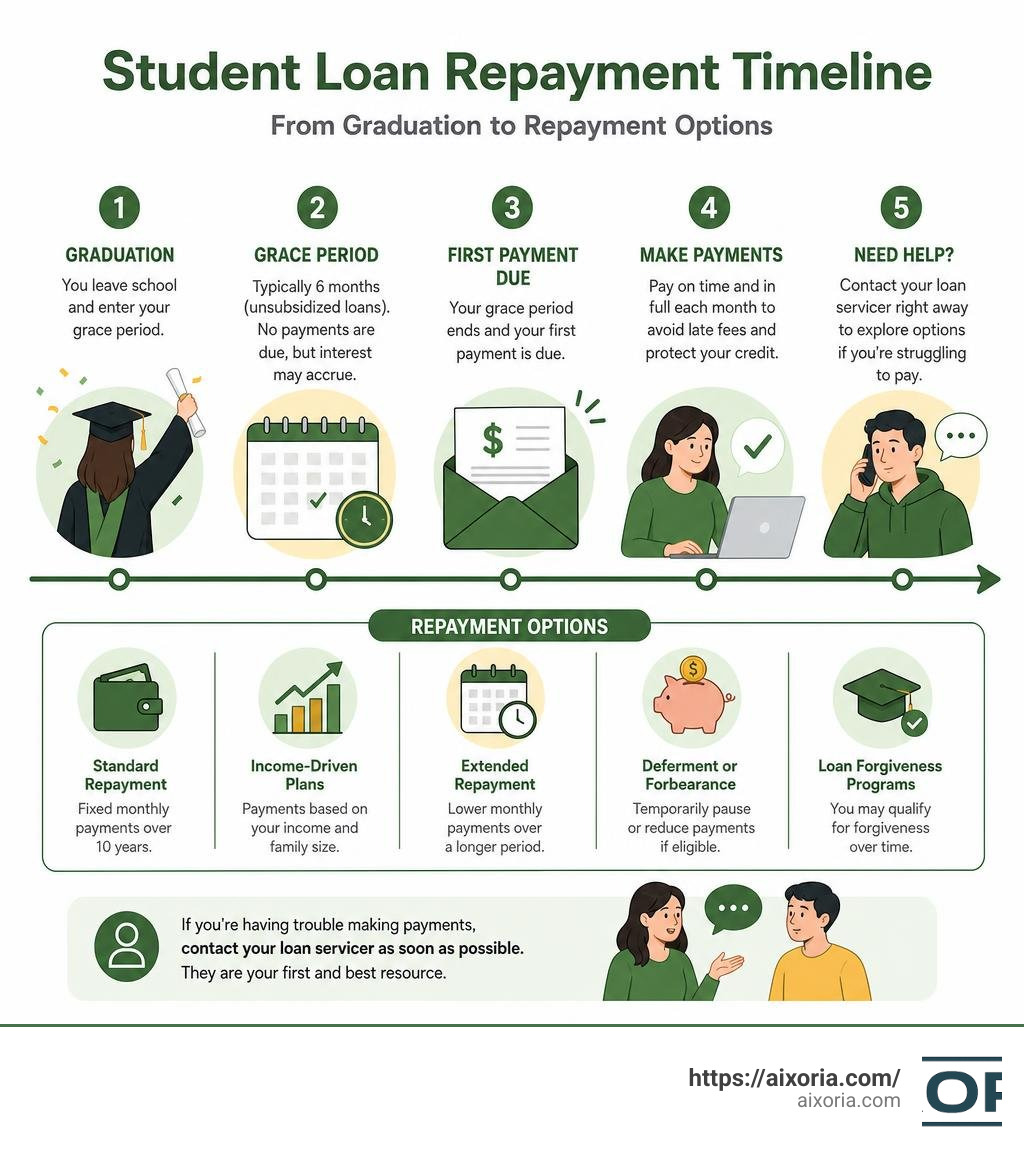
Who Should You Contact If You Have Trouble Making Payments Once You Leave School?
When the grace period ends and the first bill hits your inbox, reality sets in. If your budget is stretched thin, you might feel tempted to ignore the notifications. Please don’t do that. Instead, you need to know exactly Who to Contact If You Have Trouble Making Payments After Leaving School.
The definitive, expert-verified answer to the question of who should you contact if you have trouble making payments once you leave school? is your loan servicer.
You might see multiple-choice questions online, such as this helpful discussion on A. Your loan servicer – brainly.com, asking whether you should reach out to your school’s financial aid office, your parents, or your loan servicer. While your parents might offer some sympathy (and maybe a home-cooked meal), only your loan servicer has the legal authority to actually modify your loan terms, pause your payments, or enroll you in an affordable repayment plan.
Why Your Loan Servicer is Your Primary Contact
Your loan servicer is a private company contracted by the federal government (or hired by your private lender) to handle the administrative side of your debt. They are responsible for:
- Account Management: Keeping track of your balance, interest accrual, and payment history.
- Payment Processing: Collecting your monthly installments and applying them to your principal and interest.
- Authorized Modifications: Reviewing applications for income-driven repayment plans, processing deferment or forbearance requests, and updating your repayment status.
Because they act as the gatekeeper to your loan account, they are the only entity that can officially mark your account as “paused” or “on time” when you make alternative arrangements. If you don’t communicate with them, they will assume you are simply refusing to pay, which triggers automated collection actions.
School Financial Aid Office vs. Loan Servicer
It is easy to see why some graduates get confused. Throughout your college career, your school’s financial aid office was your go-to resource for everything money-related. They helped you secure grants, processed your work-study paperwork, and disbursed your loan funds.
However, once you graduate, drop below half-time enrollment, or leave school, the financial aid office hands the reins over to your loan servicer.
There are only a few exceptions to this rule:
- Perkins Loans: If you have an older Federal Perkins Loan, your school may still act as the lender or utilize a specialized institutional billing service.
- Overborrowing: If you realized you accepted more loan money than you actually needed during the semester, your financial aid office can help you return the excess funds before they accrue unnecessary interest.
For standard Direct Subsidized, Unsubsidized, or private loans, the financial aid office can only offer general advice. They cannot alter your bills or stop collection calls.
How to Identify and Reach Your Student Loan Servicer
Now that you know you need to talk to your servicer, you have to figure out who they actually are. Student loans are frequently transferred between different servicing companies, meaning the company that held your loan during your sophomore year might not be the one billing you today.

Finding Your Federal Loan Servicer
If you have federal student loans, finding your servicer is a straightforward process. The U.S. Department of Education keeps a centralized record of all federal debt.
- Log into StudentAid.gov: Use your FSA ID to access your personal dashboard.
- View “My Aid”: Navigate to the dashboard section that displays your total federal loan balance.
- Check Servicer Details: Here, you will see the name of the company (such as MOHELA, Nelnet, Aidvantage, or Edfinancial) managing your loans.
- Access Direct Contacts: For a complete list of phone numbers, websites, and business hours, you can consult the official Loan Servicer Contact Information for Student Loan Borrowers page.
Finding Your Private Loan Servicer
Private student loans do not show up on government databases like StudentAid.gov. If you borrowed from a private bank, credit union, or online lender, you will need to take a different route:
- Check Your Credit Report: You can pull a free copy of your credit report from AnnualCreditReport.com. Your private student loans will be listed under your active accounts, along with the name of the lender or servicer.
- Search Your Email and Mail: Look for billing statements, welcome letters, or disclosures sent around the time you graduated.
- Review Lender Reviews and Guides: If you are dealing with specific private lenders, reading up on specialized reviews, such as our Advantage Student Loan Review 2026: Rates, Eligibility & Pros Explained, can help you understand how private servicers structure their customer service and what terms they offer.
Repayment Options, Deferment, and Forbearance
When you get your servicer on the phone, you shouldn’t just say, “I can’t pay.” Instead, you want to guide the conversation toward the specific programs designed to protect your financial health.
Here is a quick look at the three main pathways your servicer can help you navigate:
| Option | Best For | How It Works | Interest Accrual |
|---|---|---|---|
| Deferment | Temporary hardships (unemployment, returning to school, military service) | Pauses payments for a set period | Government pays interest on subsidized loans; unsubsidized loans accrue interest |
| Forbearance | Short-term financial emergencies, medical expenses, or transition periods | Pauses payments for up to 12 months at a time | Interest accrues on all loan types and is added to the principal balance |
| Income-Driven Repayment (IDR) | Long-term affordability based on income | Caps monthly payments at a percentage of your discretionary income | Unpaid interest may be covered depending on the specific plan |
Postponing Payments: Deferment vs. Forbearance
If you need a temporary breathing room, you can ask your servicer to pause your payments. However, you must understand how interest behaves during this pause.
According to the federal Exit Counseling Guide, choosing between deferment and forbearance can have a massive impact on the total cost of your loan:
- Deferment: If you qualify for a deferment (for example, through an Unemployment Deferment or Economic Hardship Deferment), the federal government will pay the interest on your Direct Subsidized Loans during the pause.
- Forbearance: If you do not qualify for a deferment, you can request a discretionary forbearance. While this stops the immediate bills, interest will continue to build up on all of your loans. When the forbearance ends, this accrued interest is often “capitalized” — meaning it is added to your main principal balance, and you will start paying interest on your new, larger balance.
Use pauses as a temporary bridge, not a permanent retirement plan for your debt.
Lowering Payments with Income-Driven Repayment (IDR) Plans
If your income is low and you expect it to stay that way for a while, pausing your payments is rarely the best long-term move. Instead, ask your servicer to transition you to an Income-Driven Repayment (IDR) plan.
IDR plans calculate your monthly payment based on your family size and your adjusted gross income. If you are unemployed or earning a very low wage, your monthly payment under an IDR plan can be set to exactly $0. Crucially, even a $0 monthly payment counts as an “on-time” payment toward eventual loan forgiveness.
As of July 2026, the landscape of student loan repayment is constantly evolving due to shifting legal frameworks and new government initiatives. For example, if you are monitoring ongoing legal battles regarding federal forgiveness and discharge programs, keeping an eye on updates like the Federal Student Loan Loan Discharge Lawsuit 2026: Who Qualifies & How to Win can give you a clearer picture of what long-term relief might look like for your account.
Consequences of Ignoring Student Loan Payments
We get it. Dealing with loan servicers can be frustrating. But simply walking away and hoping the problem disappears is a recipe for financial disaster.

Delinquency vs. Default Timelines
What happens when you miss a payment? The clock starts ticking immediately, and the consequences escalate over time.
As outlined in the federal guidelines for Perkins Loan Billing, Collection, and Default, there is a strict timeline that governs non-payment:
- Day 1 (Delinquency): The very day after you miss a scheduled payment, your loan is considered delinquent. Your servicer will begin sending late notices and calling your number.
- Day 90 (Credit Reporting): Once you are 90 days past due, your servicer will report your delinquency to the major national credit bureaus. Your credit score will take a massive hit, making it incredibly difficult to get approved for a credit card, rent an apartment, or buy a car.
- Day 270 (Default): For standard federal loans, if you go 270 days without making a payment, your loan officially enters default.
Long-Term Financial Damage of Default
Once a loan enters default, the government stops playing nice. The consequences of default are severe, enduring, and incredibly difficult to escape:
- Acceleration: The entire balance of your loan (plus all accrued interest) becomes due immediately. You lose access to deferment, forbearance, and income-driven repayment plans.
- Wage Garnishment: The government can legally order your employer to withhold up to 15% of your disposable paychecks to pay off your defaulted loans — without needing a court order.
- Tax Offset: Your federal and state tax refunds can be seized automatically and applied to your debt.
- Collection Fees: Massive collection fees (up to 18% or more of your balance) can be tacked onto your total debt.
What to Do If Your Loan Servicer Is Unresponsive
What happens if you try to do the right thing, but your loan servicer is unhelpful, keeps you on hold for hours, or processes your paperwork incorrectly?
A 2024 Consumer Financial Protection Bureau (CFPB) report analyzing over 18,000 borrower complaints highlighted widespread issues with servicer errors, inaccurate billing, and poor customer support. If you find yourself stuck in this loop, you need to escalate your issue.
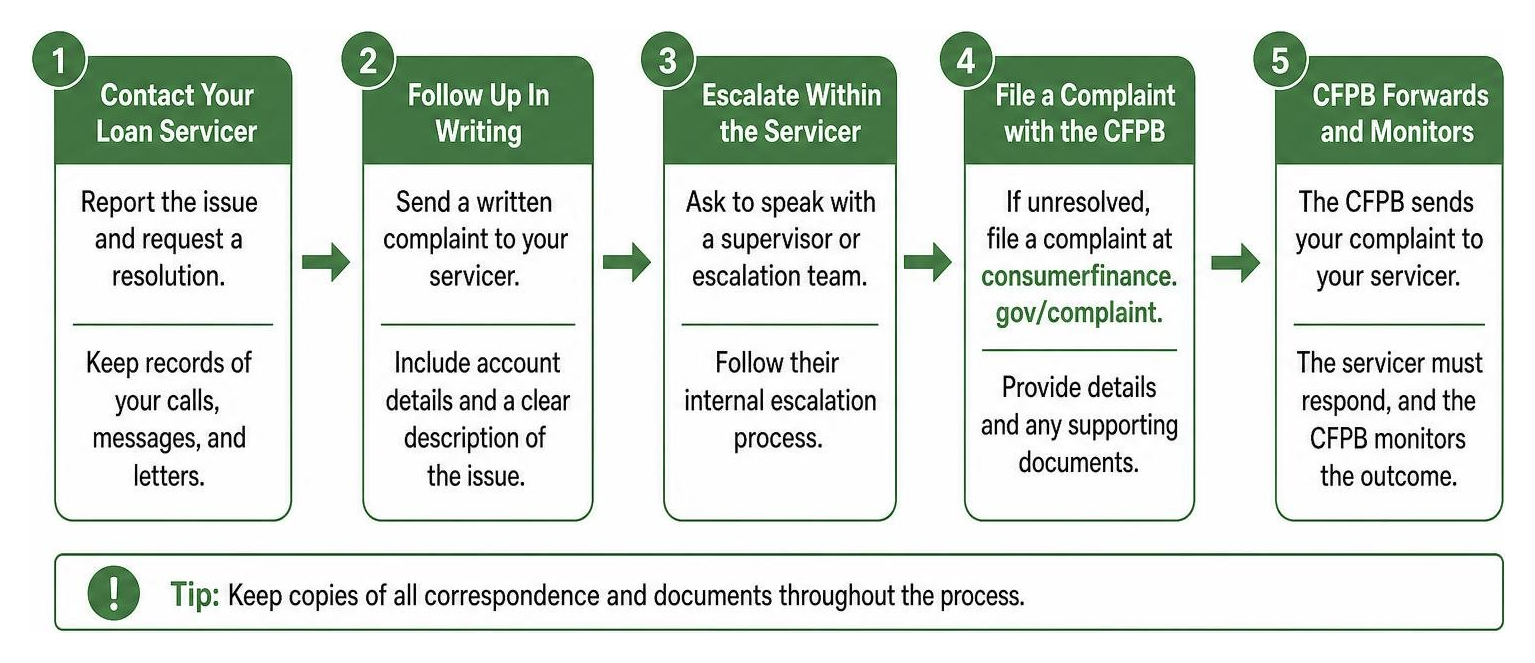
Filing a Complaint with the CFPB
If your servicer is making errors or refusing to process your IDR application, you should file a formal complaint with the Consumer Financial Protection Bureau.
The CFPB is a federal agency that holds financial institutions accountable. You can submit a detailed account of your issue, along with any supporting documents, directly through the CFPB’s portal. For more information on your rights as a consumer and how to protect yourself, visit the CFPB guide on What should I do if I can’t afford my student loan payment?.
Contacting the Federal Student Aid (FSA) Ombudsman
If you have federal student loans and cannot resolve a dispute with your servicer, the Federal Student Aid Ombudsman Group is your ultimate resource.
The Ombudsman is an independent, neutral office designed to resolve disputes between borrowers and servicers. They will review your case, mediate between you and the company, and help find a fair resolution. You can reach them through the help center on StudentAid.gov or by calling 1-877-557-2575.
Frequently Asked Questions about Student Loan Repayment
Who should you contact if you have trouble making payments once you leave school?
You should immediately contact your loan servicer. They are the only entity authorized to modify your payment terms, enroll you in income-driven repayment plans, or grant you a temporary payment pause (deferment or forbearance).
What is the best way to find out who should you contact if you have trouble making payments once you leave school?
For federal student loans, log into your dashboard at StudentAid.gov to view your assigned servicer. For private student loans, check your monthly billing statements or pull your free credit report from AnnualCreditReport.com to identify the lender.
Can you change your student loan repayment plan after graduating?
Yes. If you have federal loans, you can change your repayment plan at any time for free. You can use the Federal Student Aid Loan Simulator tool to compare different plans and apply directly through your servicer’s website.
Conclusion
Facing student loan payments can be incredibly stressful, but taking proactive action is the absolute best way to protect your credit score, your income, and your peace of mind. Your loan servicer is your primary partner in navigating this journey. Reach out to them the moment you anticipate a budget shortfall — they have the tools to help you stay afloat.
At Aixoria, we are dedicated to helping you make sense of complex financial landscapes. To stay updated on the latest financial tools, legal changes, and technological shifts affecting your wallet, explore our comprehensive Aixoria AI Updates today!
3 thoughts on “Who Should You Contact If You Have Trouble Making Student Loan Payments? (2026 Guide)”