Why Knowing Your Federal Student Loan Documents Could Save You Thousands

What document explains your rights and responsibilities as a federal student loan borrower? The answer is the Master Promissory Note (MPN) — and reading it carefully before you sign could be one of the most important financial moves you make.
Quick Answer:
- The Master Promissory Note (MPN) is the primary legal document that explains your rights and responsibilities as a federal student loan borrower.
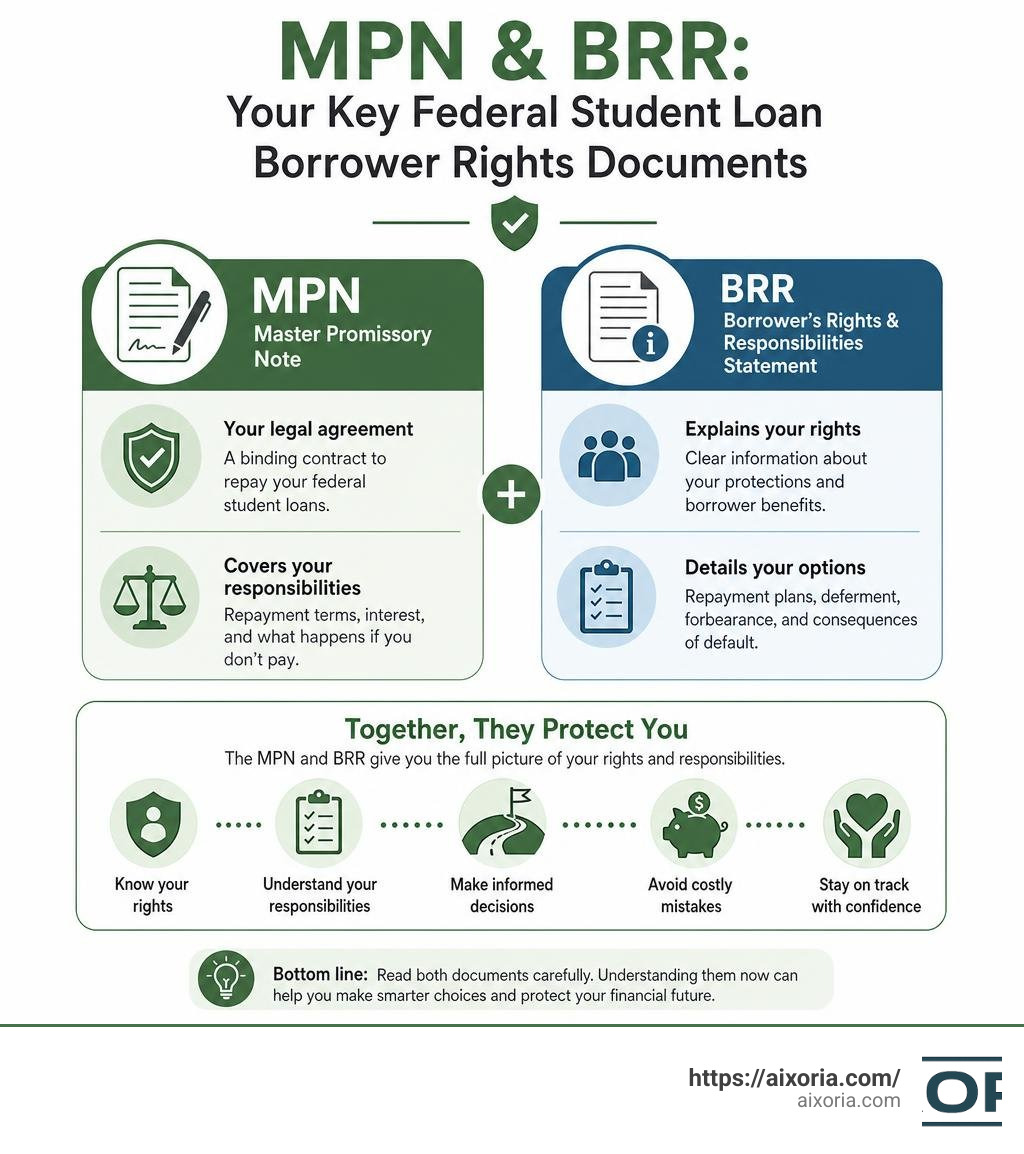
- It is accompanied by the Borrower’s Rights and Responsibilities Statement (BRR), which provides additional detail on loan terms, repayment options, and consequences of default.
- Together, these two documents cover everything from interest rates and repayment plans to what happens if you miss payments.
Over 43 million Americans carry federal student loan debt — averaging around $37,000 per borrower. Yet most people sign the MPN without fully understanding what it says.
That’s a problem. The MPN is a binding legal contract. Once signed, you’re on the hook for every dollar borrowed — plus interest.
The good news? The document isn’t as complicated as it looks once you know what to focus on.
This guide breaks it all down in plain language: what the MPN covers, what your rights are, what you’re responsible for, and what happens if things go wrong.
What Document Explains Your Rights and Responsibilities as a Federal Student Loan Borrower?

When we step into higher education, we are often bombarded with financial aid jargon. Award letters, FAFSA, disbursements, and grace periods can make anyone’s head spin. But if there is one document you absolutely must understand, it is the one that directly dictates how your debt will behave over the next ten to twenty years.
Understanding What Document Explains Your Rights and Responsibilities as a Federal Student Loan Borrower
The Master Promissory Note (MPN) is the foundational legal document that you must sign before receiving any federal student loan. Think of it as the ultimate rulebook for your student debt. When you sign the MPN, you are not just saying “yes” to free-flowing college funds; you are making a binding legal promise to the U.S. Department of Education to repay the loan, plus any accrued interest and fees.
However, the MPN is rarely a standalone text. It is legally paired with the William D. Ford Federal Direct Loan Program Direct Subsidized Loan and Direct Unsubsidized Loan Borrower’s Rights and Responsibilities Statement. This statement (often abbreviated as the BRR) acts as an extended user manual. While the MPN is your promise to pay, the BRR is the detailed breakdown of your consumer protections, repayment flexibility, and legal obligations.
Together, these documents outline:
- The exact terms and conditions of your loans.
- How interest is calculated, charged, and capitalized.
- Your rights to postpone payments through deferment or forbearance.
- Your options for loan forgiveness, cancellation, and discharge.
- The severe legal consequences if you fail to make payments.
Why the MPN is the Document That Explains Your Rights and Responsibilities as a Federal Student Loan Borrower
Why is it called a “Master” promissory note instead of just a regular promissory note? The magic lies in its multi-year utility.
Under a single MPN, you can receive multiple federal student loans over a period of up to 10 years. This means you do not have to sign a brand-new, tedious contract every single semester or academic year. Your school can simply make subsequent disbursements based on your initial signature, provided you remain eligible.
Because the MPN has such a long lifespan and covers multiple financial transactions, it contains strict borrower certifications. By signing, you certify under penalty of perjury that:
- All information you provided is entirely true and accurate.
- You will use the loan funds only for authorized educational expenses (such as tuition, room, board, books, and required equipment).
- You will immediately repay any overpayments or funds disbursed in error.
Understanding these certifications is crucial. If you are ever facing legal challenges regarding your student debt, your signed MPN is the exact document the courts will look to. For instance, if you are tracking changes in the legal landscape regarding debt relief, such as the Federal Student Loan Discharge Lawsuit 2026 Who Qualifies How to Win, your eligibility and rights will always be anchored back to the original terms agreed upon in your signed MPN.
Key Terms, Interest, and Repayment Options in the MPN

Before you sign on the dotted line, you need to understand the mechanics of what you are borrowing. Let’s look at the key terms, interest calculations, and repayment pathways outlined in the MPN.
Subsidized vs. Unsubsidized Loan Terms
The federal government offers two primary types of loans for undergraduate students under the Direct Loan Program: Subsidized and Unsubsidized. The MPN treats these two very differently, and the financial impact of each is massive.
| Feature | Direct Subsidized Loans | Direct Unsubsidized Loans |
|---|---|---|
| Financial Need Requirement | Yes (must demonstrate need via FAFSA) | No (available regardless of financial need) |
| Who Pays the Interest in School? | The U.S. Department of Education | The Borrower |
| Grace Period Interest Coverage | Yes (interest is paid by the government) | No (interest accrues and must be paid/capitalized) |
| Deferment Interest Coverage | Yes | No |
| Eligibility Group | Undergraduate students only | Undergraduate, graduate, and professional students |
If you qualify for a Direct Subsidized Loan, the government essentially pauses the interest clock while you are enrolled at least half-time, during your six-month grace period, and during authorized periods of deferment.
However, if you are a first-time borrower on or after July 1, 2013, you should note the historical 150% maximum eligibility limit. This rule states that you cannot receive Direct Subsidized Loans for more than 150% of the published length of your educational program (for example, six years for a four-year bachelor’s degree). If you exceed this limit, you may lose the interest subsidy on your existing subsidized loans.
To review these rules in simple, government-provided terms, you can read the official PLAIN LANGUAGE DISCLOSURE FOR DIRECT SUBSIDIZED LOANS AND DIRECT UNSUBSIDIZED LOANS.
Interest Capitalization and Total Loan Cost
For Direct Unsubsidized Loans, interest begins accumulating the moment the school receives the funds. Federal student loans use a simple daily interest formula:
$$\text{Daily Interest} = \frac{\text{Principal Balance} \times \text{Interest Rate}}{365.25}$$
For example, if you have a $7,500 Unsubsidized Loan at a 6.8% interest rate, your loan will accrue approximately $1.39 in interest every single day.
If you do not pay this interest as it accumulates while you are in school, during your grace period, or during deferment, it doesn’t just sit there. It undergoes a process called capitalization.
Capitalization means your unpaid interest is added directly to your principal balance. From that point forward, you are charged interest on your new, larger principal balance. You are literally paying interest on your interest!
We can see the long-term impact of capitalization in this common scenario:
- The Setup: You have a $30,000 unsubsidized loan balance at a 6% interest rate.
- The Pause: You enter a 12-month deferment period where you choose not to pay the interest as it accrues ($1,800 total).
- The Capitalization: At the end of the deferment, that $1,800 is added to your principal, making your new balance $31,800.
- The Cost: Over a standard 10-year repayment term, this single capitalization event costs you an extra $598 in total repayment and raises your monthly payment by about $20.
To avoid this, we highly recommend making interest-only payments while you are in school or during grace periods. If you want to compare how these federal interest rates stack up against non-federal options, you can check out our Advantage Student Loan Review 2026 Rates Eligibility Pros Explained.
Repayment Plans and the Standard Default
When your six-month grace period ends, you must begin repaying your loans. If you do not proactively select a repayment plan, your loan servicer will automatically place you on the Standard Repayment Plan.

While the Standard Repayment Plan is the fastest way to pay off your debt and saves you the most money in interest over time, its fixed monthly payments can be incredibly high. Fortunately, your MPN guarantees your right to switch repayment plans at any time.
The primary options include:
- Standard Repayment Plan: Fixed monthly payments for up to 10 years (or up to 30 years for consolidated loans).
- Graduated Repayment Plan: Payments start low and increase every two years, lasting up to 10 years.
- Extended Repayment Plan: For borrowers with more than $30,000 in outstanding loans, allowing up to 25 years for repayment with fixed or graduated payments.
- Income-Driven Repayment (IDR) Plans: These plans (such as IBR, ICR, and other income-contingent variations) cap your monthly payments at a percentage of your discretionary income (usually 10% to 20%) and offer forgiveness on any remaining balance after 20 or 25 years of qualifying payments.
To keep your finances healthy, the Consumer Financial Protection Bureau (CFPB) suggests keeping your total student loan payments at or below 8% of your gross monthly salary. If your standard payment exceeds this 8% threshold, contacting your loan servicer to enroll in an IDR plan is highly recommended.
Consequences of Default and Loan Postponement
Life doesn’t always go according to plan. If you find yourself struggling to make your monthly student loan payments, the absolute worst thing you can do is ignore the bills.
Postponing Payments Legally
If you experience financial hardship, unemployment, or decide to go back to graduate school, your MPN outlines legal avenues to temporarily pause your payments:
- Deferment: A temporary pause on payments. If you have subsidized loans, the government will continue to pay the interest during this period. Common types include In-School Deferment, Unemployment Deferment, and Economic Hardship Deferment.
- Forbearance: If you do not qualify for a deferment, you can request a forbearance. During forbearance, you can stop making payments or reduce your monthly payment for up to 12 months. However, interest will continue to accrue on all your loans, including subsidized loans.
Always contact your loan servicer immediately to discuss these options before you miss a payment.
Loan Forgiveness and Discharge Options
In certain circumstances, you may not have to pay back your loans at all. Your MPN and the accompanying BRR detail several federal forgiveness and discharge programs:
- Public Service Loan Forgiveness (PSLF): Forgives the remaining balance on your Direct Loans after you have made 120 qualifying monthly payments under an income-driven repayment plan while working full-time for a qualifying government or non-profit employer.
- Teacher Loan Forgiveness: If you teach full-time for five consecutive complete academic years in a low-income school, you may qualify for forgiveness of up to $17,500 on your Direct Loans.
- School Closure or Discharge: If your school closes while you are enrolled or shortly after you withdraw, you may be eligible for a complete discharge of your debt.
- Direct Consolidation Loans: You can combine multiple federal student loans into a single loan with a single monthly payment and a fixed interest rate, which can make managing your debt much easier and open up additional forgiveness pathways.
For a comprehensive guide on managing your payments and exploring these options, you can consult the official Department of Education’s Repaying Your Loans Guide.
Frequently Asked Questions About Student Loan Documents
What is the difference between a loan holder and a loan servicer?
The loan holder is the entity that actually owns your promissory note (for Direct Loans, this is the U.S. Department of Education). The loan servicer is a private company contracted by the Department of Education to handle the administrative side of your loan. Your servicer sends you bills, processes your payments, helps you change repayment plans, and answers your questions.
How can I reduce the total cost of my federal student loans?
You can reduce the total cost of your loans by:
- Making interest payments while you are in school to prevent interest capitalization.
- Signing up for automatic debit payments, which grants you a 0.25% interest rate reduction.
- Paying more than your minimum monthly payment whenever possible (there are never any prepayment penalties on federal student loans).
What should I do if I accept more loan money than I need?
If you realize you have borrowed too much, contact your school’s financial aid office immediately. You have the right to cancel all or a portion of your loan within 120 days of disbursement without paying any interest or loan fees on the canceled amount.
Conclusion
Understanding what document explains your rights and responsibilities as a federal student loan borrower is the first step toward masterfully managing your educational debt. The Master Promissory Note (MPN) and its accompanying Borrower’s Rights and Responsibilities Statement (BRR) are not just boring pieces of bureaucratic paperwork—they are your legal shield and financial roadmap.
Before you receive your first loan disbursement, make sure you complete your mandatory entrance counseling using the Direct Loan Entrance Counseling tool. For a deeper look into the rules governing these counseling sessions, you can read the Direct Loan Counseling | 2023-2024 Federal Student Aid Handbook.
If you are borrowing for graduate school or a dependent student, you will also want to review the Direct PLUS Loan Borrower’s Rights and Responsibilities Statement to understand the unique interest and credit terms associated with PLUS loans.
At Aixoria, we believe that financial literacy is the key to building a secure future. Stay informed, keep in close contact with your loan servicer, and continue exploring our latest guides and resources on AI Updates and Financial Insights to make the smartest decisions for your financial life.
3 thoughts on “What Document Explains Your Rights and Responsibilities as a Federal Student Loan Borrower?”