What Is Business Software? A Quick Answer for Busy Business Owners
Scr0ll d0wn to D0VVNL0AD
What is business software — in simple terms — is any application or set of programs that helps a company run its daily operations more efficiently.
Here’s a fast breakdown:
- Definition: Digital tools designed to automate, manage, and improve how a business operates
- Who uses it: Everyone from solo freelancers to Fortune 500 companies
- What it does: Handles tasks like accounting, customer management, payroll, project tracking, and more
- Key benefit: Replaces slow, error-prone manual work with fast, accurate automation
- Common examples: ERP systems, CRM platforms, accounting software, HR tools, project management apps
Every company that runs smoothly has one thing in common: it depends on software to get work done.
Think about what happens without it. Staff enter data by hand. Invoices get lost. Reports take days to pull together. Errors pile up. And as the business grows, the chaos grows with it.
That’s the problem business software solves.
Today, over 90% of small and medium-sized businesses use at least one form of business software to manage their operations. And the global market for these tools exceeded $600 billion in 2024 — a number that tells you how central this technology has become.
But with hundreds of options across dozens of categories, it can feel overwhelming — especially if you’re a small business owner without a dedicated IT team.
This guide cuts through the noise. You’ll learn exactly what business software is, which types matter most, and how to pick the right tools for your specific situation.
Defining What is Business Software and Its Core Functions
To truly understand what is business software, we need to look beyond the code. At its heart, Business software is a strategic asset. Unlike consumer software—think of the games on your phone or your personal social media apps—business applications are built for organizational workflows, multi-user access, and high-stakes accuracy.
The primary mission of these tools is to increase profit by either cutting costs or speeding up the production cycle. In 2026, we see this happening through three core pillars:
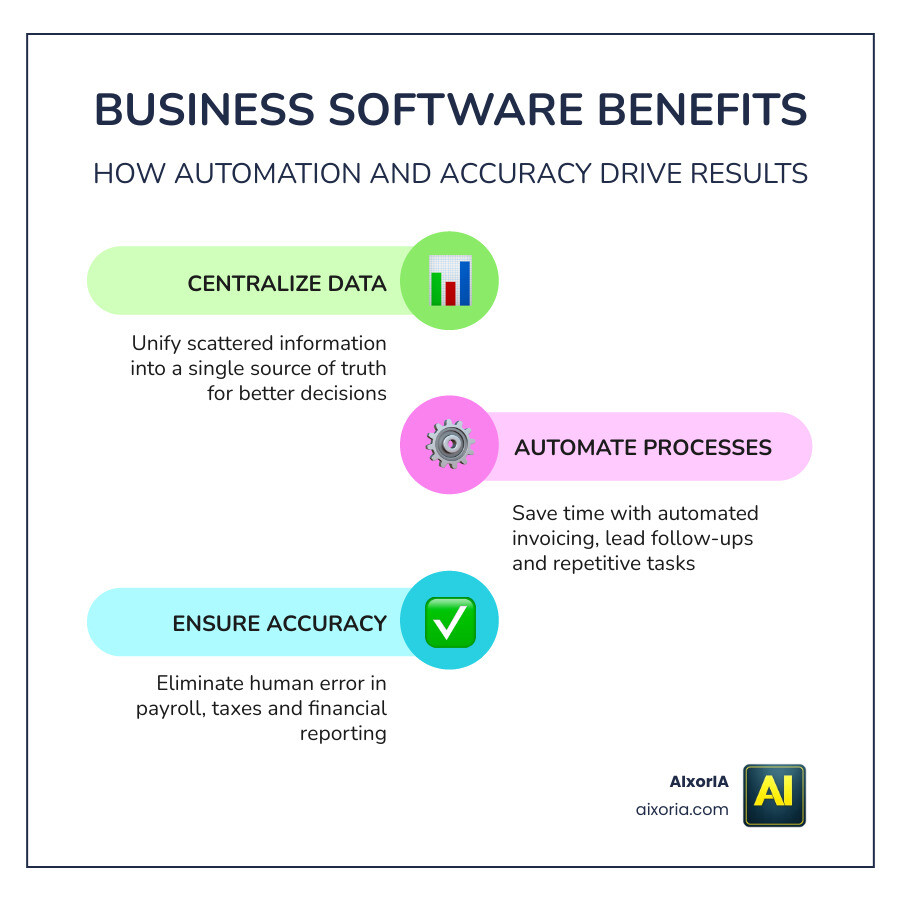
- Data Centralization: Instead of having information scattered across sticky notes and disconnected spreadsheets, software creates a “single source of truth.” When everyone looks at the same data, mistakes vanish.
- Process Automation: Software handles the “boring stuff.” Whether it’s generating an invoice the moment a sale is made or triggering a follow-up email to a new lead, automation frees your team for high-value work.
- Operational Accuracy: Humans are great at many things, but we aren’t perfect at repetitive calculations. Software doesn’t get tired or bored, ensuring that your payroll and taxes are correct every single time.
According to research on What Is Business Software? Types, Benefits and How to Choose, these tools are essential for managing complex functions including:
- Inventory and supply chain logistics
- Human resources and payroll compliance
- Financial reporting and tax preparation
- Customer relationship management (CRM)
- Content management and SEO optimization

Essential Categories of Modern Business Applications
The world of business technology is vast, but most tools fall into a few key buckets. Understanding these categories helps you identify where your business might have “gaps” in its digital foundation.
Understanding ERP and CRM as Business Software
If your business was a body, the ERP (Enterprise Resource Planning) would be the nervous system. It integrates everything—finance, HR, supply chain, and inventory—into one cohesive unit. It’s particularly vital for mid-sized to large organizations that need integrated workflows across different departments.
On the front lines, we have CRM (Customer Relationship Management). This software tracks every interaction with a prospect or client. Using the best sales collaboration software in 2026 allows your team to close deals faster, while the best team communication tools in 2026 ensure that the handoff from sales to support is seamless. Statistics show that CRM users see an average 34% improvement in customer retention.
Financial and Accounting Solutions for Growth
Money is the lifeblood of your company, and manual bookkeeping is a recipe for disaster. Businesses implementing accounting software report a 25% reduction in financial errors. These tools manage your general ledger, accounts payable, and accounts receivable with ease.
For smaller operations, finding the best invoicing software for small business can be a game-changer for cash flow. As you grow, you might look toward the best accounting workflow automation software in 2026 SOC 2 AI to handle complex tax compliance and audit trails automatically.
Note: Research indicates the average cost per manually processed invoice is $10.18, compared to just $2.82 with automation.
Project Management and Workflow Tools
How do you know who is doing what, and by when? That’s where project management comes in. Whether you need the best software to create a flowchart in 2026 to map out a new process or you’re looking for the best free project management software for small business in 2026, these tools keep teams aligned.
For a deeper dive into specific tools, check out our what are the best software for project management 2026 guide. These platforms allow for precise resource allocation, ensuring no single employee is burnt out while others are underutilized.
The Evolution and Future Trends of Business Technology
We’ve come a long way from the early days of computing. In 1962, the first RCA business application ran on a machine with just 4k of memory! Back in the early 1980s, project management software could cost a staggering $500,000 per copy.
Today, Enterprise software is more accessible than ever thanks to the Cloud and SaaS (Software as a Service) models. We no longer need massive server rooms; we just need a browser.
As we move through 2026, the biggest trend is the “AI-ification” of everything. We are seeing a massive surge in RPA (Robotic Process Automation), especially in the legal, healthcare, and banking sectors. Tools like the best workflow automation software in 2026 tested are now using machine learning to predict bottlenecks before they happen. Modern software doesn’t just store data; it interprets it, helping us make better decisions in real-time.
How to Choose the Right Business Software for Your Needs
Choosing the wrong tool is one of the most expensive mistakes a growing business can make. It’s not just the subscription cost; it’s the lost time and frustrated employees.
Strategic Selection of What is Business Software for SMEs
When we help our clients at AIxorIA, we always suggest starting with the “highest-pain” problem. Don’t buy ten tools at once. According to the What Is Business Software? Complete Guide (2026), you should evaluate:
- Scalability: Can the software handle 50,000 orders as easily as 50?
- Ease of Use: If it’s too complex, your team will just go back to using spreadsheets.
- Security Compliance: Look for SOC 2 Type II certification and 99.9% uptime SLAs.
- Technical Support: Does the vendor offer fast, human support when things go wrong?

Implementation Challenges and Best Practices
Buying the software is only 20% of the battle; the other 80% is implementation. Common hurdles include data migration (moving your old info into the new system) and “change resistance” from staff.
To succeed, we recommend:
- Documenting your processes before you even look at a demo.
- Running a pilot program with real data and a small group of users.
- Prioritizing training. Use the best communication tools for remote teams in 2026 to keep everyone updated during the transition.
- Using specialized management tools. If you are managing multiple software rollouts, the best project portfolio management software in 2026 can help you track the ROI of your tech stack.
Frequently Asked Questions about Business Software
What is the difference between business and consumer software?
Consumer software is built for individuals (like Spotify or Netflix). What is business software is built for groups. It features multi-user permissions, audit trails for compliance, and the ability to integrate with other professional tools like accounting or payroll systems.
How does business software improve decision-making?
By consolidating data into real-time dashboards, software removes the guesswork. Instead of “feeling” like sales are down, you can see exactly which products are underperforming and why, allowing for data-driven pivots. Companies using ERP systems, for instance, report a 20-30% increase in productivity due to better visibility.
Is cloud-based business software secure for enterprises?
Yes, in most cases, modern cloud (SaaS) providers have better security than a small business could afford on its own. They employ full-time security teams, use advanced encryption, and maintain multiple backups to ensure your data is safe and always accessible.
Conclusion
Navigating business software doesn’t have to be a headache. Whether you are looking to automate your first invoice or integrate a global supply chain, the right tools are out there to help you scale without the chaos.
At AIxorIA, we specialize in making this digital transformation simple. We provide custom AI solutions, tool training workshops, and performance audits designed to empower your team. Our mission is to provide simple language help and affordable services that get you results fast.
Ready to take the next step in your digital journey? Explore more about AIxorIA services and let’s build a more efficient future together.