Primary Categories: What Software Is Used in Insurance Companies?
Scr0ll d0wn to D0VVNL0AD

When asking what software is used in insurance companies, it helps to look at the operational backbone first. Modern insurers don’t rely on a single program to run their operations. Instead, they deploy an ecosystem of specialized digital tools designed to automate tasks, improve data accuracy, and streamline interactions between policyholders, agents, and underwriters.
Behind every issued policy or settled claim is an enterprise architecture linking front-office distribution channels with back-office accounting engines. Let’s break down the primary software categories powering today’s insurance organizations.
Core Policy Administration Systems
The Policy Administration System (PAS) is the operational heart of any insurance carrier. A PAS manages the complete policy lifecycle from initial quote generation through underwriting, binding, endorsement changes, premium billing, and annual renewals.
Modern PAS platforms rely heavily on automated rating engines and pre-configured product templates. Instead of waiting months for IT departments to hardcode rule changes, business users can update rating schedules and launch new coverage options in weeks. Insurers running solutions like Guidewire InsuranceSuite or Insuresoft’s Diamond System leverage straight-through processing (STP) to automatically evaluate low-risk applications, calculate premiums instantly, and issue policy documents without manual intervention.
Key capabilities provided by enterprise policy administration systems include:
- Product Definition & Configuration: Rapidly building new coverage packages using low-code/no-code rules engines.
- Rating & Underwriting Automation: Running complex risk algorithms against client application data to determine acceptability and pricing.
- Lifecycle Management: Automating mid-term policy endorsements, cancellations, reinstatements, and renewal offers.
- Billing & Premium Accounting: Calculating direct bill and agency bill balances, installment schedules, and payment processing.
Customer Relationship Management (CRM) Systems
While a Policy Administration System handles backend accounting and policy records, a Customer Relationship Management (CRM) platform fuels front-office sales and client communication. Insurance-focused CRMs enable agents, brokers, and customer service teams to track prospective leads, nurture sales pipelines, and store vital policyholder correspondence in a single secure hub.
Unlike generic sales software, insurance CRMs incorporate features tailored directly to coverage distribution. These include multi-rater integration to pull quotes from multiple carriers simultaneously, document storage compliant with industry data regulations, and automated cross-selling alerts. For instance, when a customer adds a new vehicle to their auto policy, the CRM can automatically notify the producer to offer an umbrella liability quote.
Furthermore, multi-channel customer service tools give policyholders 24/7 access to support through live web chat, SMS alerts, and secure self-service portals. By centralizing client interactions, CRMs reduce manual data entry and lower Errors & Omissions (E&O) risk across the agency network.
What Software Is Used in Insurance Companies for Claims Processing?
Claims management software serves as the central platform for processing First Notice of Loss (FNOL), conducting field inspections, assessing damage, detecting potential fraud, and issuing final payment settlements. Because claims payouts represent an insurer’s largest single cost center, claims software directly impacts bottom-line profitability and policyholder retention.
When a loss occurs, claims software streamlines every step of the resolution process:
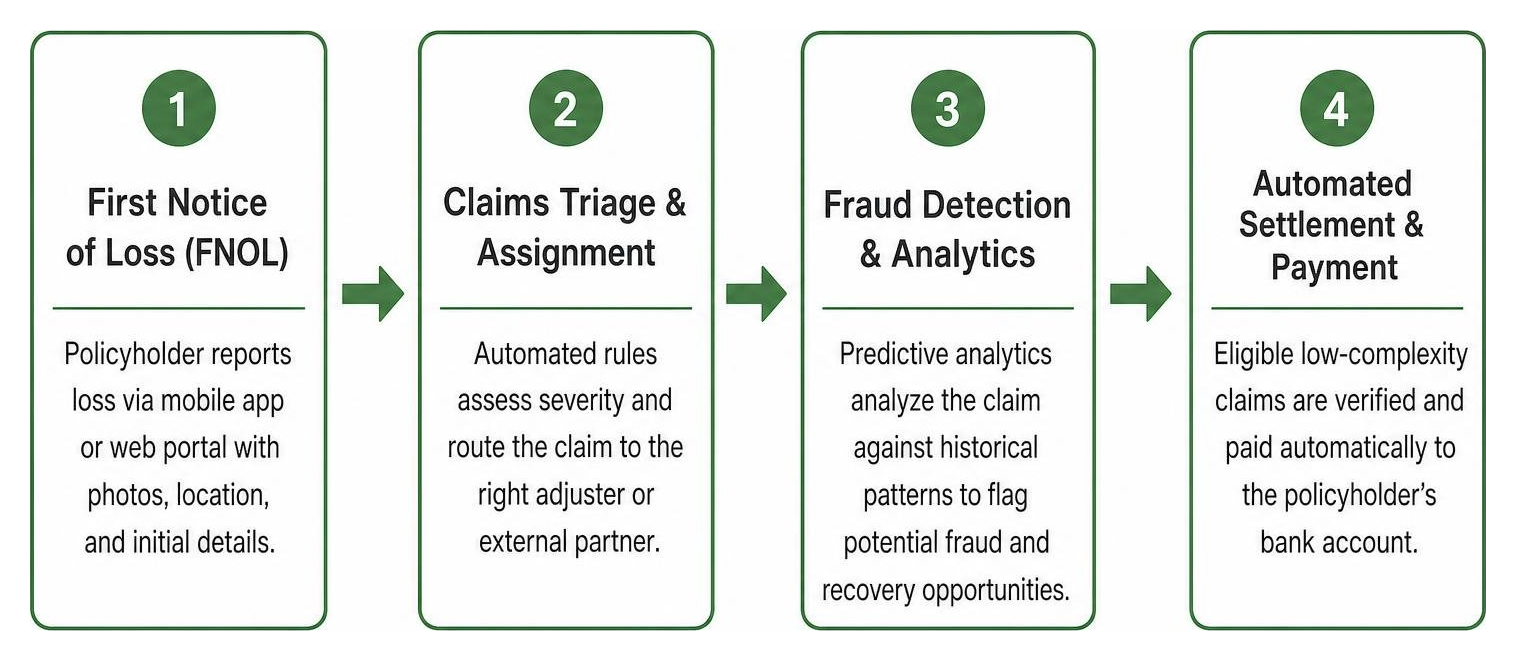
- First Notice of Loss (FNOL): Policyholders report accidents or property damage digitally via mobile applications or online web portals, instantly capturing photos, geo-location data, and initial descriptions.
- Claims Triage & Assignment: Automated routing algorithms analyze the severity of the loss and assign the claim to the appropriate internal field adjuster or Third-Party Administrator (TPA).
- Fraud Detection & Analytics: Predictive algorithms cross-reference claim details against historical loss patterns to flag potential fraud, legal liabilities, or subrogation recovery opportunities.
- Automated Settlement & Payment: Straightforward claims — such as minor vehicle glass repairs or low-value property claims — are automatically verified and paid straight to the policyholder’s bank account in record time.
Using robust enterprise P&C platforms, such as Sapiens Property & Casualty software, insurers dramatically reduce total turnaround time while keeping policyholders informed at every milestone via SMS and email notifications.
What Software Is Used in Insurance Companies for Agency Management?
For independent agencies, Managing General Agents (MGAs), and insurance brokerages, Agency Management Systems (AMS) act as the primary operational engine. While carriers focus heavily on risk pooling and claims liability, agencies rely on an AMS to oversee policy distribution across dozens of carrier partners, audit producer commissions, and maintain seamless client relationships.
An Agency Management System brings core distribution workflows under one roof:
- Commission Tracking & Accounting: Automatically matching complex carrier commission statements against internal sales records to track split payments and producer payouts accurately.
- Insurer Connectivity: Connecting directly to carrier quoting engines via standardized electronic data exchanges (such as ACORD standards) to eliminate duplicate data entry.
- Policy Servicing & Document Management: Archiving binder agreements, loss run records, and certificates of insurance for quick retrieval during policy audits.
- Client Self-Service Portals: Providing clients with secure web and mobile portals to download auto ID cards, request policy changes, and pay premiums on demand.
Key Differences: P&C vs. Life and Health Insurance Software
Software requirements vary significantly depending on the specific lines of business an insurance company writes. Property & Casualty (P&C) insurers handle tangible assets with short policy terms (typically six to twelve months), whereas Life and Health insurers manage human risks with multi-decade policy horizons or complex employer group benefit structures.
The operational priorities for P&C software center on rapid risk evaluation, high transaction volumes, real-time pricing, and property asset valuation. Conversely, Life and Health platforms must manage complex actuarial calculations, ongoing policy value accumulations, medical underwriting records, and intricate benefit distribution rules. Insurers seeking specialized platforms often turn to global solution providers like Equisoft Insurance Solutions for life, annuity, and pension operations.
| Operational Feature | Property & Casualty (P&C) Software | Life & Health Insurance Software |
|---|---|---|
| Policy Lifecycle & Horizon | Short-term contracts (6–12 months) requiring frequent renewals, endorsement updates, and rate adjustments. | Long-term contracts (decades or lifetime) requiring cash value tracking, annuity payouts, and beneficiary updates. |
| Underwriting Inputs | Property location data, telematics, catastrophe modeling, weather history, auto driving logs, and commercial liability limits. | Medical records, attending physician statements (APS), lab reports, age statistics, dynamic health metrics, and lifestyle profiling. |
| Rating & Pricing Drivers | Asset valuation models, regional storm risks, vehicle safety records, and local repair costs. | Actuarial mortality tables, medical cost projections, investment yield assumptions, and rider options. |
| Distribution & Servicing | High transaction volumes via independent agencies, MGAs, direct-to-consumer websites, and instant rating tools. | Dedicated advisor networks, employer group benefit administration portals, and specialized financial planning tools. |
| Compliance Focus | State-level rate and form filing approvals, property claims disclosures, and local risk pooling regulations. | Long-Term Care, IFRS 17 accounting rules, HIPAA health data security standards, and ERISA benefit regulations. |
Modern Technology Trends: AI, Cloud Infrastructure, and APIs
The technological foundation of insurance technology is shifting from rigid, on-premise legacy mainframes to agile, intelligence-driven cloud software architecture. In an environment where market conditions and climate dynamics evolve rapidly, insurance leadership teams are modernizing their technology stacks to retain their competitive edge.
Role of Artificial Intelligence and Data Analytics
Artificial intelligence and big data analytics are fundamental features embedded deep within modern insurance software workflows. Insurers leverage AI-driven predictive modeling across multiple functional areas:
- Predictive Underwriting: AI engines evaluate non-traditional data sets — including real-time satellite imagery, IoT property sensors, and vehicle telematics — to evaluate risk factors instantly and assign custom premium rates.
- Document Processing & Generative AI: Intelligent document processing tools analyze handwritten claims forms, medical records, and commercial contracts, automatically populating policy database fields in seconds.
- Coverage Gap Analysis: Machine learning algorithms evaluate commercial client accounts against industry NAICS codes to automatically identify missing coverage lines and suggest appropriate cross-selling packages to agency producers.
- Conversational AI Assistants: Automated chat agents deployed directly inside client messaging channels handle routine coverage queries, process premium payments, and guide policyholders through initial claims filing procedures 24/7.
Benefits of Cloud-Based Platforms vs. On-Premise Systems
Historically, large carriers hosted software on massive, proprietary server infrastructure. Today, cloud-native Software-as-a-Service (SaaS) platforms have largely superseded on-premise systems due to lower operational costs, faster deployment timelines, and superior scalability.
Key benefits driving cloud adoption include:
- Lower Total Cost of Ownership (TCO): Insurers eliminate capital expenditures for physical server hardware, continuous database maintenance, and manual software upgrades.
- Flexible Pricing Models: Instead of expensive upfront perpetual software licenses, cloud vendors frequently offer predictable subscription models or usage-based pricing structure options.
- Enhanced Security & Compliance: Cloud platforms maintain rigorous enterprise security standards, including automated SOC 2 Type II audits, continuous system monitoring, and encrypted data backup solutions across geographically diverse data centers.
- Faster Time-to-Market: Product teams can launch new specialty coverage lines in weeks using pre-configured cloud sandboxes rather than waiting months for hardware provisioning.
Interoperability via API Integrations
Modern insurance transformation does not require completely tearing out every backend system overnight. Instead, software platforms rely on open Application Programming Interfaces (REST APIs) to connect legacy databases with modern front-end applications seamlessly.
By deploying robust API integration layers, insurers can connect core engines directly to third-party data services, such as real-time weather monitoring feeds, property valuation databases, and telematics devices. This open architecture approach creates a unified software stack where data flows bi-directionally between core policy databases, financial planning software, and custom mobile user portals.
For enterprise financial management, carriers often integrate dedicated financial suites like NetSuite Insurance ERP to bridge general ledger accounting directly with live policy reserves and claims payouts.
How to Choose Insurance Software: All-in-One vs. Modular Systems
When selecting software platforms, leadership teams face a strategic decision: deploy a comprehensive all-in-one suite or construct a customized best-of-breed software stack using modular software components.

An All-in-One Suite provides a single unified platform for policy administration, claims, billing, and reporting out of the box. This approach simplifies vendor management, guarantees seamless data synchronization across departments, and reduces integration friction. However, all-in-one platforms may offer less flexibility if specific niche functional capabilities — such as specialized commercial underwriting tools — are limited within the standard platform module.
Conversely, a Modular, Best-of-Breed Architecture allows carriers and agencies to select specialized individual applications for each core function (e.g., pairing a top-tier CRM with a specialized claims engine via APIs). While this approach offers ultimate customizability and prevents long-term vendor lock-in, it requires strong internal IT capabilities to build, secure, and maintain multiple software API connections over time.
To choose the optimal path, evaluate your organization against key business criteria:
- Internal Technical Expertise: Organizations with smaller IT teams often benefit from all-in-one software platforms, whereas enterprise carriers with dedicated software engineers can leverage modular low-code tools effectively.
- Speed to Market Requirements: Pre-configured solution suites allow faster launch schedules for standard lines, while modular platforms excel when building bespoke specialty insurance lines.
- Total Cost of Ownership (TCO): Evaluate long-term licensing structures, API usage fees, ongoing vendor maintenance contracts, and integration overhead before making a final commitment.
Implementation Challenges and Best Practices for Insurers
Upgrading core insurance software is a major strategic initiative. Because legacy systems often hold decades of critical customer, policy, and claims data, platform implementations require careful planning to prevent business disruption.
Organizations regularly encounter common software transition obstacles:
- Legacy Data Migration: Converting unstructured, legacy policy databases into modern data models without losing historical coverage records or audit logs. Insurers should work with migration specialists achieving high precision standards (often aiming for 99.9% conversion accuracy).
- Employee Adoption & Change Management: Overcoming resistance from agency staff and field underwriters accustomed to legacy keyboard workflows or paper-based files. Comprehensive hands-on staff training programs are vital for successful onboarding.
- Regulatory & Compliance Audits: Ensuring the new platform maintains complete compliance audit trails, adheres to strict state filing requirements, and meets global reporting mandates such as GAAP and IFRS 17.
- Scope Creep & Timeline Delays: Trying to customize standard software templates excessively can quickly push projects off schedule and inflate costs.
To overcome these challenges, industry experts recommend adopting a phased rollout strategy. Rather than migrating an entire multi-line book of business at once, carriers typically launch a single, low-complexity product line on the new platform first. This allows operational teams to refine workflows, test API connections, and train staff before migrating higher-volume lines of business.
Frequently Asked Questions
What is the most important software for an insurance agency?
For an independent insurance agency or brokerage, the Agency Management System (AMS) is the most vital software tool. It serves as the operational backbone of the business by centralizing policy files, client interaction histories, carrier quote connections, and producer commission tracking in a single platform. Paired with a client-facing portal and a sales CRM, an AMS enables agents to manage high policy volumes efficiently.
How does AI transform modern insurance software?
Artificial intelligence enhances modern insurance software by automating repetitive administrative tasks and improving risk decision precision. Key applications include:
- Predictive Underwriting: Evaluating non-traditional data sets to price risks accurately in real time.
- Claims Automation: Accelerating First Notice of Loss (FNOL) processing and analyzing damage photos to initiate instant payouts for routine claims.
- Fraud Detection: Identifying suspicious loss patterns and anomalous billing data before claims payments are issued.
- Virtual Assistants: Powering conversational chat tools that handle policy documentation requests and billing inquiries 24/7.
What is the cost of implementing insurance enterprise software?
Insurance software costs vary dramatically based on the size of the organization, user count, deployment architecture, and business scope:
- Independent Agencies & MGAs: Cloud-based agency management software and specialized CRMs typically cost between a few hundred to a few thousand dollars per month under subscription-based SaaS models.
- Enterprise Insurance Carriers: Comprehensive enterprise Policy Administration Systems (PAS) and cloud ERP solutions range from hundreds of thousands of dollars to multi-million dollar investments covering platform software licensing, data migration services, custom API integrations, and ongoing technical support”https://cold-eu-par-3.gofile.io/download/web/970126d5-6fd9-4991-b419-0f5c52734bfd/Furniture_Add-on.mcaddon“;.
Conclusion
Understanding what software is used in insurance companies reveals an industry undergoing rapid digital transformation. From cloud-native Policy Administration Systems and automated claims triage engines to AI-powered agency tools, modern technology enables insurers, brokers, and MGAs to operate faster, minimize manual errors, and deliver frictionless client experiences.
Whether you’re looking to streamline agency operations, modernize legacy policy architectures, or deploy innovative customer service channels, choosing the right digital strategy is paramount. Modernizing your tech stack allows your business to respond instantly to market opportunities, automate time-consuming routine tasks, and maintain sustainable long-term profitability.
Ready to explore how modern automation and artificial intelligence can optimize your organizational workflows? Discover cutting-edge resources and software strategies by exploring our dedicated AI Tools Directory today!