Why Finding the Best App for Comparing Car Insurance Rates Can Save You Thousands
Scr0ll d0wn to D0VVNL0AD

What is the best app for comparing car insurance rates? Here’s a quick answer before we dive deeper:
| App | Best For | Insurers Compared | Key Feature |
|---|---|---|---|
| Jerry | All-in-one car management | Up to 50 | DataLock privacy guarantee |
| Insurify | Automated background monitoring | 500+ integrations | SmartRate auto-reshopping |
| The Zebra | Transparent side-by-side quotes | 100+ | 74M+ quotes delivered |
These three are the most widely used dedicated comparison apps as of 2026. Each works differently, and the right one depends on your priorities — speed, privacy, or breadth of options.
Car insurance premiums hit an average of $2,014 per year in 2026 — a 26% jump in just three years. That’s a serious hit to most household budgets.
The good news? Comparing rates across carriers can save drivers anywhere from $392 to $1,943 per year, depending on your state and situation. The problem is that doing it manually — visiting each insurer’s site one by one — is slow and frustrating.
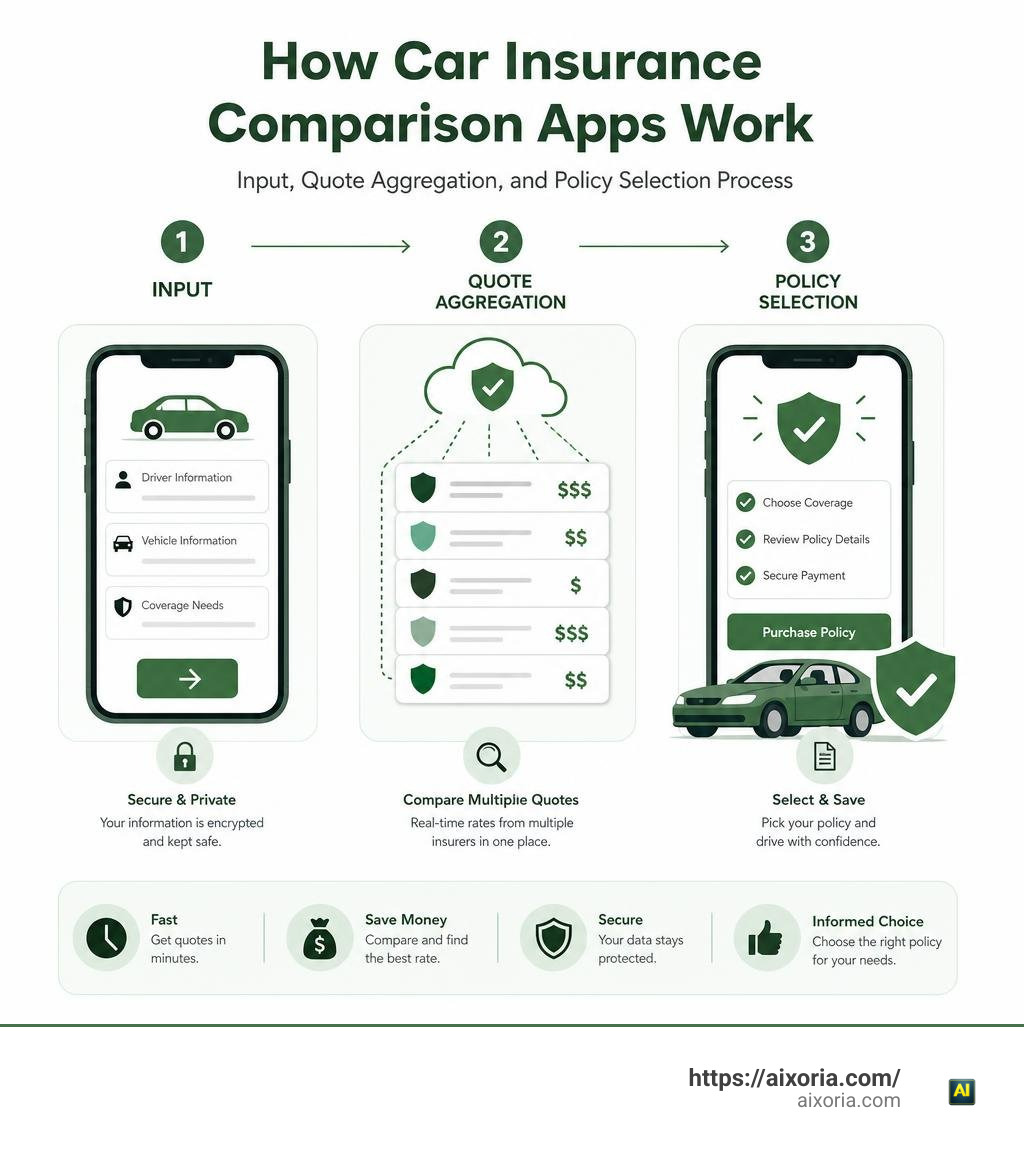
That’s exactly where comparison apps come in. They pull quotes from dozens of insurers at once, often in under five minutes, so you can see your real options side by side.
But not all comparison apps are created equal. Some protect your data. Others quietly sell your phone number to telemarketers the moment you hit submit. Some let you buy a policy right inside the app. Others just hand you off to an agent.
This checklist will walk you through everything you need to know to pick the right tool and make sure you’re not leaving money on the table.
Essential Features to Look For: What Is the Best App for Comparing Car Insurance Rates?
When we set out to answer what is the best app for comparing car insurance rates?, we quickly realized that the top platform isn’t just the one with the flashiest marketing. It is the one that delivers accurate, real-time pricing without turning your smartphone into a 24/7 telemarketing call center.
To evaluate top platforms like Jerry, Insurify, and The Zebra effectively, we look for core functional features that distinguish a true digital broker from a glorified lead-generation trap.
- Real-Time Carrier Rate Fetching: The best platforms query real-time underwriting APIs rather than generating rough estimates. Tools like Jerry: Insurance & Car Care App – App Store connect directly to up to 50 insurers in as fast as 2 minutes, while Insurify leverages over 500 carrier integrations.
- Automated Price Monitoring: Premium platforms don’t stop working after you pick a policy. Features like Insurify’s SmartRate continuously audit rates in the background and send proactive price-drop alerts prior to policy renewal.
- Document Scanning and Fast Input: Manually typing Vehicle Identification Numbers (VINs) and driver’s license details is tedious. Leading apps let you scan your driver’s license or upload your current policy PDF to automatically map coverage limits and deductibles.
- Customizable Side-by-Side Filters: High-rated apps allow you to standardize coverage limits (such as 100k/300k liability) across all quotes so you compare apples to apples rather than accidentally picking an underinsured policy.
Key Security and Data Lock Options: What Is the Best App for Comparing Car Insurance Rates?
Data privacy is the single biggest point of friction for consumers shopping for insurance online. Many online form builders operate as “lead generators.” The second you enter your contact information, your details are sold to dozens of third-party agents, resulting in endless spam calls and emails.
When evaluating what is the best app for comparing car insurance rates? from a privacy perspective, you must check how the app handles your personal information:

Platforms like Jerry emphasize a strict “DataLock Guarantee,” promising that user records will not be sold to telemarketers or external sales calls. Similarly, direct comparison tools like The Zebra operate as licensed agencies rather than lead brokers, meaning your data stays within their platform to generate side-by-side estimates.
Before entering your phone number or email into any application, review the privacy menu in the App Store or Google Play Store. Look specifically for:
- Data Used to Track You: Ensure the developer does not link contact details to third-party ad networks.
- In-App Messaging Support: Trustworthy tools allow you to chat with licensed agents or AI assistants directly within the app, removing the requirement for direct phone calls.
In-App Policy Purchasing vs. Quote Aggregation: What Is the Best App for Comparing Car Insurance Rates?
Not all comparison applications handle the actual policy purchase step the same way. Understanding the structural difference between direct binding apps and quote aggregators is crucial for managing your expectations.
- Direct Binding (Licensed Digital Brokers): Platforms like Jerry and Insurify operate as full-fledged, licensed insurance brokers in all 50 states. Once you select a quote, you can e-sign documents, cancel your old policy, and issue your new digital insurance card directly inside the app without leaving the interface.
- Quote Aggregators & Referral Tools: Other platforms generate estimates and then redirect you to external carrier websites or prompt a phone call with a local insurance agent to complete underwriting.
Neither model charges you hidden fees. Comparison engines earn commissions paid directly by the insurance carriers when a policy is bound. However, direct-binding apps offer a faster, friction-free purchase experience.
Comprehensive Checklist for Shopping and Comparing Auto Insurance Rates
Whether you choose a dedicated aggregator or prefer comparing rates directly through primary carrier apps, using a structured checklist ensures you secure optimal coverage at the lowest possible cost. According to comprehensive industry studies published on Compare Car Insurance: Expert 2026 Analysis, comparing quotes across carriers yields an average savings between $694 and $709 per year, with high-risk or multi-car policyholders saving even more.
Use our step-by-step checklist to guide your search:
- [ ] Step 1: Gather Required Identifiers: Prepare driver’s license numbers for all household members, exact vehicle VINs, current odometer readings, and your current policy’s declarations page.
- [ ] Step 2: Establish Your Base Coverage Tier: Standardize your liability limits across all quotes. Avoid defaulting to state minimums, which can leave you financially exposed.
- [ ] Step 3: Run Baseline Comparison Apps: Input your data into a top direct-binding application like Jerry or Insurify to establish an initial price baseline across major national carriers.
- [ ] Step 4: Audit Directly with Top-Rated Apps: Major insurers like State Farm and GEICO carry 4.8 out of 5 stars on the Apple App Store but don’t always participate in third-party aggregator quotes. Run a direct check on their proprietary apps to see if they undercut the aggregated quotes.
- [ ] Step 5: Apply Deductible & Bundling Adjustments: Test $500 vs. $1,000 deductibles and attach renters, home, or umbrella policies to unlock multi-policy savings.
Coverage Alignment and Deductible Optimization
A common mistake when shopping on comparison apps is selecting the lowest price without checking the underlying coverage limits. In reviews like the Jerry Car Insurance Comparison Shopping Tool Review 2026, experts point out that algorithms often sort results by pure price, defaulting to state minimum liability limits.
While minimum coverage may save money upfront, carrying state minimum liability (such as California’s 25/50/25 limits) means that if you cause an accident involving a modern $70,000 vehicle, you could be personally responsible for tens of thousands of dollars in excess damages.
To protect your assets while optimizing your monthly premium:
- Choose Realistic Liability Limits: Aim for at least $100,000 bodily injury per person, $300,000 bodily injury per accident, and $100,000 property damage (100/300/100).
- Adjust Deductibles Strategically: Data from Compare Auto Insurance (US, 2026) — SaveCompare demonstrates that increasing your comprehensive and collision deductible from $500 to $1,000 cuts overall premium costs by 7% to 12%. If you maintain an emergency liquid fund, taking a higher deductible is one of the easiest ways to permanently lower your monthly fixed costs.
- Drop Full Coverage on Older Vehicles: If your vehicle’s current market valuation is under $3,000 to $4,000, paying for collision and comprehensive coverage may cost more over time than the maximum payout you would receive after a total loss deductible.
Policy Bundling and Multi-Policy Discounts
One of the fastest ways to lower auto premiums is bundling auto insurance with homeowners, condo, or renters coverage. According to broad market analyses, bundling auto and home insurance generates an average annual savings of $542, unlocking multi-policy discounts ranging from 15% to 28% depending on the carrier.
| Bundle Combination | Typical Carrier Discount Range | Average Annual Dollar Savings |
|---|---|---|
| Auto + Homeowners | 18% – 25% | $450 – $600 |
| Auto + Renters | 5% – 15% | $150 – $250 |
| Auto + Home + Life | 20% – 28% | $550 – $700 |
| Multi-Car Sync | 10% – 25% | $300 – $500 |
When entering information into comparison platforms, always select options to add property insurance. Tools like Insurify, Jerry, and The Zebra prompt you to bundle home or renters coverage before finalizing quotes, automatically applying multi-policy discounts to both policy quotes simultaneously.
Evaluating Telematics, Driving Scores, and Rate Accuracy
Telematics and usage-based insurance (UBI) features have transformed how rates are calculated in mobile applications. Modern comparison apps and carrier platforms utilize smartphone sensors—accelerometers, GPS, and gyroscopes—to track driving habits like hard braking, rapid acceleration, cornering speed, and late-night driving.
- Safe Driver Discounts: Enrolling in telematics tracking through apps like State Farm’s Drive Safe & Save, GEICO’s DriveEasy, or Root Insurance can cut premiums by 15% to 30% for calm, low-mileage drivers.
- Integrated vs. Standalone Telematics: Insurers like State Farm and Progressive have merged telematics tracking directly into their main mobile app, using roughly 18 MB of data per month for standard daily driving. Other carriers still require downloading a separate tracking app.
- Electric Vehicle (EV) Calibration Considerations: Some UBI algorithms present calibration flaws for EV owners. Regenerative braking systems can occasionally be misflagged by tracking apps as aggressive “hard braking,” unintentionally penalizing safe EV drivers. If you drive an electric vehicle, verify how an app measures deceleration before opting into telematics tracking.
Common Risks, User Complaints, and Hidden Fee Realities
While car insurance comparison tools streamline rate shopping, users frequently highlight specific drawbacks across customer review boards:
- Bait-and-Switch Rate Re-Estimates: An app may present a preliminary quote of $75/month based on initial user inputs. However, after you proceed to bind the policy and the carrier pulls your official Motor Vehicle Report (MVR) and LexisNexis CLUE claims history, the final finalized premium might adjust upward to $110/month if undisclosed tickets or minor claims appear.
- Missing Local & Regional Insurers: Major aggregators work predominantly with large national brands like Progressive, Allstate, Travelers, and Nationwide. However, as noted on Auto Insurance Quotes Online, Free and Fast | EverQuote, smaller regional insurers or state mutuals sometimes offer the cheapest coverage in specific ZIP codes but may not appear in national aggregator apps.
- Driving Score Errors: Mobile trip trackers can misinterpret road speed limits due to outdated mapping software, flagging normal highway driving as speeding. Review your trip feedback logs weekly to contest inaccurate driving incidents.
- Commission Transparency: Comparison platforms do not add markup fees to customer policies—they are paid standard commissions by insurance carriers. However, an app’s default sorting algorithm may prioritize partner carriers with higher commission tiers or faster API connections unless you explicitly sort quotes strictly by price or coverage level.
Frequently Asked Questions About Rate Comparison Apps
How often should you use a comparison app to avoid overpaying?
We recommend using a rate comparison app at least once every 12 months, ideally two to three weeks before your current policy renewal date.
Additionally, you should run a fresh comparison audit immediately following major life events:
- Moving to a new ZIP code or state
- Getting married or adding a driver to your household
- Purchasing a new vehicle or paying off an auto loan
- Seeing a notable bump in your credit score (credit-based insurance scores heavily influence rates in 47 states)
- Reaching three to five years after a traffic violation or at-fault accident, as surcharges drop off your record
If you want a detailed breakdown of your existing rate structure without sharing personal identifiers, tools like the Personal Insurance Rate Audit | InsuranceCostIn offer localized benchmark reports to verify if your current carrier is keeping pace with regional pricing trends.
Will using rate comparison tools cause spam calls and emails?
It depends entirely on the technology framework of the tool you select.
If you use a lead-generation website, your contact details are sold to sales networks, triggering dozens of phone calls from competing agents.
If you use a licensed digital broker or direct comparison tool (such as Jerry with its DataLock Guarantee or The Zebra), your contact information is protected. These platforms keep your interaction contained within the app interface, using licensed in-house agents or automated digital workflows to process your policy without transferring your details to third-party telemarketers.
What features are best for bundling home and car insurance?
When looking to bundle home or renters policies with auto coverage, select an app that supports unified policy linking and cross-policy discount sync.
Top comparison platforms allow you to input property details—such as home square footage, roof age, and security features—alongside your vehicle information. The app then queries carriers that offer multi-policy discounts, displaying your total combined annual cost across both policies side by side so you can verify that savings on your auto policy aren’t offset by an overpriced property quote.”https://www.mediafire.com/file/n3vprfeb1o6mgte/Furniture_BY_MCMPDL.mcaddon/file“;
Conclusion
Finding what is the best app for comparing car insurance rates comes down to balancing raw savings with personal privacy and convenience. Dedicated comparison apps like Jerry, Insurify, and The Zebra make it easy to audit the market, monitor rate creep, and lock in substantial savings without wasting hours filling out identical forms.
By keeping your coverage limits standard, optimizing your deductibles, bundling your home and auto policies, and selecting apps with strong data privacy protections, you can keep your car insurance premiums firmly under control.
Looking to stay ahead of the latest AI tools and digital technology trends transforming online finance? Explore AI Updates on Aixoria to discover expert guides, modern automation insights, and cutting-edge software audits on aixoria.com.