Toyota Dashboard Recalls Explained: What Every Owner Needs to Know

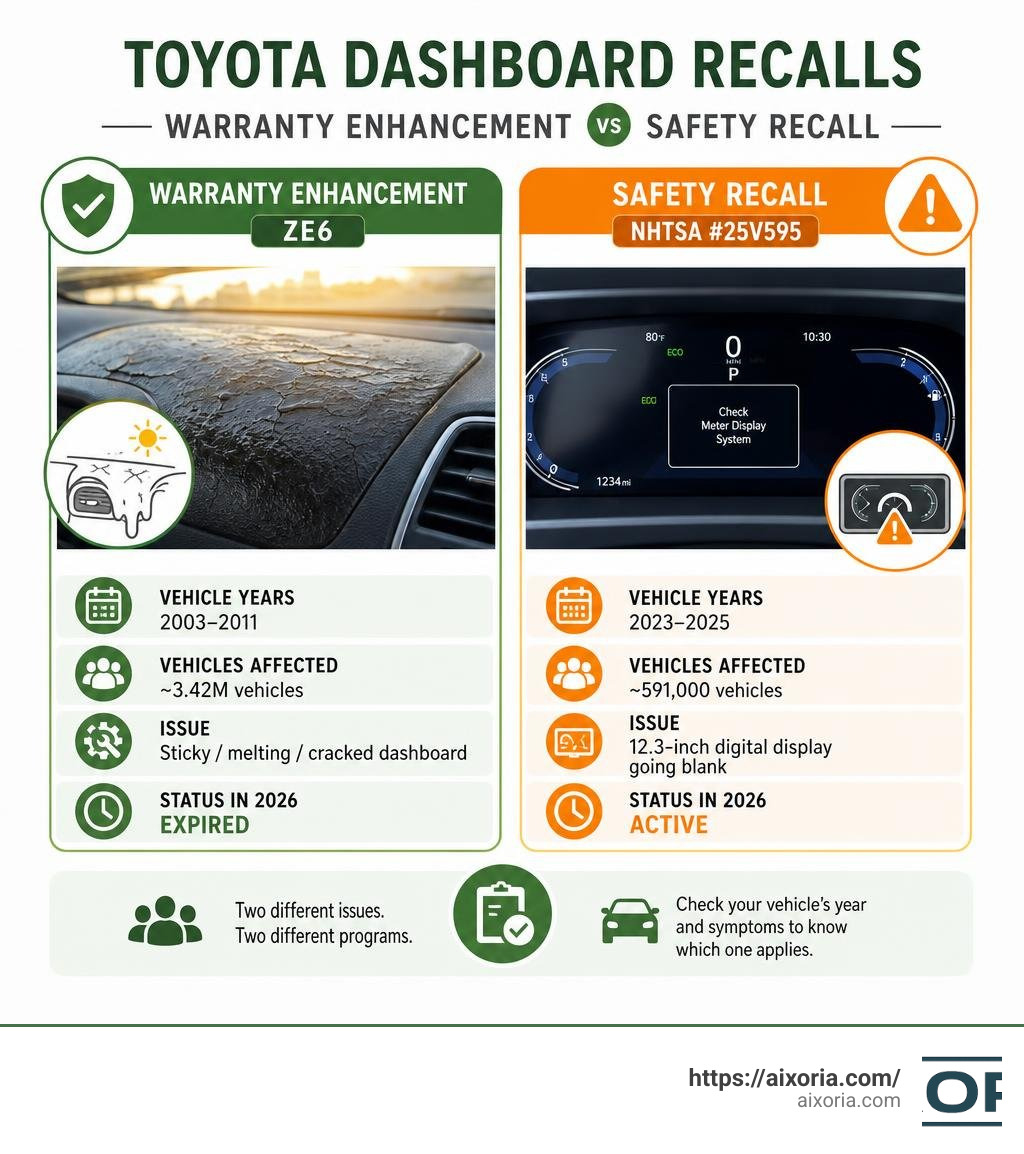
What is the recall on Toyota dashboards? There are actually two separate issues to know about — and they affect very different vehicles.
Here’s a quick breakdown:
| Issue | Type | Vehicles Affected | Status in 2026 |
|---|---|---|---|
| Sticky/melting/cracked dashboard | Voluntary Warranty Enhancement (ZE6) | 2003-2011 model years (~3.42M vehicles) | Expired |
| 12.3-inch digital display going blank | Safety Recall (NHTSA #25V595) | 2023-2025 model years (~591,000 vehicles) | Active |
If your Toyota has a sticky or melting dashboard, you are likely thinking of the older Warranty Enhancement Program ZE6. Toyota voluntarily extended coverage for cracked and melting dashboards on about 3.42 million vehicles — but that program’s primary coverage ended May 31, 2017, with secondary coverage capped at 10 years from the vehicle’s first use date.
If you own a newer Toyota with a 12.3-inch digital instrument cluster that goes blank on startup, that is a separate and currently active safety recall covering models like the RAV4, Tacoma, Camry, and Highlander from 2023-2025.
Most people searching this question own an older Camry, Sienna, Avalon, or similar model with a dashboard that has turned sticky and shiny — and they want to know if Toyota will still fix it for free. The short answer: it depends on your vehicle’s age and first-use date, and for most owners in 2026, the free repair window has closed.
Keep reading for the full picture — which models are affected, whether you still qualify, and what your options are if the program has expired for your vehicle.
What is the recall on Toyota dashboards?
To understand what is happening with your vehicle, we need to clear up some common terminology. When a car part fails on a massive scale, manufacturers typically address it in one of two ways: a formal safety recall or a voluntary service campaign (such as a Warranty Enhancement Program).
Many owners refer to the sticky dashboard phenomenon as “the dashboard recall,” but it was never officially classified as a safety recall by the National Highway Traffic Safety Administration (NHTSA). Instead, Toyota addressed the issue through Warranty Enhancement Program ZE6 and Customer Support Program ZJA.
Because these were voluntary customer satisfaction campaigns rather than safety recalls, they were subject to strict expiration dates. Safety recalls, such as those addressing critical hazards like the historic Takata airbag recall, generally do not have an expiration date and must be performed by the manufacturer free of charge for the life of the vehicle. Voluntary warranty enhancements, on the other hand, only extend the coverage window for a set number of years.
By utilizing a voluntary program, Toyota was able to manage a massive logistical challenge. Replacing dashboards on millions of vehicles required a phased rollout because parts manufacturers simply could not produce replacement instrument panels fast enough to meet immediate demand.
The Sticky and Melting Dashboard Issue: What is the recall on Toyota dashboards?
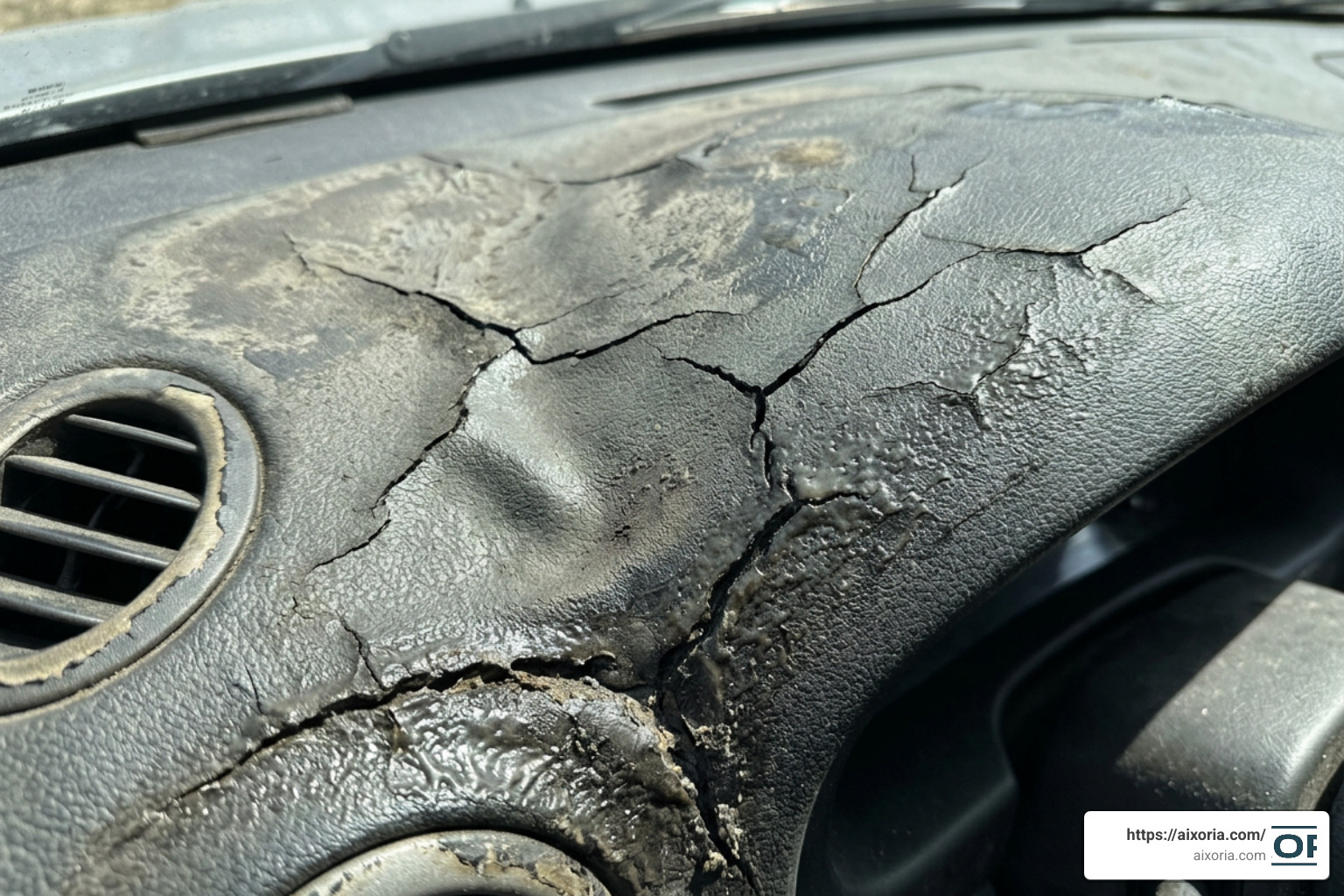
If you have ever parked your car in the sun on a hot summer day only to return to a dashboard that looks wet, feels like fresh hot glue, and leaves a nasty residue on your fingers, you have experienced the melting dashboard issue firsthand.
This problem is caused by a chemical breakdown of the materials used to construct the instrument panel. Under the pressure of high temperatures, intense sunlight, and high humidity, the polyurethane and plastic compounds in the dashboard begin to degrade. Over time, the material loses its structural integrity, causing it to crack, secrete a sticky substance, and take on a highly reflective, shiny appearance.
While Toyota treated this as a cosmetic issue, thousands of frustrated drivers argued it was a major safety hazard. The newly shiny, melted surface of the dashboard acts like a mirror under direct sunlight, throwing an intense, blinding reflective glare onto the inside of the windshield. In many cases, this glare severely compromises driver visibility. Furthermore, owners worried about whether a degrading dashboard would prevent the passenger-side airbag from deploying correctly in an accident.
To address these growing concerns, Toyota issued internal guidelines to dealerships, outlining how to identify affected vehicles and manage repairs. You can read the technical details of how these cases were handled in the Official Warranty Policy Bulletin.
Affected Toyota Models and Production Years
The melting dashboard issue was incredibly widespread, spanning nearly a decade of vehicle production. The primary campaign, known as Program ZE6, covered approximately 3.42 million vehicles in the United States alone.
The table below outlines the specific models and model years that were included in this voluntary program:
| Model | Model Years Covered |
|---|---|
| Toyota 4Runner | 2003–2005 |
| Toyota Avalon | 2005–2010 |
| Toyota Camry | 2007–2011 |
| Toyota Camry Hybrid | 2007–2011 |
| Toyota Sienna | 2004–2010 |
| Toyota Solara | 2004–2008 |
If you own one of these models and your dashboard is currently sticky, melting, or covered in spiderweb cracks, your vehicle was originally part of this massive service campaign.
Coverage Details and Expiration of the ZE6 Program

When Toyota launched the Warranty Enhancement Program, they structured the coverage into two distinct windows: a primary coverage phase and a secondary coverage phase.
- Primary Coverage: This phase offered blanket coverage for all affected vehicles regardless of mileage or age. However, this absolute safety net was temporary and officially expired on May 31, 2017.
- Secondary Coverage: Once the primary coverage window closed, Toyota transitioned to a secondary coverage model. This offered protection for 10 years from the vehicle’s date of first use, regardless of how many miles the car had driven. The “date of first use” is the date the vehicle was first sold or leased as a new car.
For a later-production vehicle covered under a related campaign, such as certain 2010–2011 Camrys, Toyota issued a similar window under the Official Customer Support Program Bulletin, which provided coverage until November 26, 2019, or 10 years from the date of first use.
Because we are now in June 2026, even the very latest vehicles covered under the secondary 10-year window have aged out of the program. For example, a 2011 Toyota Camry sold in late 2011 would have reached its 10-year coverage limit in late 2021. Consequently, the voluntary free replacement program has officially expired for all affected models.
Checking Your VIN and Eligibility
Even though the voluntary dashboard replacement program has expired, it is always a smart idea to check your Vehicle Identification Number (VIN) for any other open safety recalls.
Unlike voluntary warranty extensions, safety recalls do not expire. If your vehicle has an outstanding safety recall (such as an airbag or fuel system issue) that was never completed by a previous owner, a Toyota dealership is legally required to fix it for free.
To check your vehicle’s status:
- Locate your 17-digit VIN (found on a metal plate on the driver’s side dashboard near the windshield, or on your registration card).
- Go to the official Toyota recall lookup portal or the NHTSA recall database.
- Enter your VIN to see a complete list of open safety recalls or service campaigns.
If you recently purchased an older Camry or Sienna and the previous owner never claimed their dashboard replacement, you cannot reactivate the expired ZE6 program. Because the campaign was tied to a strict timeline rather than ownership status, the expiration remains final regardless of whether you received an official notification letter.
Repair Options, Costs, and DIY Alternatives
If you are dealing with a sticky, melting dashboard in 2026 and your vehicle is out of the warranty window, you are likely wondering about your repair options.
If you choose to have the dashboard replaced professionally at a Toyota dealership, prepare for a relatively high bill. Because the voluntary program has ended, you will be responsible for both parts and labor.
- Parts Cost: A brand-new OEM replacement dashboard pad typically costs between $800 and $880.
- Labor Cost: Replacing a dashboard is a highly labor-intensive process. It requires removing the steering wheel, center console, instrument cluster, and passenger-side airbag assembly. Dealership flat-rate guides estimate this job takes around 2 to 2.2 hours of labor for a trained technician, but in the real world, independent shops may charge for 4 to 8 hours of labor, bringing the total repair cost to anywhere from $1,200 to $1,800.
Fortunately, you do not have to spend thousands of dollars to restore your vehicle’s interior. There are several practical, budget-friendly alternatives available.
Out-of-Warranty Solutions: What is the recall on Toyota dashboards?
For owners looking to address a sticky dashboard without breaking the bank, here are the most popular and effective solutions:
- Aftermarket Fabric Dash Covers: The easiest and most affordable fix is to install a custom-molded carpet or velour dash cover (such as those made by Coverking). These covers cost between $50 and $100, fit snugly over your existing dashboard, and completely eliminate windshield glare while hiding cosmetic damage. Just ensure the cover is specifically designed to allow proper passenger-side airbag deployment.
- DIY Dashboard Replacement: If you are mechanically inclined, you can purchase a new OEM dashboard pad (such as part number 5540106091B0 for certain Camry models) and perform the replacement yourself. This is a major project that typically takes about 8 hours of focused work. We highly recommend taking step-by-step photos during disassembly, organizing all screws and clips in labeled sandwich bags, and carefully disconnecting the battery before working near any airbag wiring.
- Latex Paint and Vinyl Coatings: Some owners have had success cleaning the sticky residue with heavy-duty degreasers (like isopropyl alcohol) and sealing the surface with matte latex paint or specialized vinyl interior coatings. This helps dry out the surface and reduces the sticky texture, though it requires careful masking of the vehicle’s interior.
- Talcum Powder or Baby Powder: A very cheap, temporary cosmetic fix involves dusting the sticky areas with talcum powder or baby powder. The powder binds with the sticky chemical compounds, neutralizing the tackiness for a few weeks or months at a time.
- Salvage Yard Hunting: You can search local auto salvage yards for a replacement dashboard. However, be cautious: finding a used dashboard from this era that isn’t already sticky or cracked can be quite difficult, as most vehicles in the yard have been exposed to the same environmental conditions.
How the Melting Dashboard Issue Compares to Modern Toyota Recalls
While the melting dashboard issue of the 2000s was a mechanical and material failure caused by environmental wear, modern Toyota dashboard recalls look very different. Today, our dashboards are highly digitized, and issues are more likely to involve software glitches and screen blackouts than melting plastics.
Digital vs. Analog Dashboard Failures
A prime example of a modern dashboard issue is the safety recall involving Toyota’s newer 12.3-inch digital instrument clusters.
In late 2025, Toyota issued a safety recall covering approximately 591,000 vehicles due to a software defect that could cause the digital instrument panel to go completely blank upon starting the vehicle. This is a critical safety issue because a blank screen prevents drivers from seeing vital safety information, such as vehicle speed, warning lights, and driver assistance indicators.
You can read the official regulatory filing for this issue in the NHTSA Recall 25V595 Report. This recall covers a massive lineup of modern vehicles, including:
- 2023–2025 Toyota RAV4 and RAV4 Prime
- 2024–2025 Toyota Tacoma
- 2023–2025 Toyota Highlander and Grand Highlander
- 2025 Toyota Camry
- 2023–2025 Toyota Crown and 2025 Crown Signia
- 2023–2024 Toyota Venza
- 2023–2025 Toyota GR Corolla
- Lexus TX, RX, and LS models
Additionally, in mid-2026, Toyota addressed another digital cluster issue under recall campaign 26V341, which affects vehicles like the 2025 Lexus UX Hybrid, 2024 Lexus GX, Toyota Mirai, and 2024–2025 Toyota Land Cruiser Hybrid. In these vehicles, the instrument panel combination meter could fail to display critical safety warnings, violating Federal Motor Vehicle Safety Standards (FMVSS) 101 and 305. The official details are documented in the NHTSA Recall 26V341 Acknowledgment.
Unlike the older melting dashboard campaigns, these modern digital display failures are official safety recalls. Because they pose an immediate safety risk on the road, Toyota dealerships will update the software or replace the combination meter hardware completely free of charge, with no expiration date on the repair.
Frequently Asked Questions about Toyota Dashboard Recalls
Why did my Toyota dashboard get sticky and melt?
The sticky, melting texture is caused by a chemical breakdown of the polyurethane materials in the dashboard pad. When exposed to a combination of high temperatures, high humidity, and direct UV sunlight over several years, the plastic compounds degrade, causing the dashboard to sweat, melt, crack, and become highly reflective.
Will Toyota still replace my sticky dashboard for free in 2026?
No. The voluntary Warranty Enhancement Program (ZE6) and Customer Support Program (ZJA) have officially expired. The program’s secondary coverage was capped at 10 years from the vehicle’s date of first use. Because the newest affected models are from 2011, all eligible vehicles have aged out of the free repair window.
How do I check if my Toyota has an active safety recall?
You can check for active safety recalls by visiting the official Toyota recall lookup tool or the NHTSA recall database and entering your vehicle’s 17-digit VIN. You can also search by your license plate and state to see if there are any outstanding, uncompleted safety recalls for your vehicle.
Conclusion
Navigating vehicle recalls and warranty extensions can be tricky, especially when dealing with older, widespread issues like Toyota’s melting dashboards. While the window for a free OEM replacement has closed, understanding your vehicle’s history and knowing your aftermarket options can help you keep your car safe, comfortable, and looking great on the road.
At Aixoria, we love breaking down complex automotive and tech topics into simple, actionable guides. If you want to dive deeper into smart solutions, digital systems, or step-by-step guides, Learn more about AI Tutorials to see how we make complex topics easy to master!