When Your Plan Becomes Outdated Before You Even Start
Scr0ll d0wn to D0VVNL0AD

Adaptive Software Development (ASD) is a flexible, iterative software development methodology that replaces rigid upfront planning with a repeating cycle of Speculate, Collaborate, and Learn — designed specifically for complex projects where requirements change frequently.
Quick answer:
- What it is: A development approach built around continuous adaptation, not fixed plans
- Created by: Jim Highsmith and Sam Bayer, growing out of Rapid Application Development (RAD) in the 1990s
- Core cycle: Speculate → Collaborate → Learn (repeated in short, time-boxed iterations)
- Best for: Projects with evolving requirements, high uncertainty, or fast-changing markets
- Key traits: Mission-focused, feature-based, iterative, time-boxed, risk-driven, and change-tolerant
Imagine you spend weeks building a detailed project plan. Then the market shifts. A customer changes their mind. A new technology appears. Suddenly, your plan is already out of date — and you haven’t written a single line of code.
This is the problem ASD was built to solve.
Rather than fighting change, ASD expects it. It treats uncertainty not as a failure of planning, but as a normal part of building complex software. Instead of the traditional “Plan → Design → Build” sequence, ASD teams work in short cycles that keep them constantly aligned with real-world feedback.
It’s one of the earliest precursors to the modern Agile movement. Jim Highsmith, one of ASD’s creators, later became one of the 17 co-authors of the Agile Manifesto in 2001. That connection isn’t a coincidence — many of Agile’s core values trace directly back to ASD’s principles.
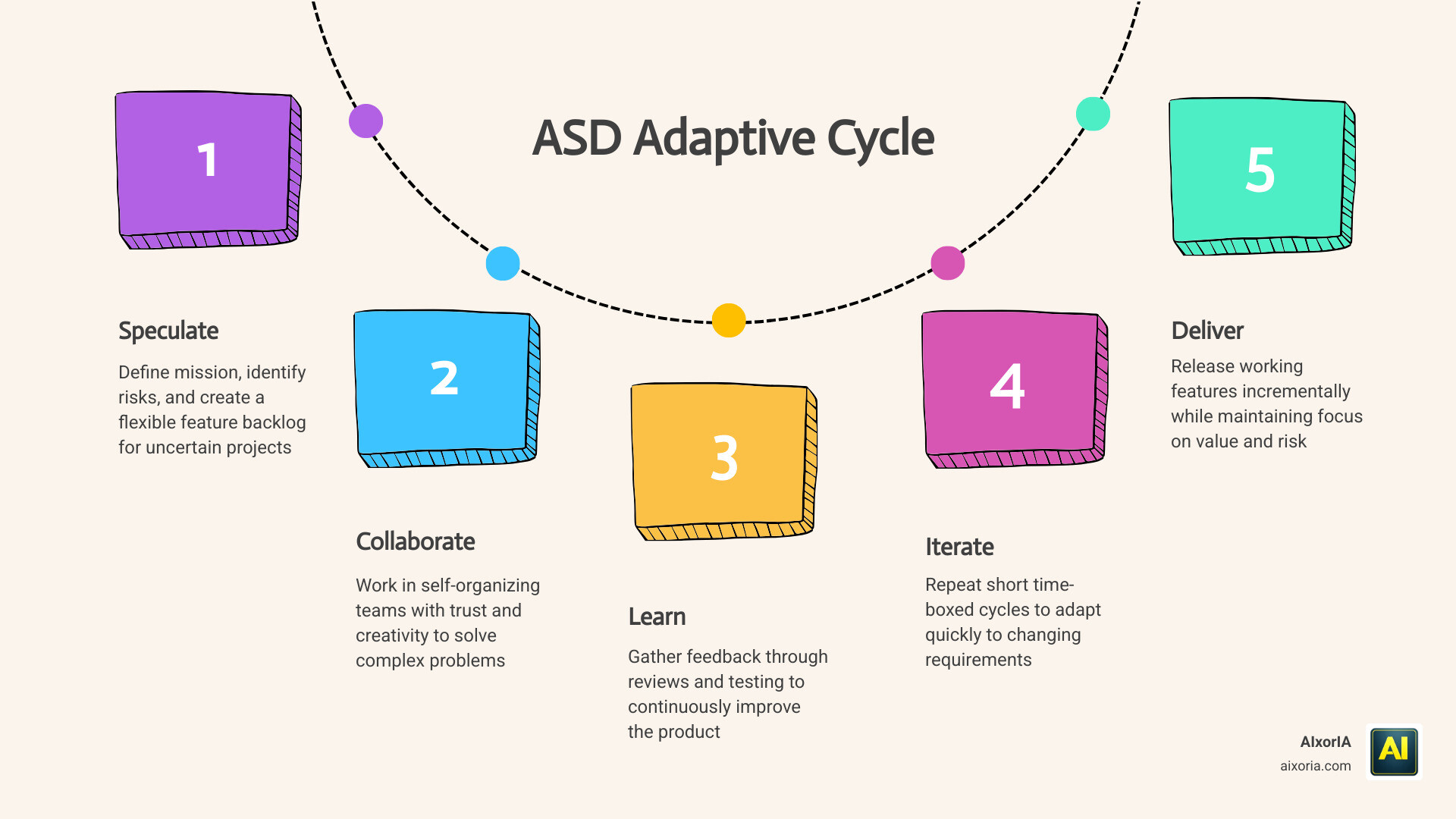
What is Adaptive Software Development?
At its heart, what is adaptive software development (ASD) is a philosophy that views change as an opportunity rather than a disruption. It was formally introduced by Jim Highsmith and Sam Bayer, who realized that traditional methods weren’t cutting it for high-speed, high-complexity systems.
According to Adaptive software development – Wikipedia, the methodology grew out of work on Rapid Application Development (RAD). While RAD focused on speed, ASD added a layer of continuous learning and mission-focus. It acknowledges a fundamental truth: in complex environments, you can’t predict every outcome. You have to “speculate” and then adjust.
The Agile Manifesto shares many DNA strands with ASD. Both prioritize individuals and interactions over processes and tools. ASD is specifically:
- Mission-focused: The team knows why they are building the product, even if the how changes.
- Feature-based: Development is organized around functional features, not technical tasks.
- Change-tolerant: It assumes that requirements will evolve throughout the lifecycle.
The Historical Roots of what is adaptive software development
In the mid-1990s, the software world was dominated by the “Waterfall” model. It was a time of massive, rigid documentation. Highsmith and Bayer saw that for innovative, high-uncertainty projects, this rigidity led to failure. They proposed ASD as a way to handle the “paradox of planning”—the idea that the more you plan a complex system upfront, the more likely you are to be wrong.
As an antecedent to modern Agile, ASD provided the bridge from the speed-focused RAD models to the value-focused frameworks we use in 2026. It was designed for environments where the technical landscape was shifting as fast as the business requirements.
ASD vs. Traditional Waterfall Methodology
To understand why ASD is so transformative, we need to see it side-by-side with the old way of doing things.
| Feature | Waterfall Model | Adaptive Software Development (ASD) |
|---|---|---|
| Planning | Rigid, upfront, and detailed | Speculative, iterative, and lightweight |
| Change | Difficult and expensive to implement | Welcomed as a core part of the process |
| Customer Role | Involved mostly at start and end | Continuous involvement and feedback |
| Delivery | Single release at the project’s end | Incremental, feature-based releases |
| Risk | High (risks found late in the game) | Low (risks identified early via learning) |
While Waterfall relies on predictability, ASD relies on adaptability. In today’s world of AI and rapid market shifts, sticking to a 12-month rigid plan is often a recipe for obsolescence.
The Three Phases of the ASD Lifecycle
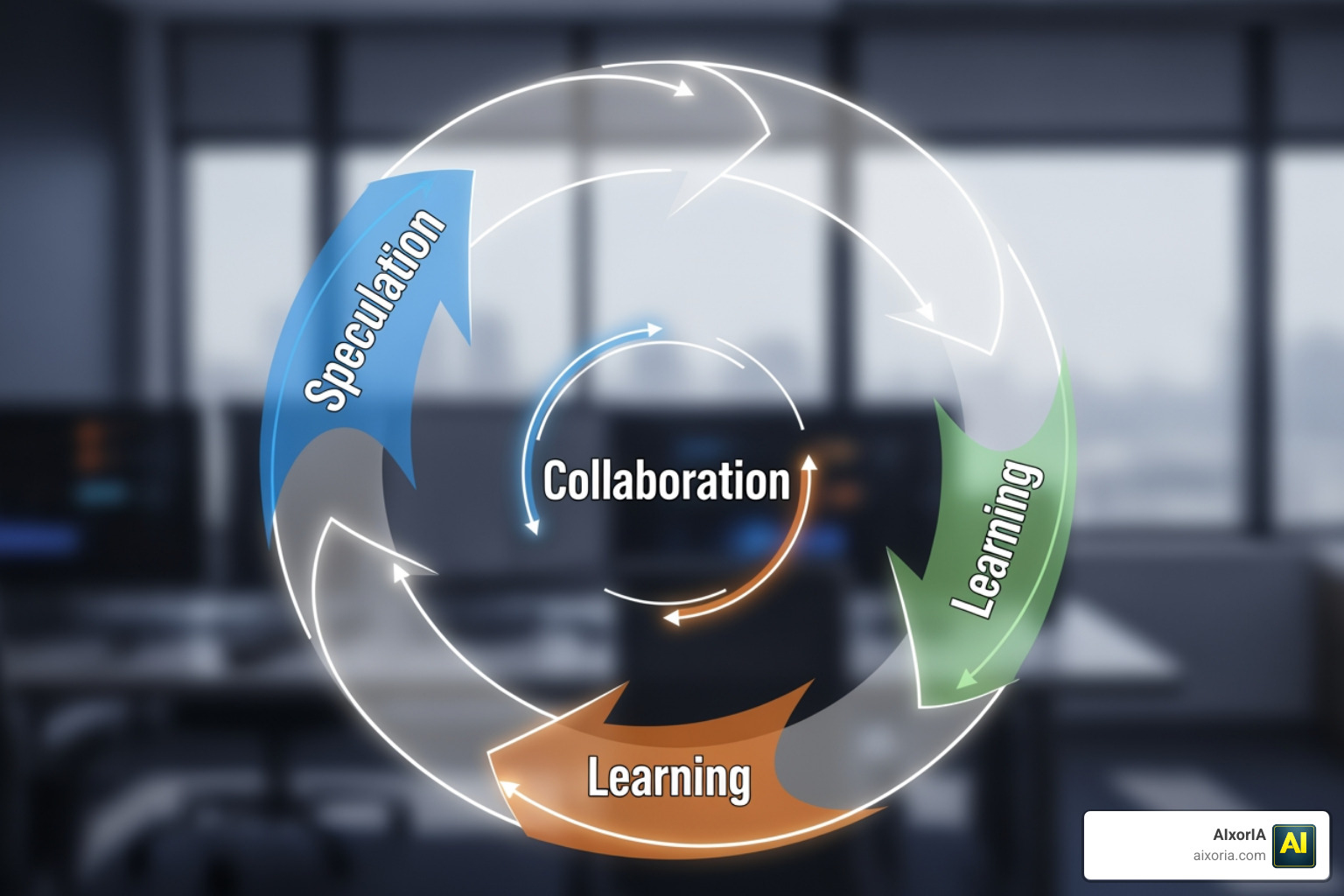
Instead of linear steps, ASD uses a repeating loop. These iterations typically last two to four weeks, ensuring the team never drifts too far from the project’s mission.
Speculate: Planning for Uncertainty
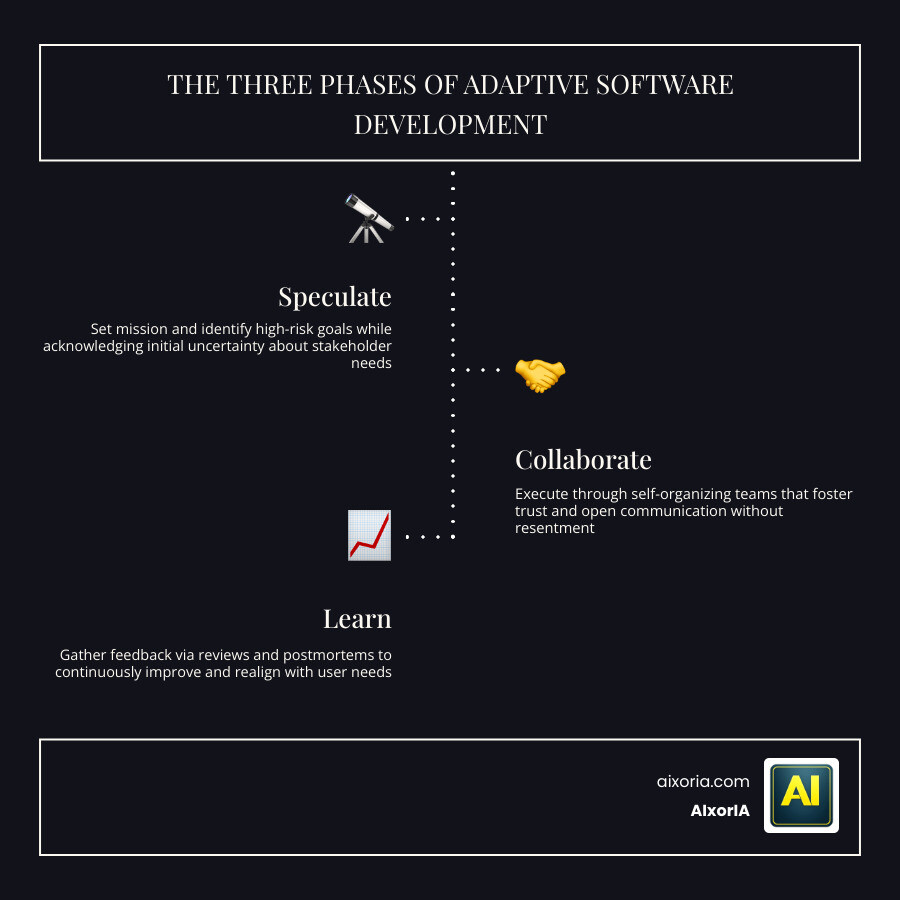
In ASD, we don’t “plan” in the traditional sense; we speculate. We acknowledge that stakeholders are likely to be “wrong” about some aspects of the project initially. In this phase, we set the mission, identify high-level goals, and define the initial feature backlog.
Because this phase involves managing complex tasks and timelines, using the Best Ai Tools For Project Management can help teams keep their “speculations” organized and data-driven without becoming bogged down in rigid documentation.
Collaborate: The Human Element of what is adaptive software development
This is where the actual work happens, but ASD treats it as a psychological exercise as much as a technical one. Collaboration requires trust, open communication, and self-organizing teams. It’s about creating an environment where team members can criticize work without animosity and assist each other without resentment.
To foster this kind of environment in 2026, many teams leverage the Best Ai Tools For Work to streamline communication and ensure that everyone stays aligned on the creative mission.
Learn: Continuous Improvement and Feedback
The learning phase is what makes the methodology “adaptive.” After each iteration, the team gathers feedback through focus groups, technical reviews, and project postmortems. We ask: “What did we build? Is it what the user actually needs? What did we learn about the technology?”
This phase often incorporates “shift-left” testing, where quality assurance happens throughout the cycle rather than at the end. Utilizing the Best Ai Tools For Productivity In 2026 allows teams to automate these feedback loops and focus on high-level improvements.
Key Characteristics and Benefits of ASD
The primary benefit of ASD is its ability to handle “uncertainty.” By delivering functional software in small increments, teams can provide value almost immediately.
- Risk-Driven Development: By tackling high-risk features early, the team reduces the chance of a catastrophic failure late in the project.
- Transparency: Constant customer involvement means there are no “surprises” at the end of the six-month mark.
- Faster Time-to-Market: You don’t wait for a perfect product; you release a working one and evolve it.
Why ASD is Essential for 2026 Complex Projects
As we move further into the decade, projects are becoming more complex due to AI integration and global market volatility. ASD is particularly suited for R&D-heavy projects where the “final” product isn’t fully known at the start.
For businesses looking to stay ahead, integrating Best Ai Tools For Business Strategy In 2026 with an adaptive mindset allows for a level of scalability and organizational maturity that rigid models simply can’t match.
Comparing ASD to Scrum and Kanban
While ASD is an Agile methodology, it differs from its “cousins” in several ways:
- Scrum: More structured with fixed roles (Scrum Master, Product Owner) and specific ceremonies. ASD is more fluid and principle-driven.
- Kanban: Focuses on flow and “just-in-time” delivery. ASD is more focused on the iterative learning cycles of Speculate-Collaborate-Learn.
- DSDM: Prioritizes fixed timelines and strict ownership, whereas ASD emphasizes flexibility and team ownership of the mission.
Implementation Challenges and Best Practices

No methodology is perfect. What is adaptive software development (ASD) requires a high level of maturity.
- Scope Creep: Without discipline, the “embrace change” mantra can lead to a project that never ends.
- High User Involvement: You need customers who are willing to show up and give feedback regularly.
- Skill Requirements: ASD works best with experienced, autonomous developers who are comfortable with ambiguity.
For those just starting out, especially entrepreneurs, using the Best Ai Tools For Entrepreneurs In 2026 can help manage the administrative overhead that comes with high-frequency collaboration.
Best Practices for Adopting an Adaptive Mindset
- Start with a Pilot: Don’t flip your whole organization overnight. Try ASD on a smaller, high-uncertainty project first.
- Build a Culture of Trust: Collaboration fails if people are afraid to admit they were “wrong” during the speculation phase.
- Automate Everything: Use CI/CD and automated testing to keep the “Learn” phase fast and efficient.
- Keep Backlogs Living: Your feature list should be a dynamic document, not a stone tablet.
Frequently Asked Questions about ASD
How does ASD handle changing requirements?
Change is built into the Speculate-Collaborate-Learn cycle. Instead of seeing a change request as a problem, the team views it as “new learning” that is incorporated into the next speculation phase. This ensures the product stays aligned with the market.
Is ASD suitable for all types of projects?
No. It is ideal for complex systems, startups, and innovative R&D. However, if you are working on a project with fixed-scope compliance requirements or a very predictable, repetitive task, a more traditional or structured Agile model might be better.
What are the main limitations of ASD?
The biggest hurdle is the demand for stakeholder availability. If your client can’t meet every two weeks, the “Learn” phase breaks down. It also requires highly skilled talent; junior teams may struggle with the lack of rigid “how-to” instructions found in other frameworks.
Conclusion
At AIxorIA, we believe that the future of business belongs to the adaptable. Whether we are providing custom AI solutions, conducting performance audits, or leading tool training workshops, we see how an adaptive mindset transforms organizations.
In the 2026 landscape, being “right” at the start is less important than being able to “learn” quickly. By embracing the principles of Adaptive Software Development, you ensure your business strategy is future-proof and resilient.
Ready to take your business to the next level? Explore our guide on AI Tools for Business in 2026: Autonomous Agents & ROI Formula to see how we help businesses navigate the complexities of the modern digital world with simple language and expert support.