Do Doctors Get Better Mortgage Rates in 2026?
Scr0ll d0wn to D0VVNL0AD

Do doctors get better mortgage rates? Not automatically. A doctor with the same credit, down payment, loan type, and debt level as another buyer may receive a similar rate.
For Aixoria readers, the more useful question is how modern underwriting, data models, and digital mortgage platforms evaluate doctors differently from other borrowers. In 2026, lenders increasingly rely on risk-based pricing, automated income review, student-loan data, and portfolio lending models. Those systems do not simply reward a medical title, but they can recognize the financial profile common to many physicians: high earning potential, strong employment stability, and a predictable jump from residency or fellowship income to attending income.
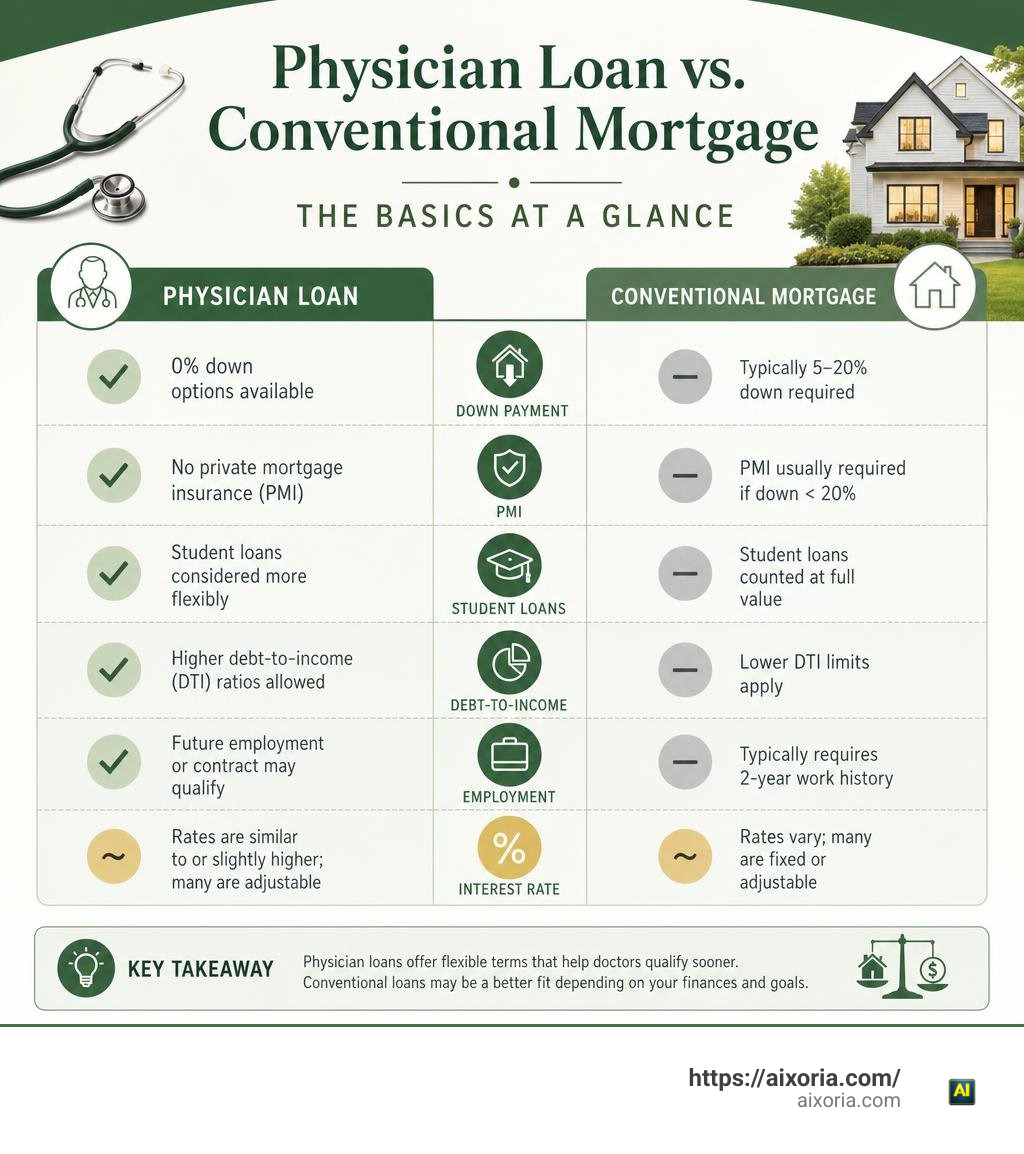
That is why physician mortgage loans can offer better overall borrowing terms for doctors early in their careers. These loans may allow 0% down, no private mortgage insurance (PMI), higher debt-to-income limits, and more flexible treatment of student loans or a future employment contract.
The trade-off is important: physician loans often have rates that are similar to, or slightly higher than, conventional mortgage rates. Many are also adjustable-rate mortgages, so the payment can rise after the initial fixed period.
| Quick answer | What it means |
|---|---|
| Lower rate by profession? | No. Being a doctor alone does not guarantee a lower interest rate. |
| Better loan terms? | Often, yes. Doctors may qualify for low- or zero-down financing without PMI. |
| Best option for every doctor? | No. A conventional, FHA, or VA loan can be less expensive in the right situation. |
| What matters most? | Credit score, debt-to-income ratio, down payment, loan type, lender fees, and whether the rate is fixed or adjustable. |
For residents, fellows, and new attending physicians, the real advantage is often qualifying sooner despite limited savings, high student debt, or a short work history. The right mortgage is not necessarily the one with the lowest advertised rate. It is the one with the lowest total cost and a payment that still fits your life if rates, income, or housing values change.
Do Doctors Get Better Mortgage Rates?
When asking whether do doctors get better mortgage rates?, we have to separate the actual interest rate from the overall financial package. Strictly speaking, lenders do not give medical doctors a lower interest rate purely because of the “MD” or “DO” behind their name. However, because physicians display exceptional occupational stability and carry a default rate that is approximately 73% lower than average borrowers, financial institutions often treat them as premium low-risk clients.
This is where mortgage pricing becomes a useful example of the data-driven financial systems Aixoria covers. Lenders are not just making a human judgment about a profession. They are using underwriting models, credit data, debt calculations, income projections, and internal portfolio strategy to decide how much risk a borrower represents.
To capitalize on long-term physician earning potential, banks offer specialized physician mortgage loans. These are frequently held as portfolio loans, meaning the bank keeps the mortgage on its own balance sheet rather than selling it to Fannie Mae or Freddie Mac. Because the bank holds the risk directly, it can customize risk-based pricing rules.
In exchange for offering 100% financing, meaning zero down payment, and waiving monthly private mortgage insurance (PMI), lenders often price physician loans with a slight interest rate premium, usually 0.125% to 0.375% higher than a standard conventional loan with 20% down. But when we look at the net monthly payment, the total cost for a physician can end up lower because skipping PMI saves hundreds of dollars every month.
| Loan Feature | Standard Conventional Loan | Physician Mortgage Loan |
|---|---|---|
| Typical Down Payment | 3% to 20% | 0% to 5% |
| Private Mortgage Insurance (PMI) | Required if down payment < 20% | Waived completely |
| Interest Rate Structure | Baseline market rate | Same as conventional, or +0.125% to +0.375% premium |
| Student Debt DTI Calculation | 1% of balance or full payment | Actual IBR payment or excluded if deferred |
| Work History Requirement | 2 years of tax returns/paystubs | Signed offer letter up to 150 days prior to start |
How Risk Models Impact Physician Mortgage Rates
To understand why mortgage rates fluctuate for physicians, we need to examine how underwriter risk models operate. Mortgage interest rates across the board are influenced by macro factors like the 10-year Treasury yield and individual bank pipeline liquidity. However, credit underwriting models adjust individual rates based on loan-to-value (LTV) ratio, credit score, and income stability.
For standard borrowers, putting 0% down presents significant default risk. If real estate prices drop, the borrower may have little or no equity cushion. Lenders offset this by charging higher interest rates and mandating PMI. But physicians follow a unique career trajectory: high guaranteed future income paired with strong job security. Underwriters know that many medical professionals have durable earnings and a lower default profile than the average borrower.
As highlighted in recent research on Healthcare worker mortgage rate analysis 2026, specialized healthcare mortgage programs evaluate future earning growth rather than relying solely on historical tax returns. This structural shift is part of a broader fintech trend: lenders are using more specialized borrower data to make pricing and approval decisions.
How Lenders Handle Physician Loans vs Conventional Mortgages
Conventional mortgages must conform to government-sponsored enterprise (GSE) rules set by Fannie Mae and Freddie Mac. In 2026, standard conforming loan limits sit around $832,750 in many parts of the country. If a borrower needs a larger loan, they may enter jumbo mortgage territory, which can require stricter cash reserves and down payments of 10% to 20%.
Physician loans bridge this gap by offering high loan limits, frequently $1 million to $2 million, without requiring jumbo-sized down payments or private mortgage insurance.
For example, a traditional home buyer purchasing a $1,000,000 home with 5% down ($50,000) through a conventional loan could face substantial monthly PMI fees, often between $400 and $800 per month, alongside jumbo underwriting scrutiny. A physician using a specialized doctor loan may be able to purchase that same $1,000,000 home with zero down and $0 PMI. Even if the doctor loan’s interest rate is 0.125% higher, the elimination of PMI can save the physician thousands of dollars annually. For a complete breakdown of how these mechanisms work, review the Complete physician mortgage guide.

Core Benefits and Underwriting Requirements for Doctors
The real value of a doctor loan lies in its underwriting flexibility. Traditional mortgage rules were built for steady 9-to-5 corporate workers who build cash reserves over decades. They perform poorly for medical trainees who spend their twenties accumulating student debt while earning resident stipends, only to experience a 3x to 5x income jump overnight.
From a technology and data perspective, physician loans show how niche borrower models can create different financial outcomes. Instead of relying only on backward-looking paystubs and tax returns, many doctor loan programs evaluate signed contracts, specialty-specific income expectations, actual student-loan payment data, and the timing of a residency-to-attending transition.
The core advantages of physician mortgage loans include:
- 100% Financing (Zero Down): Eliminates the need to wait years to save six figures in cash before buying a home.
- No PMI: Saves borrowers 0.5% to 1.5% of the loan amount annually in unnecessary insurance premiums.
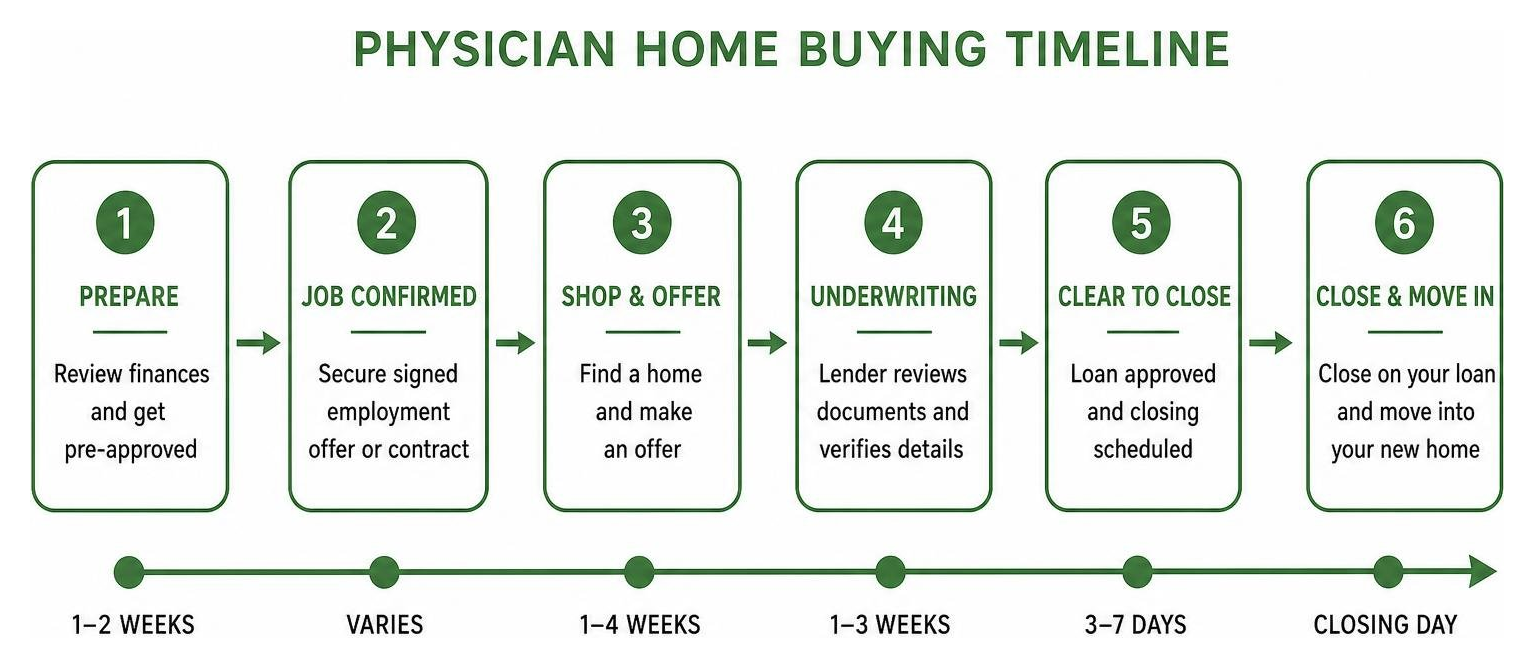
- The 150-Day Future Contract Rule: Allows medical residents and fellows to close on a primary residence up to 90 to 150 days before their official job start date using an executed offer letter.
- Flexible Gift Funds: Allows 100% of closing costs and down payments, if any, to come from family gifts or grants without borrower contribution requirements.
- Primary Residence Focus: Designed explicitly for primary homes, protecting the program’s low default risk profile.
Do Doctors Get Better Mortgage Rates Than Standard Borrowers?
When comparing specialized doctor loans directly to standard healthcare professional programs, physicians often receive distinct pricing advantages. Because an attending doctor’s salary typically starts well above $200,000, lenders may tier their rate sheets by credential, income stability, and expected career path.
Specialized medical programs may offer rate reductions ranging from 0.25% to 0.75% below broader national averages for borrowers who combine high credit scores with signed employment agreements. While a registered nurse or allied health professional might secure an excellent loan with a 5% deposit, a fully licensed physician (MD or DO) can unlock zero-down structures at highly competitive interest rates. If you are exploring zero-down frameworks, consult this Zero down mortgage guide for medical professionals.
Credit Score and Debt-To-Income Thresholds
While doctor loans offer generous terms, underwriters do not hand them out blindly. Lenders maintain firm credit and debt guidelines to protect their portfolio risk:
- Credit Score Minimums:
- 680 FICO: Unlocks 100% financing up to $1,500,000 with select lenders.
- 700 FICO: Standard baseline for most national physician mortgage programs.
- 720+ FICO: Unlocks maximum loan limits up to $2,000,000 with 0% down, along with the sharpest interest rate tiers.
- Debt-To-Income (DTI) Caps:
- Standard conventional loans enforce strict DTI caps between 36% and 45%.
- Physician mortgages allow DTIs up to 50% and occasionally higher for high-earning attendings, depending on the lender.
- Student Debt Treatment:
- Standard Fannie Mae rules may assess non-deferred student loans using a percentage of the total loan balance or the documented required payment. For a doctor with $300,000 in medical school debt, this can create a large assumed monthly obligation.
- Doctor loan underwriters often look at your actual Income-Driven Repayment (IBR/PAYE) statement, which might be low during residency, or may exclude deferred loans if qualifying on future attending income.
Qualifying Medical Degrees
While initially created strictly for MDs and DOs, many lenders now extend physician loan programs to:
- Doctor of Medicine (MD)
- Doctor of Osteopathic Medicine (DO)
- Doctor of Dental Surgery (DDS) & Doctor of Medicine in Dentistry (DMD)
- Doctor of Veterinary Medicine (DVM)
- Doctor of Podiatric Medicine (DPM)
- Doctor of Pharmacy (PharmD)
- Certified Registered Nurse Anesthetist (CRNA / DNAP)

Risks, Alternatives, and Refinancing Strategies
Despite their undeniable perks, physician mortgage loans are not risk-free financial tools. The combination of zero down payment and high loan limits creates an overleveraging hazard.
This is why doctors should not rely only on an automated approval screen, a rate quote, or a lender’s marketing language. In a data-driven mortgage market, the same borrower can receive very different outcomes depending on the pricing model, ARM structure, credit overlays, closing costs, and how the lender treats student debt. Comparing the total cost of each option is more important than focusing on a single headline rate.
The primary risk stems from interest rate structures. Many 100% financing doctor loans are structured as Adjustable-Rate Mortgages (ARMs), such as 5/6, 7/6, or 10/6 ARMs. An ARM offers a fixed, lower interest rate for the first 5, 7, or 10 years, after which the rate adjusts periodically based on prevailing market benchmarks.
If local real estate values decline by 5% to 10% after you buy with 0% down, you may suddenly owe more than the home is worth, creating an “underwater” mortgage. If your ARM fixed period ends while you are underwater, refinancing into a fixed-rate loan can become difficult without bringing substantial cash to the closing table.
When Do Doctors Get Better Mortgage Rates with Conventional or VA Loans?
A physician loan is not always the best product on the market. Depending on your liquid assets and military background, alternative loan types can easily beat a doctor mortgage:
- Conventional Mortgages with 20% Down: If you have saved enough cash to put 20% down, a standard conventional loan will often offer a lower fixed interest rate than a 0% down physician loan, while avoiding PMI entirely.
- VA Loans: For military physicians or veterans, a VA loan can be extremely competitive. VA loans offer 0% down, no monthly PMI, and interest rates that are typically 0.25% to 0.50% lower than both conventional and physician mortgages.
- FHA Loans: While FHA loans allow down payments as low as 3.5% with a 580 credit score, they require mortgage insurance premiums (MIP), which can make them less attractive for doctors with high future incomes.
- 80/10/10 Piggyback Loans: A strategy where you take a primary mortgage for 80% of the price, a second loan (HELOC) for 10%, and put 10% down. This avoids PMI while locking in standard conforming rates on the primary loan.
Refinancing and Recasting Doctor Loans
Many physicians utilize a doctor loan as a temporary stepping stone. A resident might acquire a home with 0% down using a 7-year ARM during training. Once they graduate to an attending role, their income may increase substantially, enabling them to build equity or pivot financial strategies.
Two popular exit strategies include:
- Rate-and-Term Refinance: Swapping an adjustable doctor loan for a standard 30-year fixed conventional mortgage once your home’s equity reaches 20%. This can reduce interest rate uncertainty.
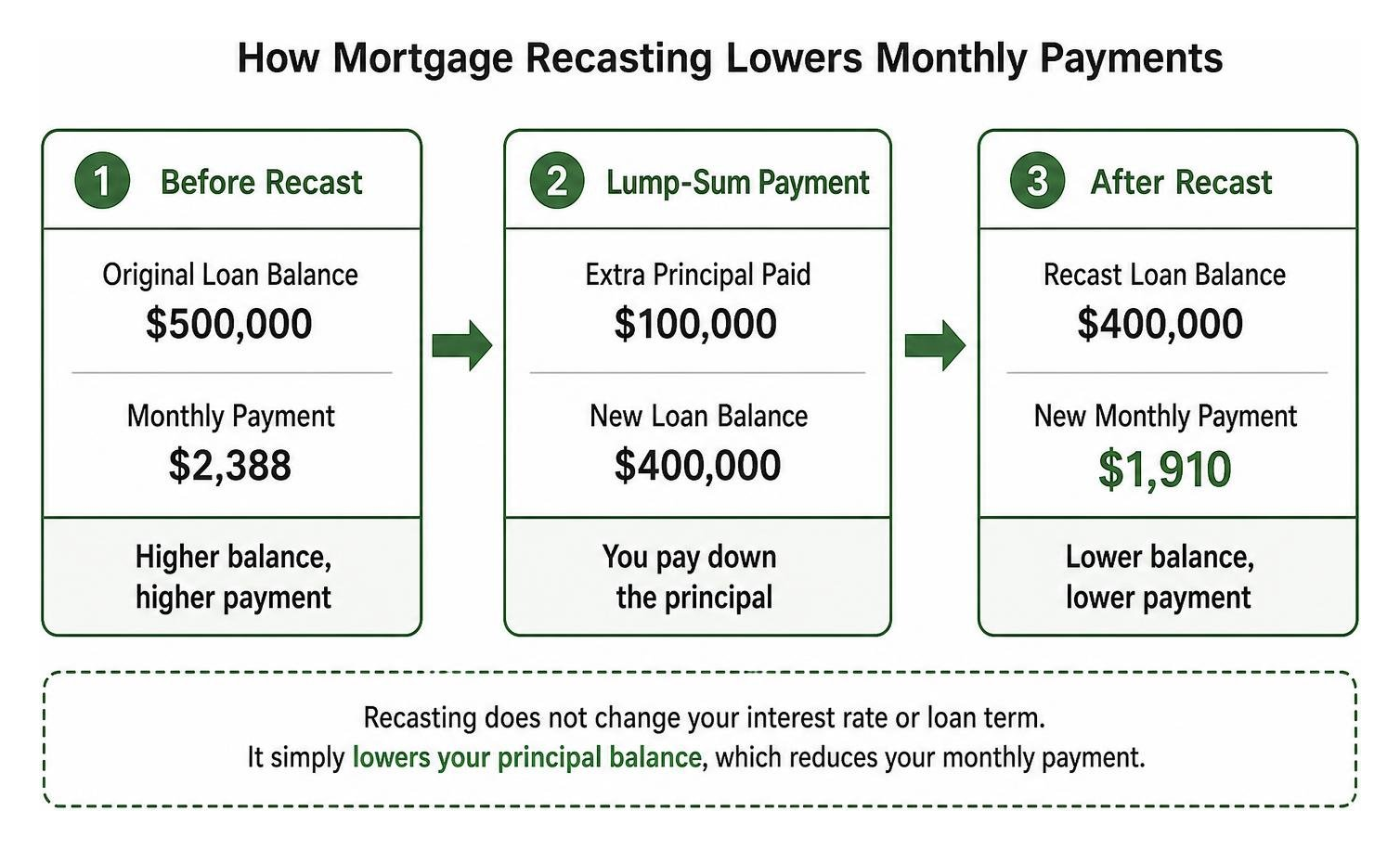
- Mortgage Recasting: If you receive an attending signing bonus or sell a previous property, you can make a large lump-sum principal payment, such as $50,000 or $100,000, to your existing lender. For a small administrative fee, often $250 to $500, the lender will recalculate (“recast”) your monthly payment based on the new, lower principal balance without requiring a full refinance or new closing costs.
Frequently Asked Questions
Can medical residents buy a home before starting their job?
Yes. One of the greatest features of a physician mortgage is the ability to close on a home 90 to 150 days before your official job start date. Lenders accept a fully signed employment contract or residency appointment letter specifying your starting salary in place of traditional paystubs or two years of tax returns.
How is student debt calculated for a doctor mortgage?
Unlike conventional loans that automatically assume a monthly debt payment equal to 1% of your total student loan balance, doctor loan underwriters use your actual Income-Driven Repayment (IBR/PAYE/SAVE) statement. If you are in residency and your required monthly payment is $0 or $150, underwriters use that lower figure to calculate your Debt-to-Income ratio. If your loans are in deferment or forbearance, many doctor loan programs exclude them entirely.
Can you use a physician loan for an investment property?
Generally, no. Physician mortgage loans are strictly intended for primary residences. Lenders offer these exceptional terms because owner-occupied primary homes carry the lowest default rates. You cannot use a 0% down physician loan to purchase a pure rental property or vacation home. However, some lenders permit purchasing a multi-family property (such as a duplex or triplex) provided you live in one of the units as your primary residence.
Conclusion
So, do doctors get better mortgage rates? While they do not automatically receive a lower interest rate baseline purely because of their medical license, doctors access a level of borrowing power that many other professions do not. Through specialized doctor loans, medical professionals can purchase homes with zero down payment, skip costly private mortgage insurance, and bypass some student debt barriers.”https://www.mediafire.com/file/m1bobw6u7zs1db6/Fur_Craft_3.0_BY_MCMPDL.mcaddon/file“;
For Aixoria readers, the bigger lesson is that mortgage pricing is increasingly shaped by data, automation, underwriting models, and fintech-enabled risk segmentation. A physician loan is not just a special perk for doctors. It is an example of how lenders use borrower-specific data to customize financing terms.
However, smart financial management requires looking past shiny zero-down promises. We always advise shopping across multiple lenders, comparing physician ARMs against conventional fixed loans, and ensuring your long-term housing costs remain comfortable relative to your gross income. Building wealth is about balance sheet efficiency, not just leverage.
To stay informed on modern financial strategies, mortgage developments, AI-powered financial tools, and tech-driven trends shaping real estate, explore our latest insights at AI Updates and Industry Trends.