Why the Right Social Media Campaign Management Software Changes Everything
Scr0ll d0wn to D0VVNL0AD
Choosing the best social media campaign management software is one of the most impactful decisions a small business or marketing team can make in 2026. With dozens of platforms competing for your attention — and your budget — it’s easy to feel overwhelmed before you even post a single update.
Here’s a quick answer if you’re short on time:
| Tool | Best For | Starting Price |
|---|---|---|
| Hootsuite | Enterprise brands & large teams | ~$199/month |
| Cloud Campaign | Agencies & white-label needs | Free trial available |
| Zoho Social | Small businesses & remote teams | ~$15/month |
| Sprout Social | Mid-to-large teams with deep analytics | ~$199/month |
| SmarterQueue | Agencies & freelancers | Free trial available |
| Planable | Team collaboration & approvals | Free plan available |
| Buffer | Creators & small businesses | Free / $6/month per channel |
These tools go far beyond simply scheduling posts. The best ones handle campaign planning, team approvals, AI-assisted content creation, analytics reporting, and multi-platform publishing — all from a single dashboard.
Social media is still one of the most powerful ways to reach customers and grow a brand. But managing it manually across five or six platforms, while also responding to comments, tracking performance, and proving ROI to stakeholders? That’s a full-time job — often more than one.
The right software turns that chaos into a clean, repeatable workflow.
This guide breaks down exactly what to look for, which platforms stand out in 2026, and how to match the right tool to your team’s actual needs.
What is the Best Social Media Campaign Management Software?
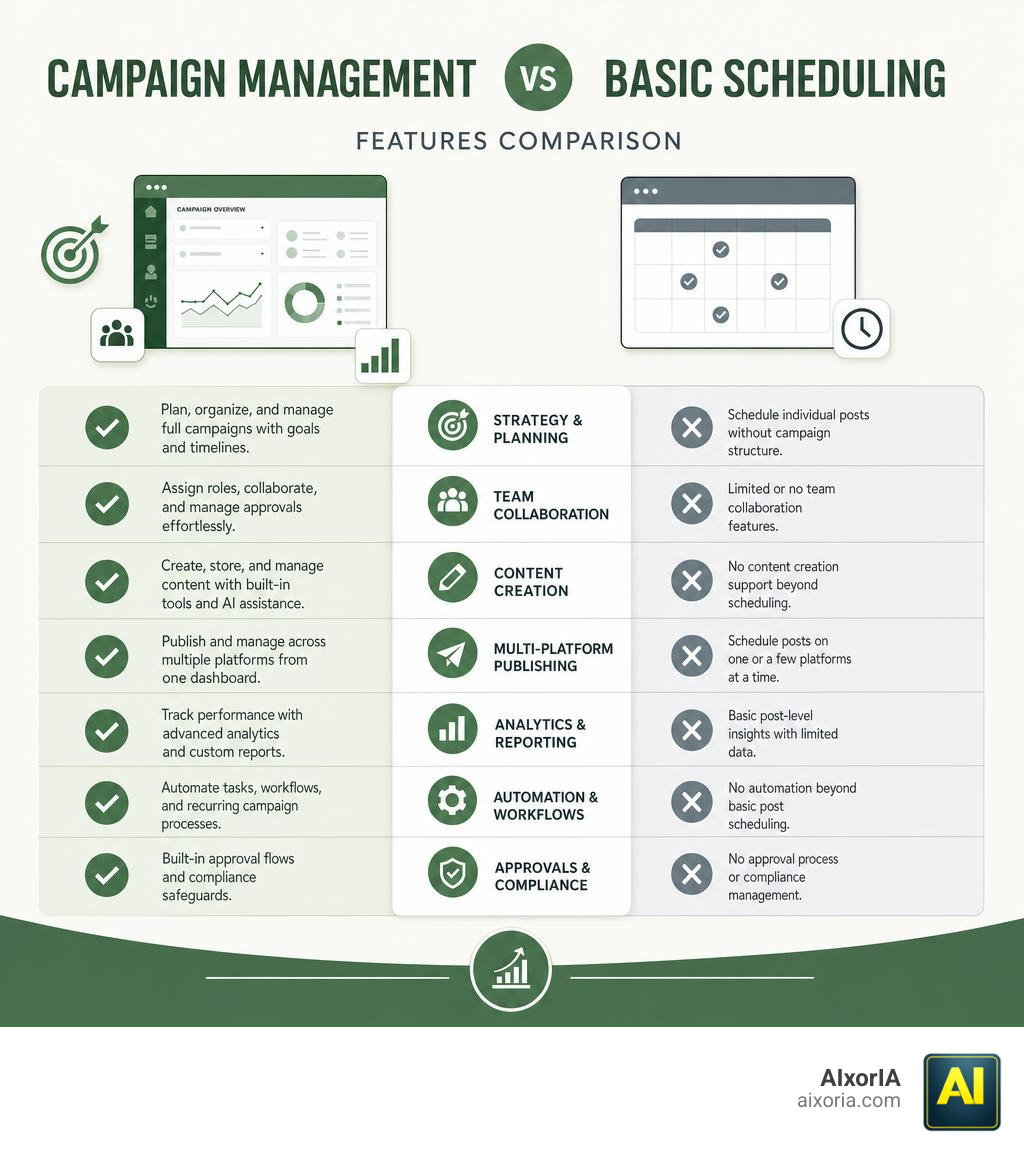
When we talk about the best social media campaign management software, we are looking at platforms designed to orchestrate entire multi-channel marketing campaigns. While basic scheduling tools merely push posts live at a set time, campaign management software acts as a centralized command center. It aligns your overall campaign strategy, automates repetitive workflows, and helps you navigate platform-specific API limitations and compliance guidelines without breaking a sweat.
Choosing the wrong tool can lead to disjointed campaigns and burnt-out teams. To see how these tools stack up against the broader landscape of modern marketing platforms, you can check out our analysis of the 9 Best Social Media Campaign Management Software In 2026.
Core Features of the Best Social Media Campaign Management Software
To move the needle on your marketing goals, a top-tier platform must offer more than just a calendar grid. The absolute must-have features include:
- A Unified Inbox: Managing comments, direct messages, and brand mentions across five different platforms is a recipe for headache. A unified inbox consolidates these conversations, allowing your team to respond to everything in one place.
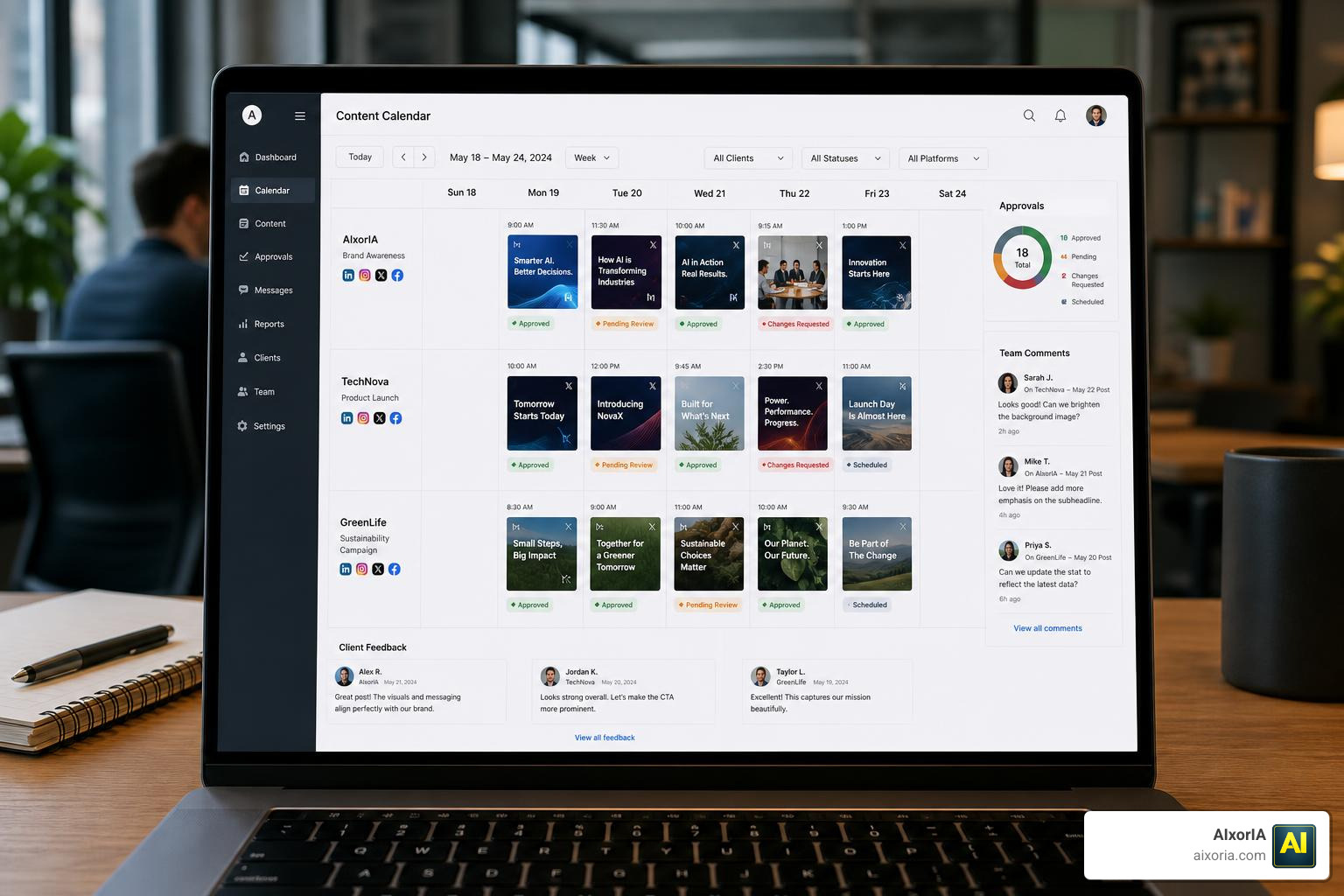
- A Visual Content Calendar: A drag-and-drop interactive calendar lets you organize your publishing pipeline, see the big picture at a glance, and space out content pillars effortlessly.
- Social Listening and Sentiment Analysis: Real-time monitoring tools track brand mentions, industry keywords, and competitor activity. Sentiment analysis automatically flags whether conversations are positive, neutral, or negative.
- Centralized Asset Libraries & Brand Templates: Storing approved graphics, logos, and videos in a shared library ensures that your team always publishes on-brand content.
For teams looking for a highly integrated experience that combines these features seamlessly, the All in One Social Media Management Tool | Zoho Social serves as an excellent example of a unified command center. It is currently trusted by over 250,000 businesses across 180 countries to keep their social presence active and organized.
How AI is Transforming the Best Social Media Campaign Management Software
By May 2026, artificial intelligence is no longer a futuristic luxury; it is the engine driving modern social media tools. Modern platforms leverage AI production layers to drastically cut down manual effort — often by over 50%.
AI assistants like Zoho’s Zia or Cloud Campaign’s AI engine help teams with:
- Caption Generation and Tone Matching: Instantly drafting platform-optimized captions, rewriting hooks, and matching specific brand voices.
- Content Repurposing: Turning a single long-form blog post, webinar, or video into a dozen social-ready snippets, threads, and short-form video scripts.
- Trend Detection: Scanning millions of online conversations to spot emerging trends before your competitors do.
- Smart Community Management: Sorting incoming messages by urgency and drafting suggested replies based on historical brand interactions.
To explore how these automated workflows operate in action, take a look at the AI Manager for Social Media – Automate Your Content & Engagement | Cloud Campaign . Additionally, if you are looking to maximize the visual impact of your campaigns, combining these schedulers with specialized creative tools can make a massive difference. Read our guide on the Best Ai Tools For Identifying Top Performing Ad Creatives In 2026 to see how AI can optimize your visual assets.
Key Capabilities for Agencies, Brands, and Enterprises
Different organizations have vastly different social media needs. A freelance social media manager needs quick scheduling and simple reporting, while a global enterprise requires strict permission controls, compliance tracking, and deep CRM integrations.
For agencies and freelancers managing multiple clients, tools like the Social Media Scheduler for Agencies & Freelancers | SmarterQueue are designed to prevent you from “drowning” in client accounts. SmarterQueue has helped publish over 44 million posts and generate 286 million clicks for more than 13,000 brands. Its “Power Scheduling” and evergreen content recycling features allow agencies to keep client queues full with minimal manual intervention.
Meanwhile, if your primary roadblock is the endless back-and-forth email chains for client sign-offs, Planable: Social media management built for agencies & brands offers a visual, highly collaborative workspace. It replaces clunky spreadsheets with an interactive calendar and feed view where clients can leave comments, suggest edits, and approve posts with a single click.
Agency-First Features and Client Collaboration
If you run an agency, your software is your product packaging. The client experience needs to be seamless, professional, and fully branded. This is where white-labeling and multi-tenant dashboards become critical.
Top agency platforms allow you to:
- White-Label the Dashboard: Replace the software provider’s logo and colors with your own agency’s branding, giving clients a completely custom portal to log into.
- Simplify Onboarding: Use tools that integrate with Zapier to automate client invitations and account connections.
- Establish Role-Based Permissions: Ensure clients can view and approve content without accidentally deleting scheduled queues or changing platform settings.
Platforms like RIUVI – All-in-One Social Media Management Platform excel here by offering a simple, visual workflow that clients and team members can understand in under a minute, complete with dedicated workspaces to keep different brands strictly separated. Agency users of automated scheduling and approval portals report saving up to 30% of their time on scheduling and see a 40% boost in client satisfaction.
Enterprise-Grade Security and Integrations
For large brands and enterprise organizations, social media management is a team sport that touches customer service, sales, and public relations. Enterprise-grade campaign software must integrate directly with your wider tech stack, including CRMs (like Salesforce or HubSpot), creative suites (like Canva), and advertising networks.
Furthermore, security is paramount. Large organizations need single sign-on (SSO), audit logs, and predictive crisis monitoring to safeguard their brand reputation. When scaling customer touchpoints across enterprise departments, integrating these social channels with your broader customer engagement strategies is vital. For more on this, check out our review of the 9 Best Customer Engagement Software In 2026.
Measuring Campaign ROI and Reporting Metrics
At the end of the day, the best campaigns are the ones that deliver measurable business results. To prove the value of your social media efforts to stakeholders, you need to look beyond vanity metrics (like likes and follows) and track actionable conversion data.
| Metric Type | Key Performance Indicators (KPIs) | Why It Matters |
|---|---|---|
| Organic Performance | Engagement rate, share of voice, reach, follower growth | Measures brand awareness, community health, and organic reach. |
| Paid Social Performance | Click-through rate (CTR), cost per click (CPC), return on ad spend (ROAS) | Tracks direct financial efficiency and advertising performance. |
| Business Impact | Conversion rate, referral traffic, customer acquisition cost (CAC) | Proves the direct line from social media activity to revenue. |
Using an integrated platform like the All-In-One Social Media Management Software | Adhook allows brands to track both organic posts and paid social ads in one place. This unified view helps marketing teams cut manual reporting times by up to 50% while getting a clear, holistic picture of campaign performance.
Real-world data proves the power of consolidated campaign management. For instance, the Barceló Hotel Group grew their followers by 46% by centralizing their strategy on a unified platform. Similarly, Mapfre consolidated their account management to a single system and boosted online interactions by 31%, while healthcare brand DaVita saved an equivalent of $1.5 million in advertising value by leveraging automated employee advocacy tools.
Frequently Asked Questions about Social Campaign Software
How does campaign management software differ from basic scheduling tools?
Basic scheduling tools are designed for a “set-it-and-forget-it” posting process. They allow you to queue up text and images to go live at a specific time. In contrast, campaign management software handles the entire lifecycle of a marketing campaign. This includes cross-platform strategy alignment, collaborative approval workflows for teams and clients, real-time social listening, unified customer service inboxes, paid ad tracking, and in-depth ROI reporting.
What are the typical pricing models for enterprise-grade social software?
Social media software pricing generally scales based on three main factors:
- Per-User Pricing: Platforms like Hootsuite and Sprout Social charge per user seat (often starting around $199/month per user), which can scale quickly for larger teams.
- Per-Channel Pricing: Tools like Buffer charge a flat fee per connected social channel (e.g., $6/month per channel), making it highly affordable for small businesses with small footprints.
- Custom Enterprise Contracts: Large brands typically negotiate custom annual contracts that include unlimited workspaces, advanced security features, custom integrations, and dedicated account support.
How do platforms handle API restrictions on networks like X and TikTok?
Social media management tools are bound by the official APIs (Application Programming Interfaces) provided by networks like Meta, TikTok, and X (Twitter). When these networks restrict their APIs—such as making developer access more expensive or limiting certain types of automated interactions—software providers must adapt. High-quality platforms maintain strict compliance with these API rules to keep your accounts safe from shadowbans or suspension, even if it means some advanced features (like automated personal profile posting on certain networks) require manual mobile notifications.
Conclusion
Finding the best social media campaign management software in 2026 isn’t about finding the tool with the most features; it’s about finding the one that fits your team’s specific workflow. Whether you are an agency looking to scale client approvals, an enterprise brand protecting its online reputation, or a growing business trying to turn social engagement into revenue, the right tool will save you hours of manual work and give you the clear data you need to grow.
At AIxorIA, we understand that adopting new technology can come with a steep learning curve. We provide custom AI solutions, tool training workshops, hands-on tutorials, and performance audits to help your business implement these advanced systems without the stress.
Ready to make your marketing smarter? Explore our comprehensive guide on AI Tools for Business in 2026 to learn how autonomous agents and smart automation can maximize your ROI today.