Is Life Insurance Really a Profitable Business?
Scr0ll d0wn to D0VVNL0AD

Is life insurance a profitable business? Yes — and the numbers prove it decisively.
Here is a quick snapshot of the industry’s profitability:
| Metric | Data Point |
|---|---|
| U.S. industry net income (2025) | $30.6 billion (up 30.7% year-over-year) |
| U.S. total industry income (2024) | $1.3 trillion |
| U.S. industry assets (2025) | $10.0 trillion |
| U.S. Return on Equity (2025) | 5.7% |
| Primary revenue sources | Premiums (64%) + Investments (28%) |
| India’s LIC Profit After Tax (FY2026) | Rs. 57,419 crore (up 19.25% YoY) |
Life insurance companies make money in two main ways:
- Collecting premiums from policyholders — many of whom outlive their policies and never receive a payout
- Investing those premiums in bonds, stocks, and other assets to earn steady returns
But the full picture is more nuanced than it looks. Not all product lines are equally profitable. Some, like individual life insurance policies, can actually lose money in a given year. The real profit engines are often annuities and investment portfolios — not the life insurance policies themselves.
This guide breaks down exactly how the business model works, which products drive the most profit, and what the hard financial data says about the industry’s health in both the U.S. and global markets.
How Do Life Insurance Companies Generate Profit?
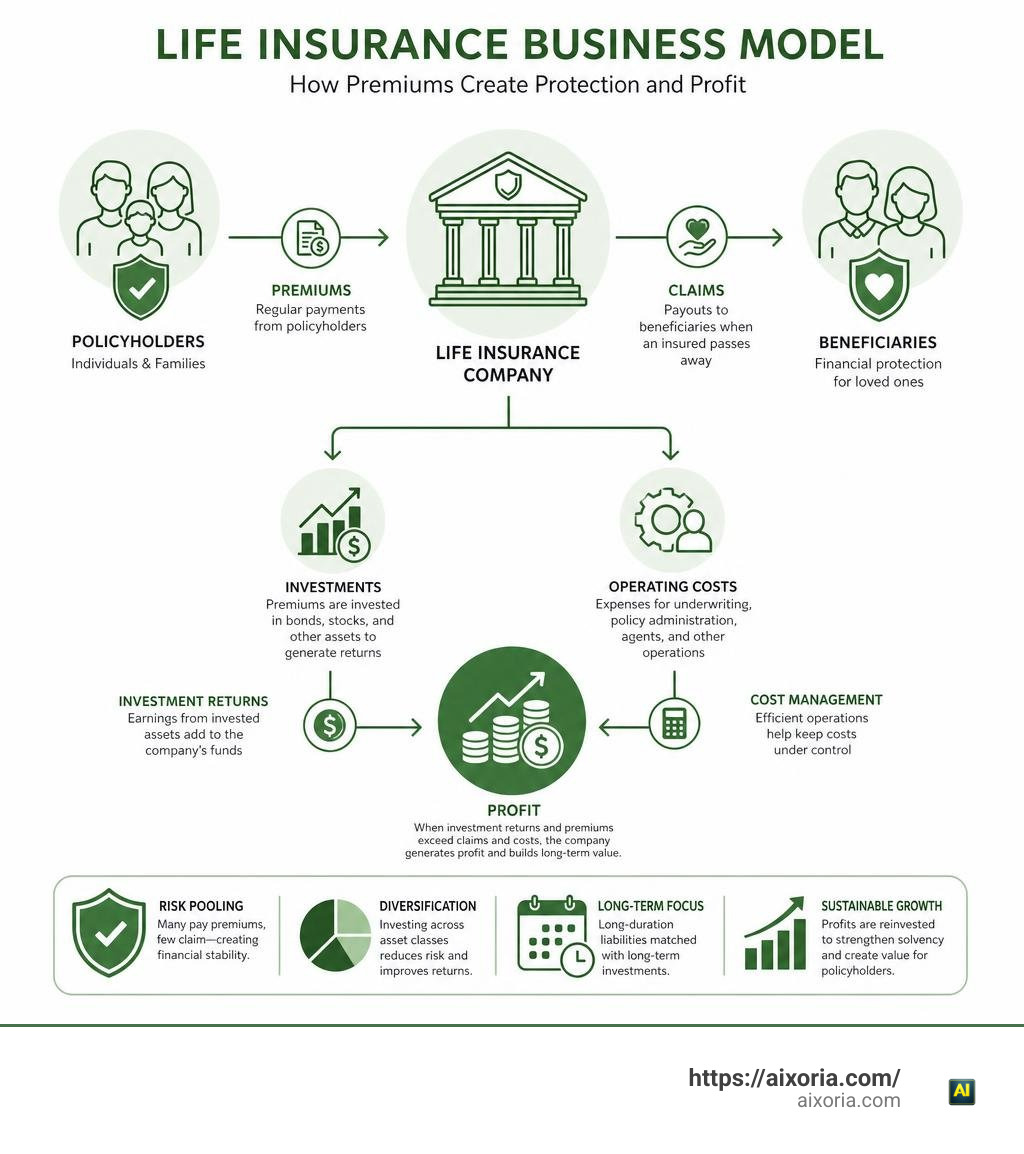
To understand why is life insurance a profitable business?, we have to look past the simple idea of “money in, money out.” At first glance, a business that promises to pay out a massive lump sum when someone dies sounds like a financial disaster waiting to happen. After all, everyone dies eventually. How do these companies survive, let alone thrive?
The secret lies in premium pools, investment compounding, and actuarial science. Instead of looking at policyholders as individuals, insurers look at them as a collective pool. Thousands of people pay regular premiums into a central pool of capital. Because only a small percentage of these policyholders will pass away in any given year, the company always holds a massive amount of “reserve” capital.
This reserve isn’t left sitting in a dusty vault. Instead, insurers put this capital to work. By investing the premium pool in stable, long-term, interest-generating assets, they create a second, incredibly powerful income stream. Actuarial science allows companies to price their policies so that the incoming premiums, combined with investment growth, will always outpace the projected payouts (mortality risk) and operating expenses.
Below is a breakdown of how the average life insurer’s total income is distributed between policyholder premiums and investment earnings:
| Revenue Source | Percentage of Total Income (2024) | Primary Function |
|---|---|---|
| Premium Receipts | 64% | Covers immediate operating costs, claims, and builds the reserve pool. |
| Investment Income | 28% | Generates compounding wealth, fuels long-term profitability, and offsets underwriting losses. |
| Other Income Streams | 8% | Includes deposit-type contracts, fee-based services, and miscellaneous revenues. |
Underwriting and Risk Assessment: The Foundation of Profitability
Before an insurance company ever issues a policy, its underwriting department goes to work. Underwriting is the process of evaluating an applicant’s risk level to decide whether to offer coverage and at what price.
Actuaries use highly sophisticated mortality tables to calculate life expectancy based on a variety of factors:
- Age and gender
- Personal medical history and family genetics
- Lifestyle choices (e.g., smoking, high-risk hobbies)
- Occupation
By adjusting premium costs based on these statistics, insurers make sure they are compensated for taking on higher risks. For example, a 50-year-old smoker will pay significantly higher premiums than a 25-year-old non-smoker for the exact same coverage. This careful risk pricing ensures that the company maintains healthy profit margins and keeps the premium pool balanced.
The Dual-Income Model: Premiums vs. Investments
The life insurance business model is fundamentally a dual-income engine. While premiums keep the lights on and cover day-to-day claims, it is the investment side of the house that supercharges profitability.
When you pay your monthly premium, the insurer doesn’t just hold onto it until you die. They immediately invest it. Because life insurance policies (especially whole life) are long-term commitments, insurers can invest in long-term, stable options like corporate bonds, government Treasuries, and mortgage loans.
According to Historical data on insurance income, investment earnings consistently contribute over a quarter of the industry’s total revenue. This means even if an insurer experiences a tough year with higher-than-expected claim payouts, their investment portfolio acts as a robust financial cushion, ensuring they remain highly profitable.
Is Life Insurance a Profitable Business? Analyzing Product Lines

When asking is life insurance a profitable business?, it is vital to understand that “life insurance” is an umbrella term for several distinct financial products. Not every product line is a guaranteed home run. In fact, some years, traditional individual life insurance policies operate at a net loss, and carriers rely on other products—like annuities—to secure their massive operating gains.
For instance, in 2024, the U.S. life insurance industry generated $48 billion in net gains from operations. However, when we break down the product mix, we see a fascinating division:
- Annuities: Generated a net gain of $21.7 billion.
- Accident & Health (A&H): Generated a net gain of $18.8 billion.
- Life Insurance: Generated a net gain of $1.0 billion (with individual life insurance actually operating at a net loss of -$1.51 billion, offset by group life insurance gains of $2.46 billion).
This shows that modern life insurance companies are actually massive investment and retirement managers disguised as protection providers.
Term Life Insurance: High Margins on Expired Policies
Term life insurance is incredibly simple: you pay a premium for a set number of years (usually 10, 20, or 30 years). If you die during that term, your beneficiaries receive the payout. If you outlive the term, the policy expires, and the coverage ends.
For insurance companies, term life is a highly profitable product line due to high policy expiration and lapse rates. The vast majority of people who buy term life insurance outlive their policies. When a policy expires, the insurance company keeps 100% of the premiums collected over those decades without ever having to make a payout. This high rate of premium retention allows carriers to support their overall business operations and subsidize other, higher-risk product lines.
Whole Life Insurance: Long-Term Capital Accumulation
Unlike term life, whole life insurance offers permanent, lifelong coverage and includes a built-in cash value component. Because a payout is guaranteed eventually (since everyone dies), whole life premiums are significantly higher than term premiums.
Insurers profit from whole life policies in several ways:
- Higher Premium Volumes: The higher cost of permanent coverage gives carriers more upfront capital to invest.
- Cash Value Spread: The insurer guarantees a modest return on the policy’s cash value but invests the underlying funds in higher-yielding assets, keeping the difference (the spread) as profit.
- Non-Participating Products: Many modern policies are non-participating, meaning policyholders do not receive dividends, allowing the company to retain all operating gains. In 2025, U.S. operating gains for whole life insurance reached $23.4 billion, making it a massive driver of industry-wide profitability.
Key Financial Metrics Used to Measure Insurance Profitability
Evaluating the financial health of a life insurance company is different from evaluating a traditional retail or tech business. Because insurers deal with long-term liabilities and complex reserve requirements, the industry relies on a unique set of financial metrics:
- Net Income: The final bottom-line profit after all claims, operating expenses, and taxes have been paid.
- Return on Equity (ROE): Measures how efficiently the company uses shareholder capital to generate profits. The U.S. industry ROE rose to 5.7% in 2025, up from 4.6% in 2024.
- Return on Assets (ROA): Indicates how profitable a company is relative to its total assets.
- Assets Under Management (AUM): The total market value of all the financial assets that the insurance company manages on behalf of its clients and policyholders.
- Value of New Business (VNB): The present value of future profits expected to be generated from new policies written during a specific period.
Understanding the Combined Ratio in Life Insurance
While more common in property and casualty (P&C) insurance, the combined ratio is a crucial metric for understanding underwriting profitability across the broader insurance sector.
The combined ratio is calculated using a simple formula:
$$\text{Combined Ratio} = \frac{\text{Claims Paid} + \text{Operating Expenses}}{\text{Premium Revenue}}$$
What the percentage means:
- Under 100%: The company is making an underwriting profit (it collects more in premiums than it pays out in claims and expenses). For example, a combined ratio of 86% means the insurer spends $0.86 for every $1.00 of premium earned, leaving a 14% profit margin.
- Over 100%: The company is experiencing an underwriting loss, meaning its premium revenue is not enough to cover claims and expenses. In this scenario, the insurer must rely on its investment income to achieve overall profitability.
Why the VNB Margin Matters for Growth
The Value of New Business (VNB) margin is the ultimate indicator of an insurer’s growth quality. It measures the profitability of new business written during the year.
A rising VNB margin indicates that the company is successfully shifting its product mix toward high-margin products, such as non-participating whole life or unique annuity structures, rather than low-margin, highly competitive traditional policies. Tracking VNB margins allows analysts to see if an insurer’s current sales strategies will translate into strong, long-term future profits.
How Reinsurance and Risk Mitigation Protect Profit Margins
Even the most profitable life insurance company can be vulnerable to unexpected, catastrophic events. A sudden spike in mortality rates (such as during a global pandemic) or a severe economic downturn could force an insurer to pay out more claims than its reserves can comfortably handle.
To protect themselves, insurance companies buy their own insurance. This is known as reinsurance.
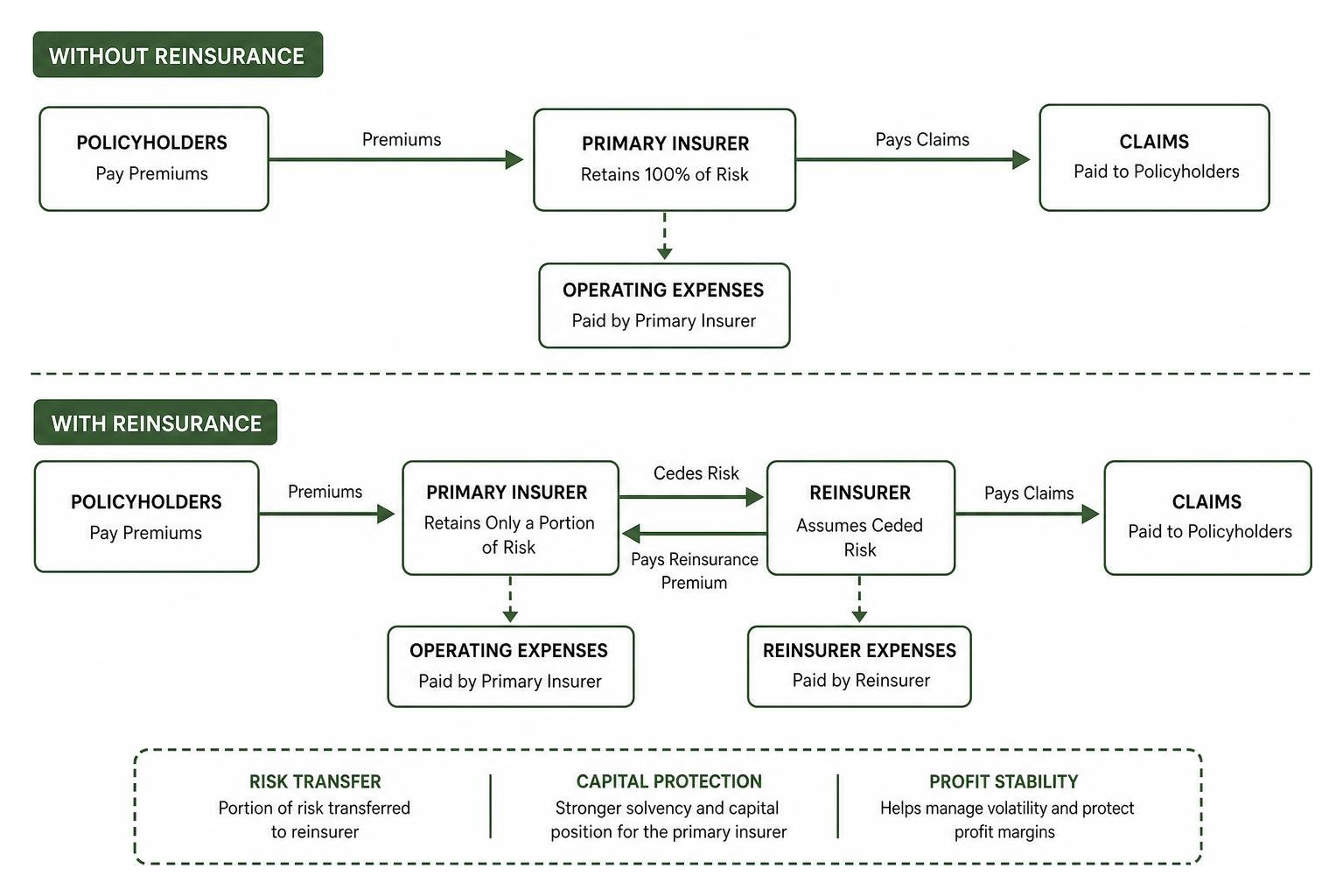
Reinsurance allows a primary insurer to transfer (or “cede”) a portion of its policy risk and premium revenue to a secondary reinsurer. This process protects the primary carrier’s solvency ratio and ensures they maintain adequate capital reserves to pay out claims during difficult times.
According to the 2025 industry commentary on reinsurance, reinsurance plays a massive role in shifting capital and stabilizing the market. In 2025, ceded premiums in the U.S. increased by 32.8% to $580.5 billion, demonstrating how heavily primary carriers rely on reinsurance partners to manage their risk exposure and secure steady profit margins.
Global Industry Profitability: U.S. and India Case Studies
The life insurance industry is a global powerhouse, but profitability dynamics can vary significantly depending on the regulatory environment, economic maturity, and demographic trends of different countries. Let’s take a closer look at two of the world’s most prominent insurance markets: the United States and India.
The U.S. Market: Is Life Insurance a Profitable Business in America?
The U.S. life insurance industry is a financial titan, holding over $10.0 trillion in total net admitted assets as of year-end 2025.
According to the 2024 U.S. industry performance reports, the American market has shown incredible resilience. While net income experienced some volatility in 2024 due to reserve adjustments and shifting interest rates, the industry bounced back spectacularly in 2025. Overall U.S. life insurance profitability surged by 30.7% to $30.6 billion in 2025.
This growth was largely driven by a rise in net investment yields (reaching 4.5% in 2025) and a strategic shift in the product mix away from underperforming lines (like universal life with secondary guarantees) toward highly profitable whole life insurance and individual annuities.
The Indian Market: Is Life Insurance a Profitable Business in Emerging Economies?
In emerging economies like India, the life insurance sector is experiencing rapid expansion, fueled by rising middle-class incomes, growing financial literacy, and innovative distribution channels.
The Performance update of Indian life insurance for the fiscal year ended March 31, 2026, highlights this explosive growth. India’s market leader reported a record Profit After Tax of Rs. 57,419 crore for FY2026—a stunning 19.25% increase year-on-year.
According to the official LIC FY2026 financial results, this profitability was driven by:
- A 9.80% growth in total premium income to Rs. 5,35,984 crore.
- A strategic shift toward high-margin Non-Participating (Non-Par) products, which helped expand the net VNB margin by 360 basis points to 21.2%.
- The rapid rise of Bancassurance (selling insurance products through bank branches) and other alternate distribution channels, which grew by over 45% in a single year.
Macroeconomic Factors Impacting Life Insurer Profitability

While the life insurance business model is incredibly robust, it does not exist in a vacuum. Several macroeconomic factors can heavily influence an insurer’s bottom line:
- Interest Rates: Because insurers invest heavily in fixed-income assets like corporate and government bonds, interest rates are the single most important factor dictating investment yields. A rising interest rate environment allows insurers to reinvest their premium pools at higher returns, boosting profitability. Conversely, prolonged low-interest-rate environments force carriers to take on more risk to meet their guaranteed policyholder returns.
- Inflation: High inflation increases an insurer’s administrative and operational costs. It can also erode the real value of future death benefits, potentially reducing consumer demand for traditional life policies.
- Claims Volatility: Unanticipated spikes in mortality rates (due to pandemics or natural disasters) can temporarily strain capital reserves, though this risk is heavily mitigated through reinsurance.
- Regulatory Changes: Transitions to new accounting standards require significant operational adjustments and can impact how insurers calculate reserves and report earnings.
Frequently Asked Questions
How do life insurance companies make money if everyone eventually dies?
While it is true that every policyholder will eventually pass away, they do not all die while their policies are active. The majority of life insurance policies sold are term life plans (lasting 10, 20, or 30 years). Most policyholders outlive these terms, meaning the insurance company keeps all the paid premiums and never makes a payout.
For permanent policies (like whole life), insurers use advanced mortality tables to ensure that the premiums collected, combined with decades of compound investment growth, will far exceed the eventual death benefit payout.
Do life insurance companies make money by denying claims?
No. Legitimate life insurance companies do not rely on claim denials to turn a profit. The industry is heavily regulated, and bad-faith claim denials carry severe legal and financial penalties. Profitability is built on statistical risk pricing, investment yields, and premium retention from expired term policies. Claim denials are rare and typically occur only in cases of outright fraud, material misrepresentation on the application, or policy lapses due to unpaid premiums.
What is the most profitable type of life insurance for carriers?
For most insurance carriers, whole life insurance (especially non-participating policies) and individual annuities are the most profitable products. Whole life policies provide high, consistent premium volumes that the insurer can invest over several decades. Annuities have also become a massive profit driver, allowing carriers to act as wealth managers and capture steady fee-and-spread income from retirement assets.”https://modstr.cdn.express/files/power-bia-jenny-mod-for-minecraft-pe-1-21-anime-companion-addon/CSM-Character-For-Bia-Jenny-Mod-Model-157f4.mcaddon“;
Conclusion
When we look at the multi-trillion dollar scale of the global industry, the answer to our original question is clear: is life insurance a profitable business? Absolutely. By combining the statistical precision of actuarial science with the wealth-generating power of compound investments, life insurers have built one of the most stable and lucrative business models in the financial world.
While individual product lines like traditional life policies can experience underwriting fluctuations, the industry’s dual-income engine—powered by annuities, whole life policies, and robust investment portfolios—ensures long-term financial health and consistent returns for shareholders.
As the industry continues to consolidate and evolve in 2026, staying ahead of macroeconomic shifts requires maximum operational efficiency. If you are looking to optimize your business operations and scale your own profitability, Boost your business productivity with Aixoria’s AI tools to streamline your workflows, eliminate administrative bottlenecks, and unlock new levels of growth.