How Much Is a $1,000,000 Life Insurance Policy? (2026 Rates)
Scr0ll d0wn to D0VVNL0AD

How much is a $1,000,000 life insurance policy? For most healthy adults, it costs far less than you might expect.
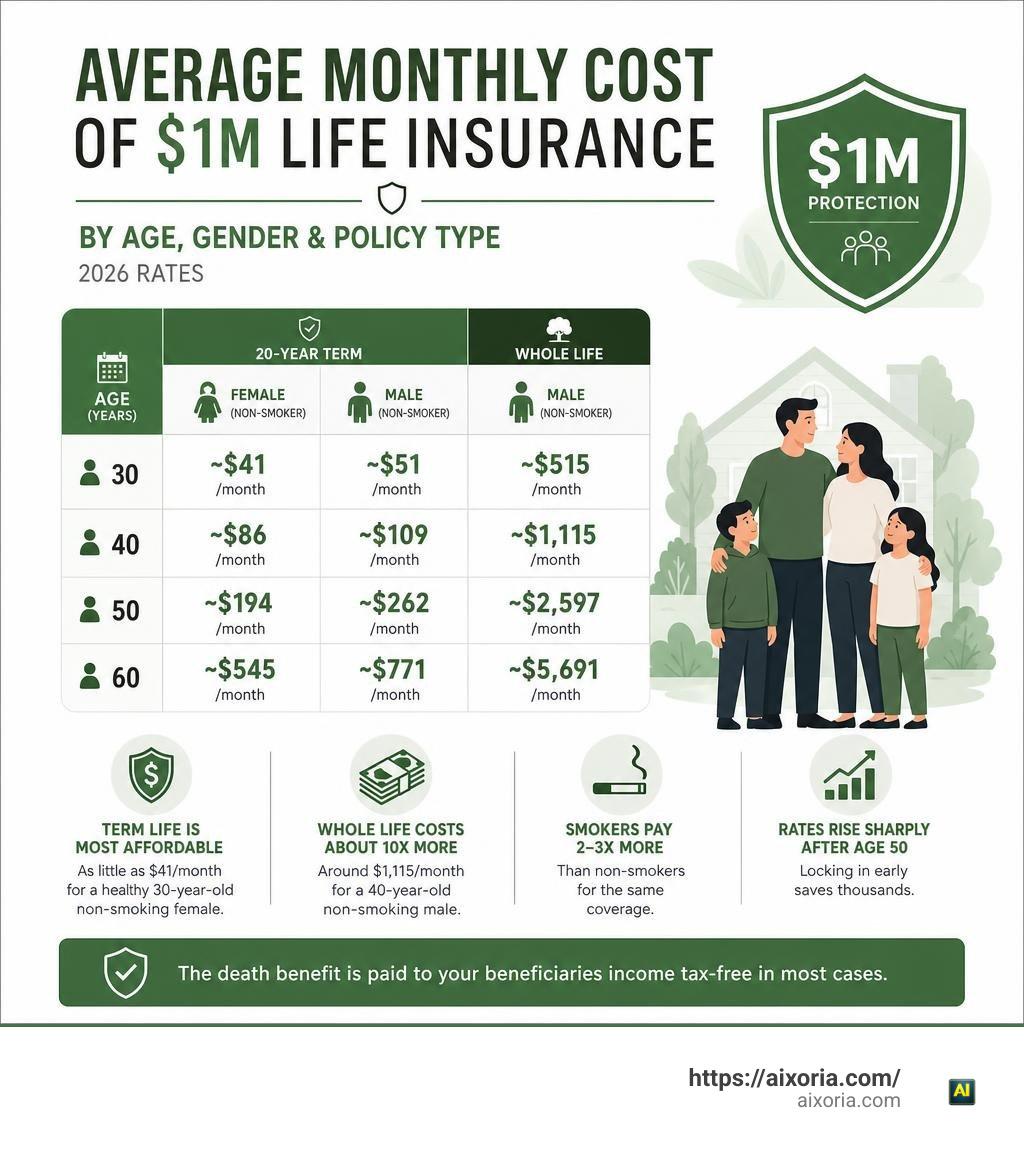
Here are average monthly costs for a $1 million, 20-year term policy in 2026:
| Age | Female (Non-Smoker) | Male (Non-Smoker) |
|---|---|---|
| 30 | ~$41/month | ~$51/month |
| 40 | ~$86/month | ~$109/month |
| 50 | ~$194/month | ~$262/month |
| 60 | ~$545/month | ~$771/month |
A few things to know upfront:
- Term life is the most affordable option – a healthy 30-year-old can pay as little as $41/month.
- Whole life costs roughly 10 times more – around $1,115/month for a 40-year-old man.
- Smokers pay 2-3 times the non-smoker rate for the same coverage.
- Rates rise sharply after age 50. Locking in early saves thousands.
The death benefit is paid to your beneficiaries income tax-free in most cases. The IRS explains that life insurance proceeds paid because of the insured person’s death generally are not taxable income, although interest or certain special situations may be treated differently.
One million dollars sounds like a lot of coverage. But for a family with a mortgage, young children, and one or two incomes to protect – it’s actually a fairly standard starting point.
How much is a $1,000,000 life insurance policy?
When we look at the average cost of a million-dollar policy, the overall price is highly dependent on whether you choose term life or permanent life insurance. For most families, a term life policy provides the perfect balance of robust protection and affordability.
To help you visualize the cost differences, we have compiled the average monthly premiums for both term and permanent (whole life) policies based on age and gender.
| Age | Gender | 20-Year Term Policy Cost (Monthly) | Whole Life Policy Cost (Monthly) |
|---|---|---|---|
| 30 | Female | ~$41 | ~$700 |
| 30 | Male | ~$51 | ~$888 |
| 40 | Female | ~$86 | ~$920 |
| 40 | Male | ~$109 | ~$1,115 |
| 50 | Female | ~$194 | ~$1,283 |
| 50 | Male | ~$262 | ~$1,665 |
As you can see, there is a clear gender gap in life insurance pricing. On average, men pay roughly 30% more for life insurance than women. This pricing difference exists because women have a statistically longer life expectancy and are less likely to engage in high-risk occupations or lifestyles.
How much is a $1,000,000 life insurance policy for different age groups?
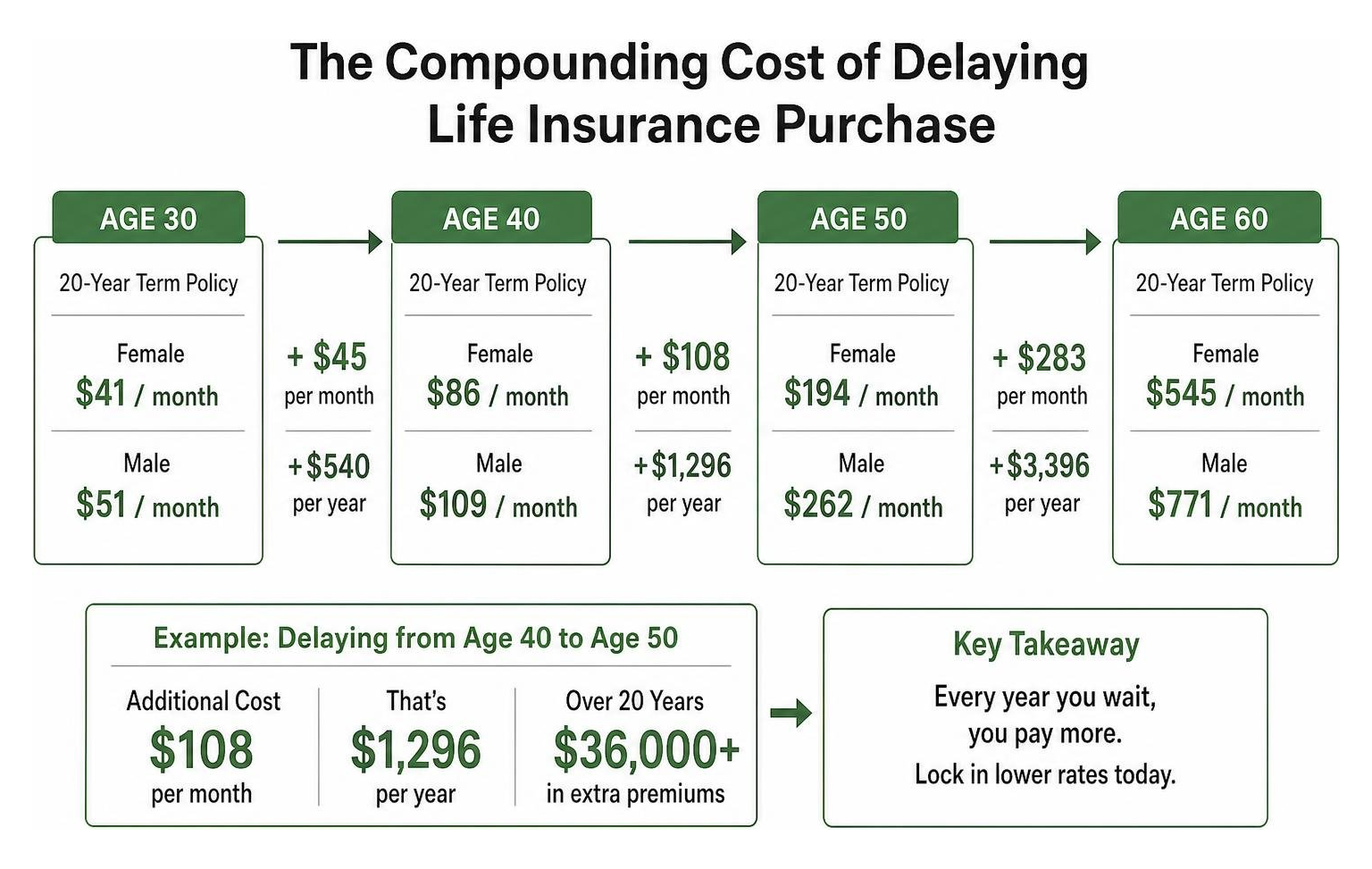
The single greatest driver of life insurance costs is age. Every year we wait to purchase a policy, the premium increases. This rate acceleration starts slowly in our 20s and 30s, begins to pick up speed in our 40s, and jumps dramatically once we hit our 50s and 60s.
Let’s look at how the rates evolve across different decades:
- Age 30: This is the golden window for buying life insurance. A healthy 30-year-old female can secure a 20-year term policy for around $41 per month, while a 30-year-old male pays around $51.
- Age 40: Rates begin to step up. A 40-year-old woman pays an average of $86 per month, and a 40-year-old man pays $109.
- Age 50: This is where the pricing curve steepens significantly. A 50-year-old woman pays around $194 per month, while a 50-year-old man jumps to $262.
- Age 60: For those entering their 60s, the risk profile is much higher. A 60-year-old woman will pay an average of $545 per month, and a 60-year-old man will face premiums around $771.
Delaying your purchase can be an incredibly expensive decision. For example, waiting from age 40 to age 50 to buy a 20-year term policy costs an additional $1,836 per year in premiums. Over the course of the 20-year term, that delay translates to over $36,000 in extra payments for the exact same amount of coverage.
How much is a $1,000,000 life insurance policy for smokers vs. non-smokers?
If you use tobacco or nicotine products, your premiums will see a massive increase. Because smoking is tied to severe long-term health risks, insurers charge smokers two to three times more than non-smokers for the exact same million-dollar policy.
For instance, a healthy 40-year-old male non-smoker pays an average of $109 per month for a 20-year term policy. If that same 40-year-old male is a smoker, his premium skyrockets to an average of $376 per month. That is a difference of $267 per month, which adds up to an extra $64,080 over the 20-year lifespan of the policy!
It is also important to understand how modern insurers handle alternative nicotine products. If you use nicotine pouches (like Zyn), e-cigarettes, or enjoy occasional cigars, some companies will automatically classify you as a smoker and double your rates. However, a few select carriers are more lenient and may offer non-tobacco rates if you only use alternative nicotine products. Working with an expert who knows which carriers to target can save you thousands.
Most life insurance companies require you to be completely nicotine-free for at least 12 to 24 consecutive months before they will reclassify you to non-smoker rates. If you have recently quit, it is highly recommended to lock in a policy now and apply for a rate reduction once you hit that tobacco-free milestone.
Key Factors That Determine the Cost of a Million-Dollar Policy

When you apply for a million-dollar life insurance policy, insurers use a process called underwriting to assess how much risk you pose. This risk assessment determines your final premium.
Understanding these factors can help you prepare for the application process:
- Age and Gender: As discussed, being younger and female generally yields the lowest rates.
- Health Status and Medical History: Insurers look at your height, weight (BMI), blood pressure, cholesterol levels, and family medical history. Common conditions like diabetes or cardiovascular issues can push you into a higher premium tier.
- Tobacco and Nicotine Use: Any form of smoking or regular nicotine consumption will significantly impact your rates.
- Occupation: Some jobs carry a higher risk of accidental death. If you work in construction, law enforcement, military operations, or even municipal garbage collection, underwriters may apply a surcharge to your premium.
- Lifestyle and Hobbies: If you enjoy weekend activities like scuba diving, skydiving, or car racing, you must disclose these. High-risk hobbies can lead to higher rates or specific policy exclusions.
- Term Length: The longer the term, the more risk the insurer assumes. A 30-year term policy will naturally cost more than a 10-year or 20-year term policy because the likelihood of a claim increases as you age.
Term Life vs. Permanent Life Insurance for a $1 Million Death Benefit

One of the most important decisions we must make is choosing between term life and permanent life insurance.
- Term life insurance is pure protection. It covers you for a set period (usually 10, 20, or 30 years). If you pass away during this term, your beneficiaries receive the $1 million tax-free payout. If you outlive the term, the policy simply expires. Because there is no cash value component, term life is incredibly affordable.
- Whole life insurance is a type of permanent coverage that lasts your entire life, as long as premiums are paid. It guarantees a $1 million payout and includes a savings component known as cash value. This cash value grows at a guaranteed rate over time, which you can borrow against. However, this lifelong guarantee and cash value growth make whole life roughly 10 times more expensive than term life.
- Universal life insurance is another permanent option. It is generally cheaper than whole life because its cash value growth is tied to market interest rates or equity indexes rather than fixed, guaranteed returns. This transfers some risk to the policyholder, which lowers the premium but requires careful monitoring to ensure the policy remains adequately funded.
For most people, paying the premium difference for permanent life insurance is difficult to justify unless they have specific long-term needs, such as supporting a dependent with special needs or managing complex estate taxes.
Who Should Consider a $1 Million Life Insurance Policy?
A million dollars sounds like a massive fortune, but when it is tasked with replacing your income for decades, paying off a mortgage, and putting children through college, it can disappear surprisingly fast.
We find that a $1 million policy is often the sweet spot for:
- Young Families: If you have children under 10, a million-dollar policy ensures your partner can cover day-to-day living costs, childcare, and future tuition if you are no longer there to earn an income.
- Homeowners with Mortgages: If you have a remaining mortgage balance of $300,000 to $600,000, a $1 million policy ensures your family can pay off the debt entirely and remain in their home.
- High Earners: If you make $100,000 or more per year, a $1 million policy represents roughly 10 years of your salary. This gives your family a vital financial cushion to maintain their standard of living.
- Business Owners: Partners often use million-dollar policies to fund buy-sell agreements, ensuring the surviving partners can buy out a deceased partner’s share without liquidating the company.
If you want to calculate your exact coverage needs, we recommend using the structured DIME formula:
- Debt: Add up all your outstanding personal debts, credit cards, and car loans.
- Income: Multiply your annual salary by the number of years your family will rely on your financial support (e.g., 10 years).
- Mortgage: Add the exact remaining balance on your home loan.
- Education: Estimate the future cost of college tuition for all of your children (a safe estimate is $100,000 to $150,000 per child).
- Subtract Assets: Subtract any existing savings, liquid investments, or current active life insurance policies from the total of steps 1 through 4.
The remaining number is your ideal coverage amount. For many middle-class households, this formula naturally lands right around the $1 million mark.
Frequently Asked Questions About Million-Dollar Life Insurance
Can I get a $1 million policy without a medical exam?
Yes! Thanks to modern technology and data underwriting, healthy applicants can often qualify for a $1 million policy without a medical exam through accelerated underwriting.
Instead of sending a nurse to your home to collect blood and urine samples, the insurance company uses automated tools to analyze your medical records, prescription history, and driving records in real-time. If you are young and healthy, you can be approved in minutes.
However, if you have pre-existing health conditions or are over the age of 50, a traditional fully underwritten policy with a medical exam will likely still be required to get the best possible rates.
How long does it take to get approved for a $1 million policy?
The approval timeline depends entirely on the type of underwriting:
- Accelerated Underwriting (No Exam): Can take anywhere from a few minutes to a few days.
- Fully Underwritten (Medical Exam Required): Typically takes 4 to 6 weeks. This timeline is mostly spent waiting for the medical exam results and retrieving physical records from your primary care physicians.
What is the difference between a $1 million and a $10 million policy?
The main differences lie in the underwriting complexity and the financial justification required:
- Financial Underwriting: For a $1 million policy, insurers rarely ask for extensive financial proof. For a $10 million policy, you must provide tax returns and proof of net worth. Insurers use strict income multipliers (such as limiting coverage to 20–25 times your annual income) to ensure the high coverage amount is financially justified.
- Medical Requirements: A $10 million policy will always require a full medical exam, an EKG, and extensive lab work.
- Volume Discounts: Interestingly, a $10 million policy does not cost exactly 10 times more than a $1 million policy. Insurers often offer volume discounts on larger face amounts, which drops the premium cost per thousand dollars of coverage.https://modstr.cdn.express/files/lucy-cyberpunk-jenny-mod-model-for-minecraft-pe/Lucy-Cyberpunk-Jenny-Mod-Model-fb287.mcaddon“;
Conclusion
Securing a $1 million life insurance policy is one of the most practical and loving steps you can take to protect your family’s financial future. For the cost of a couple of takeout meals or a streaming subscription each month, you can guarantee that your family will be able to pay off the mortgage, stay in their home, and send your children to college—no matter what the future holds.
Because life insurance rates only go up as we get older, there is no financial benefit to waiting. Locking in your premium today is the smartest way to keep your long-term costs as low as possible.
At Aixoria, we are committed to helping you navigate complex financial decisions with clarity and ease. To stay updated on the latest trends in financial planning, insurance technology, and smart wealth protection strategies, explore our resources at Aixoria AI Updates.