A Human-Centric Perspective on AI Collaboration, Creativity, and Cognitive Responsibility (2026)
For the past year, I’ve used generative AI almost every day.
Not casually. Professionally.
I’ve used it to:
- outline articles
- summarize technical reports
- organize research
- debug content structures
- generate alternative arguments during writing
And I’ve also seen it fail in surprisingly convincing ways.
One afternoon, while researching a long-form article on cybersecurity trends, an AI tool confidently cited a non-existent research paper. The formatting looked real. The explanation sounded authoritative. Even the fake statistics felt believable.
The source did not exist.
That moment changed how I think about generative AI.
Not because the technology was useless, but because it revealed something deeper: generative AI is incredibly powerful at producing language, but language is not the same thing as understanding.
That distinction may define the entire future relationship between humans and AI.
The Real Question Is No Longer “Will AI Replace Humans?”
That conversation is already outdated.
Generative AI is already integrated into:
- marketing workflows
- software development
- customer support
- education systems
- research pipelines
- content production
The more useful question now is:
What role should humans play in a world where machines can generate ideas, language, images, and decisions at scale?
The answer is more complicated than most headlines suggest.
AI is neither:
- a magical replacement for human intelligence
- nor just another productivity app
It is a cognitive amplification system.
And like every amplification technology in history, it changes both human capability and human responsibility.
The Future of Human-AI Collaboration

The strongest AI users are not the people replacing themselves with automation.
They are the people learning how to collaborate with it intelligently.
That difference matters.
When people imagine AI workflows, they often imagine a machine doing all the work while humans step aside. In practice, the most effective workflows usually involve layered collaboration between machine speed and human judgment.
For example, modern content strategists increasingly use AI systems to:
- generate topical maps
- identify semantic keyword clusters
- summarize search intent patterns
- restructure drafts for readability
But the final strategic decisions still depend heavily on human expertise.
A generative model can suggest what audiences search for.
It cannot fully understand:
- cultural nuance
- emotional timing
- ethical context
- brand trust
- audience psychology
That remains deeply human territory.
My View: The Line I Draw With AI
This is where I think many discussions become dishonest.
People either pretend AI is dangerous in every context or pretend it is perfect for everything.
Neither is true.
Personally, I use AI heavily for:
- structure
- brainstorming
- summarization
- pattern analysis
But I do not allow it to write my final conclusions without human revision.
Why?
Because meaningful writing is not just organized information.
It is judgment.
Sometimes AI produces paragraphs that sound polished but feel emotionally empty. Other times it overuses patterns that experienced readers instantly recognize:
- generic motivational openings
- artificial transitions
- exaggerated certainty
The more you work with AI systems, the easier these patterns become to notice.
That is why I increasingly think the future value of human work will not come from raw production volume. It will come from:
- perspective
- interpretation
- trust
- originality of thought
Human vs. AI: What Each Actually Does Better
| Capability | Humans | Generative AI |
|---|---|---|
| Emotional understanding | Strong | Simulated |
| Pattern recognition at scale | Limited | Excellent |
| Ethical judgment | Strong | Weak |
| Speed of content generation | Moderate | Extremely fast |
| Long-term contextual wisdom | Strong | Limited |
| Repetitive task execution | Weak | Excellent |
| Creativity from lived experience | Strong | Indirect imitation |
This is why the relationship should not be framed as simple competition.
Humans and AI systems optimize for different things.
The healthiest future likely involves humans focusing more on:
- judgment
- strategy
- ethics
- meaning
while AI handles:
- repetition
- synthesis
- scaling operations
- first-draft generation
How Human Creativity Evolves with Generative AI (2026 Perspective)
One of the biggest fears surrounding AI is the fear that creativity itself will become obsolete.
That fear misunderstands what creativity actually is.
AI can generate:
- paintings
- music
- stories
- videos
- code
But generation is not identical to creation.
Most generative systems work by predicting statistically likely outputs based on enormous training datasets. They remix patterns exceptionally well. Humans, however, create from lived experience:
- memory
- struggle
- relationships
- identity
- emotion
- culture
Those things cannot simply be scraped from datasets.
Ironically, the explosion of AI-generated content may increase the value of authentic human perspective.
We are already seeing this happen.
Readers increasingly recognize “AI-flat” writing:
- perfectly grammatical
- structurally clean
- emotionally generic
As a result, human specificity becomes more valuable.
A personal insight.
A nuanced opinion.
A real failure story.
A genuinely original analogy.
These become differentiation signals in an internet flooded with automated content.
The Hidden Risk: Cognitive Dependence
This is the part people discuss far less than they should.
Generative AI makes thinking feel easier.
That convenience can slowly reduce intellectual friction, which is often where deep understanding develops.
I noticed this personally while researching technical topics.
At first, AI helped accelerate research dramatically. Tasks that once took four hours could be reduced to one. But after relying too heavily on summaries for several weeks, I realized something uncomfortable:
I was processing information faster, but sometimes understanding it more shallowly.
That distinction is critical.
AI can compress information extremely efficiently.
It cannot guarantee comprehension.
If humans stop actively verifying, questioning, and synthesizing ideas themselves, AI may weaken the very cognitive skills it appears to enhance.
That is why intellectual responsibility matters more than ever.
A Simple Checklist for Responsible AI Use
Before trusting AI-generated output, ask:
1. Is this factually verified?
AI systems hallucinate confidently.
2. Is important context missing?
Summaries often flatten complexity.
3. Does this output sound persuasive without evidence?
Fluent language can create false credibility.
4. Am I outsourcing judgment or just accelerating workflow?
This is the most important question.
Education Systems Are Already Being Forced to Adapt
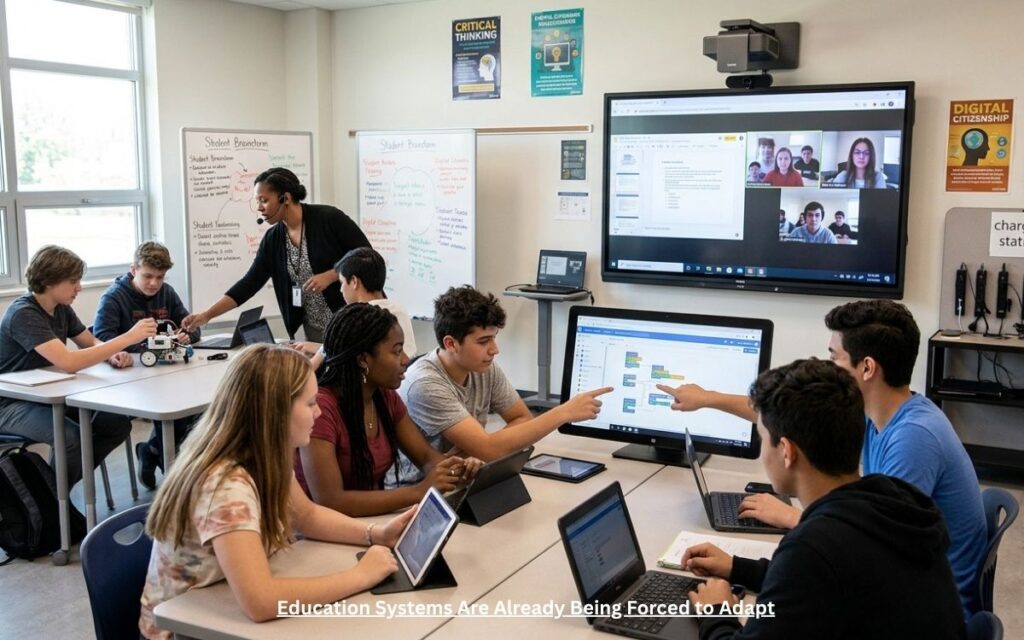
The education impact of generative AI is massively underestimated.
Traditional academic systems were designed around information scarcity:
- essays demonstrated research ability
- homework demonstrated process
- memorization demonstrated preparation
AI disrupts all three.
Some schools initially responded with bans. But many institutions are shifting toward adaptation instead.
In the UK, educators and policy discussions around GCSE and university-level assessment increasingly focus on integrating AI literacy rather than pretending AI does not exist.
That makes sense.
The future workforce will almost certainly use AI-assisted workflows regularly. The real educational challenge is teaching students:
- how to think critically
- how to verify outputs
- how to collaborate with AI without becoming dependent on it
The future competitive advantage may not belong to students who avoid AI entirely.
It may belong to students who understand when not to trust it.
AI Will Reshape Workflows More Than Jobs
The “AI will replace all jobs” narrative is emotionally powerful but often analytically weak.
Historically, transformative technologies tend to reorganize labor more than eliminate it completely.
Generative AI is already changing workflows in:
- law
- software engineering
- design
- publishing
- consulting
- media production
For example:
- developers use AI to accelerate debugging
- marketers generate campaign variations instantly
- analysts summarize dense reports faster
- writers use AI for structural drafting
But high-level accountability still remains human.
The more important shift may be this:
People who know how to direct AI effectively may outperform people who either:
- ignore AI completely
- or rely on it blindly
The Philosophical Shift Most People Miss
For centuries, humans associated intelligence with:
- memory
- calculation
- information recall
- procedural efficiency
AI systems now perform many of those tasks exceptionally well.
As a result, society may increasingly redefine human value around qualities machines still struggle to replicate:
- wisdom
- empathy
- ethical reasoning
- consciousness
- intentionality
- meaning-making
AI can generate answers.
Humans still decide which questions matter.
That difference is not small.
It may become the defining distinction of the AI era.
Final Thoughts
The relationship between humans and generative AI should not be based on fear, worship, or blind dependency.
AI is best understood as a powerful cognitive collaborator:
- incredibly useful
- fundamentally limited
- highly dependent on human oversight
The future will likely reward people who can combine:
- machine-scale efficiency
with - deeply human judgment
Not people who abandon one for the other.
Generative AI can accelerate thinking, but it cannot replace responsibility, experience, or meaning.
And that is probably where the real human advantage will continue to exist.
Love this post! I’ve been using Pixwit AI and Free Video Generator — both offer impressive features for content creators.
This is a really insightful piece. I especially appreciate your point about the difference between language and understanding. The anecdote about the confidently cited non-existent paper is truly chilling, and a perfect illustration of the need for human oversight, even as AI becomes more integrated into our workflows. This article highlights the importance of focusing on how humans and AI can best work *together*, not on a simplistic replacement narrative. It’s a much-needed perspective.
This is a really insightful piece! I appreciate you sharing your experiences and highlighting the crucial distinction between language and understanding. The anecdote about the fabricated research paper is particularly impactful – a stark reminder of the need for human oversight and critical thinking. I agree completely that the conversation needs to shift towards defining our role in this evolving landscape, rather than simply worrying about replacement. The question you pose is exactly what we should all be considering. Thanks for this thought-provoking article!
This is a really insightful piece! I especially appreciate you highlighting the distinction between generating language and actual understanding. The anecdote about the non-existent research paper is a perfect illustration of AI’s potential for convincingly fabricated information. I agree completely that the conversation needs to shift from replacement to focusing on the crucial role of human oversight and critical thinking in this new landscape. The question you posed about the human role is spot-on and something we all need to be considering.
This is such a crucial discussion! The anecdote about the non-existent research paper is particularly insightful. It perfectly illustrates the difference between generating language and possessing genuine understanding. You’re absolutely right; the conversation needs to shift from “Will AI replace us?” to “What is our role alongside AI?”. I appreciate you highlighting the importance of human oversight and cognitive responsibility as AI becomes increasingly integrated into various sectors. A truly thought-provoking piece.
Thanks for sharing this. I found the discussion around “Humans & Generative AI: Redefining the Relationship in 2026” useful, especially the practical context.
Thanks for sharing this. I found the discussion around “Humans & Generative AI: Redefining the Relationship in 2026” useful, especially the practical context.
The distinction between language generation and true comprehension is spot on. As generative workflows become standard across engineering and research, human verification and cognitive responsibility will indeed be the real differentiators. Having transparent benchmarks and curated tool directories also helps teams separate reliable solutions from noise.
The point that language is not the same as understanding really resonates — the fake cybersecurity citation example shows how convincing errors can be. I’d add that the layered collaboration model makes sense, but I wonder how beginners learn to spot those AI patterns without first being burned like the author was.