Why Claiming Insurance for Dental Implants Is More Complicated Than You Think

Can you claim insurance for dental implants? Yes — but only under the right conditions, and rarely for the full cost.
Here is a quick answer to what most people need to know:
| Question | Quick Answer |
|---|---|
| Does dental insurance cover implants? | About 30–40% of plans do, typically covering 40–50% of the cost |
| What is the annual payout limit? | Most plans cap at $1,000–$2,000 per year |
| Does medical insurance cover implants? | Sometimes — if tooth loss was caused by an accident, cancer, or a congenital condition |
| Does Medicare cover implants? | Original Medicare does not; some Medicare Advantage plans may |
| Can I use an HSA or FSA? | Yes — dental implants are IRS-qualified medical expenses |
A single dental implant — from extraction to final crown — typically costs between $3,000 and $6,000. Even with a plan that covers major restorative work, your insurer’s annual maximum will often run out long before the bill is paid.
That gap is what catches most people off guard.
This guide walks you through exactly how insurance coverage works for implants, which policy clauses can block your claim, and what your real options are when coverage falls short.
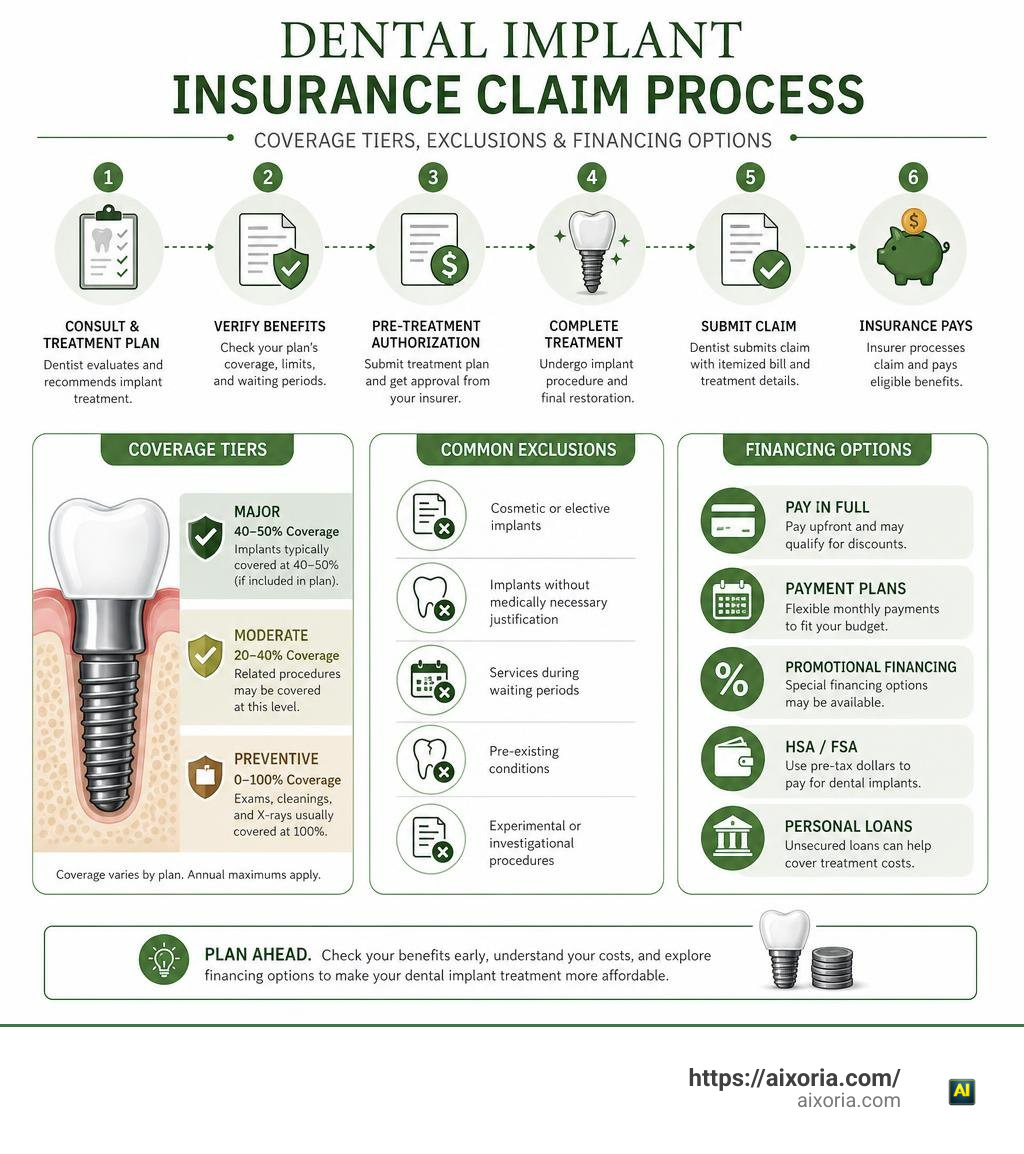
Can I claim insurance for dental implants? Understanding Dental Coverage Tiers

Historically, dental insurance providers classified dental implants as cosmetic or experimental procedures. Because traditional bridges and dentures were the industry standard, insurers argued that implants were an unnecessary luxury.
Fortunately, the tide is turning. As we navigate 2026, the clinical consensus has firmly shifted: the American Dental Association now recognizes implants as the gold standard for tooth replacement due to their ability to preserve jawbone structure and prevent adjacent teeth from shifting. Today, approximately 30% to 40% of dental plans include some form of implant coverage.
To understand how your plan handles these claims, we have to look at how dental insurance tiers its benefits. Most PPO plans operate on a 100-80-50 structure:
- Preventive Care (100% covered): Cleanings, routine exams, and basic X-rays.
- Basic Restorative Care (70% to 80% covered): Simple fillings, non-surgical extractions, and deep cleanings.
- Major Restorative Care (40% to 50% covered): Crowns, bridges, root canals, and — if you are covered — dental implants.
If your plan includes implant coverage, it will fall under the “Major Restorative” tier. This means the plan will typically cover up to 50% of the negotiated in-network fee, leaving you to pay the remaining 50% out of pocket. However, as we will explore, this 50% coverage is strictly bound by your policy’s annual maximum and specific clinical rules. For a deeper dive into which providers offer these benefits, you can read more about Are Dental Implants Covered by Insurance? What You Need to Know.
Component-Level Coverage: Post, Abutment, and Crown
When we talk about a “dental implant,” we are actually talking about three separate components, each billed under a different clinical code:
- The Implant Post (CDT Code D6010): The titanium or zirconia screw surgically placed into your jawbone. This acts as the artificial root.
- The Abutment (CDT Codes D6056/D6057): The connector piece that screws into the post and protrudes above the gum line.
- The Prosthetic Crown (CDT Codes D6058-D6062): The custom-made ceramic tooth that attaches to the abutment.
It is incredibly common for an insurance policy to cover one of these components but completely exclude the others. For example, some plans feature “crown-only” coverage. Under these rules, your insurer might agree to cover 50% of the prosthetic crown (D6058) because they view it similarly to a standard crown over a natural tooth. However, they may deny the surgical placement of the post (D6010) and the abutment, leaving you to pay those surgical costs entirely out of pocket.
Before scheduling your surgery, we always recommend asking your provider for a detailed, itemized treatment plan that breaks down each code so you can verify component-level coverage.
How Annual Maximums and Deductibles Limit Your Payout
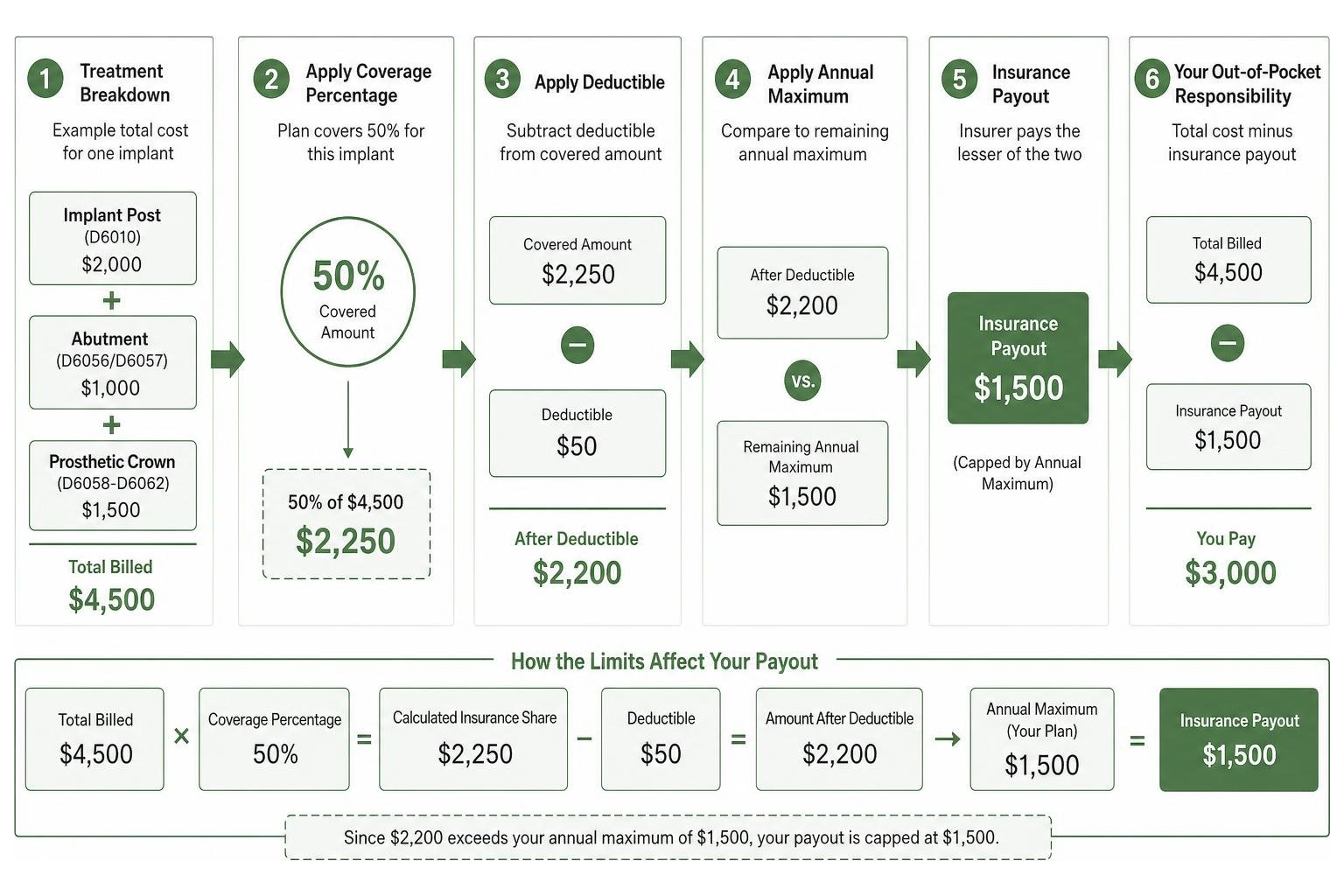
Even if your plan boasts “50% coverage for dental implants,” the actual dollar amount you receive is limited by your annual maximum benefit. This is the absolute limit on what your insurance company will pay for your dental care in a single calendar year.
Most standard dental plans carry an annual maximum of just $1,000 to $1,500 — a limit that has remained virtually unchanged since the 1970s. Premium plans may offer limits up to $2,000 or $2,500.
To see how this works in practice, let us look at how standard and premium plans pay out for a single implant costing $4,500:
| Feature | Standard PPO Plan | Premium PPO Plan |
|---|---|---|
| Average Annual Maximum | $1,500 | $2,500 |
| Implant Coverage Tier | 50% (Major Restorative) | 50% (Major Restorative) |
| Typical Deductible | $50 | $50 |
| Calculated Insurance Share (50%) | $2,250 | $2,250 |
| Actual Insurance Payout | $1,500 (Capped by Annual Max) | $2,200 (After $50 Deductible) |
| Your Out-of-Pocket Share | $3,000 | $2,300 |
As you can see, under a standard plan, your “50% coverage” is cut short because the insurance company’s share ($2,250) exceeds your annual maximum limit ($1,500). Once that cap is hit, you are responsible for 100% of the remaining balance, plus your deductible.
Key Policy Clauses That Can Block Your Implant Claim
The fine print in dental policies is filled with clauses designed to limit the insurer’s financial risk. Even if your plan explicitly covers implants, these three common clauses can completely block your claim.
The Missing Tooth Clause and Pre-Existing Conditions
The Missing Tooth Clause is the most common reason dental implant claims are denied. This clause states that if you lost a tooth before your current insurance policy’s effective date, the insurer will not pay to replace it.
For example, if you lost a tooth in 2024, started a new job with a new dental plan in 2025, and decided to get an implant in 2026, the insurer will review your dental records and dental X-rays. Once they establish that the tooth was already missing before your policy started, they will deny the claim for the implant post, abutment, and crown.
If you are planning to change insurance providers, always check the “Exclusions and Limitations” section of the new policy booklet to see if a missing tooth clause is active.
The Least Expensive Alternative Treatment (LEAT) Clause
The Least Expensive Alternative Treatment (LEAT) Clause allows your insurance company to limit their payout to the cost of the cheapest medically acceptable treatment option.
While your dentist may recommend a dental implant as the absolute best clinical solution to replace a missing tooth, your insurance company may point out that a three-unit dental bridge or a removable partial denture is cheaper. Under the LEAT clause, the insurer will calculate their 50% coverage based on the cost of the cheaper alternative.
If a partial denture costs $800, your insurer’s 50% share is $400. Even if you choose to proceed with the $4,500 dental implant, the insurance company will only pay out $400, leaving you to cover the remaining $4,100 out of pocket.
Waiting Periods for Major Restorative Care
A waiting period is the amount of time you must be enrolled in an insurance plan before your benefits for major restorative work kick in. For dental implants, waiting periods typically range from 6 to 12 months.
If you attempt to claim an implant during this period, the claim will be automatically denied. Insurers use waiting periods to prevent “ad-hoc enrollment” — where a patient signs up for a policy, immediately gets thousands of dollars in major dental work done, and then cancels the plan.
However, we often see waiting periods waived on employer-sponsored group plans if you can prove you had continuous, uninterrupted dental coverage under a prior plan.
How to Claim Insurance for Dental Implants Under Medical Plans
One of the best-kept secrets in restorative dentistry is that medical insurance can sometimes cover dental implants. Because medical plans do not have the restrictive $1,500 annual caps common to dental plans, successfully filing a medical claim can save you thousands of dollars.
To learn more about the step-by-step process of medical filing, consult our guide on Medical Insurance for Dental Implants: A Step-by-Step Guide to Coverage.
Proving Medical Necessity for Dental Implants
Medical insurance will never cover dental implants for cosmetic reasons or simple tooth decay. To get a medical plan to pay, we must prove that the implants are a medical necessity to treat a systemic health issue or reconstruct physical trauma.
Common medical scenarios that qualify include:
- Severe Physical Trauma: Tooth loss and jaw fractures resulting from a car accident, sports injury, or physical assault.
- Oral Cancer Reconstruction: Implants needed to restore teeth and jaw structure after tumor resection or radiation therapy.
- Congenital Defects: Treating severe developmental conditions such as cleft palate, cleft lip, or ectodermal dysplasia (where teeth fail to develop naturally).
- Severe Systemic Bone Loss: Conditions where severe atrophy of the jawbone prevents a patient from chewing or swallowing, leading to severe nutritional deficiencies or digestive issues.
Essential Documentation: CPT Codes and Pre-Authorization
Filing a medical claim for dental implants is highly complex because medical billing uses CPT (Current Procedural Terminology) codes and ICD-10 diagnosis codes instead of standard dental CDT codes.
Your oral surgeon or dentist must document your case thoroughly. To submit a successful claim, we must compile:
- A Letter of Medical Necessity: A detailed letter from your physician or oral surgeon explaining why implants are required to restore vital bodily functions (like chewing or speaking) rather than just your smile.
- Diagnostic Imaging: 3D Cone Beam CT (CBCT) scans, X-rays, and clinical photographs showing jawbone degeneration or physical trauma.
- Specific CPT Codes: Codes such as 21248 (reconstruction of mandible or maxilla with implants for reconstruction) or 41899 (unlisted procedure, dentoalveolar structure).
- Written Pre-Authorization: You must obtain written approval from your medical insurer before any surgical cuts are made. Proceeding without pre-authorization is a guaranteed path to a claim denial.
Maximizing Benefits and Alternative Financing Options
When standard coverage leaves a large remaining balance, strategic planning can help you minimize your out-of-pocket expenses. For a comprehensive look at the best plans and strategies, check out the Does Dental Insurance Cover Implants? Coverage, Costs & Best Plans resource.
One of the most effective strategies is calendar-year splitting. Because dental implants require a multi-stage healing process over several months, you can time your appointments across two policy years:
- Year 1 (December): Have your tooth extracted, complete any necessary bone grafting, and place the surgical implant post. This utilizes your Year 1 annual maximum.
- Year 2 (January/February): After the bone heals, return to the office to place the abutment and final prosthetic crown. This utilizes your Year 2 annual maximum.
By splitting a $5,000 treatment across December and January, you can effectively double your insurance payout, applying two separate annual limits ($1,500 + $1,500 = $3,000) to a single tooth replacement.
Using HSAs and FSAs for Out-of-Pocket Implant Costs
If you have a Health Savings Account (HSA) or a Flexible Spending Account (FSA), you can use these tax-advantaged accounts to pay for the out-of-pocket portion of your dental implants.
Because the IRS classifies dental implants as a qualified medical expense, you can pay your dental office using pre-tax dollars. Depending on your federal and state tax bracket, utilizing an HSA or FSA effectively provides a 20% to 30% discount on your out-of-pocket costs.
For 2026, make sure to plan your contributions during your employer’s open enrollment period to match your estimated dental treatment timeline.
What to Do If Your Dental Implant Claim Is Denied
If your insurance claim is denied, do not panic. Insurers frequently issue initial denials as a standard administrative practice. To fight back, we recommend following these steps:
- Request an Explanation of Benefits (EOB): Identify the exact reason for the denial (e.g., missing tooth clause, lack of clinical documentation, or coding errors).
- File an Internal Appeal: Work with your dental billing coordinator to submit a formal appeal letter. Include additional supporting evidence, such as pre-operative radiographs, periodontal charting, and narrative clinical notes.
- Request a Peer-to-Peer Review: If the internal appeal fails, your oral surgeon can request a telephone review with the insurance company’s medical director to explain the clinical necessity directly.
- Pursue an External Review: If all internal avenues are exhausted, you have the legal right to request an independent external review by an objective third-party medical professional.
Frequently Asked Questions about Claiming Insurance for Dental Implants
Can I claim insurance for dental implants if the tooth was missing before I enrolled?
In most cases, no. If your policy contains a Missing Tooth Clause, the insurance company will exclude coverage for any tooth lost prior to your enrollment date. However, some premium employer-sponsored group plans do not have this exclusion. Always check your plan’s specific policy booklet or request a pre-determination of benefits before starting treatment.
Can I claim insurance for dental implants through Medicare or Medicaid?
Original Medicare (Parts A and B) explicitly excludes routine dental care and dental implants. However, some Medicare Advantage (Part C) plans offer supplemental dental benefits that may cover a portion of implant costs.
Medicaid adult dental benefits are highly state-dependent. In most states, Medicaid views dental implants as elective and will only cover cheaper alternatives like standard dentures. Implants are only covered under Medicaid in extreme cases of medical necessity, such as reconstructive surgery following oral cancer or severe trauma.
How long is the typical waiting period before I can claim insurance for dental implants?
The typical waiting period for major restorative services, including dental implants, is 6 to 12 months from your plan’s effective date. If you are transitioning from a previous dental plan with no gap in coverage, you can often request a waiting period waiver from your new insurer by submitting proof of prior continuous coverage.
Conclusion
Navigating the financial side of restorative dentistry can feel overwhelming, but securing coverage for dental implants is entirely possible with the right approach. By understanding your dental plan’s coverage tiers, identifying restrictive clauses like LEAT or missing tooth rules, and exploring medical insurance options, you can significantly lower your out-of-pocket costs.
At Aixoria, we believe that financial barriers shouldn’t stand in the way of a healthy, confident smile. If you are interested in exploring how modern technology and strategic planning can make your dental restoration seamless and accessible, check out our latest insights on AI Updates and Restorative Tech to see how the industry is evolving to better serve patients.
1 thought on “Can You Claim Insurance for Dental Implants in 2026? Full Coverage Guide”