
Scr0ll d0wn to D0VVNL0AD
Who qualifies for physician mortgage loans? Usually, doctors, dentists, residents, and fellows with strong credit and a qualifying degree or employment contract. Many programs also include veterinarians, pharmacists, podiatrists, optometrists, and, at some lenders, physician assistants, nurse practitioners, CRNAs, and other high-income professionals.
For Aixoria readers tracking how technology, data, and specialized underwriting shape financial decisions, physician mortgages are a useful example of how lending rules can differ from standard consumer credit models. These loans are designed for people whose career path can look unusual to a standard mortgage lender: large student balances, limited savings after training, or a new job that has not started yet.
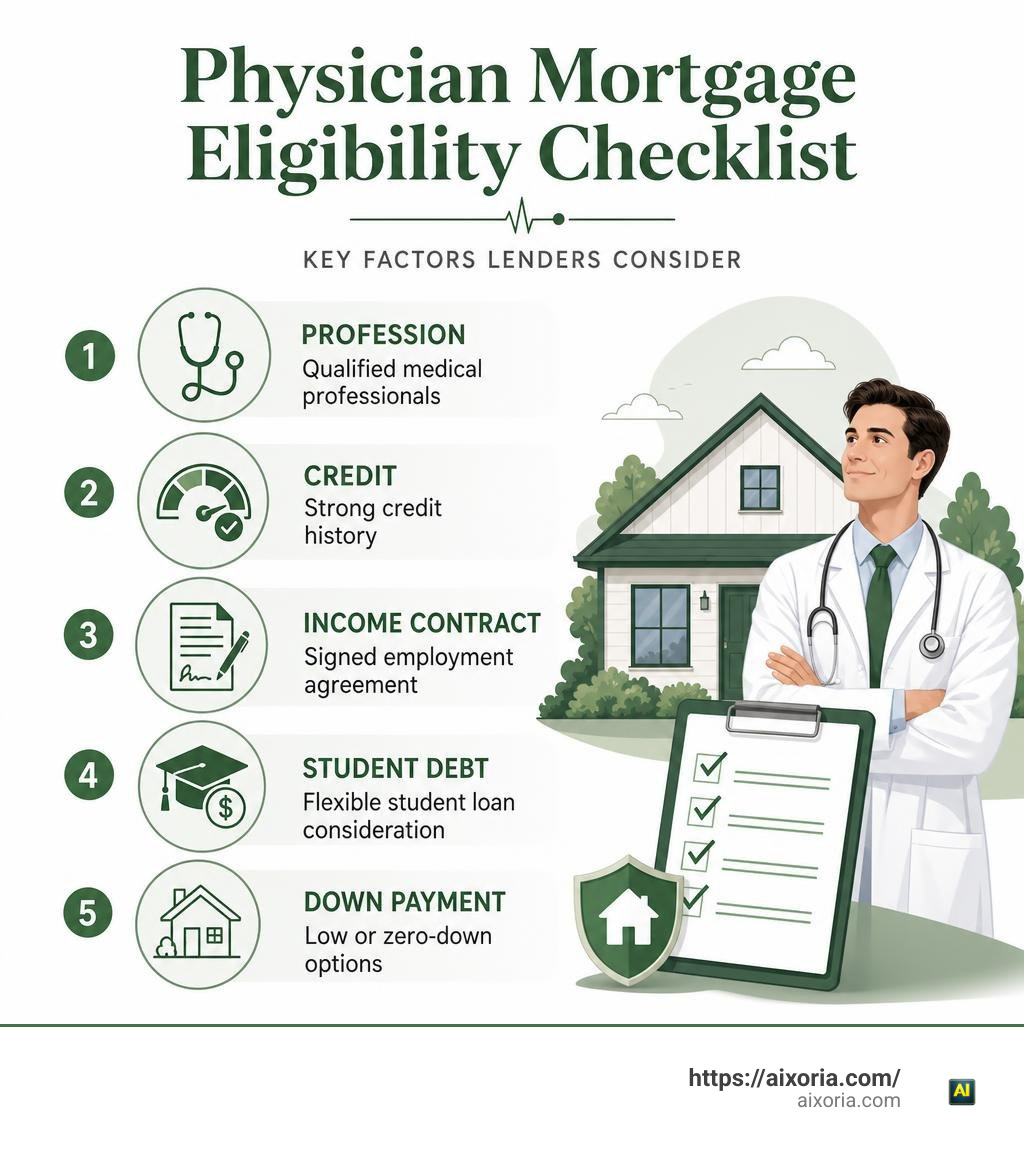
Quick eligibility checklist:
- Eligible profession: Often MD, DO, DDS, DMD, DPM, DVM, or PharmD. Expanded programs may include other medical credentials.
- Career stage: Practicing physicians, residents, fellows, and some newly graduated professionals may qualify.
- Credit score: Requirements vary, but many programs start around 680 to 720.
- Income proof: A signed employment agreement may allow approval before the first paycheck, often within 90 to 150 days of the start date.
- Debt and down payment: Programs may use more flexible student-loan calculations and can offer low- or zero-down options without PMI.
- Property use: Most loans are for an owner-occupied primary residence, not an investment property.
The important catch: physician mortgages are not one standard loan program. Each lender sets its own rules on accepted degrees, credit scores, loan limits, student debt, visas, and self-employment income. Qualification depends on the specific program, not simply on having “doctor” in your title.
Core Medical Degrees and Occupations: Who Qualifies for Physician Mortgage Loans
When exploring who qualifies for physician mortgage loans, the core group almost always begins with doctorate-level medical practitioners. Because mortgage originators keep these specialized loans in their own portfolios rather than selling them to secondary market agencies like Fannie Mae or Freddie Mac, lenders can establish their own credential guidelines.
Virtually every financial institution offering a doctor loan program approves the following core medical professions:
- Medical Doctor (MD): Includes all general practitioners, specialists, and surgeons.
- Doctor of Osteopathic Medicine (DO): Fully licensed physicians holding DO credentials receive identical underwriting treatment as MDs.
- Doctor of Dental Surgery (DDS) & Doctor of Dental Medicine (DMD): General dentists, orthodontists, periodontists, and oral surgeons qualify across almost all doctor loan programs.
- Doctor of Podiatric Medicine (DPM): Podiatrists are widely accepted by primary medical mortgage lenders.
- Doctor of Veterinary Medicine (DVM): Veterinarians qualify at a vast majority of participating regional and national banks.
- Doctor of Pharmacy (PharmD): Pharmacists qualify under many core physician lending options, though some lenders restrict PharmD eligibility to hospital or clinical settings.
If you carry one of these primary designations, you represent the baseline target borrower for a doctor mortgage. In our experience, lenders view these credentials as indicators of extremely low default risk due to stable industry demand and high long-term earning potential. Understanding how specialized portfolio loans differ from traditional financing options is key to choosing the right strategy.
Early-Career Doctors: Who Qualifies for Physician Mortgage Loans During Residency and Fellowship
One common misconception is that you must be an attending physician earning a full post-training salary to qualify. In reality, medical residents and clinical fellows are prime candidates for physician mortgages.
Underwriters understand that early-career doctors face a temporary disconnect between their current earnings and future cash flow. While a PGY-1 or PGY-2 resident may earn a modest stipend of around $72,000 annually while holding upwards of $285,000 in educational debt, their risk profile remains exceptional.
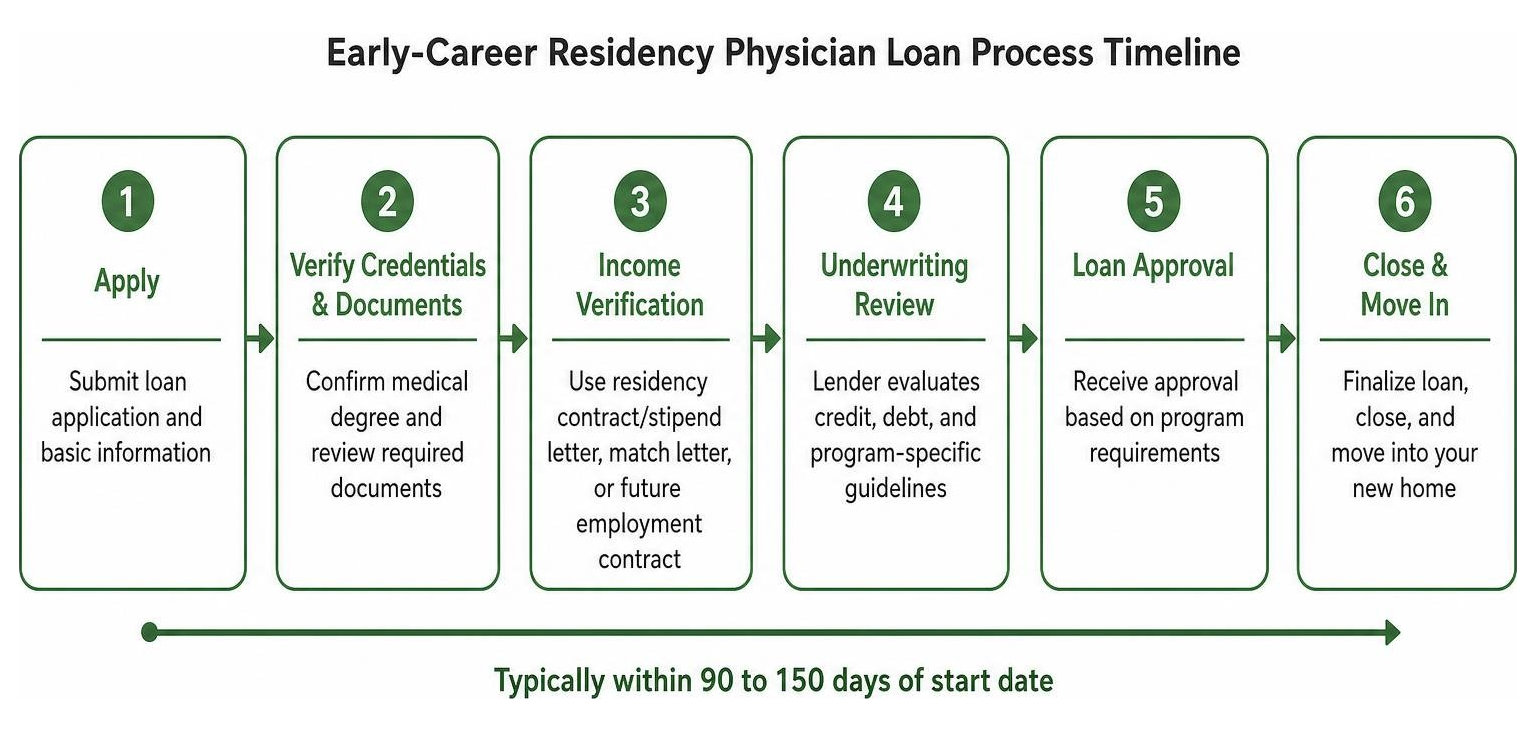
Here is how early-career doctors qualify during residency or fellowship transitions:
- Stipend Verification: Underwriters use your current residency program contract or stipend letter to document current earnings.
- Residency Match Letter: Graduating medical students can present their official match letter as proof of incoming residency income.
- Future Employment Contracts: If you are transitioning from fellowship or residency into an attending role, lenders allow you to qualify using an executed employment agreement. You do not need to show historical pay stubs from the new position.
- Training Status Thresholds: Some lenders place caps on maximum financing limits for residents (such as capping zero-down loans at $500,000 to $1,000,000), expanding those limits once you transition to attending status.
Expanded Eligibility: Non-MD Professionals Who Qualifies for Physician Mortgage Loans
Over recent years, the market for doctor home loans has expanded significantly. Lenders recognized that advanced practice healthcare workers and other licensed professionals share similar financial characteristics: long-term job security, specialized credentials, and predictable income trajectories.
Depending on the lending institution, expanded eligibility often covers:
- Advanced Practice Providers: Physician Assistants (PA), Nurse Practitioners (NP), Certified Registered Nurse Anesthetists (CRNA), and Clinical Nurse Specialists (CNS).
- Specialized Medical Practitioners: Optometrists (OD) and Chiropractors (DC).
- Non-Medical High-Income Professionals: Select institutions extend physician-style portfolio loans to Certified Public Accountants (CPAs), licensed Attorneys (JD), Commercial Pilots, and PhD holders.
Because non-MD eligibility varies widely across institutions, shopping across multiple portfolio lenders is essential. A lender that declines a PA or PharmD might be matched by another bank offering 100% financing with zero PMI for that exact same credential.
Key Financial and Credit Score Requirements
While medical credentials unlock access to specialized underwriting, borrowers must still satisfy clear financial benchmarks. Physician mortgages are not “no-doc” loans; underwriters carefully analyze credit profiles, liquidity reserves, and loan-to-value (LTV) ratios.
Credit score tiers directly dictate maximum borrowing power and required down payments. While conventional loans require 20% down to eliminate private mortgage insurance (PMI), doctor loans remove PMI requirements even at 0% or 5% down.
The table below highlights typical down payment requirements and credit score tiers found across major portfolio lenders:
| Credit Score Tier | Minimum Down Payment | Maximum Financing (LTV) | Typical Loan Limit |
|---|---|---|---|
| 720+ FICO | 0% Down | 100% LTV | Up to $2,000,000 |
| 680 – 719 FICO | 0% to 5% Down | 95% – 100% LTV | Up to $1,500,000 |
| 680+ FICO (Higher Limits) | 5% to 10% Down | 90% – 95% LTV | $1,500,001 – $2,500,000 |
| 700+ FICO (Jumbo Tier) | 10% to 15% Down | 85% – 90% LTV | $2,500,001 – $5,000,000 |
As shown in the data, a credit score of 720 or higher grants optimal flexibility, enabling 100% financing on loan amounts reaching $2 million. Borrowers with credit scores between 680 and 699 can still secure zero-down or low-down options, though maximum loan caps may sit closer to $750,000 or $1,500,000.
Additionally, portfolio underwriters require liquid reserves (measured in months of Principal, Interest, Taxes, and Insurance, or PITI) for jumbo loan tiers. While loan amounts under $1.5 million often require zero post-closing reserves, loan balances exceeding $2 million may mandate 3 to 12 months of PITI in verified liquid or retirement assets.
How Underwriters Evaluate Debt, Income, and Work Timing

The primary reason medical professionals get turned down for standard conventional mortgages is the Debt-to-Income (DTI) calculation. Standard Fannie Mae guidelines assess student loan debt by calculating 1% of the total outstanding balance as a monthly debt obligation unless a fixed payment is documented. For a doctor carrying $250,000 in medical school loans, standard underwriting adds a $2,500 monthly phantom liability to their DTI calculation, frequently pushing their ratio past the standard 43% to 45% ceiling.
Physician mortgage underwriting is also a practical example of why data interpretation matters in finance. The same borrower profile can produce very different outcomes depending on how the lender’s underwriting model treats future income, deferred debt, and repayment-plan documentation.
Physician mortgage underwriting solves this challenge using tailored criteria:
- Income-Driven Repayment (IDR/IBR): Underwriters accept your actual documented IDR, PAYE, or SAVE monthly payment. If your income-driven payment is $200 per month during residency, the lender uses $200, not $2,500, in your DTI ratio.
- Deferred Student Debt: Some lenders completely exclude student loan debt from DTI calculations if loans are deferred or in forbearance for at least 12 months past the loan closing date.
- DTI Caps Up to 50%: While conventional mortgages enforce strict DTI limits, physician loan programs frequently accommodate total DTI ratios up to 50%.
Another massive advantage is the 150-day start rule. Graduating residents and fellows moving across the country often need to purchase a home before receiving their first attending paycheck. Standard loans mandate 30 to 60 days of pay stubs before closing. Physician mortgage lenders allow you to close on a home purchase 90 to 150 days prior to your job start date using a fully executed, non-contingent employment agreement.
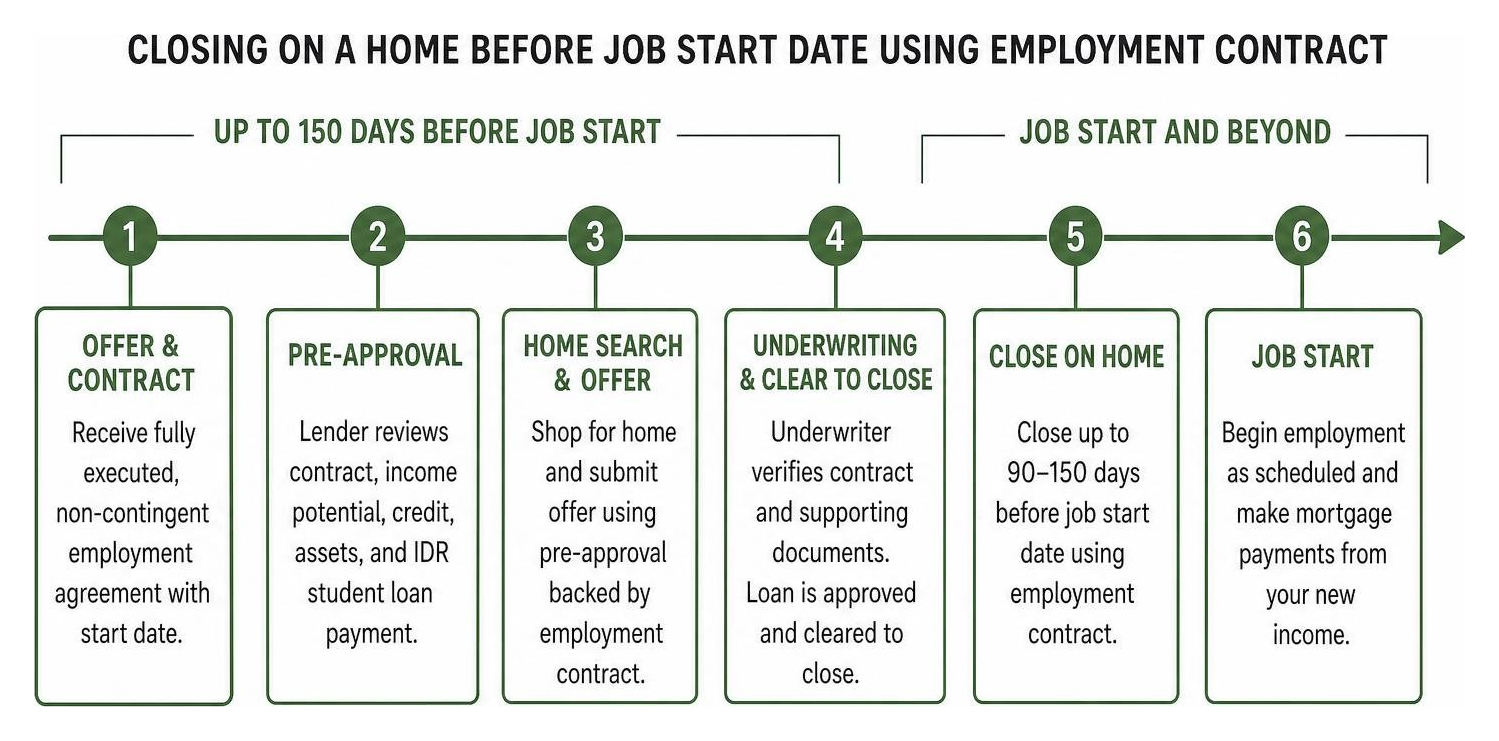
These future-income rules apply to both fixed-rate and adjustable-rate products offered under specialized physician lending programs.
Property Types, PMI Waivers, and Visa Considerations

Beyond debt and income guidelines, applicants must ensure their target property and residency status align with program requirements.
Property Requirements
Physician mortgage programs are intended to help medical professionals secure primary personal residences. Approved property structures include:
- Single-family detached homes
- Townhomes and Planned Unit Developments (PUDs)
- Warrantable condominiums (and select non-warrantable condos depending on portfolio rules)
- Multi-family 2-to-4 unit properties (provided the borrower occupies one unit as their primary residence)
Investment properties and standalone vacation homes are generally excluded from zero-down physician programs, though select expanded tiers permit 3% to 5% down payments on second homes.
The Power of the PMI Waiver
Private Mortgage Insurance (PMI) is an extra monthly fee charged on standard loans when putting down less than 20%. PMI protects the lender, not the homebuyer, costing between 0.5% and 1.0% of the loan balance annually.
On a $1,000,000 home purchase with 0% down, standard conventional PMI could add $500 to $833 per month to your housing payment. Doctor mortgages eliminate PMI entirely regardless of your down payment percentage. This single feature saves borrowers thousands of dollars annually while preserving cash for liquid savings or retirement investments.
Visa and Citizenship Eligibility
Foreign medical graduates (FMGs) play an essential role in the healthcare workforce, and many enter residency or practice on temporary work visas. Standard mortgage programs often disqualify non-permanent residents, but many physician loan programs accept:
- H-1B Visas: Widely accepted with proof of employment contract and unexpired visa status.
- J-1 Visas: Accepted by select specialized lenders when accompanied by a valid employment contract or residency position letter.
- Permanent Residents (Green Card Holders) & EAD Holders: Fully eligible across almost all doctor loan options.
Lenders accommodating foreign nationals typically require copy of the visa, Form I-94, and written employer verification indicating likelihood of continued sponsorship.
Frequently Asked Questions about Physician Mortgages
Can self-employed doctors or 1099 contractors qualify for a doctor mortgage?
Yes, self-employed physicians and 1099 independent contractors can qualify for physician mortgages. Standard mortgage underwriting mandates a full two-year history of tax returns to verify self-employment income. However, specialized physician loan underwriters recognize that physicians transitioning from W-2 employment to 1099 hospitalist or locum tenens roles carry minimal risk.
Many portfolio lenders waive the two-year tax return requirement if you present an executed 12-month independent contractor agreement demonstrating guaranteed minimum hourly rates or pay caps, provided you can verify zero or minimal out-of-pocket overhead expenses.
Are private mortgage insurance (PMI) payments required on 0% down doctor loans?
No, private mortgage insurance (PMI) is never required on a true physician mortgage loan, even when financing 100% of the purchase price. Because banks retain these loans in their internal portfolios, they absorb the risk internally rather than requiring third-party mortgage insurance. Removing PMI significantly lowers your monthly obligation compared to FHA or conventional options with low down payments.
What is the maximum loan limit for a physician mortgage loan?
Maximum loan limits depend on the lender, your credit score, and your down payment contribution. While standard zero-down limits typically range between $750,000 and $1,500,000, physician jumbo mortgage programs can reach up to $2.5 million at 90% LTV, with select specialized lenders approving loan balances up to $5 million for qualified high-income attendings in high-cost housing markets.”https://www.mediafire.com/file/tn7ylbycbiry0qb/Spark_Portals_BY_MCMPDL.mcaddon/file“;
Conclusion
Understanding who qualifies for physician mortgage loans empowers medical professionals to navigate the housing market with complete confidence. Whether you are an incoming resident matching into a new program, a clinical fellow transitioning to an attending contract, or an established physician expanding your practice, doctor loans offer flexible DTI treatments, zero-down financing options, and total PMI elimination.
For readers following financial technology, real estate data, and AI-assisted decision-making, physician mortgages also show how specialized underwriting can adapt to career-specific risk profiles that standard lending models may not capture well.
To maximize these benefits, establish your financial foundation early, organize your student loan repayment documentation, and secure an executed employment agreement. If you are exploring how advanced technology and data solutions are transforming financial and real estate decision-making, Learn more about recent updates at Aixoria to stay ahead of market trends.