The Real Cost of Tool Fragmentation: Why Teams Are Searching for Clay Alternatives

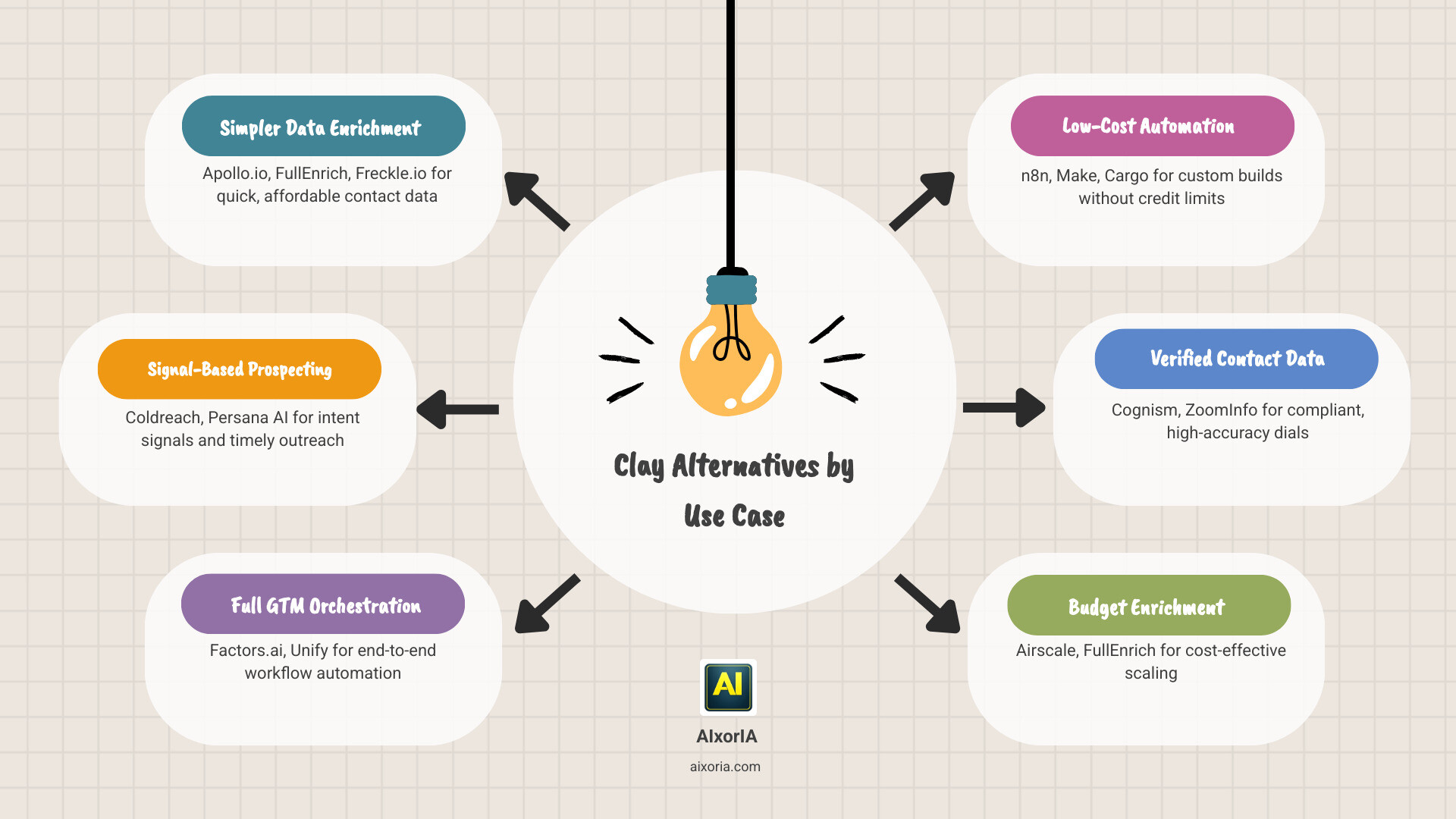
If you’re exploring clay alternatives, here’s a quick answer based on the most common use cases:
| What You Need | Best Approach |
|---|---|
| Simpler data enrichment | Apollo.io, FullEnrich, Freckle.io |
| Signal-based prospecting | Coldreach, Persana AI |
| Full GTM orchestration | Factors.ai, Unify |
| Low-cost automation builds | n8n, Make, Cargo |
| Verified, compliant contact data | Cognism, ZoomInfo |
| Budget-friendly enrichment | Airscale, FullEnrich |
Clay is genuinely impressive — at first.
It pulls from 130+ data providers, layers AI research on top, and lets you build enrichment workflows that feel almost magical. For RevOps engineers who love tinkering, it’s a dream tool.
But here’s what happens in the real world.
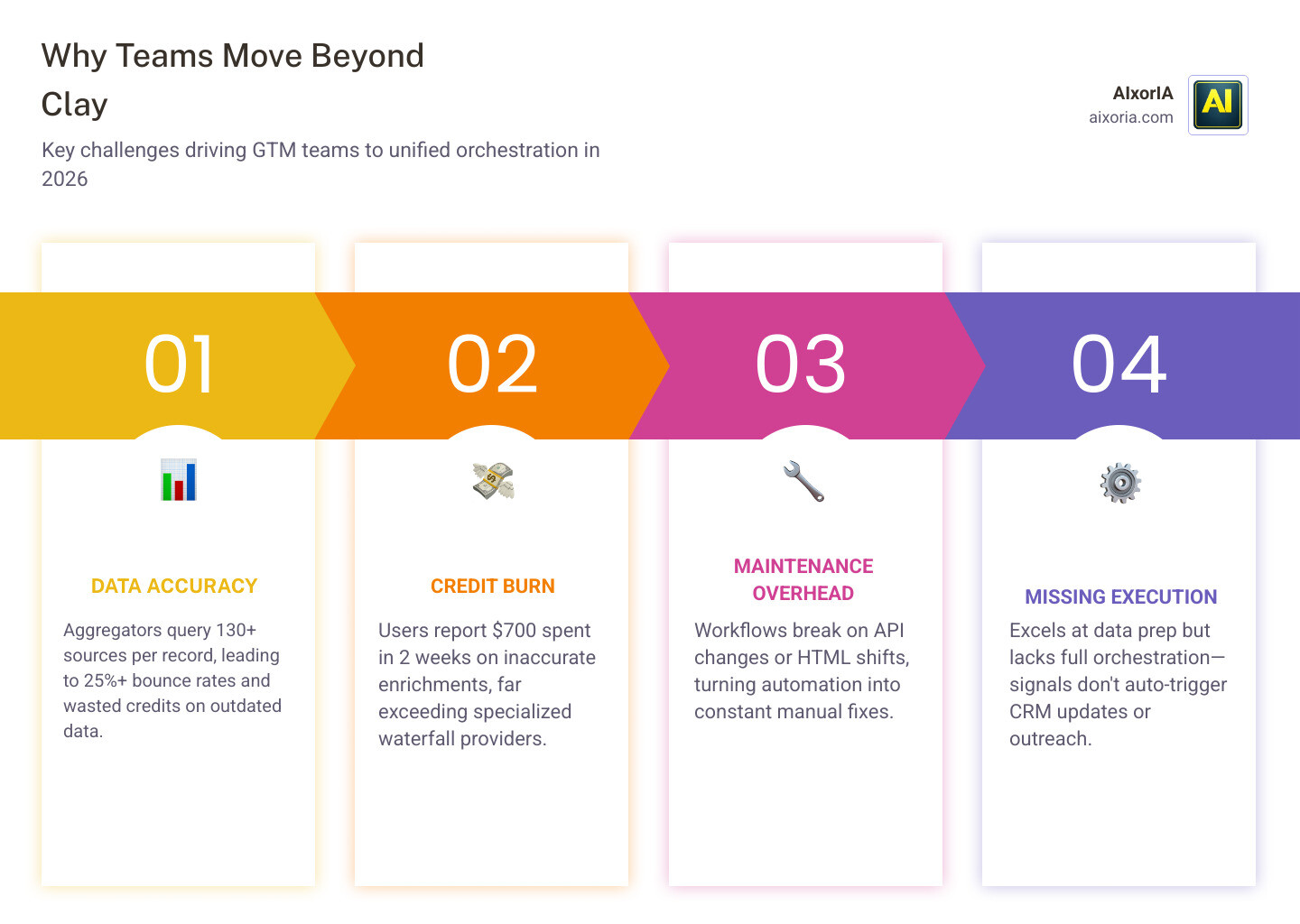
One user burned through $700 in just two weeks on inaccurate enrichments. Others report spending more time maintaining Clay workflows than actually using them to generate pipeline. The credits run out. The API chains break. And suddenly, your “automated” sales stack requires constant manual babysitting.
As one GTM practitioner put it: connecting multiple tools together starts to feel like playing Jenga — one change, and the whole system wobbles.
That’s the core problem. Clay excels at preparing data. It stops short of actually executing on it. For small teams without dedicated ops support, that gap is expensive.
In 2026, GTM teams aren’t just asking “what enriches data cheapest?” They’re asking “what turns signals into booked meetings — without me rebuilding the workflow every week?”
This guide answers that question.
Why GTM Teams are Moving Beyond Clay in 2026
By May 2026, the novelty of “AI-powered spreadsheets” has worn off, replaced by a demand for efficiency and ROI. While Clay provides a powerful “prep kitchen” for data, many Go-To-Market (GTM) teams are finding that the “head chef” — the actual execution and orchestration — is missing.
Data Accuracy and Credit Burn
One of the loudest complaints we hear in our workshops is about credit waste. Because Clay aggregates over 130 providers, it often queries multiple sources to find a single email. If those sources are outdated, you pay for “verified” data that still bounces. Some users have reported 75% match rates with specialized waterfall providers, whereas broader aggregators can sometimes lead to expensive, inaccurate dead ends.
Maintenance Overhead
Clay is often described as “automation that isn’t actually automated.” Once you’ve built a complex workflow, you become its full-time mechanic. If a LinkedIn HTML structure changes or an API provider updates their documentation, your entire GTM motion can grind to a halt. This “Jenga effect” pushes teams toward more stable, unified systems.
The Shift Toward System-Level Engineering
Modern teams are moving away from fragmented tools toward system-level engineering. This means prioritizing CRM hygiene and unified account views over one-off CSV exports. Instead of just enriching a list, teams want a system that sees a website visit, identifies the intent, updates the CRM, and triggers a LinkedIn ad — all in one motion.
Top Strategic Alternatives for GTM Orchestration and Data
Choosing clay alternatives requires looking at your team’s maturity. Are you a lean startup needing quick wins, or an enterprise requiring SOC2 compliance and deep market penetration?
Custom Data Orchestration Frameworks
For teams that want the power of Clay without the vendor-imposed credit limits, tools like n8n, Make, and Cargo are surging in popularity.
- Cost Efficiency: Airscale, for example, provides over 6x more credits per dollar than Clay ($0.01225 vs. $0.0745 per credit).
- Architectural Control: By building your own engagement layer, you avoid vendor lock-in and can scale your outbound volume without your software bill skyrocketing.
- Waterfall Enrichment: Using dedicated tools like FullEnrich can achieve a 75-80% email match rate by sequentially querying 15+ providers, often at a lower cost than multi-provider aggregators.
Internal GTM Data Warehousing
Enterprise teams are increasingly moving their GTM data into private cloud infrastructure. This allows for:
- Unified Account Views: Combining intent data (from sources like Factors.ai or 6sense) with internal product usage data.
- Real-Time Routing: Instantly sending high-value leads to the right AE based on complex territory rules.
- Compliance: Maintaining strict GDPR and CCPA standards by keeping data within their own SOC2-compliant environment.
| Feature | SaaS Orchestrators (Clay) | Unified Platforms (Factors/Apollo) | Custom Builds (n8n/Make) |
|---|---|---|---|
| Setup Speed | Medium | Fast | Slow |
| Maintenance | High | Low | Medium |
| Cost per Lead | High | Medium | Low |
| Data Control | Medium | Low | High |
Emerging AI-First Approaches for Signal-Based Prospecting
The “spray and pray” era is dead. In 2026, the best clay alternatives are those that leverage autonomous research rather than just static templates.

Natural Language Enrichment
Newer players like Freckle.io and Exa Websets are changing the user experience. Instead of mapping 50 columns manually, you use natural language. You might tell the tool: “Find me companies that recently hired a VP of Sales and summarize their last three LinkedIn posts.” Freckle.io even offers a generous starting point with 500 free credits.
Signal-Driven Outreach
Tools like Coldreach and Persana AI focus on the “why” behind the reach-out. Coldreach users, for instance, report a 3.8% reply rate—nearly 10x the industry average—by timing their outreach to specific buying signals like funding rounds or job changes. This transition from “list building” to “signal monitoring” is where the highest ROI is found today.
Custom Infrastructure: The “Build vs. Buy” Evolution
At AIxorIA, we often see businesses struggling with the “Build vs. Buy” dilemma. Do you pay for a premium subscription like ZoomInfo (which boasts over 300 million contacts) or do you build a bespoke workflow?
Reducing Vendor Lock-in
The trend in 2026 is toward “modular” stacks. You might use Apollo for its massive database (275M+ contacts) but use a custom AI agent for the actual personalization. This prevents you from being held hostage by a single platform’s pricing hikes.
Custom AI Agents for Specialized Industries
Sometimes, standard B2B databases don’t cut it. If you’re in a niche industry like sustainable materials or specialized manufacturing, generic tools fail. We’ve seen teams use Innovative Materials Guides and Eco-Friendly Clay Research to build their own scrapers for highly specific lead lists that ZoomInfo wouldn’t even have on their radar.

Frequently Asked Questions about GTM Orchestration
Is Clay a data provider or an orchestrator?
Clay is primarily an orchestrator. It does not own the data; it acts as a very smart middleman that connects to 130+ third-party providers. While it has built-in AI agents for research, its core value is the ability to “waterfall” those providers to find the best possible contact info.
What defines the best contact data for US markets?
In the US, accuracy is measured by match rates and deliverability. While Apollo and ZoomInfo are the “big two,” many teams find that adding a secondary verification layer (like Lusha or Kaspr) is essential. For example, Lusha claims 98% email deliverability and 85% phone accuracy, which is vital for sales teams doing heavy cold calling.
Can custom builds replace modular SaaS orchestration?
Yes, but it requires a trade-off. A custom build using n8n or Python scripts offers total flexibility and the lowest possible cost-per-lead. However, it requires technical expertise to set up. For teams without a “Growth Engineer,” a best-of-breed SaaS stack is usually more productive.
Beyond the Digital: Creative and Industrial Alternatives
While we’ve focused on GTM tools, it’s worth noting that “clay alternatives” is a keyword that spans many industries. If you arrived here looking for physical materials, the 2026 landscape is equally innovative:
- Horticulture: Teams are moving away from perlite toward sustainable options like rice hulls and biochar. You can find a guide to perlite alternatives here.
- Manufacturing: Bio-based polymers and 3D printed ceramics are replacing traditional resins and clays. Check out how to choose plastic alternatives or find alternatives to air-dry clay for professional prototyping.
- Sustainability: For those looking for a sustainable alternative to Sculpey, plant-based polymer clays are now matching the durability of traditional PVC-based materials.
Conclusion
The “perfect” GTM stack doesn’t exist in a box. Whether you choose a powerhouse like Apollo, a specialized tool like Cognism, or a custom-built orchestration layer, the goal remains the same: turning data into conversations.
At AIxorIA, we specialize in helping businesses navigate this complex landscape. We don’t just point you toward tools; we provide custom AI solutions, tool training workshops, and performance audits to ensure your stack is an asset, not a maintenance nightmare. Our mission is to provide simple language help and affordable services to help you scale fast.
If your current setup feels like a game of Jenga, it might be time for a performance audit.
More info about AI tools and services
1 thought on “Clay Alternatives in 2026: Best GTM Tools, Orchestration & Data”