What Is the Best Offline Accounting Software for Small Businesses?
Scr0ll d0wn to D0VVNL0AD
What is the best offline accounting software for small businesses? The best choice depends on how you work, but a strong starting point is a desktop tool with double-entry bookkeeping, local data storage, reliable backups, and the reports your accountant needs.
For many small businesses, offline accounting means greater control. Your books stay on your computer, invoices and reports can work without internet access, and a one-time license may cost less over several years than a monthly subscription.
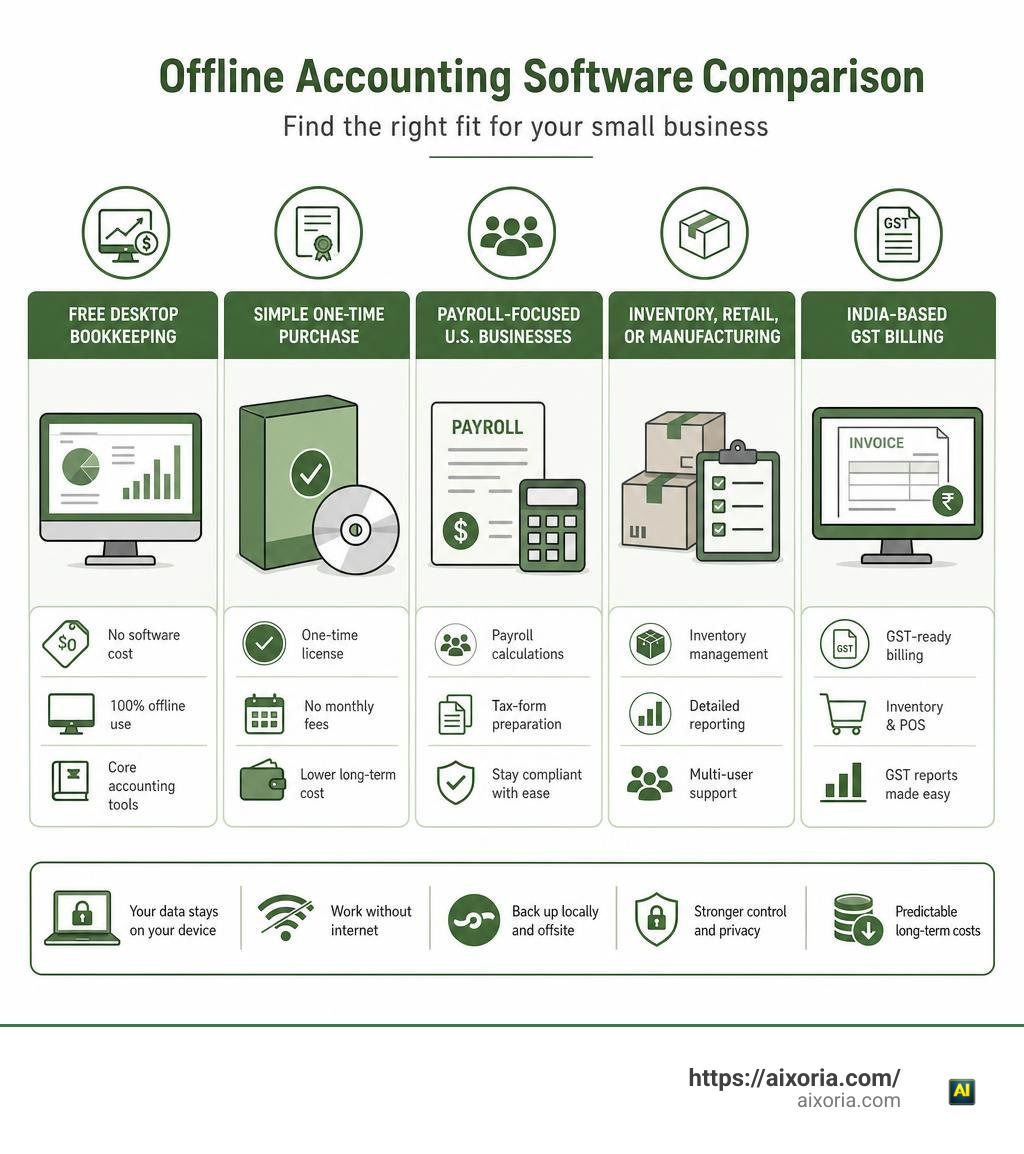
| Best fit | Offline accounting software to consider | Why it stands out |
|---|---|---|
| Free desktop bookkeeping | GnuCash or Manager.io | Local use, no software cost, and core accounting tools |
| Simple one-time purchase | Moneydance, LedgerLite, MapleBooks, or CoreBooks | Lower upfront cost and no required monthly fee |
| Payroll-focused U.S. businesses | indiAccounting with indiPayroll | Desktop accounting plus payroll calculations and tax-form preparation |
| Inventory, retail, or manufacturing | TallyPrime or DENALI Business | More robust inventory, reporting, and multi-user options |
| India-based GST billing | BizKhata | Offline billing, inventory, POS, and GST-focused workflows |
Offline software is not automatically safer or cheaper in every situation. It shifts responsibility to the business: you need secure devices, strong passwords, user permissions, and regular local and offsite backups. But for owners who value privacy, predictable costs, and the ability to work during an outage, it can be a practical alternative to cloud-only accounting.
This guide explains how to compare the leading options, choose the features that matter, and move your records without losing critical financial history.
Why Choose Offline Accounting Software Over Cloud Solutions?
When evaluating what is the best offline accounting software for small businesses, it helps to understand why so many business owners are turning away from subscription-based cloud platforms. Over the past few years, web-based accounting solutions have shifted toward monthly price hikes and mandatory cloud storage. While cloud software offers easy remote logins, it also locks your essential financial data behind ongoing payments.
In contrast, desktop accounting software operates locally on your machine. You do not need an active internet connection to generate sales invoices, calculate balances, or close out your monthly ledgers. This internet independence ensures uninterrupted operations even during power outages, remote travel, or broadband downtime.
Furthermore, total cost of ownership (TCO) heavily favors local installations over a multi-year timeline. Cloud tools charging $30 to $100+ per month quickly add up to thousands of dollars over three to five years. Perpetual licensing models allow you to buy the software once and run it indefinitely.
| Feature / Metric | Offline Desktop Accounting | Cloud-Based SaaS Accounting |
|---|---|---|
| Data Storage | Encrypted local hard drive / local server | Vendor-hosted cloud servers |
| Internet Requirement | None (100% offline functionality) | Constant, stable connection required |
| Pricing Model | One-time perpetual license or free open-source | Monthly or annual recurring subscription |
| 3-Year TCO | $0 to $300 total | $1,000 to $3,500+ total |
| Data Control | Absolute physical ownership of database files | Subject to vendor platform access and service terms |
| Price Predictability | Locked upfront cost; zero surprise increases | Frequent annual subscription rate increases |
Core Advantages of Local Data Storage
Local data storage gives you complete ownership of your company’s general ledger. When financial records reside locally in standard formats like SQLite or PostgreSQL databases, third parties cannot hold your data hostage or lock you out of your records if a service subscription lapses.
From a data privacy standpoint, keeping books offline removes entire vectors of cloud data breaches and external cyberattacks. Financial data never leaves your local drive. This is especially vital for businesses handling sensitive client details, proprietary cost structures, or confidential contractor registers.
Comparing Long-Term Costs and Data Control
The contrast in long-term financial investment between perpetual licenses and subscription models is stark. For instance, single-user perpetual licenses for tools like Moneydance start as low as $65, while solutions such as CoreBooks — Accounting Software You Actually Own provide a comprehensive desktop double-entry ledger for a $249 one-time fee. Over a five-year period, a business using a $249 one-time purchase saves thousands of dollars compared to cloud subscriptions charging $38 per month ($2,280 over five years).
In addition to direct cost savings, local accounting software provides essential administrative protections such as lock periods. Lock periods prevent team members or historical entries from altering closed accounting periods once financial reports have been verified. This ensures strict compliance standards, simplified auditing, and clean paper trails for your tax CPA.
Key Features to Look For: What is the Best Offline Accounting Software for Small Businesses?
Finding what is the best offline accounting software for small businesses requires looking past flashy graphics to focus on core financial controls. At minimum, any desktop tool you select must support true double-entry bookkeeping—every transaction must record equal debits and credits across a customizable Chart of Accounts.
Key functionality to insist on includes:
- General Ledger & Trial Balance: Real-time balancing checks to ensure accuracy across assets, liabilities, equity, revenue, and expenses.
- Bank Statement Reconciliation: The ability to import bank feeds via standard CSV or OFX statement files, matching transactions to a zero-dollar variance.
- Local Database Backups: One-click or automated local file creation for safe archiving on external drives or local network storage.
- Period Locking: Strict controls that prevent retroactive edits to past accounting dates after year-end closing.
- Tamper-Evident Audit Trails: System logs that record voucher creation, edits, and voiding actions without allowing complete record deletion.
Financial Reporting and Multi-Currency Accounting: What is the Best Offline Accounting Software for Small Businesses?
Comprehensive financial reports are vital when sharing figures with banks, investors, or tax authorities. Your chosen tool should generate standard Profit and Loss statements, Balance Sheets, General Ledgers, and Cash Flow summaries instantly.
For companies operating internationally or serving overseas clients, multi-currency support is indispensable. Solutions like MapleBooks offer native support for over 150 currencies and multiple user languages. A quality multi-currency engine automatically calculates exchange rate gains and losses upon transaction closing, keeping your local currency general ledger accurate regardless of international market shifts.
Local Payroll Processing and Tax Compliance Capabilities
Processing employee wages without cloud dependencies can be tricky due to changing regional tax brackets. However, specialized offline programs directly bridge this gap.
For example, indiAccounting — Small Business Accounting — Indomitus Group offers a base accounting package for $249, with an optional $299 indiPayroll add-on (plus an optional $99 annual tax update fee) that calculates full 50-state U.S. payroll. Rather than merely producing summary reports, it populates figures directly onto official government tax PDFs—such as IRS Forms 941, 940, W-2, and 1099-NEC—and generates EFW2 electronic wage files locally on your machine.
For Indian enterprises, platforms like BizKhata — Offline GST Billing Software for Windows & Mac | 10 Languages provide offline GST billing starting at a one-time price of ₹3,999 for its Pro Lifetime plan. It manages localized tax calculations, POS barcode printing, thermal receipts, and 10 regional languages without needing internet connectivity.
How to Evaluate Pricing and Deployment Models for Offline Bookkeeping
Evaluating software costs involves looking at initial software acquisition, system resource demands, hardware infrastructure, and ongoing maintenance. Desktop programs typically fall into three primary deployment categories:
- Free & Open-Source Software: Entirely zero-cost tools maintained by open-source communities.
- Perpetual One-Time Purchase Software: Commercial licenses where you pay once and own that software version permanently.
- Hybrid & LAN-Based Desktop Platforms: Solutions that run on desktop architecture but offer local network synchronization or optional local AI features.
Free and Open-Source Desktop Accounting Systems
If operating on a tight budget, free open-source tools provide surprisingly sophisticated feature sets. GnuCash is a well-known open-source desktop solution that runs natively across Windows, macOS, and Linux. It supports complete double-entry bookkeeping, split checkbook transactions, custom ledgers, and scheduled financial entries without charging software fees.
Similarly, Manager.io offers a completely free desktop version for single users without artificial time limits or transaction caps. Odoo Community Edition provides basic offline invoicing and payment management for tech-savvy teams capable of managing local open-source installations.
One-Time Lifetime Licenses and Modern Desktop Solutions
Commercial desktop platforms deliver polished user interfaces, streamlined installation wizards, and dedicated customer support. LedgerLite starts at a $149 perpetual license fee, offering a straightforward checkbook and ledger format. High-end mid-market tools like DENALI Business Software start around $1,999 for perpetual setup, catering to advanced inventory and audit needs. Meanwhile, specialized mid-tier options like TallyPrime offer single-user Silver licenses at $855 and multi-user Gold licenses at $2,565.
Modern tools also combine desktop power with long-term price security. For instance, Kantivo — Desktop Accounting Software with a 12-Year Price Lock pairs modern PostgreSQL database performance with a 12-year price lock guarantee starting around $299 per year. For businesses wanting modern automation, software options like AI Accounting Software — GST & VAT Compliant | Dictode feature local desktop installations that run localized AI assistance for ledger predictions and receipt parsing directly on standard Windows and Mac hardware.
Additionally, tools like CoreBooks feature local browser-based interfaces for local office environments. Using LAN Multi-User mode, up to three computers connected to the same local area network can collaborate simultaneously on a single desktop database without exposing financial data to external cloud servers.
Migration Guide: How to Transition from Cloud Accounting to Offline Systems
Transitioning from a cloud SaaS provider back to an offline desktop platform requires methodical planning to preserve your historical financial data.

Step-by-Step Data Export and System Setup
Moving your records can be broken down into clear, structured steps:
- Perform a Complete Cloud Data Export: Download all Chart of Accounts, vendor directories, customer rosters, open receivables, unpaid payables, and detailed item lists into clean CSV or Excel files.
- Establish a Clean Cut-Off Date: Choose an accounting cut-off point—such as the end of a fiscal quarter or fiscal year—to minimize active mid-period adjustments.
- Map the Chart of Accounts: Open your new offline desktop software and align its Chart of Accounts structure to match your previous setup, ensuring account numbers and sub-accounts balance properly.
- Import Opening Balances and Historical Records: Use desktop import wizards to load customer contacts, vendor balances, item catalogs, and opening trial balances.
- Reconcile Past Statements: Run trial balance reports and compare them line-by-line against your historical cloud reports to verify that assets, liabilities, and retained earnings match to the cent.
Mitigating Offline Software Limitations
While local desktop software excels in privacy and cost, it lacks automatic cloud redundancy. Mitigating these limitations requires disciplined internal practices:
- Automate Local Backups: Schedule automated daily database backup scripts to local external drives or secondary storage devices.
- Implement Physical Hardware Redundancy: Use Uninterruptible Power Supplies (UPS) and Solid-State Drives (SSDs) configured in RAID arrays to protect local databases from hardware failure.
- Enforce Role-Based Access Controls: Protect your desktop workstation with strong operating system credentials, PIN app locks, and restricted multi-user permissions so staff members only see relevant modules.

Frequently Asked Questions About Desktop Bookkeeping
What is the best offline accounting software for small businesses needing tax compliance?
For U.S. small businesses that handle internal payroll and tax reporting locally, indiAccounting combined with indiPayroll is a strong option. It calculates 50-state payroll taxes and populates official federal IRS PDF forms (941, 940, W-2, 1099) directly on your local computer. For international tax standards, Dictode supports region-aware GST, VAT, and ZATCA e-invoicing, while BizKhata offers offline GST billing and regional compliance for Indian enterprises.
Can offline accounting software work across multiple computers without cloud hosting?
Yes. Several desktop platforms support local network operations. CoreBooks features a built-in LAN Multi-User mode that allows up to three local devices on the same Wi-Fi or Ethernet network to access the master accounting file through a local browser address. Mid-market software like TallyPrime Gold Edition also supports local multi-user client-server setups across on-premise office networks without needing public internet hosting.
What happens to financial records if local desktop hardware crashes?
Because offline software stores data directly on your hard drive (often in single database files like SQLite or PostgreSQL), a hardware crash without a backup can result in data loss. You can easily prevent this risk by storing regular, automated backup files on external flash drives, network-attached storage (NAS) devices, or encrypted local backup drives. If a computer fails, you simply reinstall the desktop software on a replacement machine and restore your latest backup file in seconds.
https://www.mediafire.com/file/glv16d1vr4dyfme/SplitBlocks_BY_MCMPDL.mcaddon/file“
Conclusion
Choosing the right financial management stack comes down to balancing cost predictability, operational reliability, and absolute data control. Understanding what is the best offline accounting software for small businesses allows you to break free from monthly software rent, shield your general ledger from internet disruptions, and maintain strict data privacy.
Whether you choose a free open-source solution like GnuCash, a dedicated desktop system like CoreBooks or MapleBooks, or a payroll-equipped platform like indiAccounting, desktop software puts you in total control of your business numbers. Pairing solid local financial controls with modern office automation tools ensures your business operates efficiently on your own terms. Explore the best AI tools for productivity to discover additional smart tools that streamline your daily operations.