Why Finding the Best AI for Mental Health Matters in 2026

The best AI for mental health support in 2026 comes down to a handful of standout tools — each built for different needs:
| App | Best For | Free Tier |
|---|---|---|
| Flourish | Clinically validated all-around support | Yes |
| Wysa | Hybrid AI + human coaching | Yes |
| Ash | Emotional pattern recognition | Yes |
| Noah AI | Voice-based instant support | Yes |
| Nora | Full anonymity, 55+ languages | Yes |
It’s 11 p.m. You’ve had a brutal day. Your therapist isn’t available until next week. So you open an app — and something actually helps.
That’s the promise of AI mental health tools. And in 2026, millions of people are taking it seriously.
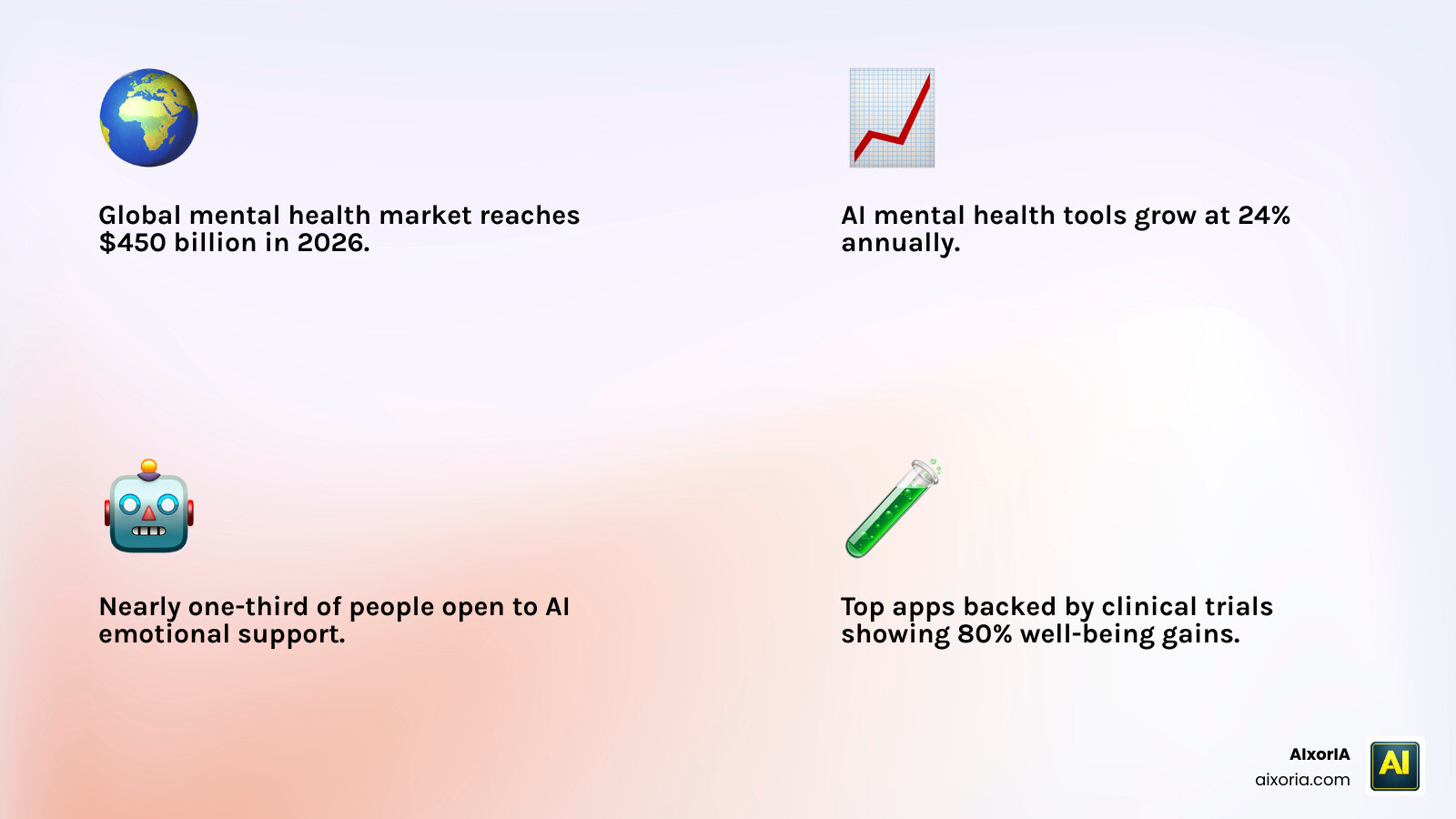
The global mental health market has hit $450 billion. The AI slice of that is growing at 24% per year. And nearly a third of people worldwide say they’re open to using AI for emotional support.
But here’s the thing: not all apps are equal. Some are backed by rigorous clinical trials. Others are little more than chatbots with a calming color palette. Choosing the wrong one isn’t just a waste of money — in some reported cases, poorly designed AI tools have actually made things worse.
This guide cuts through the noise so you can find what actually works.
Top-Rated Tools: Finding the Best AI for Mental Health in 2026
Navigating the landscape of digital wellness can feel like trying to choose a streaming service—there are too many options, and they all claim to have the “best” content. However, when it comes to your mind, the stakes are higher. In our testing and research, a few platforms consistently rise to the top.
If you are looking for a deep dive into the current leaders, we recommend checking out our detailed review of the Best Ai For Mental Health 2026 Top 5 Support Tools Tested Reviewed/.
Flourish is currently a heavyweight in the industry. It isn’t just a chatbot; it’s a platform backed by multiple randomized controlled trials (RCTs). It focuses on evidence-based Cognitive Behavioral Therapy (CBT) and Acceptance and Commitment Therapy (ACT) to help users build resilience.
Wysa continues to be a global favorite, having helped over 5 million users across 90 countries. It excels at a “hybrid” model, offering an AI penguin companion for daily check-ins while allowing users to escalate to human coaches if needed.
Noah AI Therapist has carved out a niche as the gold standard for those who prefer talking over typing. It offers instant voice-based therapy designed by licensed psychologists to provide real-time support during moments of high distress.
Ash and Youper are the “smart” companions of the bunch. Ash focuses on emotional intelligence, using proprietary psychology data to identify patterns in your behavior over time. Youper, which has over 2 million users, was highlighted in a Stanford study where 80% of users reported improved well-being through its personalized interventions.
Finally, Headspace remains the king of mindfulness. With over 100 million users, it has integrated AI to help tailor meditation and sleep journeys to your specific mood and stress levels.
Best AI for Mental Health for Anonymity and Voice
For many of us, the biggest barrier to therapy is the fear of being judged or the “paper trail” of personal data. This is where Nora- Anonymous AI Therapy stands out. Nora is built on a “privacy-first” architecture where data often stays on the device. It supports over 55 languages, making it incredibly accessible for non-English speakers. Impressively, 93% of Nora users report feeling more optimistic after just five sessions.
If you are looking for a companion that truly “listens” to the nuances of your voice, Rhea – AI Mental Health Companion and Noah AI Therapist are leading the charge in voice analysis. These tools can detect signs of stress or fatigue in your tone, offering a more “human” feel than a standard text bot. Rhea specifically focuses on untangling complex emotions through deep, guided questioning.
Selecting the Best AI for Mental Health for Your Specific Needs
The “best” app depends entirely on what you’re facing at 2:00 AM:
- For Anxiety and Panic: Noah AI’s instant voice call feature is designed to ground you during a panic attack using real-time therapeutic techniques.
- For Daily Stress and Habit Building: Flourish and Wysa offer structured exercises to help you reframe negative thoughts before they spiral.
- For Privacy and Casual Venting: Ava Mind | Free AI Mental Health App for Online Support & Therapy Tools is a fantastic free option that requires no sign-up. It’s perfect for those “in-between” moments where you just need to get a thought out of your head without a long-term commitment.
- For Emotional Tracking: Ash is excellent at looking back over your week and saying, “Hey, I noticed you feel most stressed on Tuesday afternoons—let’s look at why.”
Scientific Validation and Clinical Efficacy
We live in an era where “trust me” isn’t enough. The best AI for mental health tools in 2026 are those that put their money where their mouth is regarding science.
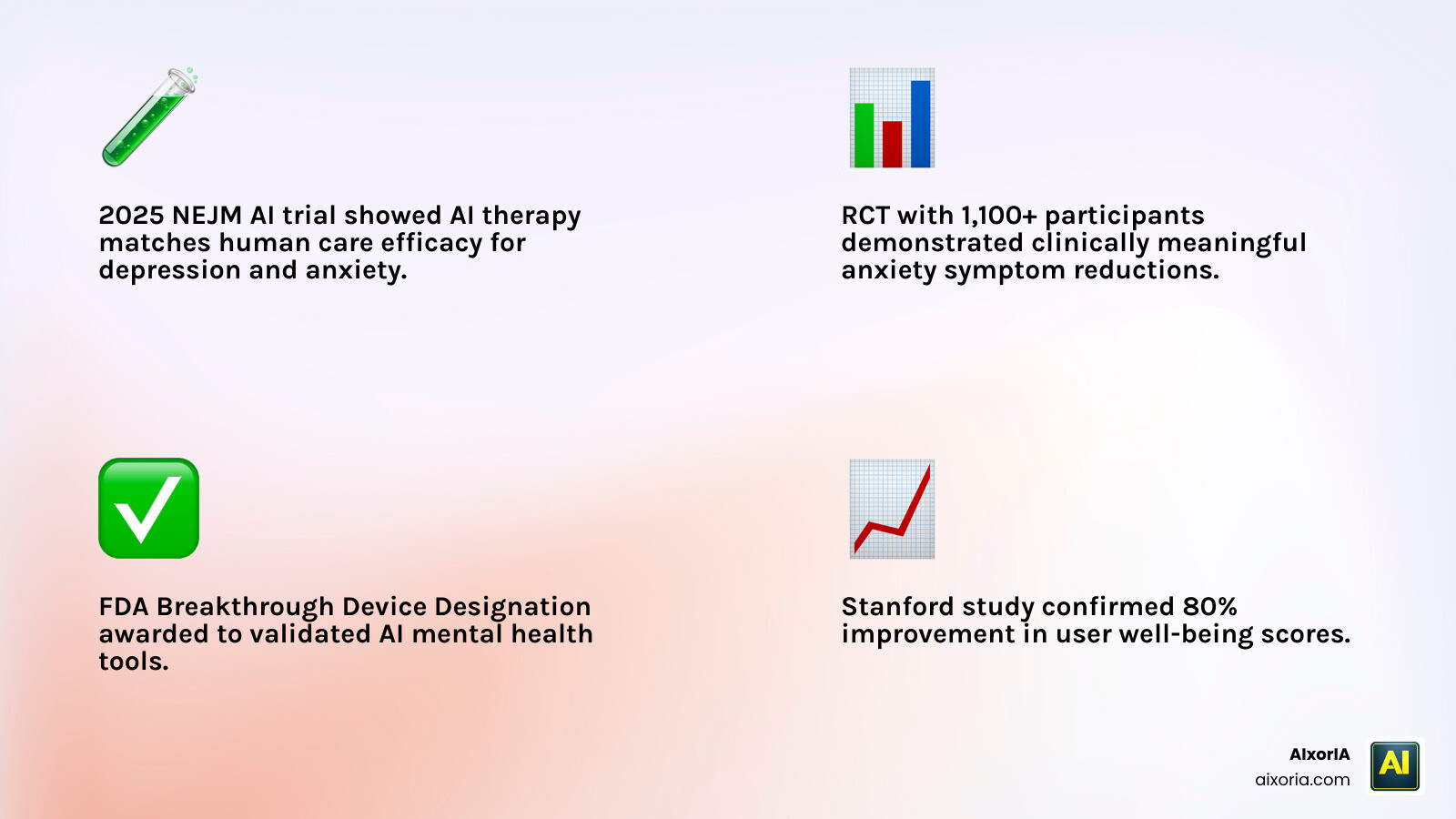
A landmark 2025 randomized controlled trial published in NEJM AI proved that well-designed AI therapy can be just as effective as human-delivered care for certain levels of depression and anxiety. This isn’t just a tech trend; it’s a clinical shift.
- Flourish led the way with an RCT involving over 1,100 participants, showing clinically meaningful reductions in anxiety symptoms.
- Woebot (now primarily an enterprise tool) previously received FDA Breakthrough Device Designation for its work on postpartum depression.
- Youper has been validated by Stanford researchers, proving that AI can actually help users recognize emotional patterns better than they do on their own.
For those interested in the deeper science, you can explore more Scientific research on AI therapy effectiveness. The consensus is clear: when AI is built by clinicians rather than just software engineers, the results are life-changing.
Key Features and Therapeutic Approaches
What makes these bots more than just a “search engine with a personality”? It’s the therapeutic frameworks they use. Most top apps utilize:
- CBT (Cognitive Behavioral Therapy): Helping you catch and “reframe” negative thought loops.
- ACT (Acceptance and Commitment Therapy): Teaching you to accept your thoughts without letting them control you.
- Positive Psychology: Focusing on strengths and gratitude to build long-term happiness.
Modern tools like Milo – Your Free AI Therapist | 24/7 Mental Health Support | Milo – AI Therapy provide a judgment-free space that feels like talking to a thoughtful friend. Milo is particularly good at breaking big, scary feelings into “manageable pieces,” which is often the hardest part of mental health maintenance.
We are also seeing a move toward multimodal integration. This means the AI doesn’t just read your text; it can analyze your voice, track your sleep patterns, and even integrate with your wearable devices to see how your heart rate correlates with your mood.
Privacy, Ethics, and Safety Safeguards
We cannot talk about the best AI for mental health without talking about safety. Your mental health data is some of the most sensitive information you own.
In 2026, the American Psychological Association has set strict guidelines for these tools. When choosing an app, we always tell our clients to look for:
- End-to-End Encryption: This ensures that only you and the AI can “read” your conversations.
- HIPAA Compliance: Especially important if the app shares data with your actual doctor or therapist.
- Crisis Protocols: A good AI knows when it’s out of its depth. If you mention self-harm or a crisis, the bot should immediately provide human-operated emergency resources like the 988 lifeline.
- Anonymity: Apps like Nora allow you to seek help without even providing your real name.

Frequently Asked Questions about AI Therapy
Can AI replace a human therapist?
In short: No. And it shouldn’t try to. The most effective use of AI is as complementary care. AI is amazing for 3:00 AM support, daily habit tracking, and practicing CBT skills. However, for “high-acuity” conditions—like severe trauma, complex PTSD, or active crisis—the “therapeutic alliance” with a human professional is essential. Think of AI as your “emotional first aid kit” and a human therapist as your “surgeon.”
How much do these apps cost in 2026?
Pricing is all over the map, but generally more affordable than traditional therapy (which can cost $150+ per hour).
- Free Tiers: Most apps (Milo, Ava Mind, Nora) offer a robust free version.
- Subscriptions: Premium tiers, like Wysa’s, often run around $74.99 per year.
- Insurance: By 2026, many forward-thinking insurance providers have started covering “digital therapeutics” as part of their wellness plans.
Is my data safe with mental health chatbots?
Most reputable apps use bank-level encryption. However, always read the privacy policy. Avoid apps that “sell anonymized data to third parties” for advertising. The best AI for mental health tools, like Noah AI or Nora, prioritize a privacy-first design where your data is treated with the same respect as a medical record.
Conclusion
The journey to better mental health doesn’t have to be a lonely one. Whether you’re untangling work stress at midnight or managing long-term anxiety, the AI tools of 2026 offer a level of support that was unimaginable just a few years ago.
At AIxorIA, we believe technology should serve humanity, especially in our most vulnerable moments. We specialize in providing custom AI solutions and tool training workshops that are easy to understand and affordable. If your business or organization is looking to implement AI tools or needs a performance audit to ensure you’re using the most effective technology, we’re here to help with fast customer support and simple language.
Ready to explore how AI can empower your life or business? Visit us at https://aixoria.com/ to learn more. Your path to clarity and growth is just a conversation away.