AI Detection in the Classroom Is No Longer Optional
Scr0ll d0wn to D0VVNL0AD
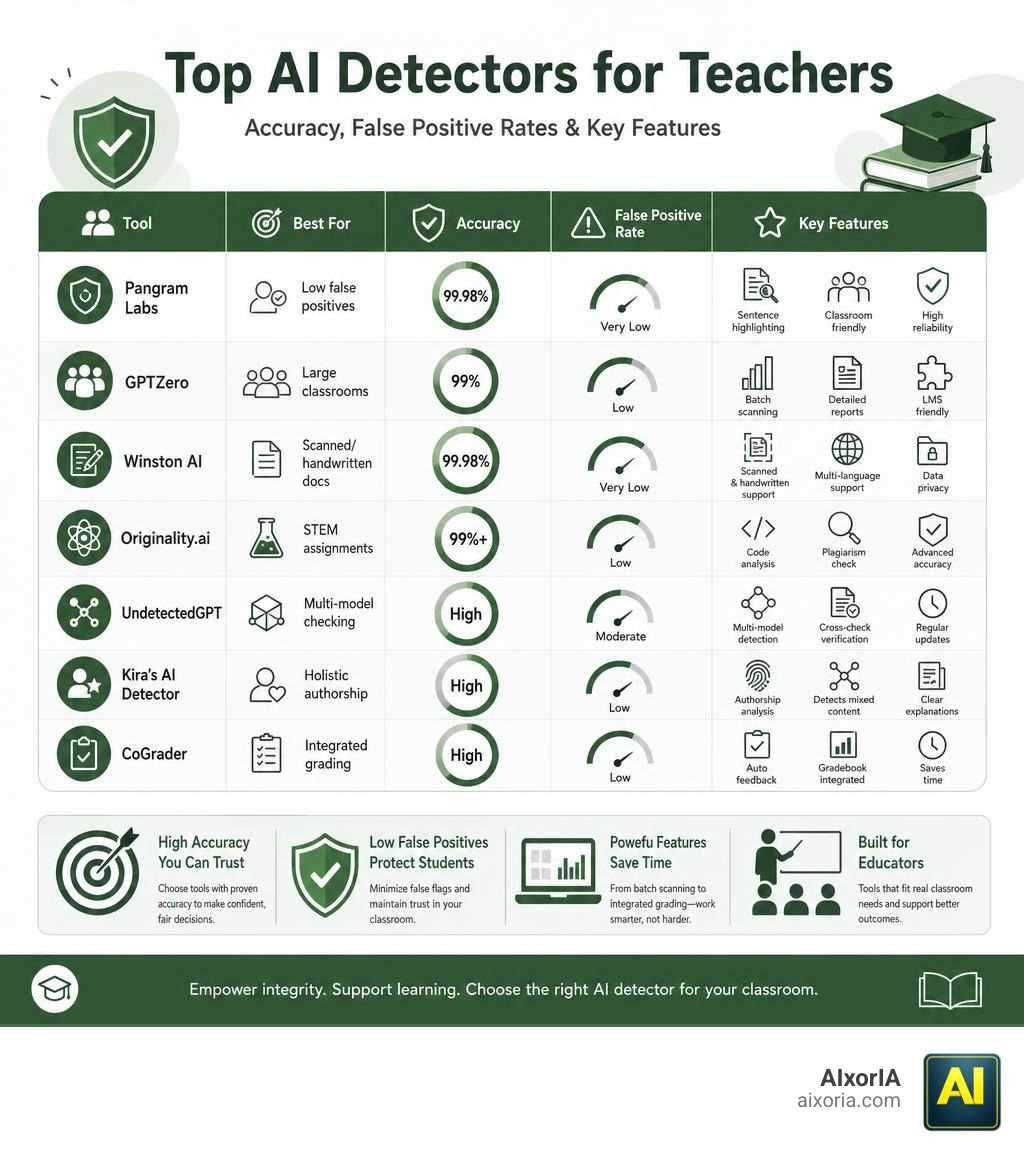
Finding the best AI content detectors for teachers doesn’t have to be overwhelming. Here’s a quick look at the top picks for 2026:
| Tool | Best For | Accuracy | Free Tier |
|---|---|---|---|
| Pangram Labs | Low false positives | 99.98% | Yes |
| GPTZero | Large classrooms | 99% | Yes |
| Winston AI | Scanned/handwritten docs | 99.98% | Limited |
| Originality.ai | STEM assignments | 99%+ | No |
| UndetectedGPT | Multi-model checking | High | Yes |
| Kira’s AI Detector | Holistic authorship | High | Yes |
| CoGrader | Integrated grading | High | Yes |
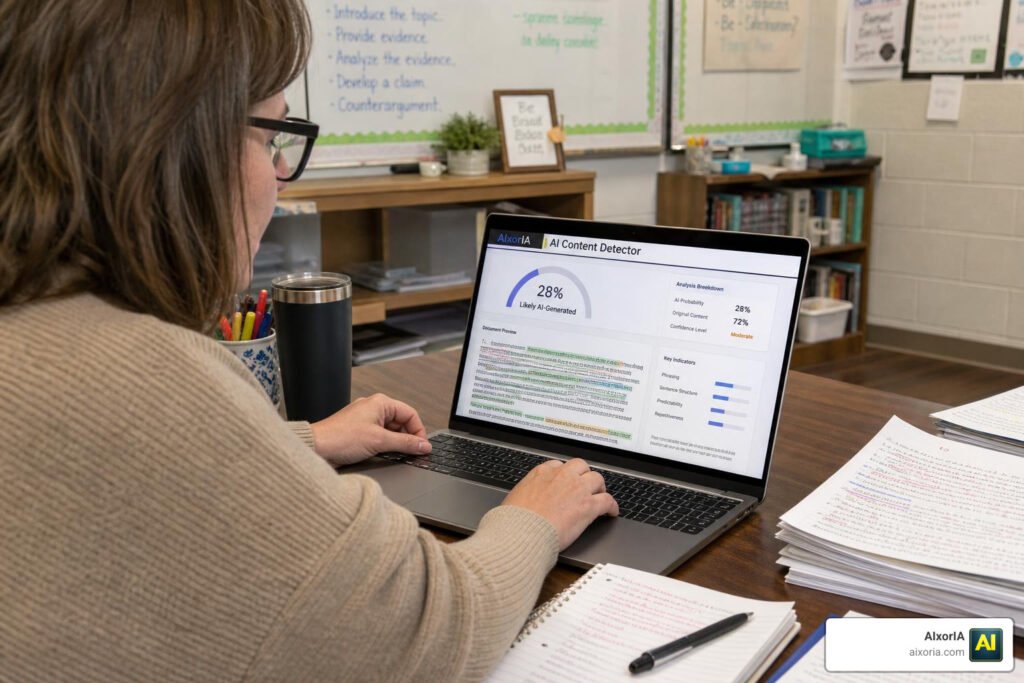
Nearly 91% of students admit to using some form of AI for assignments. That’s not a future problem — it’s happening right now, in every grade level, across every subject.
Teachers are caught in a tough spot. Accuse the wrong student and you damage trust. Miss the AI-generated work and you undermine the entire point of the assignment.
The good news? A new generation of AI detection tools is built specifically for educators. They go far beyond a simple “AI or human” verdict. The best ones highlight which sentences look AI-generated, flag mixed authorship, and even replay how a student wrote their essay in real time.
This guide compares the top tools so you can find the right fit for your classroom — whether you grade handwritten papers, run a university seminar, or manage 150 student submissions a week.
Why Educators Need the Best AI Content Detectors for Teachers
The classroom landscape in 2026 has shifted dramatically. With 44% of K-12 teachers in the U.S. reporting that 90% of their students are using AI for homework, and nearly 84% of high school students using generative AI for schoolwork, traditional grading methods are facing unprecedented challenges.
When students outsource their writing to generative models like GPT-5, Claude, or Gemini, they bypass the critical cognitive development that happens during the writing process. Writing is thinking; when we lose the writing process, we risk losing the development of critical thought.
Educators do not need these tools to act as “gotcha” machines. Instead, they need them to verify the writing process and protect academic integrity. The best AI content detectors for teachers serve as an objective starting point for constructive student-teacher conversations, helping educators understand where a student might have leaned too heavily on automated help.
Top AI Content Detectors for Classrooms Reviewed
Evaluating these tools requires looking at more than just a single accuracy percentage. We evaluated the top options on their false positive rates, ease of use, and specialized classroom features.
Pangram Labs: The Best AI Content Detectors for Teachers Seeking Low False Positives
For teachers, a false positive—wrongly accusing a student of cheating—is the absolute worst-case scenario. Pangram Labs addresses this head-on with its proprietary Hard Negative Mining technology, which reduces the false positive rate to an astonishing 1 in 10,000.
- Key Features: Sentence-level highlighting, mixed-authorship detection, and adversarial training designed to spot paraphrased or “humanized” AI essays.
- Accuracy: 99.98% on fully AI-generated content.
- Compliance & Security: Fully SOC 2 Type 2 certified and FERPA compliant. Student essays are never used to train their models.
- Why Teachers Love It: In surveys, 95% of teachers say Pangram’s detection is the most accurate, and 93% recommend its transparency tool. Furthermore, 86% of teachers report that Pangram facilitated better student-teacher conversations about AI use.
GPTZero: The Best AI Content Detectors for Teachers Managing Large Classrooms
GPTZero is one of the most widely adopted tools in education, trusted by over 380,000 educators and partner school systems globally. It is built to handle the sheer volume of a busy school week.
- Key Features: Google Docs integration with a “writing process replay” that lets you watch a student’s document history step-by-step.
- Multi-Language & ESL Support: Features debiased detection models specifically calibrated to protect ESL (English as a Second Language) students from being falsely flagged.
- Community Focus: Over 1,000 teachers have completed GPTZero’s official webinar series, earning professional development certificates.
Winston AI: Best for Scanned and Handwritten Documents
If your students still turn in physical papers, blue books, or scanned PDFs, Winston AI is the premier choice. Trusted by over 10 million users, it is one of the few platforms featuring highly advanced Optical Character Recognition (OCR) technology.
- Key Features: Scans hand-written documents, printed sheets, and PDFs directly from photos or uploads.
- Languages: Supports 13 languages including English, Spanish, French, German, and Portuguese.
- Integrations: Includes a built-in plagiarism checker alongside its 99.98% accurate AI detector.
Originality.ai: Best for STEM and Academic Models
Originality.ai offers an incredibly robust “Academic Model” designed specifically to handle the nuances of research papers, STEM assignments, and complex technical writing.
- Key Features: Optimized for detecting AI-generated coding, formulas, and STEM assignments.
- Flexible Modes: Features “Lite” mode (which allows minor AI editing like Grammarly corrections) and “Turbo” mode (for strict zero-tolerance policies).
- Accuracy: Boasts 99.6% accuracy on GPT-5 and 99.8% accuracy on DeepSeek V3.1 Chat, with a false positive rate under 1%.
UndetectedGPT: Best Multi-Model Aggregator
Rather than relying on a single detection algorithm, UndetectedGPT aggregates signals from multiple engines to give a balanced, multi-perspective verdict.
- Key Features: Sentence-by-sentence analysis that visually highlights exactly where a student transitioned from their own voice to AI-generated text.
- ESL Safeguards: Actively mitigates false positives by scanning for patterns common to non-native English writers.
- Try It: Teachers can access the free scanning tool directly via the UndetectedGPT’s AI Detector for Teachers.
Kira’s AI Detector: Best Human-Centered Authorship Checker
Kira’s AI Detector approaches writing analysis from a holistic, behavioral standpoint rather than just counting vocabulary frequencies.
- Key Features: Analyzes paragraph rhythm, tonal shifts, citation inconsistencies, and narrative texture.
- Workflow Integration: Embedded directly into Kira’s Essay QuickGrader tool, allowing teachers to evaluate authorship and grade rubrics simultaneously.
- Try It: You can access this free behavioral checker at Kira’s AI Detector for Educators.
CoGrader: Best Integrated Grading Assistant
CoGrader is an all-in-one grading platform that integrates AI detection directly into your existing grading workflow.
- Key Features: Integrates seamlessly with Canvas, Google Classroom, and Schoology to batch-process entire classes at once.
- Holistic Grading: Analyzes document edit history while providing rubric-based grading feedback that teachers can review and adjust.
- Try It: Streamline your grading pipeline by visiting CoGrader’s AI Detector and Grading Assistant.
Key Features and Best Practices for Classroom Integration
Using an AI detector effectively requires a thoughtful approach. Here are the best practices we recommend for integrating these tools into your workflow:
- Focus on Sentence-Level Analysis: Avoid using binary “AI vs. Human” scores to penalize students. Look at sentence-level highlighting to see if a student used AI to brainstorm specific sections while writing the rest themselves.
- Protect ESL Students: Traditional detectors often flag ESL writing as AI because non-native speakers tend to use highly structured, predictable phrasing. Always cross-check flagged work with tools like GPTZero or Pangram that feature debiased ESL algorithms.
- Use Writing Replays: Whenever possible, encourage students to write in environments like Google Docs where you can review the edit history. A genuine human-written essay will show a natural history of deletions, pauses, and rephrasings.
- Set Clear Syllabus Policies: Define exactly what is allowed. Is Grammarly okay? Is brainstorming with ChatGPT permitted? Establish these boundaries on day one.
Frequently Asked Questions about AI Detection in Education
Can AI detectors accurately identify content from GPT-5, Claude, and Gemini?
Yes. While LLMs are becoming increasingly sophisticated, they still rely on mathematical probability to choose the next word. The best detectors use adversarial training and update their algorithms weekly to recognize the underlying linguistic patterns of GPT-5, Claude, and other advanced models.
How do AI detectors handle ESL student writing and Grammarly edits?
Basic detectors struggle with these, often generating false positives. However, leading tools now feature specific “Lite” models or debiased algorithms. These are trained to ignore standard spelling/grammar corrections (like those from Grammarly or QuillBot) while still flagging fully generated AI text.
Are student data and privacy protected under FERPA and GDPR?
The top-tier tools reviewed in this guide (such as Pangram, GPTZero, and CoGrader) are FERPA compliant and SOC 2 certified. They encrypt student data in transit and at rest, and explicitly promise never to use student submissions to train their AI models.
Conclusion
AI is here to stay, but it doesn’t have to spell the end of original student writing. By choosing the right tool for your classroom’s unique needs, you can protect academic integrity while fostering transparent, honest conversations with your students.
At AIxorIA, we believe in making technology work for you, not against you. If you want to dive deeper into implementing these tools or setting up AI guidelines for your school, check out AIxorIA’s AI tutorials and workshops for simple, affordable, and practical guidance.
1 thought on “Best AI Content Detectors for Teachers”