The Best AI Chatbots in 2026: A Quick-Start Guide for Busy Business Owners

Finding the best AI chatbots in 2026 doesn’t have to be overwhelming. Here’s a quick snapshot before we dive deeper:
| Chatbot | Best For | Free Plan | Starting Price |
|---|---|---|---|
| ChatGPT (GPT-5.5) | General use, agentic tasks | Yes | $8/mo |
| Claude (Opus 4.7 / Sonnet 4.6) | Coding, writing, long-context work | Yes | $17/mo |
| Google Gemini 3.1 | Research, Google Workspace users | Yes | $7.99/mo |
| Microsoft Copilot | Microsoft 365 teams | Yes | $31.50/mo |
| Perplexity | Real-time research, fact-checking | Yes | $17/mo |
| DeepSeek | Budget-conscious teams, reasoning | Yes | $0.07/mo |
| Grok | X/Twitter users, open reasoning | Yes | Varies |
The AI chatbot market is projected to hit $11.8 billion in 2026, and nearly 987 million people now use one regularly. That’s not a trend — that’s a shift in how work gets done.
But here’s the problem most small business owners run into: there are too many options, too many claims, and too little time to test them all.
You’ve probably already heard of ChatGPT. Maybe your team is using Copilot. Maybe a competitor mentioned Claude. It gets noisy fast.
What actually matters is simple: which chatbot saves you the most time, fits your budget, and works with the tools you already use?
That’s exactly what this guide answers — no hype, no tech jargon, just clear comparisons built for business owners who need results, not a PhD in AI.
The market has also shifted fast in 2026. ChatGPT’s share dropped from 45.3% to 38.1% between January and April 2026. Claude surged from 1.5% to 13.1% in the same period. The old default answers no longer hold.
Market Landscape: Evaluating the Best AI Chatbots in 2026
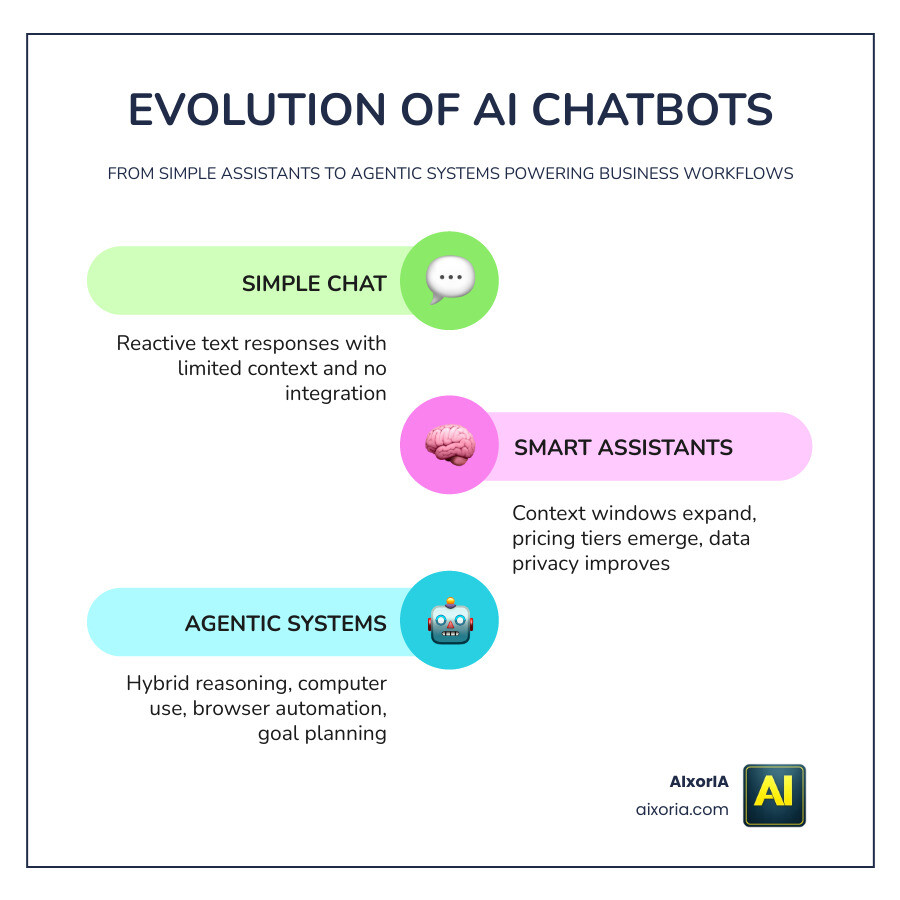
The AI chatbot landscape has matured from simple, reactive text boxes into highly integrated productivity hubs. The global chatbot market size is projected to reach $12.98 billion by the end of 2026, growing at a rapid Compound Annual Growth Rate (CAGR) of 24.8% from $8.27 billion in 2024.
What is particularly fascinating is how our relationship with these tools is changing. While casual user growth has leveled off slightly, high-frequency “power users” are locking in. High-frequency AI users grew from 6.8% to 8.5% of the total user base between December 2025 and April 2026. Once someone becomes a heavy user, they rarely go back—about 68% of these high-frequency users stay in that category month-over-month.
To help you navigate this crowded market, we have mapped out how the top contenders stack up across key business criteria:
| Chatbot | Primary Strength | Starting Price | Context Window | Key Integration |
|---|---|---|---|---|
| ChatGPT | Multi-tool orchestration & agentic tasks | $8/month (Plus starts at $20) | 128k tokens | Custom GPTs, Web |
| Claude | Advanced coding, writing, and long documents | $17/month | 1 Million tokens (beta) | GitHub, API, Desktop |
| Google Gemini | Multi-modal research & Workspace tasks | $7.99/month | 2 Million tokens | Google Workspace |
| Microsoft Copilot | Corporate document management | $31.50/month | 128k tokens | Microsoft 365 |
| Perplexity | Deep internet research | $17/month | Variable | Web Search Engines |
| DeepSeek | Highly affordable deep reasoning | $0.07/mo (Pay-as-you-go) | 128k tokens | API, Developer Tools |
How the Best AI Chatbots in 2026 Compare in Market Share
The competitive landscape is no longer a monopoly. According to the Gen AI Chatbots: May 2026 Apptopia Data Brief, daily active users (DAUs) in the US contracted slightly by 1.5% month-over-month in April 2026. However, the market share distribution tells the real story of this year’s intense rivalry.
ChatGPT, while still the market leader, saw its dominant market share slip from 45.3% in January 2026 to 38.1% in April 2026. Meanwhile, Anthropic’s Claude has been on an absolute tear, skyrocketing from a tiny 1.5% market share in January to a substantial 13.1% in April 2026. Users are increasingly realizing that while ChatGPT is an excellent generalist, Claude’s superior writing nuance and coding intelligence make it a formidable alternative. If you are trying to decide on an all-rounder, checking out our guide on what is the best AI tool for general use in 2026 can help clarify your team’s starting point.
Key Evaluation Criteria for Modern Chatbots
When we evaluate the best AI chatbots in 2026 for business use, we look beyond basic conversation. We focus on five core criteria:
- Context Window Size: How much information can the chatbot hold in its “short-term memory” at once? Google Gemini leads here with up to 2 million tokens, while Claude offers a massive 1-million-token window.
- Speed and Latency: How quickly does the bot respond during peak business hours?
- Pricing and Value: What do you get in the free tier versus paid plans, and how cost-effective are the developer API costs?
- Data Privacy: Does the vendor use your business data to train their public models? (Hint: Enterprise tiers usually protect your data, but free tiers often do not).
- Hallucination Control: How reliably does the chatbot stick to verified, grounded facts instead of making up answers?
To see how these criteria impact everyday business workflows, you can read our breakdown of what are the best AI tools for work.
Head-to-Head Comparison of Leading AI Models
Choosing the right partner for your daily tasks requires looking under the hood at the large language models (LLMs) powering these chatbots.
Benchmark Performance of the Best AI Chatbots in 2026
The battle for raw intelligence has fragmented. Instead of one model winning every test, different models now dominate specific tasks, as detailed in the ChatGPT vs Claude vs Gemini: 2026 AI Model Report.
- GPT-5.5 (OpenAI): Released in April 2026, GPT-5.5 has reclaimed leadership in agentic workflows and computer-use tasks. According to the official announcement, Introducing GPT-5.5 | OpenAI, the model scores a stellar 82.7% on Terminal-Bench 2.0 (for agentic coding) and 78.7% on OSWorld-Verified (for operating a computer desktop autonomously). It delivers state-of-the-art coding intelligence at half the token cost of previous generations.
- Claude Opus 4.7 & Sonnet 4.6 (Anthropic): Claude continues to dominate software engineering and complex reasoning. Opus 4.7 leads on SWE-Bench Pro and GPQA Diamond (scientific reasoning). It features “adaptive thinking,” meaning it can pause and reason longer on complex logic problems.
- Gemini 3.1 Pro (Google): Gemini remains the champion of needle-in-a-haystack data retrieval and leads on the ARC-AGI-2 benchmark, which tests abstract reasoning and adaptability to entirely new tasks.
Agentic Capabilities and Computer Use
The biggest trend of 2026 is the shift from passive text generation to agentic computer use.
Anthropic’s Claude Sonnet 4.6 \ Anthropic is a pioneer in this space. It is a hybrid reasoning model that can actually use a web browser or computer desktop like a human—clicking buttons, filling out procurement forms, and navigating across software platforms to complete multi-step workflows.
For high-stakes tasks, the heavy-duty Claude Opus 4.7 \ Anthropic acts as a long-running agent. It can run in the background to handle asynchronous tasks like complex code refactoring, auditing financial spreadsheets, or managing CI/CD pipelines. To keep costs manageable, Anthropic offers prompt caching (up to 90% cost savings for repeating contexts) and batch processing (50% savings for non-urgent tasks).
Choosing the Right Chatbot for Your Business Workflows
How do these models translate into real-world business value? It all comes down to aligning the tool with your specific operational bottlenecks.

- Customer Support: Excellent customer support bots in 2026 rely on “knowledge grounding”—meaning they only answer questions using your approved help articles, PDFs, and CRM data. This dramatically reduces hallucinations. B2B customer service platforms use advanced metrics like the “Customer Distress Index” to analyze ticket urgency and seamlessly hand off complex cases to human agents.
- Lead Qualification: Modern AI chat systems can identify anonymous website visitors, qualify buyers in real-time, and schedule meetings instantly, converting traffic without forcing users to fill out long forms.
- Content Creation: While ChatGPT is great for quick drafts and brainstorming, Claude’s exceptional tone control makes it the preferred tool for long-form, on-brand marketing copy.
- Coding & Development: Claude Sonnet 4.6 and GPT-5.5 can compress multi-day development projects into hours by autonomously writing, testing, and debugging code across massive codebases.
Chatbots vs. Autonomous AI Agents
As we look at the best AI chatbots in 2026, it is vital to understand the difference between a traditional chatbot and an AI agent:
- AI Chatbot: Acts like a highly knowledgeable colleague. You ask a question; it gives you a response. It operates strictly step-by-step based on your direct prompts.
- AI Agent: Acts like a colleague who can take a goal and run with it. You give it an objective (e.g., “Find the cheapest flight, book it, and add it to my calendar”), and the agent autonomously plans the steps, uses external tools, handles unexpected errors, and completes the entire workflow without you having to guide every click.
Integration, Privacy, and Implementation Pilots
Before rolling out any AI tool to your team, consider your existing technology stack. If your company runs on Microsoft 365, Copilot is the natural choice because it natively searches your emails, Teams chats, and SharePoint documents. If your team relies on Google Workspace, Gemini’s native integrations will offer a smoother experience.
Our Recommendation for a Two-Week Pilot: Don’t roll an AI tool out to the entire company at once. Gather a small pilot group of 3 to 5 team members. Have them test one or two chatbots on highly specific daily tasks (such as drafting client follow-ups or summarizing weekly reports). Measure time saved, output quality, and how easily the tool integrates with your CRM.
Crucial Warning: Ensure your team knows never to paste sensitive client information or proprietary code into free-tier chatbots, as these models may use that data for public training.
Frequently Asked Questions about AI Chatbots
Which AI chatbot is completely free?
Most major platforms offer a robust free tier, but they come with limitations on usage caps and access to the latest models during peak hours. If you want a deep dive into your options, you can read our guides on which AI chat app is completely free and check if there is a free AI as good as ChatGPT in 2026. For a list of alternative platforms, explore our roundup of the 13 best free apps similar to ChatGPT.
What is the primary difference between a chatbot and an AI agent?
A chatbot is built for conversational response—it needs you to prompt it back and forth to complete a task. An AI agent is built for autonomous action. It can set its own sub-goals, use web browsers and local APIs, self-correct its errors, and execute complex, multi-tool workflows from a single initial instruction.
How should teams structure a two-week AI pilot?
- Days 1–3: Define 2 to 3 specific use cases (e.g., email drafting, data extraction).
- Days 4–10: Have a small test group use the selected chatbot daily, logging their time saved and any errors or hallucinations.
- Days 11–12: Gather feedback on ease of use, speed, and integration.
- Days 13–15: Review the data, check security compliance, and decide whether to invest in paid team licenses.
Conclusion
The best AI chatbots in 2026 are no longer just fun novelty toys—they are essential engines for business efficiency. Whether you need Claude’s deep reasoning and coding power, ChatGPT’s agentic multi-tool orchestration, or Gemini’s massive data-retrieval context window, the right tool can fundamentally change your business’s bottom line.
At AIxorIA, we specialize in making these cutting-edge technologies simple and accessible. We help businesses design custom AI solutions, run interactive tool training workshops, conduct thorough performance audits, and build autonomous workflows. We pride ourselves on providing simple language help, affordable services, and incredibly fast customer support to ensure your team never gets left behind.
Ready to take your business productivity to the next level? Read AIxorIA’s Enterprise Guide to Autonomous Agents to learn how to calculate your ROI and start building your automated future today!