Choosing the Best Accounting Software for Freelancers Based on Legacy Accounting Alternatives
Scr0ll d0wn to D0VVNL0AD

The best accounting software for freelancers based on legacy accounting alternatives depends on what creates the most work in your business: taxes, invoices, client management, international payments, or basic bookkeeping.
For a quick answer:
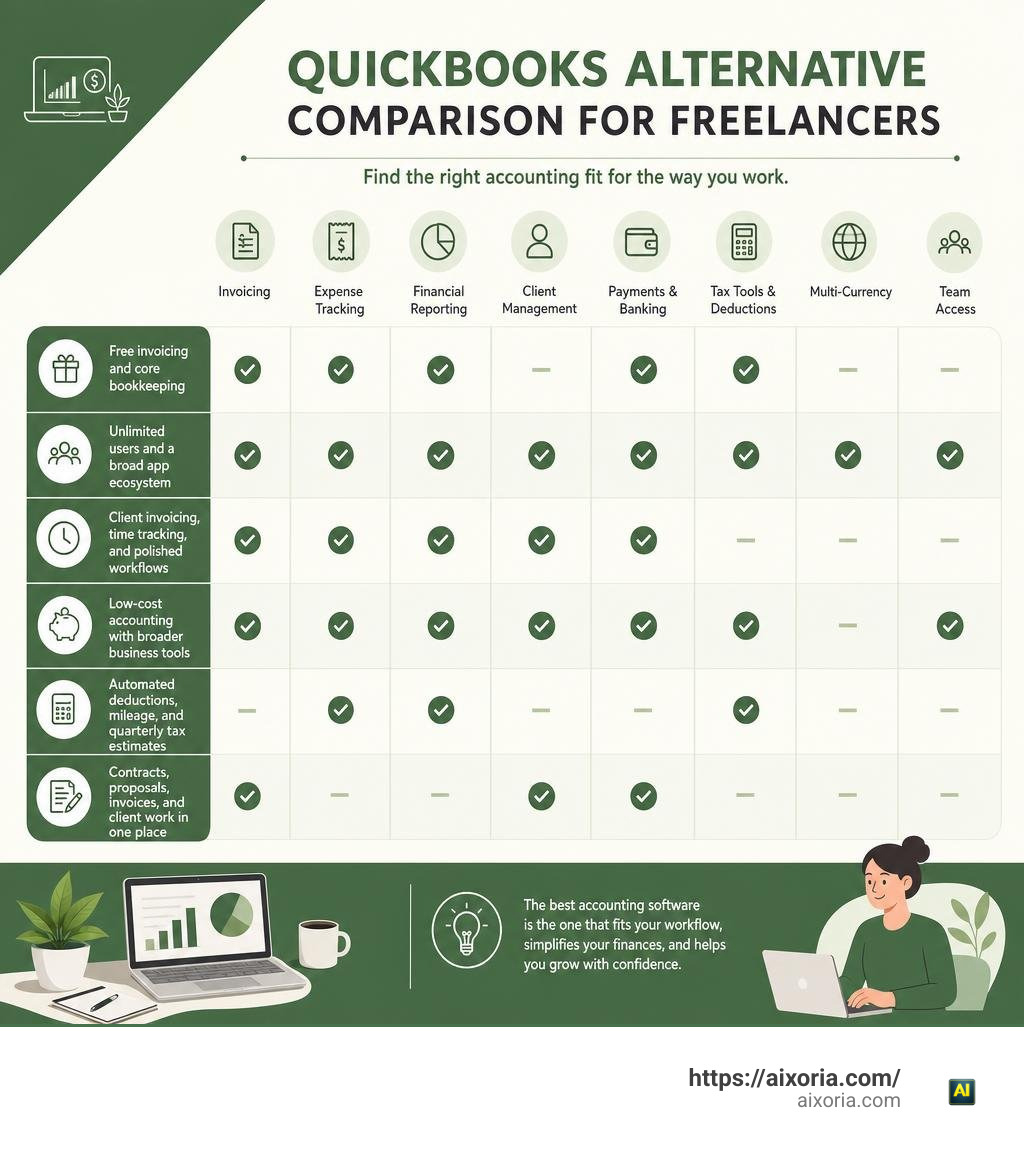
| If you need… | A strong alternative to consider |
|---|---|
| Free invoicing and core bookkeeping | Free entry-level accounting tools |
| Unlimited users and a broad app ecosystem | Scalable cloud accounting platforms |
| Client invoicing, time tracking, and polished workflows | Client-focused invoicing software |
| Low-cost accounting with broader business tools | Budget-friendly platform solutions |
| Automated deductions, mileage, and quarterly tax estimates | Freelancer-focused tax tools |
| Contracts, proposals, invoices, and client work in one place | All-in-one freelancer platforms |
Traditional self-employed software remains popular in cloud accounting, but entry-level platforms can feel limiting as a solo business grows. Freelancers often want simpler reports, better client workflows, easier tax preparation, or fewer add-on subscriptions. Some also need features traditional accounting tools treat as extras, such as receipt scanning, GPS mileage logs, contracts, e-signatures, and multi-currency payments.
The right choice is not always the platform with the longest feature list. It is the one that makes it easier to see what you earned, what you spent, what clients owe, and what to set aside for taxes.
Pain Points of Legacy Self-Employed Software for Modern Solopreneurs
Traditional legacy tools hold a significant portion of the cloud accounting software market, making them widespread in financial management. However, market dominance does not guarantee that a product is the perfect fit for a one-person business. Over the years, we have seen thousands of solopreneurs, gig workers, and creative freelancers hit significant roadblocks when relying solely on entry-level self-employed software.
One of the most persistent complaints from solo business owners revolves around product trajectory and architectural dead-ends. Unlike platforms that allow you to quietly upgrade tiers as your revenue expands, entry-level self-employed tools are often structurally separated from advanced cloud accounting software. When your business model evolves—say, when you start subcontracting, managing inventory, or requiring dynamic multi-dimensional reporting—you cannot simply upgrade with the click of a button. Instead, you are forced into a manual software migration, moving your customer databases, expense histories, and opening balances over to standard online platforms.
On top of forced migrations, pricing hikes have pushed many freelancers to re-evaluate their software stack. Starting at $15 per month for basic features, basic software can quickly become costly when combined with additional tools needed to run a solo operation. Furthermore, entry-level apps apply strict user caps across all plans and severely limit custom reporting. Solopreneurs frequently end up exporting raw financial data into manual spreadsheets just to assemble basic profit forecasts or customized revenue breakdowns.
When tax season arrives, these friction points become glaring. While basic platforms offer limited tax filing bridges, moving away from those ecosystems means losing that connection. For freelancers who want detailed financial visibility, Schedule C readiness without double-entry headaches, and software that scales effortlessly, exploring dedicated software options highlights how modern alternatives solve these foundational pain points.
Evaluating the Best Accounting Software for Freelancers Based on Legacy Accounting Alternatives
When we evaluate the best accounting software for freelancers based on legacy accounting alternatives, we look far beyond mere pricing checklists. Software structure dictates how you interact with your cash flow daily. Generally, accounting software alternatives fall into three main architectural categories:
- Stand-alone Solutions: Systems that focus directly on core bookkeeping, direct invoicing, and cash flow tracking.
- Limited Platform Solutions: Tools that provide modular growth by connecting bookkeeping to proprietary inventory, CRM, and support apps.
- Unified Platform Solutions: Comprehensive platforms that run natively on robust CRM databases, providing a single source of truth without relying on third-party connectors.
Understanding these structural differences helps solo operators pick an architecture that matches their long-term operational goals. For example, standalone tools give you an immediate, intuitive dashboard for tracking income and expenses. On the other hand, platform solutions ensure that your customer communication records and financial ledgers never experience synchronization failures.
To help you navigate the landscape, we have summarized how top freelance accounting alternatives stack up across key decision criteria:
| Platform Category | Core Focus Area | Starting Price | User Limits | Standout Freelancer Feature |
|---|---|---|---|---|
| Free Bookkeeping Tools | Zero-cost bookkeeping & simple invoicing | $0 / month (Starter) | Unlimited | Free unlimited invoicing and estimates |
| Scalable Cloud Suites | Scalable accounting with app ecosystem | $25 / month (Early plan) | Unlimited users on all plans | 1,000+ app integrations & AI integration |
| Client-Centric Apps | Client-centric invoicing & project tracking | ~$19 / month | Per-user fee structure | Integrated time tracking and client portals |
| Modular Suites | Budget-friendly platform accounting | $0 – $20 / month | Tier-dependent | Deep integration with CRM suites |
| All-in-One Freelance Hubs | All-in-one freelance workflow management | $15 / month | Per-user fee structure | Integrated client contracts & proposal templates |
| Tax Scanner Tools | Automated tax write-off detection | $20 – $30 / month | Single user focus | AI-driven tax deduction scanning |
Financial visibility is the ultimate measure of success for any accounting platform. Statistics show that over 80% of business owners agree modern cloud accounting improves financial visibility and helps them get paid on time. Whether you choose a streamlined free app or a fully connected cloud ecosystem, the goal is to gain instant clarity over your cash runway without spending hours fixing broken data syncs.
Finding the Best Accounting Software for Freelancers Based on Legacy Accounting Alternatives with Automated Tax Deduction Features
For most self-employed professionals, keeping track of every deductible business expense feels like a second full-time job. Missing out on tax write-offs directly reduces your bottom line. That is why modern freelancer-focused software prioritizes automated tax deduction discovery, optical character recognition (OCR) receipt scanning, and real-time mileage tracking.
Instead of stuffing receipts into a shoebox or scrolling through online bank statements every April, specialized platforms automatically scan your connected financial feeds for tax-saving opportunities. For example, software with built-in OCR lets you snap a photo of a restaurant bill or office equipment receipt from your phone. The system parses the vendor name, date, total cost, and tax category instantly, mapping it directly to IRS-compliant categories.
Automated mileage tracking is another game-changer. By leveraging your smartphone’s background GPS, apps automatically log business trips at the official IRS standard mileage rate (72.5 cents per mile in 2026). A web designer or rideshare driver logging thousands of miles annually can effortlessly capture thousands of dollars in tax write-offs without maintaining paper logbooks.
By integrating expense categorization with automated audit risk flagging, platforms ensure your books remain audit-proof. If you want a specialized solution built specifically around write-off capture and Schedule C readiness, exploring Vuuv expense tracking demonstrates how automated deduction tools can turn lost expenses into substantial year-end tax savings.
Key Pricing Structures in the Best Accounting Software for Freelancers Based on Legacy Accounting Alternatives
Software costs can silently erode a freelancer’s profit margins if you aren’t paying attention. When choosing an accounting tool, we must examine the hidden fees, payment processing rates, and tiered functionality behind each headline price tag.
Free tiers provide an attractive runway for solopreneurs launching their businesses. For instance, top free tools offer a $0 Starter Plan with no trial expiration, allowing unlimited invoices and estimates without forcing you to enter a credit card up front. These platforms generate revenue through payment processing fees, typically charging around 1.0% for bank payments and 2.9% + $0.60 for credit card transactions, making them ideal for low-volume or budget-conscious freelancers. For those wanting extra automation, upgraded plans ($19/month) drop transaction costs even further while adding automated receipt capture and auto-reconciliation, costing roughly 50% less than legacy entry-level accounting plans.
Other accounting solutions organize their pricing by user caps and feature access. Unlike some legacy cloud platforms that force you to pay higher monthly rates just to grant access to an additional user or bookkeeper, some alternatives offer unlimited users on every plan level. This allows freelancers to invite external CPAs, virtual assistants, or business partners into their financial dashboard at zero extra cost.
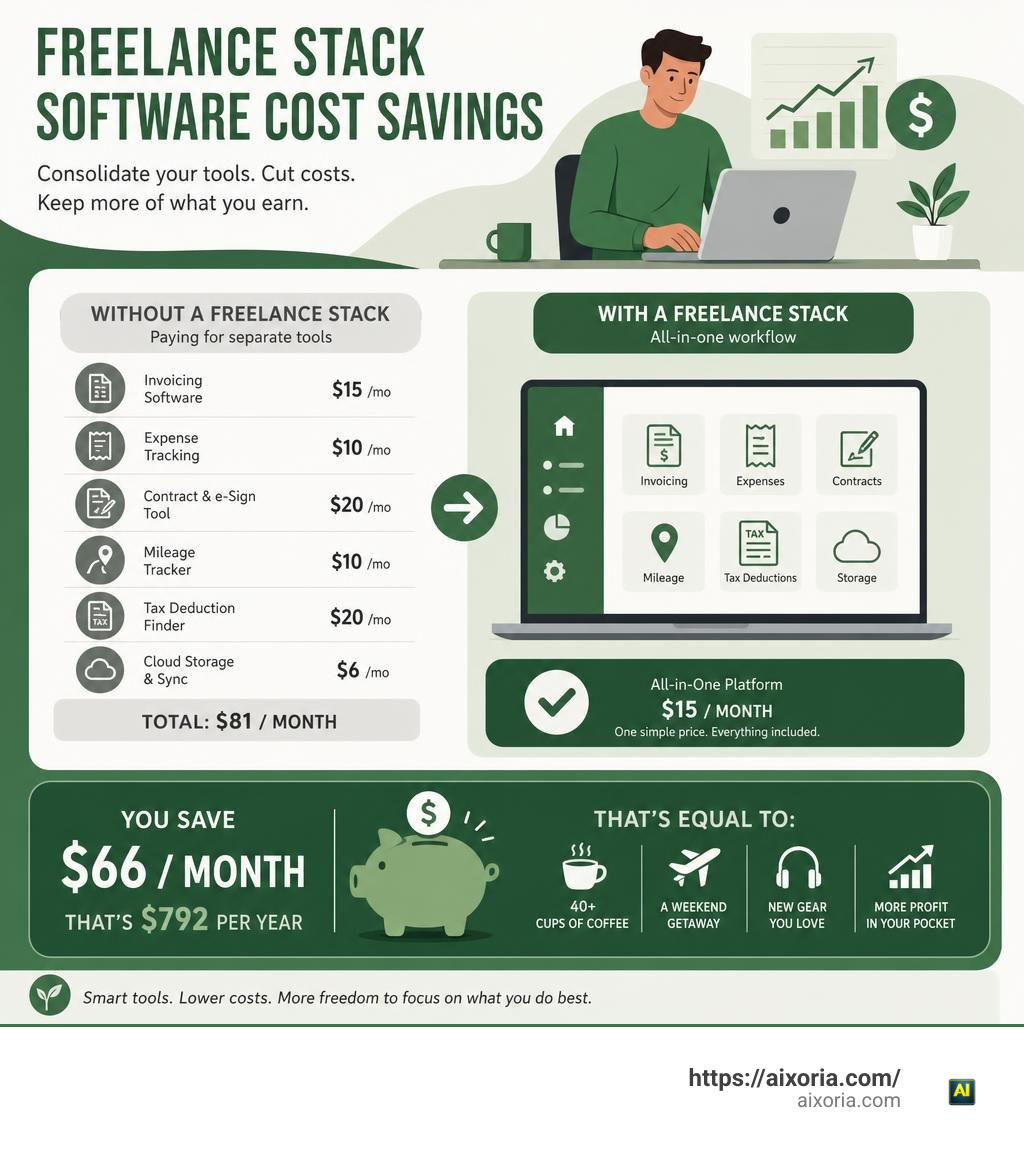
Another modern trend is the “all-in-one stack” pricing model. Independent contractors frequently pay separate monthly subscriptions for invoicing apps, contract signature tools, mileage trackers, and expense scanners. Consolidating those separate utilities into a single hub like mozey accounting tools can save freelancers roughly $252 per year compared to paying for a fragmented multi-app stack.
Specialized Features: Contracts, Multi-Currency, and CRM Integration
As modern freelancing shifts toward borderless digital work and remote consulting, standard income-and-expense logging is no longer enough. Independent professionals frequently require specialized business management utilities directly connected to their financial ledgers.
Contract management and digital signatures represent a massive operational upgrade for solo service providers. Platforms tailored for freelancers let you move seamlessly from a project estimate to a legally binding contract with e-signatures, and finally to an automated deposit invoice, all within the exact same client portal. This eliminates context-switching and ensures you never start billable work without a signed agreement in place.
Multi-currency support and global payment processing are equally critical for freelancers serving international clients. When working across borders, standard bank transfers can take days and incur steep foreign exchange fees. Modern tools integrate with established cross-border payment providers, allowing freelancers to accept multi-currency payments, hold balances in many currencies at competitive exchange rates, and process batch payments efficiently.
Finally, Customer Relationship Management (CRM) connectivity ensures that financial data and client interactions live in perfect sync. When accounting software operates independently from your CRM, customer addresses, contact details, and project notes inevitably diverge. Utilizing unified platforms or native CRM connections ensures a single source of truth. Every time a client pays an invoice, your CRM record updates automatically, giving you total visibility over customer lifetime value, open pipeline value, and payment histories.
Tax Preparation, Schedule C, and Estimated Quarterly Taxes
Tax time is notorious for causing panic among self-employed professionals. Unlike traditional W-2 employees who have income tax withheld automatically from every paycheck, freelancers are responsible for paying self-employment taxes (covering Social Security and Medicare) as well as federal and state income taxes through quarterly estimated tax payments.
Accounting software built for the self-employed transforms tax prep from a seasonal crisis into a background process. Throughout the year, every categorized expense is mapped directly to specific IRS Schedule C line items, such as advertising, car and truck expenses, home office deductions, and legal or professional fees.
To help freelancers calculate quarterly estimated taxes, modern platforms analyze your net income in real time, factoring in self-employment tax rates (typically calculated around a combined 30% tax burden rule of thumb) and projecting your tax obligation for each quarter. The software tells you exactly how much money to transfer into a dedicated tax savings account before the quarterly IRS deadlines hit.
When tax season arrives, top freelance solutions generate comprehensive CPA tax packets containing profit and loss statements, mileage logs, and Schedule C breakdowns ready for direct import or handoff to your accountant. Using dedicated bookkeeping environments like the Jolix bookkeeping platform allows solopreneurs to keep income tracking aligned with actual project deliverables, eliminating manual double-entry and ensuring year-round tax readiness.
All-In-One Personal and Business Wealth Tracking
For sole proprietors and single-member LLCs, business finances and personal life are deeply intertwined. Managing two completely separate software suites, one for tracking client invoices and another for monitoring personal budgets, retirement accounts, and home mortgages, often creates extra friction.
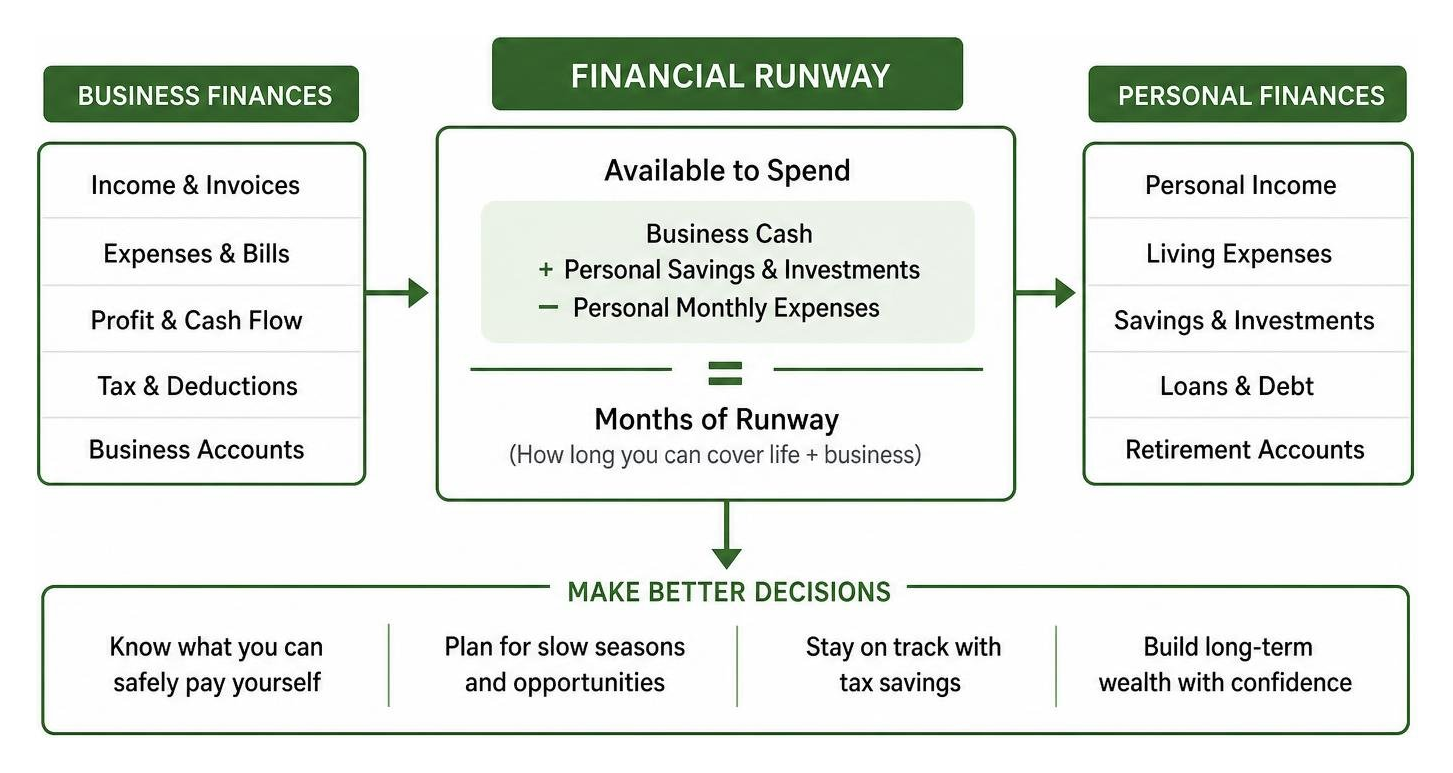
Combining personal financial management with business accounting gives solopreneurs a holistic view of their complete financial runway. When you can monitor your business cash flow alongside your personal investments, emergency savings, and daily living expenses in a single dashboard, you make far better decisions regarding how much money you can safely draw from your business as owner pay.
Comprehensive personal and business finance tools like all-in-one business and personal wealth management address this need by allowing freelancers to run multiple small business ventures alongside personal wealth tracking under a single subscription. By consolidating business cash flow forecasting with personal budgeting tools, freelancers gain complete clarity over both their immediate working capital and long-term financial independence.
Frequently Asked Questions about Freelancer Accounting
Can freelancers easily switch from basic self-employed software to another platform?
Yes, freelancers can migrate from basic self-employed software to another accounting platform relatively easily, though the process requires a few deliberate steps. Because basic entry-level tools often do not feature double-entry general ledger structures, you cannot simply perform an automated database mirror transfer. Instead, you export your historical data—including transaction history, client lists, income statements, and expense logs—in standard CSV format.
Once exported, you import your client details and transaction records into your new platform. Before finalizing the switch, ensure that your expense categories match IRS Schedule C lines in the new system. Re-link your online bank feeds and credit cards to establish automated transaction syncing moving forward. Performing this migration at the start of a new month or quarter makes bank reconciliation seamless.
How do alternatives calculate estimated quarterly taxes and Schedule C reports?
Freelancer accounting alternatives calculate estimated quarterly taxes by tracking your total gross revenue, subtracting categorized business write-offs (such as software costs, home office expenses, and mileage), and calculating your net operating profit. The system then applies the standard self-employment tax rate (15.3%) alongside estimated income tax brackets to calculate your quarterly liability.
For Schedule C reporting, software automatically assigns your logged transactions to specific IRS lines (such as Line 8 for advertising or Line 20b for equipment rent). At year-end, the software aggregates these transactions into a downloadable tax summary or Schedule C PDF that you or your CPA can use directly when filing Form 1040.
Are there free accounting platforms available for solopreneurs?
Yes, several accounting platforms offer functional free plans tailored specifically for solopreneurs and freelancers. Top entry-level providers offer permanently free plans with unlimited invoices, contact management, and basic bookkeeping without any trial time limits or credit card requirements.
Other budget-friendly platforms also offer free tiers for small businesses below certain annual revenue thresholds, which include essential invoicing and expense management tools. Additionally, platforms like Vuuv and mozey offer starter plans or zero-cost tiers that cover core bookkeeping and invoicing, allowing brand-new freelancers to keep overhead costs at zero while getting their businesses off the ground.
Conclusion
Choosing the best accounting software for freelancers based on quickbooks alternatives comes down to recognizing what your business truly requires to thrive. You do not need to settle for expensive platforms designed for multi-employee corporations when streamlined, freelancer-first solutions offer better tax automation, easier client invoicing, and total financial visibility at a fraction of the cost.”https://www.mediafire.com/file/adyg9rl9zw56pkw/Candy_Texture_Pack_BY_MCMPDL%25E2%2580%25A2COM.mcpack/file“;
At Aixoria, we know that administrative efficiency is the secret weapon of successful solopreneurs. By replacing clunky, fragmented accounting tools with intuitive, modern platforms, you reclaim dozens of hours every month—hours you can spend growing your client base, building innovative projects, or simply enjoying your freedom as an independent professional.
To explore how smart digital workflows can revolutionize how you run your business, read our guide on what is the best AI for productivity in 2026 and start building a modern, automated workspace today.
