The AI Tool Overwhelm Is Real — Here’s What Actually Works in 2026
Finding the best AI tool for general use doesn’t have to mean testing dozens of apps and wasting hours you don’t have. In 2026, we’ve moved past the ‘novelty’ phase of AI. It’s no longer about asking a bot to write a poem; it’s about integrating a digital brain into your daily operations. Whether you are a solo founder or managing a growing team, the right choice acts as a force multiplier for your cognitive output.
Here’s a quick answer if you need it now:
| AI Tool | Best For | Starting Price |
|---|---|---|
| Claude | Writing, reasoning, long documents | Free / $20/mo |
| ChatGPT | Features, voice, image generation | Free / $20/mo |
| Gemini | Google Workspace, deep research | Free / $19.99/mo |
| Perplexity | Real-time research with citations | Free / $17/mo |
| Microsoft Copilot | Microsoft 365 users | Free / $20/mo |
The short version: Claude leads for thoughtful writing and analysis. ChatGPT leads for features and versatility. Both are strong all-around picks for small business owners.
Almost every tool you already use — your email client, your docs app, your CRM — has some form of AI baked in now. But baked-in doesn’t mean useful. Most people still feel like they’re not getting real value from AI, because they haven’t found the right core tool to anchor their workflow. In 2026, the gap between a good AI tool and a great one comes down to a few things:
- How well it reasons through a problem
- How much context it can hold in a single session
- How easily it connects to tools you already use
- Whether the free plan is actually worth your time
This guide cuts through the noise. No hype, no jargon — just a clear checklist to help you pick the right AI tool for your daily work.
Defining the Best AI Tool for General Use in 2026
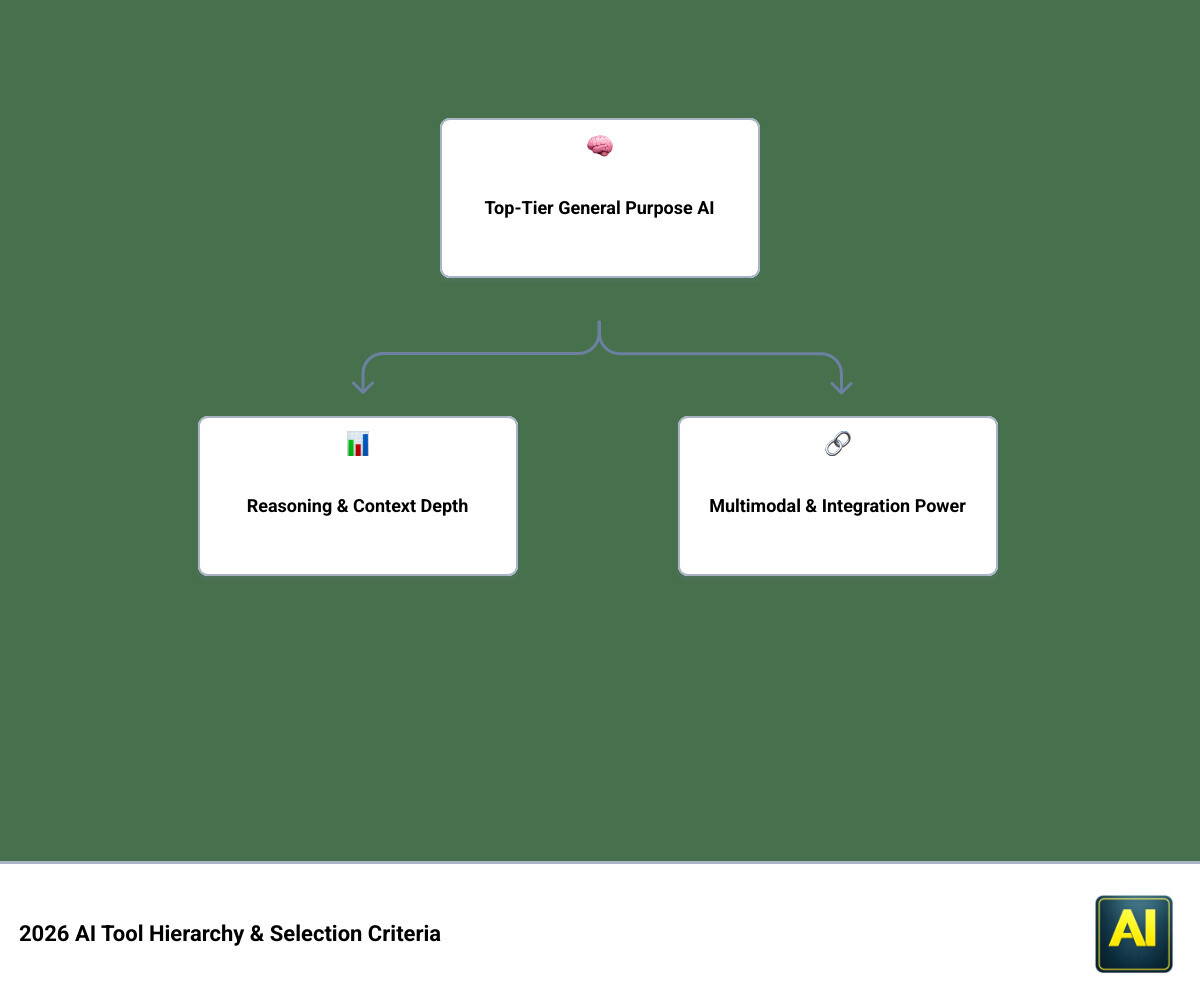
To identify the Best AI Tool for General Use, we first have to look at what “general use” actually means in today’s landscape. We aren’t just looking for a chatbot; we are looking for a productivity multiplier that understands nuance.
A top-tier tool in 2026 is defined by its reasoning capabilities. This isn’t just about matching patterns; it’s about the AI “thinking” through a problem before it speaks. In previous years, AI often hallucinated when faced with complex logic. Today, the best tools use ‘Chain of Thought’ processing, where the model internally verifies its steps before presenting an answer. This reduces errors in financial forecasting and technical troubleshooting significantly.
We also look for multimodal input, meaning the tool can see images, hear your voice, and read your code simultaneously. Another massive factor is the context window. For example, some models can now handle up to 2 million words, allowing you to upload entire books or massive code repositories without the AI “forgetting” the beginning of the conversation. When asking What is the Best AI Tool for General Use in 2026?, you must consider how it handles your specific data limits and integrations.
| Feature | Claude | ChatGPT | Gemini | Perplexity |
|---|---|---|---|---|
| Reasoning | Exceptional (Human-like nuance) | Strong (Logic & Math) | Balanced | Research-focused |
| Research | Good (Internal docs) | Moderate | Elite (Google Search) | Elite (Citations) |
| Automation | Via Projects/MCP | Via Custom GPTs | Via Google Workspace | Limited |
| Context Window | 200k Tokens | 128k+ Tokens | 1M – 2M Tokens | Variable |
Top Contenders for the Best AI Tool for General Use
The battle for the top spot is tighter than ever. While ChatGPT was the first to the party, Claude 3.5 and the latest Gemini models have made significant strides in specialized areas.
When we evaluate the Best AI Tools for Productivity in 2026, we see a clear split:
- Claude 3.5 is often the “thinker’s” choice.
- ChatGPT o1 is the “doer’s” choice for logic and complex coding.
- Perplexity Pro is the “researcher’s” choice for real-time web data.
- Gemini 3 — Google DeepMind is the “integrator’s” choice for those living in the Google ecosystem.
Why Claude is the Best AI Tool for General Use in Writing
If your daily work involves a lot of writing, editing, or complex document analysis, Claude is often the winner. Its thoughtful reasoning makes it feel less like a robot and more like a highly skilled editor.
One of its standout features is Artifacts. This allows you to view code, documents, and graphics in a side-by-side window while you chat, making it one of the Best AI Tools for Work for iterative projects. For instance, Claude’s Artifacts feature isn’t just a side window; it’s a real-time development environment. You can ask it to build a React component, and you see the code and the rendered UI side-by-side instantly. This eliminates the constant context-switching that kills productivity. With a 200k context window, you can feed it a 500-page PDF and ask for a summary of page 412 in seconds.
Furthermore, Anthropic’s focus on Constitutional AI ensures that the tool remains safe and follows instructions with a high degree of accuracy, which is vital for professional environments.
Why ChatGPT Remains the Best AI Tool for General Use Features
Despite the competition, ChatGPT remains the most feature-rich platform. Its Advanced Voice Mode is a game-changer for brainstorming on the go, allowing for near-instant, natural conversations.
For those looking for the Best AI Tools for Business Productivity, ChatGPT offers:
- DALL-E 3 for high-quality image generation.
- Custom GPTs that you can build to handle specific, repetitive tasks.
- Interactive Code Interpreter for analyzing spreadsheets and creating data visualizations on the fly.
Its Multimodal Live Mode means it can see what you see through your camera and help you solve real-world problems in real-time. This makes it an indispensable companion for field work or hands-on technical tasks.
Essential Features for Daily Productivity and Automation
For power users, the Best AI Tool for General Use is one that doesn’t just talk, but acts. This is where agentic workflows come in.

Agentic workflows represent the next frontier in business efficiency. Instead of you doing the work with AI’s help, you give the AI a goal, and it executes the sub-tasks. This might involve searching the web, summarizing findings, and drafting an email — all without human intervention between steps. Tools like Gumloop allow you to build drag-and-drop automation flows that insert AI directly into your business processes — for example, automatically scraping competitor blogs and sending a digest to Slack.
If you are a developer or a “vibe coder,” Cursor has become the gold standard, integrating AI directly into your code editor to write entire features from a single prompt. For those looking for the Best AI Tools for Entrepreneurs in 2026, consider Paradigm AI. It treats every cell in a spreadsheet as an AI agent, allowing you to perform bulk data enrichment (like finding 500 LinkedIn profiles) in minutes rather than hours.
Choosing Between Free and Paid AI Ecosystems
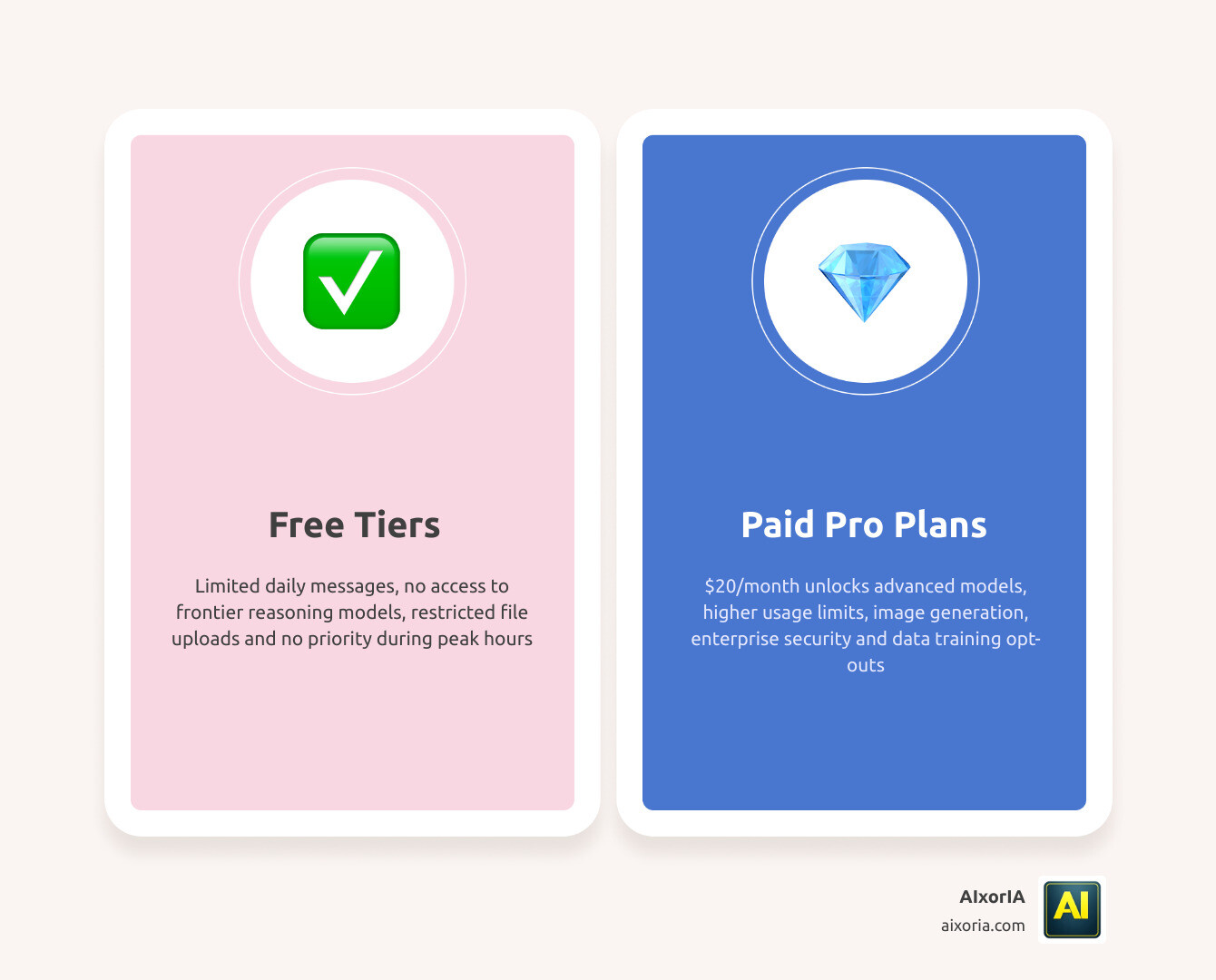
Is it worth the $20/month? For most professionals, the answer is a resounding yes. While free tiers are great for casual questions, paid “Pro” plans unlock the frontier models (like Claude Opus or GPT-o1) that offer significantly better reasoning.
Key benefits of paid plans include:
- Usage Boosts: Higher limits on how many messages you can send, which is crucial for heavy workdays.
- Priority Access: No slowdowns during peak hours when the rest of the world is online.
- Advanced Features: Access to image generation, file uploads, and web browsing capabilities.
- Privacy & Security: Many paid tiers offer enterprise-grade security and the ability to opt-out of data training, ensuring your sensitive business info stays private. This is often the deciding factor for legal and medical professionals who must maintain strict confidentiality.
Frequently Asked Questions about General AI Tools
Which AI tool has the best free plan for casual users?
If you are looking for the best bang for zero bucks, Claude’s free plan is excellent for writing quality, though its message limits are quite tight. ChatGPT’s basic plan is very generous with features like web search and some image generation. For pure search and fact-finding, Perplexity is the best free option because it provides direct citations for every claim.
Is Claude better than ChatGPT for complex reasoning?
In our experience, Claude 3.5 Sonnet often feels more “clever” and nuanced when handling creative writing or technical documentation. However, ChatGPT’s o1 model is specifically designed for “thinking” through math and logic problems. Claude is generally better at following complex, multi-step instructions without getting confused or losing the thread of the conversation.
How do I integrate AI into my existing 2026 workflow?
The easiest way is through browser extensions and mobile apps. For business users, Microsoft 365 Copilot and Google Workspace integrations are the most seamless, as they bring AI directly into Word, Excel, and Gmail. For custom needs, use API connectors or tools like Zapier to link your AI assistant to your CRM or Slack channels. This allows for a unified experience where data flows between your AI and your core business apps.
Conclusion
The Best AI Tool for General Use isn’t a one-size-fits-all solution; it’s the tool that fits your specific daily friction points. Whether you need the creative nuance of Claude, the feature-heavy powerhouse of ChatGPT, or the deep research capabilities of Gemini, the right tool is the one you actually use.
At AIxorIA, we specialize in cutting through this complexity. We provide custom AI solutions and performance audits to ensure your business isn’t just using AI, but mastering it. From tool training workshops to affordable tutorials, we help you scale your business with the latest technology without the headache. Our team is dedicated to providing simple language help and fast customer support to ensure your transition to an AI-driven workflow is as smooth as possible.
Ready to stop guessing and start growing? Start your AI transformation with AIxorIA today. We make AI simple, affordable, and incredibly fast to implement.
3 thoughts on “Best AI Tool for General Use in 2026 (Tested & Ranked for Productivity)”