How to compare AI pricing tools for hotels and rentals
Scr0ll d0wn to D0VVNL0AD
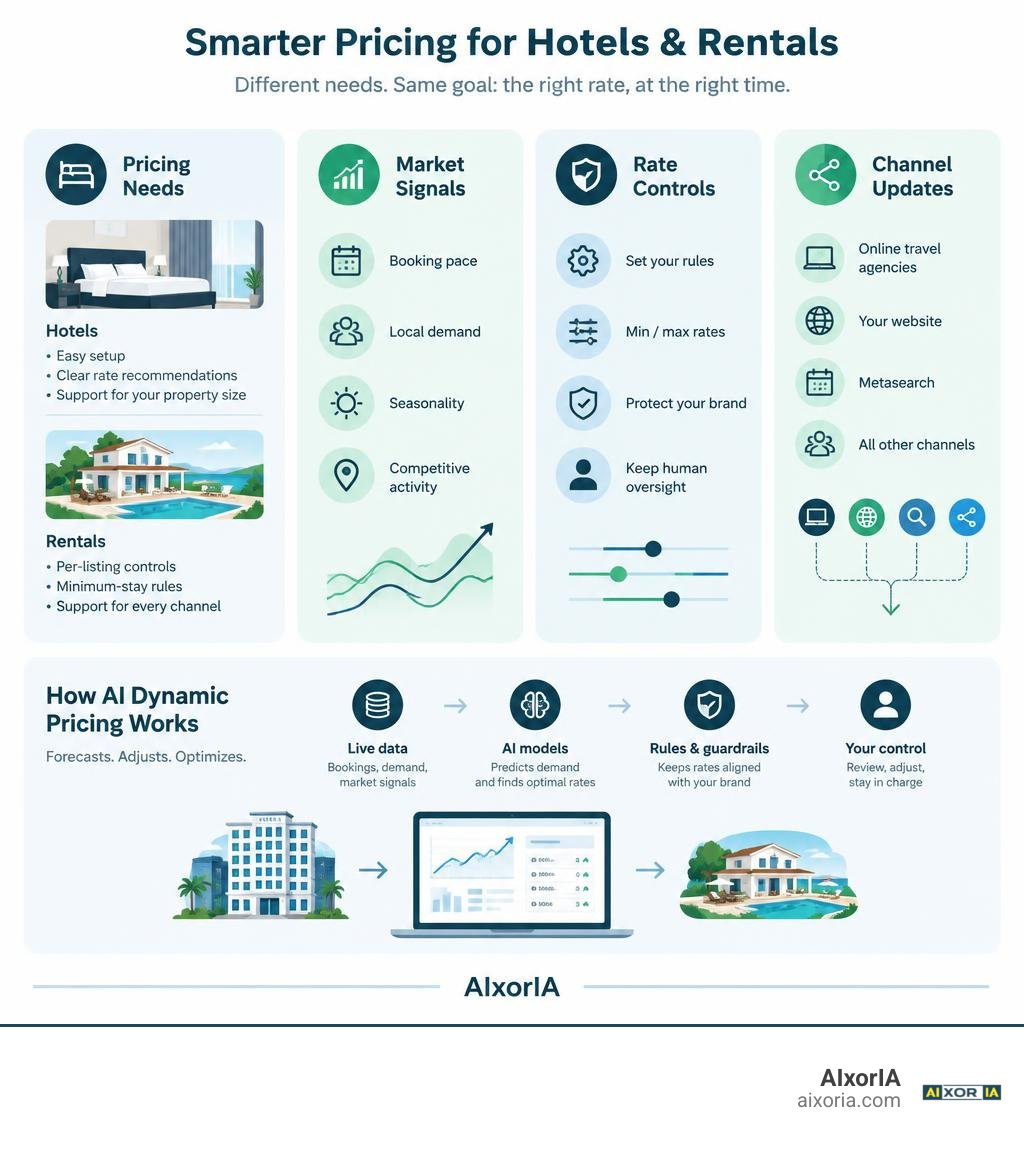
The best AI tools for dynamic pricing in hotels and rentals fit your property, connect to your booking systems, and let you control the final rates. For a small hotel, look for easy setup and clear rate recommendations. For vacation rentals, check per-listing controls, minimum-stay rules, and support for every channel you use. Larger operators also need bulk changes and portfolio reporting.
These tools use booking pace, local demand, and other market signals to adjust prices. But more automation is not always better. Before choosing one, check its cost, integration options, price limits, and how it explains each rate change.
How AI tools for dynamic pricing for hotels and rentals work
Dynamic pricing software replaces static seasonal rate cards with live, algorithmic adjustments. Instead of setting a single summer weekend rate six months ahead and hoping for the best, operators use machine learning models that assess changing conditions around the clock.
At its core, dynamic revenue management relies on continuous forecasting. The software evaluates your remaining inventory against predicted market demand, recommending or publishing optimal rates. However, modern systems are not purely autonomous black boxes. Effective dynamic pricing pairs algorithmic calculation with strict rule-based guardrails and regular human oversight, ensuring room and unit rates align with your broader brand positioning.
How AI tools for dynamic pricing for hotels and rentals read demand signals
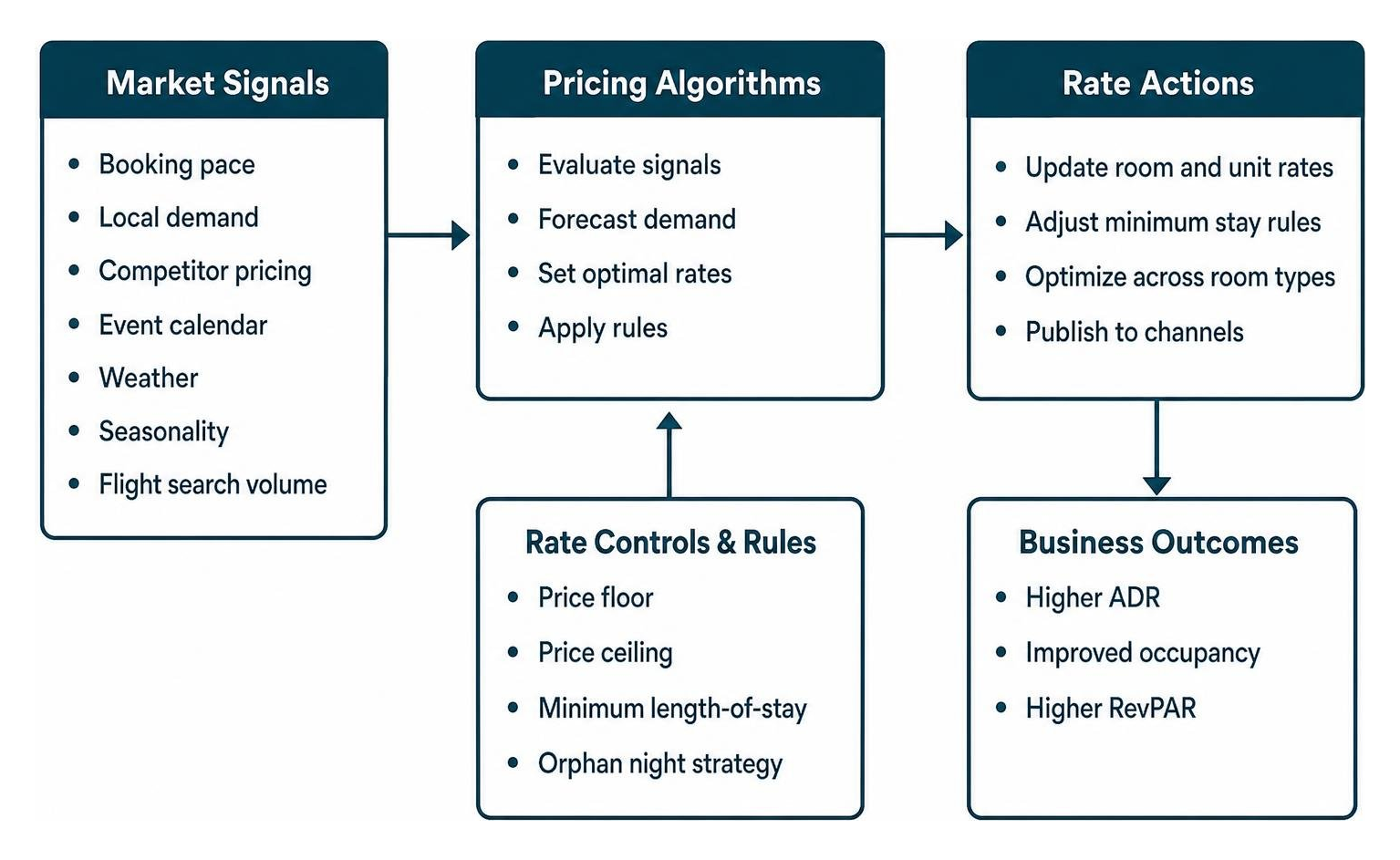
To calculate the right rate for every night, dynamic pricing engines evaluate multiple internal and external data feeds. The most critical internal signal is pickup pace—the velocity at which reservations are booked for a future stay date compared to historical averages. If a property normally books three rooms four weeks out for an October weekend but suddenly logs nine, the algorithm recognizes an unexpected demand surge and adjusts rates upward.
External signals provide market context. AI engines continuously monitor competitor pricing sets, flight search volume, local event calendars (such as concerts, sports tournaments, and conferences), weather forecasts, and broader seasonal curves. By evaluating these market signals, the software detects travel intent well before actual reservations land on your calendar.
How AI tools for dynamic pricing for hotels and rentals turn rates into revenue
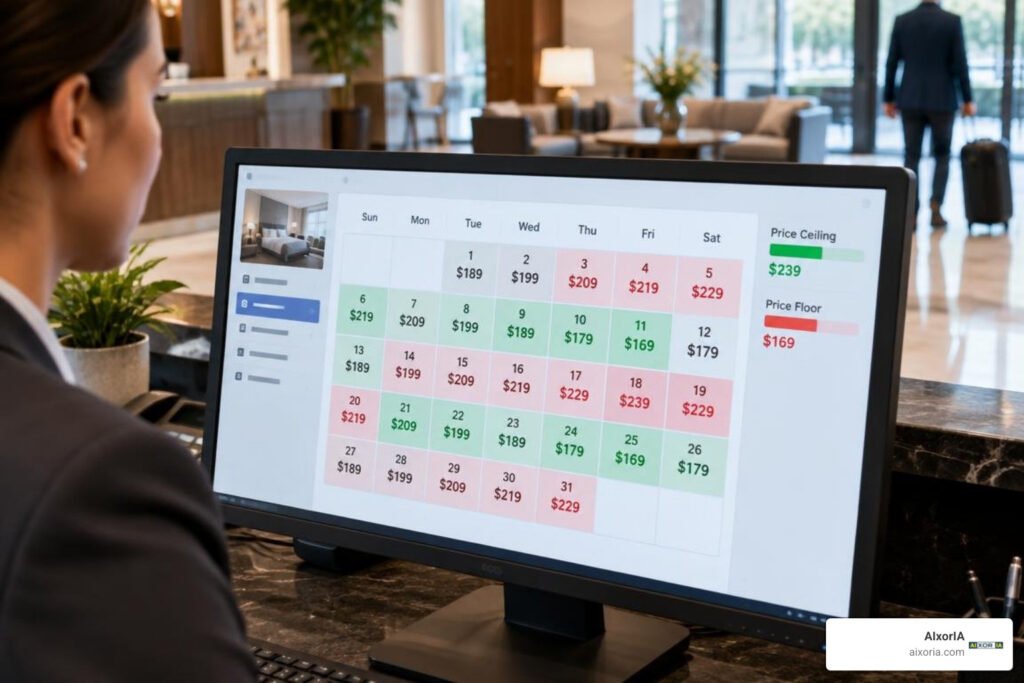
Transforming raw market signals into increased revenue requires structured pricing boundaries. Operators establish base rates along with firm price floors and ceilings. The price floor prevents the algorithm from discounting rates below operational costs, protecting margins during quiet stretches. The price ceiling stops rates from climbing so high that they alienate guests or damage review scores.
Beyond nightly rates, intelligent pricing engines manage operational constraints. They dynamically adjust minimum length-of-stay (LOS) requirements during peak periods to avoid single-night bookings that block lucrative multi-night stays. They also identify orphan nights—isolated one- or two-night calendar gaps between longer reservations—and lower stay restrictions or adjust rates to secure last-minute bookings. Optimizing these factors across distinct room types elevates Average Daily Rate (ADR), drives Occupancy, and maximizes Revenue Per Available Room (RevPAR).
How rate changes reach hotel and rental channels
A pricing calculation is only valuable if it updates your live booking channels without delay. Automated rate distribution relies on seamless connectivity between the pricing engine, your Property Management System (PMS), and your central channel manager.
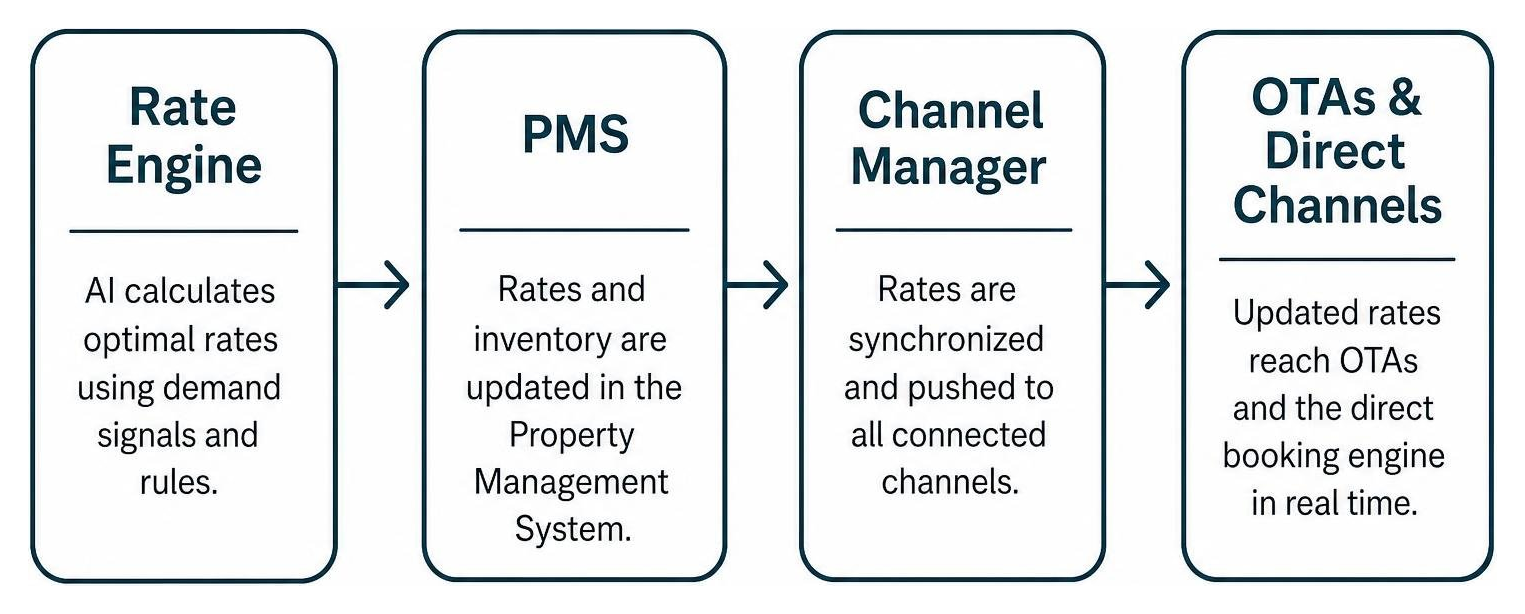
Once an updated rate is approved—either automatically via set rules or manually by an operator—the pricing tool transmits the new figures via open APIs. The channel manager pushes these rates across your direct booking engine and third-party Online Travel Agencies (OTAs) simultaneously. Real-time synchronization eliminates manual extranet updates, maintains rate parity across distribution channels, and reduces overbooking risks. Solutions offering PMS-connected AI pricing and rate controls streamline this workflow by housing rate generation, inventory status, and distribution within a single unified environment.
Compare AI pricing tool types for hotels and rentals
Different hospitality businesses require distinct pricing architectures. An independent bed-and-breakfast needs accessible automation, whereas an enterprise resort demands granular segment controls, and a vacation rental firm requires flexible multi-unit calendar tools.
| Property Type | Core Operational Fit | Primary Control Needs | Key System Integrations | Typical Portfolio Scale |
|---|---|---|---|---|
| Independent Hotels & B&Bs | Fast setup, plug-and-play autopilot, low management overhead | Price floors/ceilings, event overrides, simple KPI goals | PMS, core direct booking engine, major OTAs | 5 to 50 rooms |
| Enterprise Chains & Resorts | Deep revenue management, Open Pricing, total guest spend | Room-type tiering, corporate rate codes, LOS restrictions | Enterprise PMS, CRS, GDS, BI tools, RMS | 100+ rooms across multi-property networks |
| Vacation Rentals & Short-Term Portfolios | Multi-channel synchronization, listing-level customization | Dynamic minimum stays, orphan-night rules, last-minute discounts | Airbnb, Vrbo, Booking.com, STR-focused PMSs | 1 to 500+ individual units |
Best-fit tools for independent hotels and small groups
Lean hospitality teams rarely have the budget or hours to employ a full-time revenue manager. For independent boutique properties, inns, and small hotel groups, the ideal dynamic pricing software operates reliably on autopilot while maintaining intuitive human controls.
Several platforms in this category focus on rapid onboarding, often going live within a day. Hoteliers define their base strategy, set price guardrails, and let the software handle daily rate calculations. In verified user studies across independent properties, operators using hands-off automated pricing reported an average 19% revenue increase while saving 10 or more hours of manual spreadsheet work every week.
Best-fit tools for hotel groups and enterprise portfolios
Enterprise hotel portfolios, luxury resorts, and casino properties manage complex distribution environments with multiple room tiers, negotiated corporate rates, and group allocations. These operators require dedicated Revenue Management Systems (RMS) rather than lightweight rate updaters.
Leading enterprise platforms provide sophisticated Open Pricing capabilities. Rather than applying blanket percentage lifts, these systems independently optimize every room category, booking code, and distribution channel in real time. They factor in total guest profitability (RevPAG)—including food, beverage, and ancillary spend—alongside length-of-stay restrictions and channel acquisition costs.
Best-fit tools for vacation rentals and multi-property operators
Short-term rental (STR) property managers face unique operational challenges. Unlike hotels with identical room inventories, vacation rental operators manage distinct properties across varying neighborhoods, each with individual owner preferences, amenity profiles, and cleaning schedules.
Several tools are built specifically for this multi-unit complexity. Leading platforms price hundreds of thousands of units across more than 150 countries, allowing managers to apply customized rule profiles across hundreds of properties using bulk multi-calendars. These platforms automatically calibrate dynamic minimum stays, relax rules to capture orphan nights, and synchronize rates across Airbnb, Vrbo, and direct websites simultaneously.
Compare reported performance claims carefully
Software vendors across the hospitality sector highlight substantial performance uplifts:
- Typical automated dynamic pricing adoption correlates with a 15% to 20% average RevPAR uplift.
- Independent hotel studies frequently cite average top-line revenue gains near 19%.
- Select platform case studies report annual income improvements of 29% to 30%.
When evaluating these figures, hoteliers must look closely at attribution and baseline periods. A 30% revenue gain achieved during a broader post-pandemic travel rebound or following a major local venue opening cannot be credited entirely to algorithmic rate changes. Always evaluate software ROI against comparable historical seasons, accounting for local supply shifts and macroeconomic trends.
Benefits, selection criteria, and implementation
Adopting AI-driven rate management delivers clear commercial advantages, but achieving sustainable gains requires selecting the right software and deploying it with practical safeguards.

How AI tools for dynamic pricing in hotels and rentals can improve performance
Manual pricing is inherently reactive. Hoteliers often discover a high-demand weekend only after their rooms have sold out at standard off-peak rates. Using AI tools for dynamic pricing in hotels and rentals ensures that properties capture surging willingness-to-pay well ahead of check-in dates.
During off-peak periods, algorithmic systems prevent protracted vacancies by launching targeted, condition-based discounts and lowering minimum-stay hurdles. Managing channel-specific pricing offsets third-party OTA commissions, steering guests toward direct booking channels to safeguard net operating income. For growing operations, pairing dynamic pricing with multi-source revenue reconciliation ensures that revenue gains across all channels are tracked cleanly without accounting discrepancies.
Features to assess before choosing a tool
Before committing to a dynamic pricing platform, verify these critical capabilities:
- Integration Stability: Ensure robust, two-way API synchronization with your existing PMS and channel manager.
- Data Freshness: Look for platforms that evaluate live booking pace and competitor rates multiple times daily rather than relying on delayed daily batch updates.
- Transparent Explainability: Choose tools that provide clear, factor-ranked justifications for every suggested price adjustment so your team understands the rationale.
- Customizable Guardrails: Verify that you can establish absolute price floors, maximum ceilings, rate change limits, and manual override capabilities.
- Portfolio-Level Bulk Controls: Multi-property operators need tools that allow tagging, grouping, and seasonal rule application across dozens of listings at once.
- Predictable Cost Structure: Assess whether the pricing model is a flat monthly fee, a per-unit subscription, or a percentage-of-revenue model to ensure it fits your operating margins.
Common challenges and practical safeguards
Dynamic pricing can introduce friction if rolled out without clear operational boundaries:
- Unchecked Rate Volatility: Frequent, erratic price swings can frustrate potential guests researching a stay. Apply rate-change damping limits so prices adjust smoothly over time.
- The “Race to the Bottom”: If your algorithm blindly undercuts competitors who are discounting out of panic, rates drop rapidly. Base pricing primarily on true market demand signals rather than reactive competitor mirroring.
- Guest Perception and Trust: Returning guests who see wild price swings may feel gouged. Protect client goodwill by honoring direct-booking quotes, maintaining transparent terms, offering loyalty perks, and providing extra amenities during high-rate peak periods.
A practical rollout and ROI check
Transitioning to automated pricing should follow a measured implementation timeline:
- Step 1: Document Performance Baselines (Days 1–7): Record your trailing 12-month metrics, including ADR, occupancy, RevPAR, channel distribution costs, and fixed overhead such as short-term rental insurance costs.
- Step 2: Pilot and Calibrate (Days 8–30): Connect your PMS and channel manager in a staging environment or deploy the tool on a small, representative subset of properties. Set conservative price floors and ceilings.
- Step 3: Supervised Automation (Days 31–60): Run the system in recommendation mode or supervised autopilot. Have your revenue lead review rate adjustments daily, refining compsets and event parameters.
- Step 4: Full Deployment and Financial Review (Day 60+): Transition to automated rate publishing while retaining weekly exception checks. Measure net RevPAR against your initial baseline to confirm software ROI.
Frequently Asked Questions about AI Pricing for Hotels and Rentals
What is the difference between dynamic pricing software and a full revenue management system?
Dynamic pricing software focuses primarily on calculating and updating nightly room and unit rates based on market demand and competition. A full Revenue Management System (RMS) encompasses dynamic pricing while adding broader capabilities, including deep multi-market forecasting, total guest spend optimization (RevPAG), length-of-stay restriction controls, group booking displacement analysis, and channel inventory allocation.
Can dynamic pricing software integrate with an existing PMS and channel manager?
Yes. Leading dynamic pricing tools connect with hundreds of commercial PMS platforms and channel managers via direct APIs. This connection allows the pricing software to pull live occupancy data and push updated rates directly to your booking engine and connected OTA channels, preventing manual update delays and rate parity issues.
How can operators maintain guest trust when prices change?
Maintain guest trust by establishing sensible price ceilings, avoiding aggressive last-minute surge spikes, and ensuring rate parity across all public channels. Offering direct-booking incentives—such as flexible cancellation terms, complimentary breakfast, or loyalty discounts—reassures guests that they are receiving the best available value regardless of seasonal fluctuations.
Conclusion
Selecting the right dynamic pricing software comes down to matching technology to your operational model. Independent hotels thrive with accessible autopilot systems that save time and optimize daily rates; enterprise chains require deep, multi-segment revenue management; and vacation rental operators need flexible listing-level controls and multi-channel sync. By defining strict price guardrails, monitoring performance baselines, and maintaining transparency, operators can maximize RevPAR while delivering reliable guest value. At AIxorIA, we continue to test and evaluate emerging hospitality technologies to help your business make informed software choices—explore practical AI tools and business guides to strengthen your operational workflows.