Choosing AI Tools for Dermatology Booking and Follow-Up
Scr0ll d0wn to D0VVNL0AD
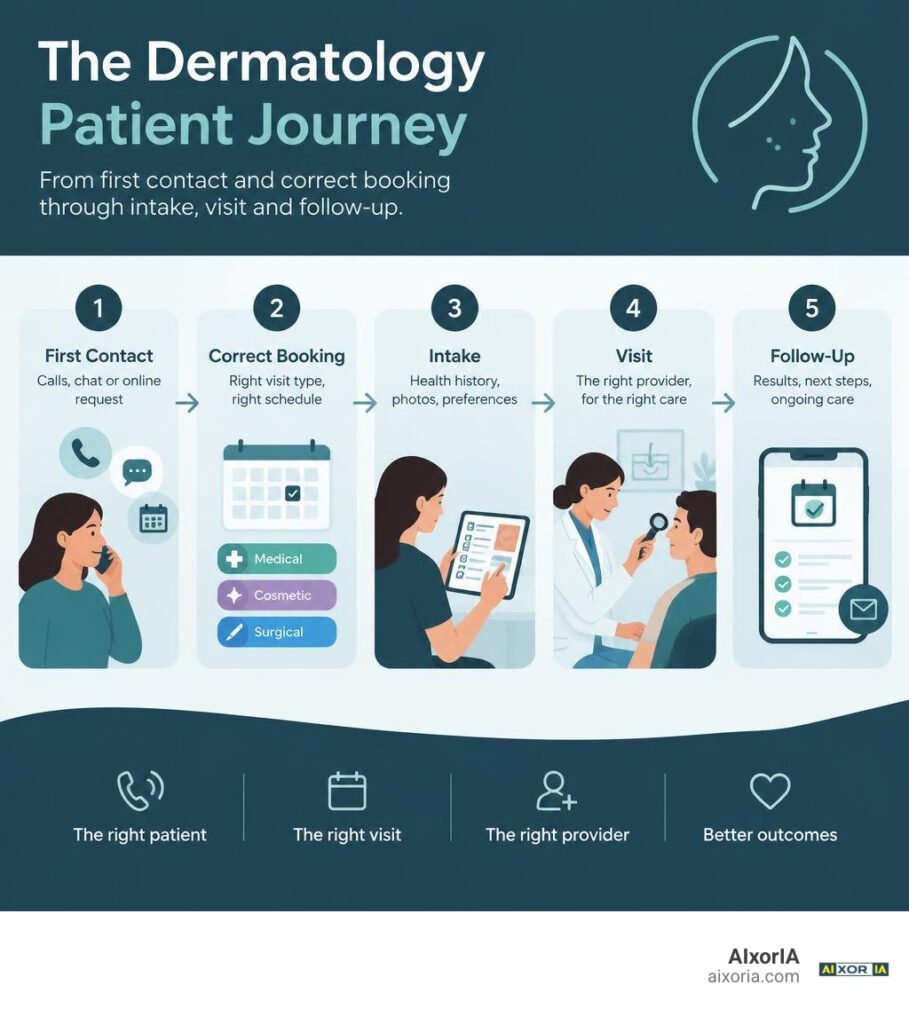
Compare tools by what they can book correctly, not just whether they answer after hours. Voice agents can handle phone calls, chat tools can capture website requests, and clinic platforms may also manage intake and reminders. For any option, check that it sends medical, cosmetic, and surgical patients to the right visit type, updates your live schedule, and hands complex questions to staff.
Follow-up matters just as much as the first booking. Ask each vendor to show how its tool schedules a biopsy-result visit, handles a time-sensitive medication follow-up, and fills a canceled slot. A live test with your own rules will tell you more than a feature list.
Why Dermatology Booking and Follow-Up Need More Than a Generic AI Receptionist
A dermatology front desk runs several businesses on one phone line. Medical visits bill insurance. Cosmetic procedures are usually cash-pay. Surgical follow-ups must land in a specific window. A generic agent treats all three as “book an appointment,” and that is where trouble starts.

We have seen the same pattern in other high-pressure settings, such as urgent care intake and wait times: speed means little if the booking is wrong.
Medical, cosmetic, and surgical visits need separate workflows
A skin check or lesion evaluation needs insurance eligibility, the right provider, and often a referral note. A cosmetic consult needs a different provider (perhaps an injector), a different slot length, and payment collected upfront. If a cosmetic request slides into the medical workflow, you get the wrong visit type with the wrong provider, and staff absorb the rework at check-in. Wide coverage with shallow dermatology logic simply books the wrong appointments faster.
Time-sensitive follow-ups can’t rely on a general booking script
Pathology results may require treatment with a specific provider, location, or slot type that someone must actively book. Mohs and biopsy follow-ups work the same way.
Isotretinoin is the classic trap. Patients fall under iPLEDGE, part of the FDA risk evaluation and mitigation strategy (REMS), with strict supply and pickup windows. Visit intervals are practice guidance rather than an FDA mandate, which is why schedulers often enforce them by hand. Because both isotretinoin and surgical windows depend on the last visit date, a fixed rules engine tends to fail. Look for logic that reads the patient’s history and your clinician-defined rules.
Long waits make cancellations and missed calls costly
New patients wait an average of 36.5 days for a dermatology appointment, so every slot counts. Around 40% of booking attempts happen outside business hours, when calls often go unanswered. Add no-shows, lapsed annual skin-check recalls, and late cancellations, and the leaks multiply. Waitlist backfill, where the tool contacts waiting patients until one confirms, turns a canceled high-value slot into a recovered one.
How to Compare AI Tools for Dermatology Clinics for Booking and Follow Up
Before demos, use a simple shortlist table. Weigh scheduling logic most heavily, because it is the most expensive criterion to get wrong.
| Tool type | Scheduling logic | Patient access | EHR integration | Follow-up | Implementation |
|---|---|---|---|---|---|
| Voice agents | Strong if specialty-trained | Phone, often SMS, 24/7 | Varies: live write-back or tasks only | Recall, waitlist, reminders | Often vendor-managed, days to weeks |
| Web chat and messaging bots | Good for cosmetic leads and FAQs | Website, WhatsApp, social | Often CRM-level | Reminders, care tips | Quick embed, more self-setup |
| Clinic platforms | Per-service durations, self-booking | Widget plus AI assistant | Own records, limited outside links | Reminders, intake, photos | Trial-based, staff configure |
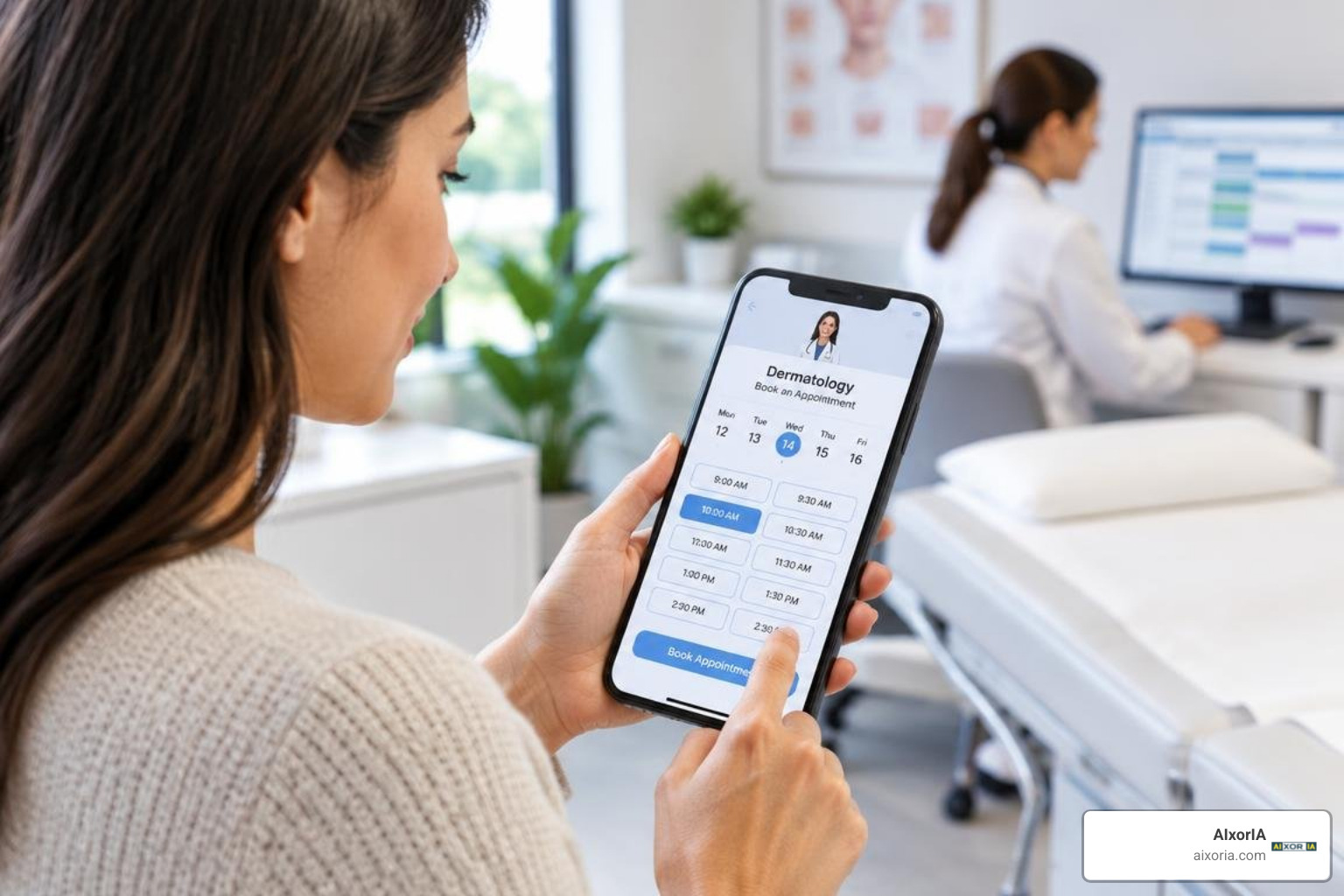
AI tools for booking and follow-up at dermatology clinics: voice, chat, and clinic platforms
Voice agents suit clinics where the phone is the main door. Several dermatology-focused options, such as PilotPractice, VoxHealth, Lippy, and Zaya Health, describe medical-versus-cosmetic sorting, live schedule access, and recalls. Clinekt Health frames its approach as separate inbound, recall, and outbound agents. Web chat and SMS tools work well for after-hours cosmetic leads and common questions about peels or microneedling. Clinic platforms bundle online booking, intake forms, check-in, and photo records, which suits clinics that want one system. Vendor claims are marketing claims; none replace your own test.
Check that bookings update the system of record
Ask whether the tool reads and writes the live schedule in both directions, or only creates tasks. Task creation means staff re-key the booking, and that offsets the time saved. Verify that it picks the correct provider, appointment type, and slot length, and that it captures insurance data. Tools without practice-system integration create exactly the manual entry you hoped to avoid. One multi-location practice reported 95% scheduling accuracy within weeks after switching away from two earlier vendors over accuracy problems, a reminder that integration depth beats feature breadth.
Test access, escalation, and accuracy, not just feature lists
Coverage claims are easy: 24/7 answering, many languages. Test what happens next. Does the caller get first-call resolution? When the agent hits something out of scope or safety-sensitive, does it transfer with identity, complaint details, insurance status, and triage context attached? Ask how accuracy is monitored after launch: ongoing automated test calls, transcript review, and dashboards for scheduling accuracy and resolution rates beat a one-time launch audit. Pressure-test the first four weeks, not just steady state.
How AI Tools for Dermatology Clinics Handle Booking and Follow-Up
Good tools close the loop while the patient is still engaged. That is the difference from an IVR menu or an answering service that takes a message for tomorrow. For a wider view of what else is out there, see our roundup of AI tools for healthcare professionals.
AI tools for booking and follow-up at dermatology clinics: automate the right tasks
AI tools for booking and follow-up at dermatology clinics should automate repetitive, rule-bound work: new bookings, rescheduling, cancellations, confirmations, recalls for annual skin checks, and waitlist outreach by voice and text. One practice that deployed a voice agent reported recovering 460 staff hours a month and 29% more appointment volume over two years without extra headcount.
Be careful with wording. A request is not a booking until the live calendar confirms it. Reminder timing matters too: a confirmation soon after booking plus a reminder before the visit, ideally by SMS, works well. For post-procedure and clinical instructions, use only clinician-approved templates, never AI-drafted advice. Isotretinoin windows, pathology visits, and urgent lesions should follow your rules, with staff review and clear escalation. Tools should never diagnose.
Connect the booking journey to intake, check-in, and photo management
Booking is only the start. Intake forms sent right after booking let patients share medical history, medications, allergies, and digital consent on their phone, so the front desk sees missing paperwork before arrival. One-click arrival status keeps patient flow visible. Longitudinal records with clinical photos let clinicians compare the same skin area across visits, which supports mole checks and treatment reviews. Photo-guided decision-support tools exist too, but they serve clinicians at the point of care rather than scheduling. Whatever you choose, store photos on the patient record rather than staff phones, and limit access by role.
What Implementation, Cost, ROI, and Compliance Should Clinics Expect?
Published figures vary widely, so treat them as ranges to question.
| Model | Typical timeline | Cost structure | ROI measure |
|---|---|---|---|
| Vendor-managed voice agent | About 24 hours to 45 days, depending on vendor | Monthly fee, sometimes per provider plus per-minute usage (one vendor lists $249 per provider monthly plus $0.25 per minute) | Attended visits, accuracy |
| Clinic platform | Trial first, self-configured | Flat monthly or annual plan, extra seats (one lists EUR 120 monthly) | Reduced no-shows, staff time |
| Custom automation | 2 to 4 weeks for focused builds | One-time build ($500 to $20,000+ by scope) plus recurring fees | Payback period |
Ask about integration fees, training, and change management. For a general method, our guide to AI tools for business in 2026 covers ROI formulas.
On compliance, require a signed BAA, encryption, audit logs, role-based access, and clear rules on call recording consent and retention. Outside the US, check GDPR requirements such as EU hosting. Appointment reminders are generally permitted under HIPAA without separate authorization, as HHS explains. Also ask what happens during downtime when the EHR connection fails.
Estimate value using attended visits and real costs
Count attended visits, not messages sent. In plain terms: recovered attended visits times net contribution per visit, minus monthly operating cost, gives monthly gain; divide the setup cost by that gain for payback. One cautious example had four recovered bookings at $100 contribution against $250 monthly cost, which shows why modest assumptions matter. Avoid double counting recovered leads, and do not treat freed staff hours as cash savings unless payroll actually falls. Evidence of upside exists: a hospital outreach program cut no-shows 28% and recovered nearly $804,000 in seven months. More ideas are in our guide to business productivity tools.
Plan a safe rollout with human oversight
- Audit your workflows and name the biggest leak.
- Run a live-call demo using your own rules: a cosmetic consult, an isotretinoin booking inside the window, and a pathology follow-up.
- Check whether each booking lands in the EHR or becomes a task.
- Set escalation rules and clinical boundaries.
- Assign a staff owner for scheduling changes, and ask how fast the vendor ships them.
- Review the first month with real call data.
Frequently Asked Questions About Dermatology Booking and Follow-Up AI
How long does implementation take, and will it replace front-desk staff?
Timelines range from a day to about six weeks. One vendor cites 30 to 45 days, combining your scheduling data with EHR setup and testing. Ask how much configuration falls on your staff. No, it should not replace your team. It absorbs routine calls so staff can handle cases needing human judgment, with a warm handoff carrying context.
Can AI safely handle urgent concerns, pathology follow-ups, and isotretinoin scheduling?
Only within rules you define. Agents should apply your protocols, route urgent callers to clinical staff, and never diagnose. Pathology and isotretinoin scheduling need clinician-approved logic tied to visit dates, plus escalation when no slot fits.
How should a clinic measure accuracy, no-show reduction, and return on investment?
Set a baseline first. Then track booking accuracy, completed visits, recovered slots, staff time, and patient satisfaction. Review call transcripts and dashboards regularly. Another primary care example saw a 50.7% drop in missed appointments with prediction plus outreach, but your own baseline is what matters.
Conclusion
The best choice is the one that fits your workflow: correct visit types, live EHR write-back, reliable follow-up, and a privacy review you trust. Run a live demo with your own calls before signing anything. For more practical comparisons, explore AIxorIA’s curated AI guides and tools.